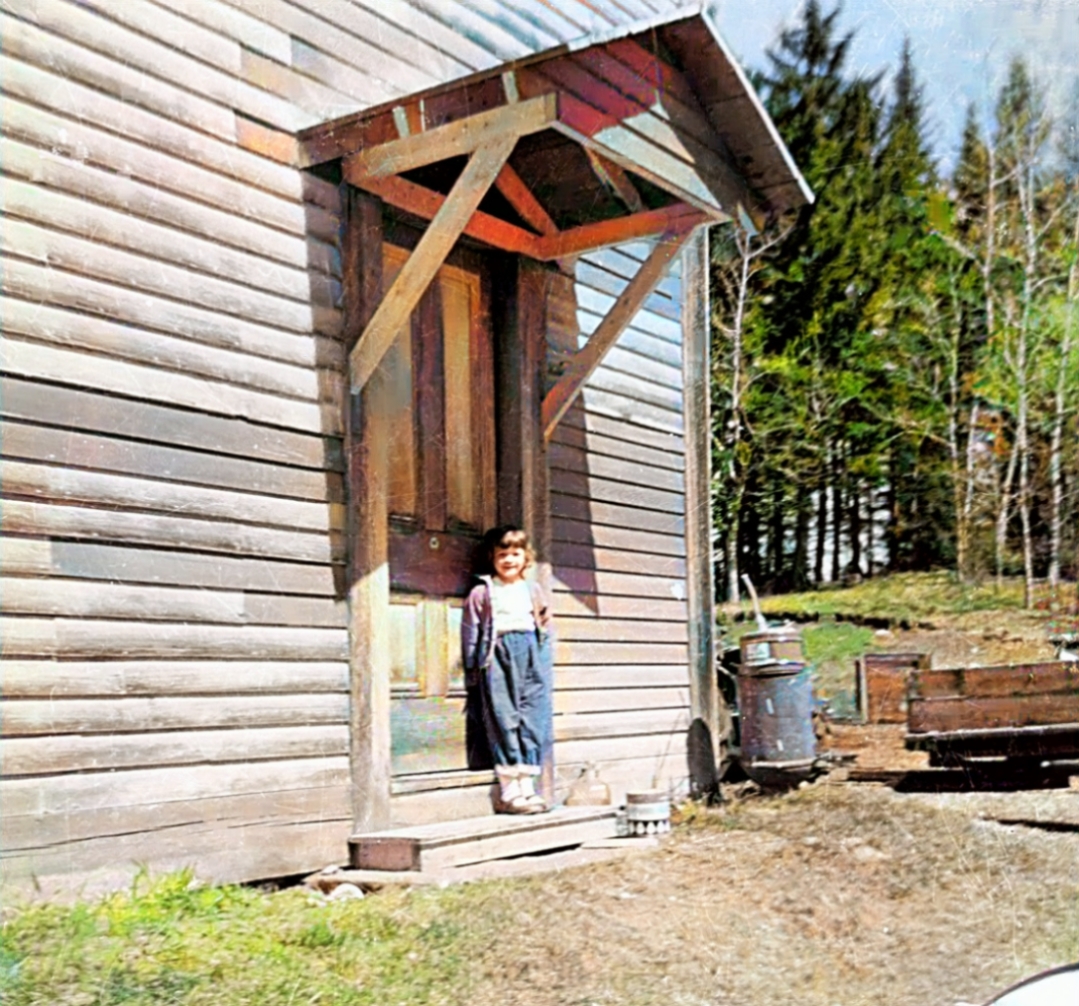
|
By: Paul S Cilwa |
Occurred: 7/1/1958 |
Milestone: #Residence |
Page Views: 9,930 |
| Hashtags: #Vermont #Victory #Autobiography |
| Rural life in the 1950s. |
| Estimated reading time: 29 minute(s) (6764 words) |
| Milestone: |
Change of Residence |
| Address: |
1291 River Road, Victory, Vermont |
Buying A House
It was a long trip, and we'd gotten a late start and Dad had to nurse the car
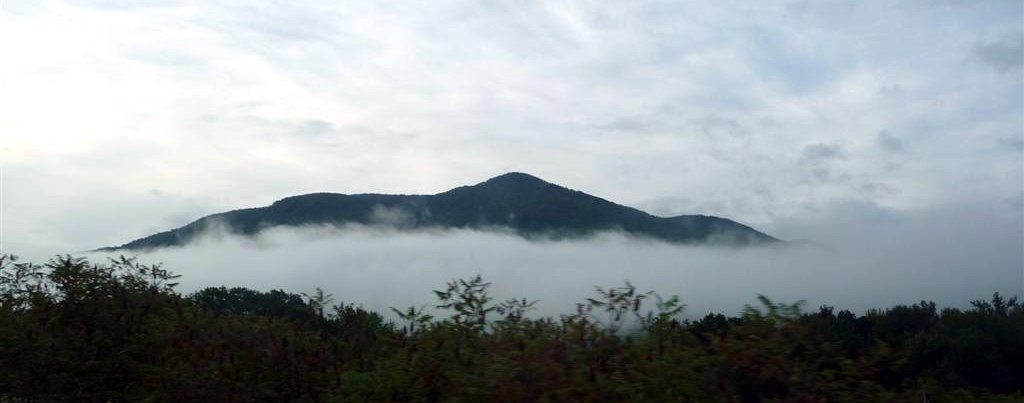
which slowed us further. We finally arrived in Vermont's Northeast Kingdom very
early in the morning. I awoke after Dad had turned off Vermont's Route 2 onto
the dirt road to the township of Victory. The road followed the Moose River,
crossing it several times so that the river was sometimes on the right side of
the car, and sometimes on the left; most times, obscured anyway by the thick
pines that lined the road and continued, unbroken, up the mountain slopes.
What surprised me most, though—besides the fact that the road was unpaved—was
a type of fog I'd never seen before, and haven't seen since. It consisted of
rolls of fog, tubes of fog, draped out along the valleys and hillsides like
giant pipes.
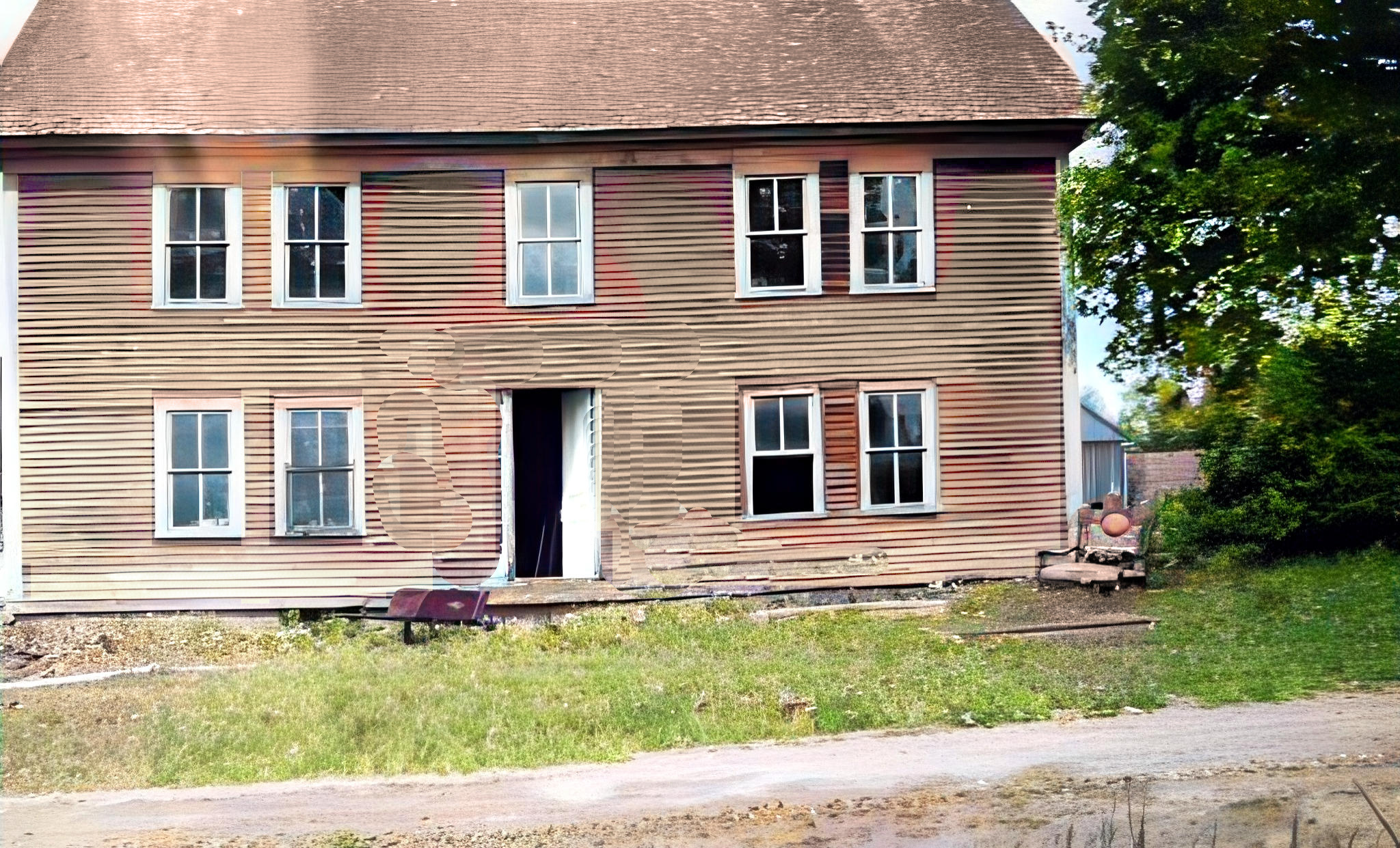
After some 25 miles of road, we arrived at our destination: An old, mustard
yellow, two-story house on the side of a hill, looking over the road with a
kind of forlorn pride, like the elderly king of a small principality sitting on
his front stoop waiting for petitioners who never come.
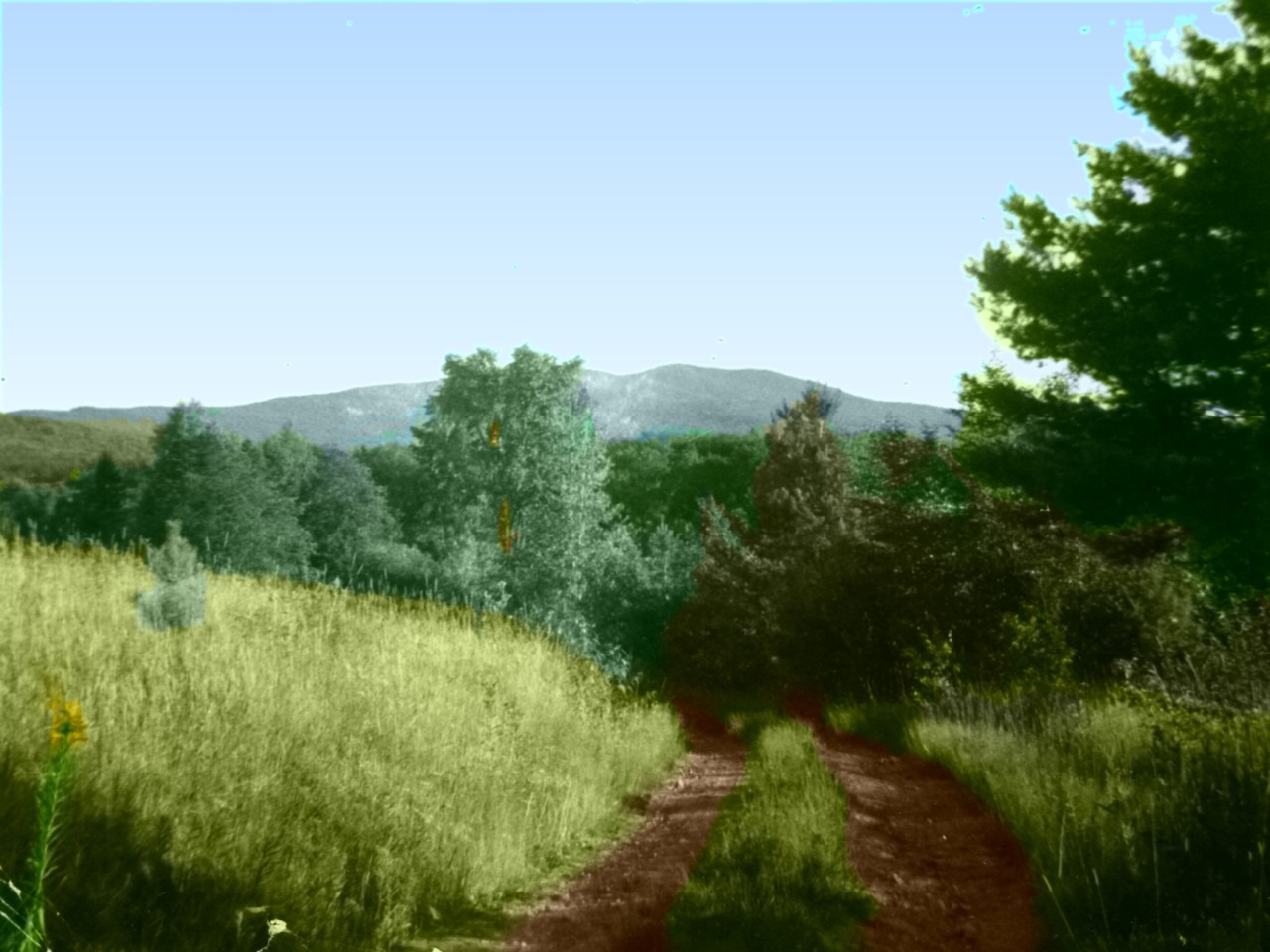
The driveway up the slope to the house was, if possible, in worse shape
than the dirt road.
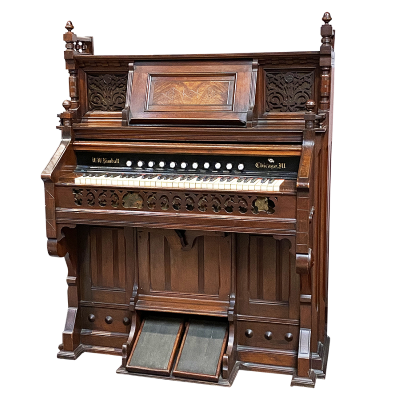
The owners of the house seemed to be expecting us and showed us through
the place. I don't remember much from that first visit, just the huge wood stove
in the kitchen, kerosene oil lamps in each room, and an organ that Mom called a
"melodeon" in the hallway. My littler sister, five-year-old Louise, found she
could (barely) reach the pedals that pumped the thing and play a few notes.
The house had no electricity, because Victory had not yet been wired for it.
It also wasn't connected to the national telephone lines. (Some houses had
access to the "fire line" telephone, a single line shared by all homes that used
it. But this was not one of them.)
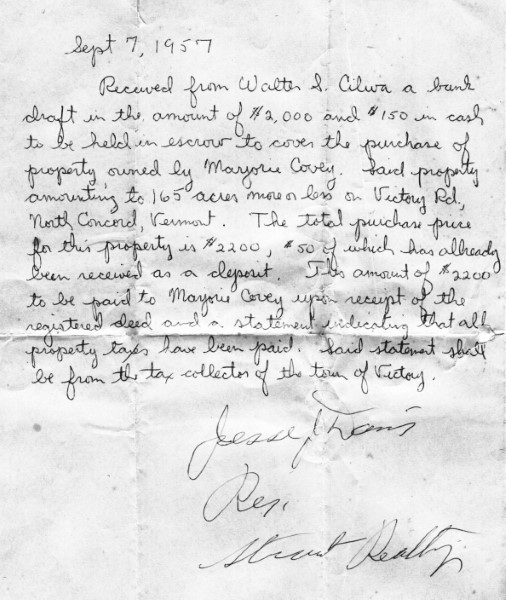
Apparently the adults reached an agreement unknown to us kids, because Mom
and Dad agreed to buy the place from the current owners, the Hoveys. The
agreement (but not the bill-of-sale) included 65 acres of property, the house, the wood stove and the
melodeon, and various pieces of furniture including tables and beds.
Moving Day

The Hoveys must have been anxious—and ready—to move. It was just a few weeks
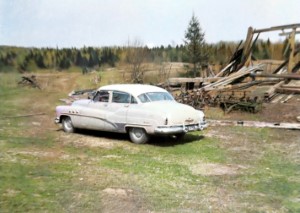
later that we towed a small, open trailer with all our portable stuff, like
dishes and our television set and sheets and blankets. We did not bring
furniture because the house we were moving into was already furnished, as was
our old house, which we were renting.
The trip was made long before the creation of the Interstate Highway System;
it was "side roads" all the way. Some of them were pretty steep. Dad had to stop
the car at the crest of one hill to let it cool, and we got out to stretch our
legs just in time to see the last dish fall from the open trailer and follow its
fellows rolling on edge down the hill.
Good old Melmac
dishes—unbreakable, you know.
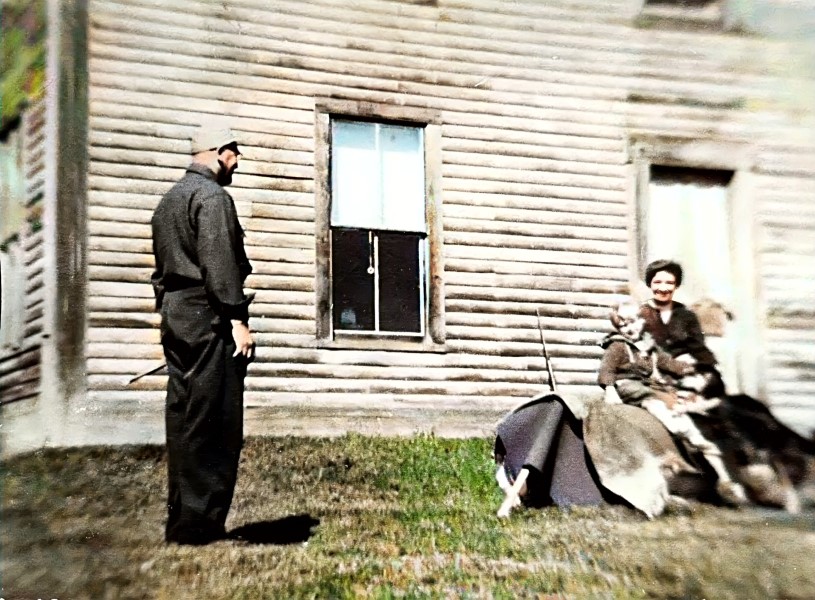
When we arrived at the end of that washboard road, and entered our new house—Mom was
not pleased. The Hoveys had stripped it. Not only were the tables and beds gone,
so was the wood stove and the melodeon. All that was left in the place was a
slightly wobbly three-legged stool and, on it, a chipped coffee cup with a
quarter cup of cold coffee inside.
The air outside was swarming with tiny gnats we learned later are called
"no-see-ums". Louise promptly got bit by one; her neck swelled to the size of a
cantaloupe and Dad had to rush her into town to a doctor, thinking she'd got the
mumps.
We had to retreat and spend that night in a motel.
The next day Mom and Dad bought furniture, paying extra to have at least some of it
delivered that day. Dad never bought anything new. He usually haunted auctions
and what today are called "garage sales" for usable cast-offs. But our
mattresses were new, as was the sofa. There was no hope, however, of finding a
new kitchen range that would run on wood or kerosene. He found a used model that
would burn wood, kerosene, as well as bottled gas. Although decades old, it was
still sturdy as an Egyptian monument, because that's how they used to build
things.
The House
Here's the layout of the house. It was built as a long, narrow box; and, even
though the broad side of it presented to the road, the front door was actually
on one of the narrow faces. That door led into a foyer, with a stairway leading
upstairs on the right, and a hall leading to the rest of the first floor on the
left. The melodeon, now gone, had rested against the outer wall at the foot of
the stairway. There was a Harry Potter-style enclosed closet beneath the stairs.
The hallway led into the dining room, or at least that's what we called it.
Mom put her nice dining room table and chairs there, anyway, pulled out of our
house in New Jersey when the renters didn't work out. (They'd been there just a
few weeks when my father went down unexpectedly and caught them selling our
furniture.) We also had a gas space heater installed there.
The house, which must once have been quite a luxury place, was piped for gas
lights. There were gas light fixtures in the walls, and a beautiful gas
chandelier hanging in the dining room. However, these lamps wouldn't use bottled
gas and were never connected. (We later found some kind of tank buried in back
of the house containing some powdered chemicals that had, apparently, generated
the gas for the lamps. But by then they'd been removed.)
The dining room had doors to three other rooms. As you stood in the door
from the hallway, at the other end of the same wall to your right was the door
to a first-floor bedroom that Dad eventually made into an inside bathroom. (I
still remember how difficult it was for him and Tommy to get the iron bathtub
he'd bought at auction down the hallway, which wasn't quite wide enough for it.)
In the wall to the right was the door to the kitchen, and on the left was the
door to the living room.
The living room also had a door into the hall, and a table on which sat our
big, heavy, useless TV set.
The Kitchen
The kitchen was the heart of the house. When we moved in, there were two
rooms: A small eating room (too small to be called a dining room) and an
adjacent cooking room. Dad and Tommy Westenberger, his son-in-law, took out the
intervening wall within a few days of our arrival. They also removed a great
barrel of flour that had been built under a cabinet and was hinged so that it
could be swung out or in as needed. I hated to see that go, as it looked like a
lot of potential fun.
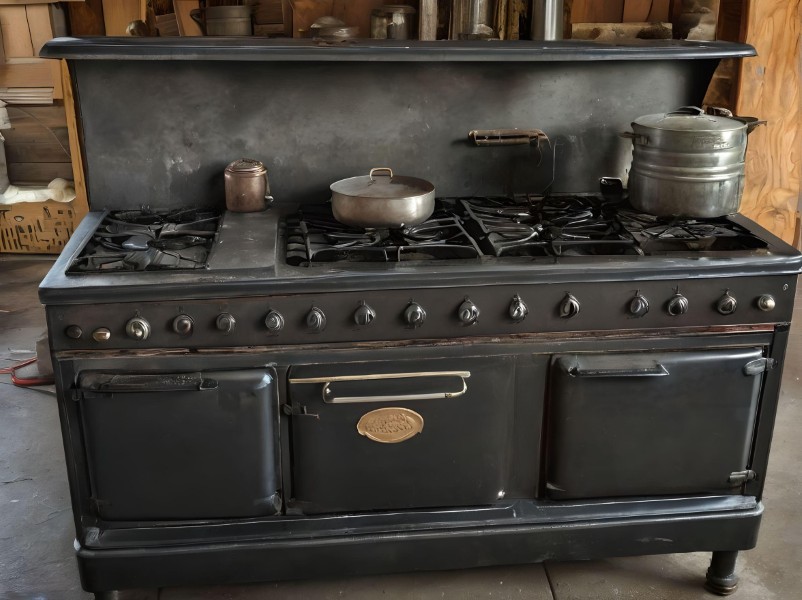
We had the wood, kerosene or gas-burning "cook stove" where the original
stove had been, so eight-inch exhaust pipes could be connected to the chimney.
(The house had no fireplace, but it had two chimneys nevertheless for wood stove
exhaust.) At first we cooked using the kerosene, until Dad could get a tank of
bottled gas delivered and filled; then Mom cooked on the gas jets by preference.
However, the oven only heated by kerosene or wood. I don't remember Mom ever
using it.
There was a sink in the kitchen with no drain, resting beneath a
hand-operated water pump. Usually such pumps are atop pipes that reach into a
spring or well. But ours drew water up from a cistern in the basement. When you
wanted to empty the sink, you simply lifted it out of its base, took it to an
open window, and poured its contents outside.
The basement was dirt-floored with walls made of granite blocks. It was
always cool, even on the hottest, most humid summer days. But we didn't play
down there much, because there were lots of spider webs (and, presumably,
spiders) and things that made little noises in the farthest, darkest corners.
The stair that led to the basement came from the kitchen, and even at the top of
the stairs it was cool. Some former owner had mounted a wooden box with a single
shelf onto the wall inside the landing, to serve as a place for milk and other
perishable foods. We used that as our "ice box" (sans ice) until Dad got a
bargain on a gas-operated refrigerator.
Water poured into the basement cistern from a lead (!) pipe that emerged from
the wall. We'd been told the pipe, nearly a century in use, was buried and led
to a spring located somewhere in the pine forest that stopped just short of the
back of the house.
The gas refrigerator was a wonder. It ran on the same bottled gas as the gas
jets in the stove, yet in the refrigerator things got cold instead of hot. I
spent years wondering
how the thing worked.
One day Mom and Dad took my sisters into town and left me in Tommy's care.
Tommy promptly fell asleep on the sofa, and I decided to make myself some
pancakes. At seven, this was not something I had ever done and I was excited and
frightened by the possibility. But there was leftover pancake batter in the
refrigerator, and I could think of no reason why I shouldn't make myself a
snack. I successfully struck a match and lit one of the gas jets, then set out
to find a frying pan. I couldn't locate one, but I did find the pot of a
pressure cooker whose lid had long been lost. Mom usually used it to make
spaghetti, but I saw no reason not to make pancakes in it. I put it on the
burner and poured a perfect pancake into its bottom, then tried to locate a
spatula. I couldn't find that, either, and had to settle for a knife.
The ingredient I had missed, of course, was shortening. By the time I tried
to peel the pancake off the bottom of the ungreased pan with the knife, it had
burnt solid into the cookware. It wouldn't budge. Sadly, and a little guiltily,
I turned off the burner and left the mess for Mom to find.
When they got home, of course, it was Tommy who got yelled at, not me. But
the experience encouraged Mom to teach me to cook, with (as it turned out the
next year) disastrous consequences.
Unfinished
There was a whole section to the house beyond the kitchen. This part, in
today's terms, would be called "unfinished." On the first floor, this section
had enough floor space and windows to create four or six rooms the size of
others in the house, but instead it was open and had been used as a workroom by
the former owners. We called it the "woodshed," though we never stored any wood
in there. We kids didn't go in there often.
If you took the front stairs to the second floor, on the way you'd notice the
beautiful wood banister. It was unfinished and worn, but we later sanded and
varnished it and it was quite lovely.
The banister continued past the top of the stairs, wrapping around back on
itself to protect walkers on the extended second floor landing from falling. In
the very front of the house, over the front door, was a very small room that Mom
used as the "sick room." If one of us kids got sick, she would have us sleep
there instead of in our own beds. I have no idea why. But as a result it was always
called the sick room
.
Next was the largest bedroom, which Mom and Dad took. It actually had a small
closet, which excited Mom because, she said, at the time the house had been
built, few homes had closets at all. But that closet dovetailed with one that
opened into the next room, in which my sisters slept. Their room was also large, and
doubled as our playroom. Both Mom and Dad's bedroom and the girls' room had grates
in the floor, through which heat from downstairs could rise in the winters. We
kids quickly discovered that the entire unit could be removed, leaving a hole
through which we could drop things to the first floor. To put an end to this,
Mom passed on the cautionary tale of my father who, when he was young, was
spying on his sisters from his bedroom grate. He quietly removed the grate, then
dropped the family cat on the head of his sister, my Aunt Louise, which startled
her so much she dropped an expensive platter she was holding. Dad, of course,
was punished. So we must never drop things through grates.
That didn't stop us from spying through the grates, though. However,
there was no one for us to spy on but the adults; and their conversations were
stupefyingly boring. So we didn't actually do it much.
My room came next; its door was in line with the stairs. Dad didn't want us
to have to rely on the cistern in the basement and a hand pump; in order to get
the bathtub to work, we would have to have running water. He calculated that the
spring on the hill was higher in elevation than my bedroom, and eventually put a
water tank in it. The tank would fill, however slowly, and then "gravity flow"
would let the water come out the taps in the bathroom and fill the inside
toilet. However, we apparently didn't have quite enough gravity, as the water
dribbled out of the taps and took some 45 minutes to fill the toilet tank.
In addition to my bed and dresser, I also had a small cuckoo clock in my
room. My window faced pine trees standing at attention in the back of the house,
and with no electricity in our house or anywhere else in the township, nights
were very dark. However, I wasn't afraid of the dark, so I didn't mind.
And even today, I prefer sleeping where it's dark and the only light comes from
ten thousand stars.
The house had been built in two sections. The newer section had higher
ceilings than the old section. The dining and living rooms, and the bedrooms
I've just described, were in the "new" section; the kitchen and woodshed were in
the "old" section. Through my bedroom was a door to another bedroom,
which was down two steps from mine. It was a small room, and no one made a bed
short enough to fit against any of the room's walls. However, in an outbuilding
we found an ancient bed frame with one leg sawed short. I suggested we use
that. Mom had her doubts, but it turned out the frame fit so perfectly in
that room it was clear the leg had been sawed off for just that purpose,
supported by one of the steps. The bed had no slats, just holes. We had to
string rope through the holes to hold a mattress. Mom said that, once, all
beds had ropes instead of slats; and the old advice to sleep tight
was a reference to these ropes.
I believe a large part of my awareness that time is a continuity comes from
my exposure, at that young age, to how things had changed within my mother's
lifetime. I understood that the differences between the house in Vermont and the house
in New Jersey, like electricity and gas and rope slats, were differences of
chronology, not location.
So the rope bed room was outfitted and declared a "guest room."
That room also had a door into another room, a slightly larger one that faced
the broad front-side of the house, with a view of the road and the glimmer of
water flickering through the trees from the Moose River. It was also made into a
guest bedroom, though anyone who stayed in it would have to pass through the
rope bed room to get to it.
The final door in the rope bed room opened onto a steep, narrow, New England
"back stairway." Those stairs took you down into the kitchen. But if, instead of
going downstairs, you stepped across the landing you'd
find yourself in the second-floor expanse of the unfinished section. We called
this room the "First Attic" because it had been used as one; there were still
some ancient trunks there the Hoveys hadn't taken with them. We used this room
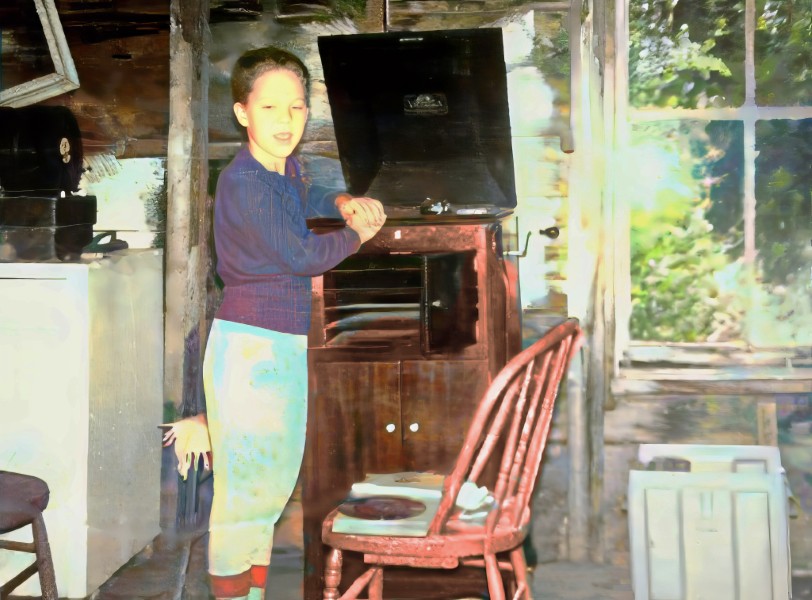
as our primary playroom. My Dad got me a cabinet Victrola and a chest of 78-rpm
records to play on it and we kept it there.
But, for awhile at least, there was a lot of traffic through the First Attic
because, on the outer, "back" wall of the house (the official back, narrow end)
was an innovation—an "outhouse" that wasn't truly outside. It was a lean-to tacked
onto that side of the house, its foundation level with the cellar but continuing
past the first floor and ending on the third with not one, not two, but three
holes for people to poop in. There was a big hole, a medium-sized hole, and a
little hole. Dad used the big hole; Mom and I fit the middle one, and the girls
took turns sitting on the little one. So high above its base, there was no smell and while it did
get rather close in the summer and was plagued by flies, still it added a
certain familial camaraderie to the basic toilet function.
Because, yes, we did often use more than one hole at a time.
Above the First Attic, and accessible by a steep stairway in it, was the
Second Attic. This space, under the roof, was a true attic. However the
floor wasn't completed and it was dangerous without being any fun, so we didn't
really use it. But if you followed a path made of planks toward the narrow front of the house, and
went up the two steps that led to the "new" section, you found yourself in the
Third Attic, which also contained an old trunk and which had a nicely
finished floor and a window that overlooked the yard and the fields and
mountains beyond. I loved the Third Attic, and wanted to remodel it into
a duplicate of Jor-El's laboratory from the comics. (Jor-El was Superman's
Kryptonian father.) I had no resources to do such a thing, but I spent endless
hours making plans on paper, most of which ignored realities of scale and would
have crowded dozens of rooms into the tiny space.
Commuting
The house's mustard yellow color, on close inspection, turned out to be the
result of decades of paint and neglect revealing bits of color from each
face-lift the place had received. Apparently it had never been painted the same
color twice. And the interior walls were covered in faded, peeling wallpaper.
Plans were made to repaper them.
But Dad couldn't spend the whole week with us. He still had his job at
Bendix, in New Jersey, where he was an engineer. He was in his
fifties but not yet ready to retire. In fact, it was just a few
months ago I learned that it had been Mom's idea to move to
Vermont, not his. He hadn't even wanted to go, since his four
sisters and their families all lived in New Jersey, as well as his
son and daughters from a previous marriage. But Mom's happiest
childhood and teenaged days had been spent in Vermont, and she
apparently did her passive-aggressive best to convince Dad to move
us there.
So Dad would make the drive to New Jersey on Sunday night to make it to work
on time Monday morning, and return home to Vermont very late Friday night (or
early Saturday morning) where he was expected to continue renovating the house.
Relatives
A parade of relatives came through. Aunt Al, Dad's oldest sister, showed up
with her husband, Uncle Frank. Aunt Al was a fierce taskmaster who firmly
believed the Devil resided in idle hands and that an idle child was up to no
good. So, even though it was Summer, there was no playtime while Aunt Al was
there. She also had some unusual nutritional opinions which she imposed on
everyone else. My sisters still remember her forcing them to eat raw eggs, which
was presented as a nutritional supplement, rather than a meal. I didn't eat
them, because I wouldn't. No amount of force could make me open my mouth
if I didn't want to, which Aunt Al eventually learned. Mom, always cowed by
strong women, neither objected nor assisted; and so I won that round, at least.
Luckily for them, Aunt Al had no children of her own.
Aunt Rose was the next sister down (Dad was the middle child of five) and she
and Uncle Mike came to visit. They did have kids and so were much more
fun to be around.
Aunt Lou was just a year younger than Dad, still single and the scandal of
the family because she lived with a man who'd been unable to get a divorce from
his wife, who'd been committed to a mental institution. I didn't like Uncle
Wally's cigars, but I did like him; and I adored Aunt Lou. She had been
Dad's favorite sister, too.
And finally came Aunt Gene, whose husband was also an Uncle Mike. They had
one son, a little older than me but I don't remember his accompanying them in
1958.
Mom's best friend, whom we called Aunt Bernie, came with her husband Uncle Bob
and his son, Robbie Junior. Robbie Junior was about 14, and afflicted with a
degenerative spinal disorder that would someday confine him to bed for the rest
of his life. But in 1958 he could still walk, if a bit unsteadily, and he and I
roamed the area around the house.
Outdoors Cuisine
In addition to the house itself, there were four outbuildings. One was a
chicken coop. Another was the size of a very generous two-car garage, and we
called it the Garage. However, we never put a vehicle in there because it was
full of stuff, most of it unidentifiable and all of it old. There was a small
barn behind the house, the pines crowding it on two sides, and the remains of a
larger barn that had collapsed some years earlier. Mom kept us away from the
ruins by warning us that rats probably lived in them.
Near the small barn, on a pile of what we'd been told was "manure" (but no
one defined) grew stalks of a reddish-green plant. When we brought them in to
Mom, she declared them to be rhubarb and good to eat, like celery, with salt. It
would be 15 years before I discovered that rhubarb is also used in pies. But I
loved the tart, salty taste and munched on it almost every time I went outside.
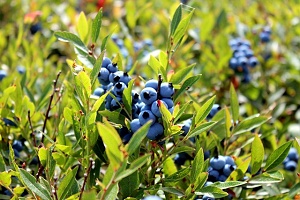
The specialty of the house, however, was blueberries. They grew everywhere,
but especially on the broad expanse between the house and the road that we
called the "front lawn." Dad decided to name our property "Blueberry Hill,"
after the then-popular song. I would lie down for hours, the sun
shining on my face through the branches of a blueberry bush, reaching up and
plucking berry after berry to eat.
The driveway degenerated from ruts in the ground to wagon tracks in the tall
grass past our house, as it continued into the woods and up the hillside. We
rarely ventured far along that road but it was bordered with red and black
raspberries and blackberries, as many as we could eat. When Aunt Al visited, she
insisted that we pick berries (that was one of our "chores") and put them in a
bucket to bring home, where she would pour milk and sugar on them, which was
supposed to make them taste better. But my sisters and I preferred them straight
from the bush, and surely ate far more than ever made it into our buckets, with
giggled mutual promises to never tell that we'd eaten the produce.
Animals
Dad had bought the property with the idea that he would turn it into a lakeside
hunting lodge. Now, that would seem difficult considering there was no lake. But
the U.S. Army Corps of Engineers was planning to dam the Moose River and flood
the Victory Bog (also known as the Victory Basin). Local environmentalists
protested the plan, as Victory Basin is a unique ecological area containing
Vermont's largest boreal forest, and an enormous amount of wildlife. The hunters
Dad wanted to lodge would have had little to hunt if the dam had gone through.
In 1967 the Victory Basin Wildlife Management Association purchased the
Victory Basin from the New England Power Company, ending the dam plans. But in
1958, the possibility was still very much in the air. And in the meantime, Dad
decided we may as well farm the land, starting with a few cows, a goat, and some
barnyard pets.
First came the dogs. They must have been obtained over Mom's objections,
because she'd always been terrified of dogs. Sniffy, who was such a perfect
example of "mongrel" that in my dog book, the picture of a mongrel looked just
like him, became mine. A fat little beagle was to be shared between my
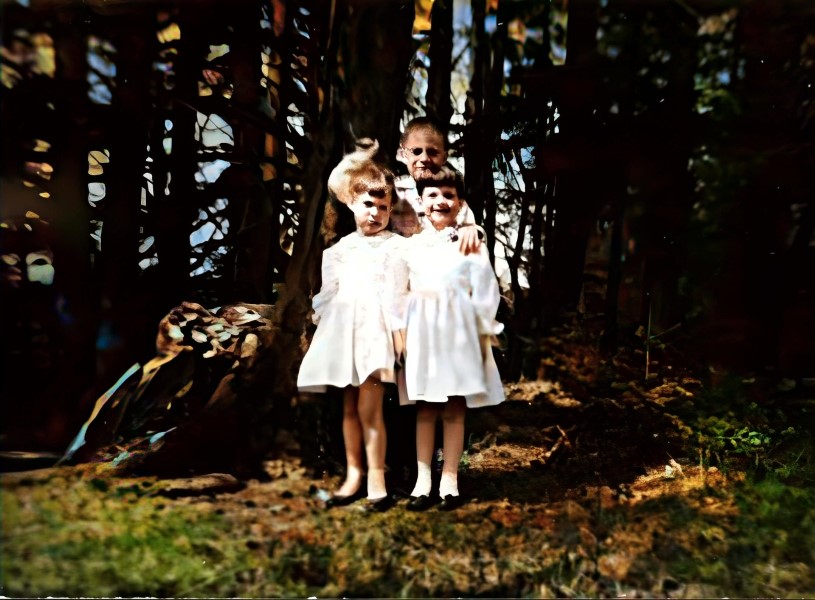
6-year-old sister, Joan, and 5-year-old Louise. Joan was a little vague about
the whole pet-naming ritual. When Dad said she could name the dog, she asked
what he meant.
"You can call him whatever you want," he explained. "Like Fido or Rover."
She went with "Rover."
Dad shored up the weak spots of the chicken coop and made it the home of two
rabbits. I named mine Whitey. Joan named hers Jumpy-Over-The-Mountains. Our
younger sister, Louise, was considered at five to be too young to have pets, or
at least that was the justification for buying two and "giving" them to the
oldest two kids.
I'm not sure what Dad had in mind for those rabbits' ultimate fate, though
I'm pretty sure it was not to eventually retire in some Old Pets Home. But
whatever it was, the dogs had a different idea. They found the rabbits
irresistible. And in spite of any common sense, the rabbits seemed to want to
get out of the chicken coop as badly as the dogs wanted them to. We usually
caught them first, and then would locate and patch the hole they'd escaped
through.
One morning Louise looked out her bedroom window and noticed a couple of bits
of white stuff on the driveway. Because we were so far out into the country that
there was absolutely no litter anywhere, it stood out. "Mommy!" she yelled.
"There's some Kleenex on the driveway!" Louise always had a very firm sense of
where things should be.
But when Mom returned from her investigation, she was ashen and wouldn't let
us go out to look. "It's the rabbits," she said. "The dogs got them."
I wanted to point out that this wasn't so much the dogs' fault as it was the
rabbits', who clearly had no sense at all. But Mom seemed too upset. This only
proved to her what evil creatures dogs were.
In any case, the chicken coop couldn't be wasted, and Dad promptly replaced
the rabbits with three ducks.
The ducks also got out of the coop on occasion, but the dogs seemed
disinterested in them. Mom would instruct me to run and gather them up; the
biggest one was the size of a five-pound bag of sugar and it wasn't easy to pick
up if it didn't want to be. But I managed to get them and put them back into the
coop.
I also got to feed them. I loved this part. Mom would make them some kind of
mush and put it in an aluminum pie plate. I would crawl through the little
door in the coop and place the plate onto the ground. The ducks definitely knew
what was going on; they would crowd me until I backed away, sticking their bills
into the mush and making little quacks of pleasure as they inhaled their meal.
But the biggest additions to the family were the calves and goat.
Apparently it's cheaper to buy a baby calf and let it grow, than to buy a
full-grown cow whose milk is immediately available. Dad bought two, Brownie and
Blackie. At the same time, he brought home Nanny, the goat.
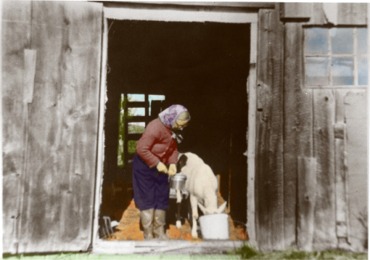
Nanny had a definite and distinct personality. Actually, she reminded me a lot of Aunt
Al. Nanny immediately adopted the calves, who followed her everywhere. Now,
calves eat grass and say "Moo" and goats eat leaves and say "Bah." But Brownie
and Blackie ate leaves and said "Mah!" That's how into their adopted mother they
were.
Nanny was very curious and was fascinated about the big building her humans
went into. One day I came in and forgot to close the door. Suddenly I heard Mom
screaming, "The goat's in the house! The goat's in the house!" She didn't seem
to have any idea what to do about it. Little Louise didn't hesitate. She marched
right up to the goat, stuck her index finger in Nanny's face, and barked, "Back,
Nanny! Back!" Nanny backed right out of the house and into the yard. From then
on, she would do anything Louise told her.
But Nanny couldn't abide weakness, and she had no mercy for Mom, who she
could sense was afraid of her. One day Mom was in the yard, raking, when she put
down her rake, tines up, to pick up a rock. Nanny saw how the rake was arranged
and practically ran to it, jumping onto the tines with her front hooves so the
handle went flying, smacking Mom in the butt.
Milk
Nanny had a superpower. She gave milk. She had two great teats (we called
them "handles") and when you grabbed one and squeezed, milk came out. I was
occasionally given the task of milking her, half-filling a bucket each time. I
was initially afraid it would hurt her, but she seemed to enjoy it, standing
patiently until I had gotten all there was to get.
But there was no way I was going to drink that stuff!
I mean, it was all well and good to call the white stuff "milk" but, at
seven, I was quite aware that milk came from the milkman or the grocery store,
in glass or waxed cardboard cartons. There was no way I was going to drink
anything that came out of a goat's handles.
Nanny liked to eat blueberries, just as I did. And when she ate a lot of
them, there would be a blue streak in her milk. In raspberry season, there'd be
a red streak; and in blackberry season a dark purple one. I've had people in
years since tell me this doesn't happen, but I saw it with my own eyes.
And then came the day I caught Mom transferring milk I had drawn from the
bucket to a used milk carton.
"What are you doing?" I demanded. I was furious that she would
consider trying to trick me, and I told her so.
"But I've been doing it for weeks," she said, "and you never noticed."
Well. I was still annoyed, but I couldn't argue with the result. Raw
goat's milk did taste like "real" milk. So Mom threw out the used carton
and I drank goat's milk from a pitcher for the rest of the time we lived there.
I suppose I could point out this incident as being the first time I realized that,
what was on a label, didn't necessarily reflect the contents.
Lights In The Woods
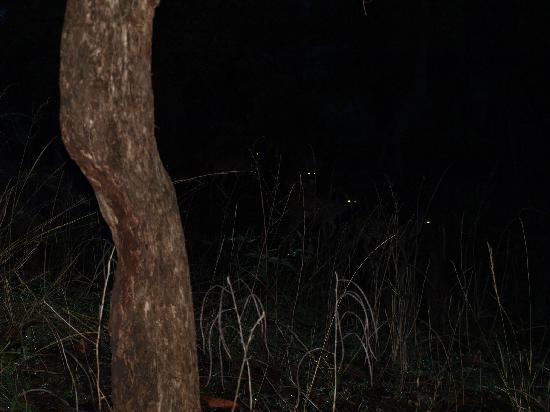
Because "the grid" had not yet come to our remote bit of wilderness, there were no street lights,
or lights of any other kind. So the nights were dark as being in a blanket; not even the stars
were brilliant enough to light the way on a moonless night.
I remember us pulling into the driveway one night. The cousin who
drove us, and my mother, had seen a "funny light" near the house which they
announced was the reflection of our car lights in the eyes of a wild animal. We
sat quietly in the car for (it seemed like) an hour before my two younger sisters
and I quietly got out of the car and filed into the house and went to bed. We
were a rambunctious bunch; we never did anything quietly. But we did that
night, and looking back it strikes me as odd behavior.
Disappearance
Nanny and the calves usually hung out around the house, where there was
plenty of tall grass and bushes. But once in awhile Nanny would get a jones for exploring.
Usually she would head north up the dirt road towards Gallup Mills, a small
community at a crossroads about an eighth of a mile up, with the calves close
behind her. Mom and Joan and Louise and I would walk there and, sure enough,
there they'd be somewhere along the road, enjoying the taste of other
bushes growing on the side.
One day my sister, Joan, six at the time, turned up missing. We looked
everywhere for her, but she was nowhere to be found—certainly not in the house,
and not in the usual play places around it, either. Mom and Louise and I got the
idea she might have wandered to Gallup's Mills. We walked there and back, my
mother becoming more and more frantic as we failed to see any sign of her. Mom
had always warned us that we might be kidnapped (I have no idea where that idea
came from) and she was at a loss as to what to do. When we got back to the
house, she sat at the dining room table, put her head down and started sobbing
hysterically. Louise and I tried desperately to calm her down. Louise decided to
get a cushion from the living room for Mom's head—and found Joan, deep asleep on
the sofa. It took several minutes to rouse her. She swore she'd been sleeping
there all the time.
At The Window
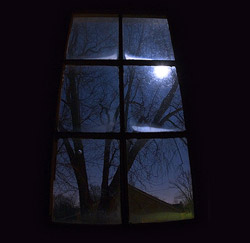
One night I got out of bed and went to the top of the stairs. My mother
and sisters were standing in silence at the foot of the stairs, staring out the
window. I joined them and asked what they were looking at. "The Northern
Lights," my mother replied, and I looked, but I couldn't see anything. Finally I
went back to bed, leaving them standing fixed at the window in silence. They no
longer have any memory of the incident at all.
The Lost Spring
Before Dad put the water tank in my room, every now and then the water from
the hillside spring would inexplicably stop flowing into the basement cistern.
Mom and I would then have to get it going again.
To do so, we'd have to find it, first. Looking back, I cannot believe that
Mom left two little girls alone while we went spring-hunting, but she did. Unaware that
they should be upset about this, they would simply continue playing with their
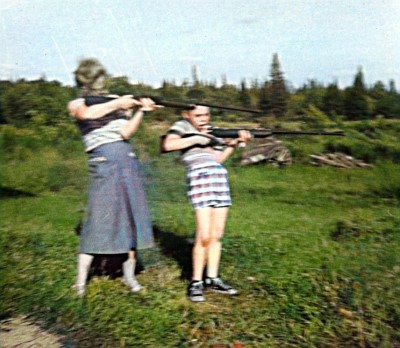
dolls and dollhouses while Mom and I put on sturdy clothes, got our rifles, and
headed into the woods.
Yes, Mom taught me to shoot when I was seven years old. I was pretty good at
it, too. She would put one of the old, broken coffee cups the Hoveys had left on
top of a fence post some fifty yards away, and before long I could reliably hit
and shatter it, even though I had to hold the weapon with the barrel under my
armpit, since my arm wasn't long enough for my finger to reach the trigger if I
held the rifle properly.
So, knowing there were bears in the woods, Mom and I would set out with these
.22 gauge rifles, confident in our belief that if we did encounter a bear
along the way, we could safely dispatch it without danger to ourselves.
We would set out along the wagon road that continued up the mountain from our
driveway, Mom keeping a sharp eye out for trails into the woods on our left.
There were many of them, most or all of them animal trails, of course. But one
would trigger some kind of memory and I would follow Mom from the sunlight into
the cool, still pine forest.
That part of the woods was quite overgrown. Sniffy and Rover would also
accompany us (and probably kept us far safer from bears than those rifles ever
could), barking and dashing about. They would run off and we could hear them
crashing about through the underbrush; then, just when we'd suspected we'd lost
them, they would burst into view, check on us with their tails wagging and out
of breath, then return to whatever scent had fascinated them so.
Eventually, inevitably, we would come upon the spring, dead leaves floating upon
its surface, and blocking the ancient lead pipe sticking into its side. I would
have to sit on a board that covered it, my boots in our drinking water, remove
the leaves and then fasten the rubber hose of a remodeled bicycle pump we'd
brought with us. A few pumps of the handle, and the gravity flow would be
restored.
(And, no, we never filtered or boiled the water that eventually
arrived at the house, and drank it…and never got sick.)
One time, Sniffy burst into the clearing when I was sitting on the board. He
jumped joyfully onto my lap, which broke the board and sent us both into the
cold water. (And now, a dog had been in our drinking water, but Mom never seemed
to think this was significant and, of course, at seven I didn't know any
better.)
It was the return back home that always seemed to take longer than the search
for the spring. When I was grown, Mom always insisted that she knew where we
were, that we were never lost. Maybe so, but I recall that at least two of these
trips started in the morning, yet we didn't make it back home until dinner time.
On one of those occasions, we finally emerged from the woods into the
farthest of a string of sand pits located on our property. So now we knew where
we were, but had a long trudge before we finally got home. When we climbed the
side of the last sand pit, putting us on the opposite side of the house from the
driveway (along a steep, rutted way we called the "short driveway"), we spotted
Joni and Louise talking to some stranger, who was standing outside his car.
Mom immediately fired her rifle into the air; the man flinched as if she'd
hit him. She then began marching in his direction as he walked toward us. When
he was within speaking distance, he said, "Do you greet all your
visitors that way?" It turned out he was just an insurance agent, and had been
asking the girls if he could speak to their parents. He may have changed
professions after that.