|
By: Paul S Cilwa |
Occurred: 6/10/1967
Posted: 12/27/2023 |
|
Page Views: 441 |
| Hashtags: #Autobiography #Lifeguards #CrescentBeach #ButlerBeach |
| It was the closest I could get to joining the Justice League of America. |
| Estimated reading time: 10 minute(s) (2262 words) |
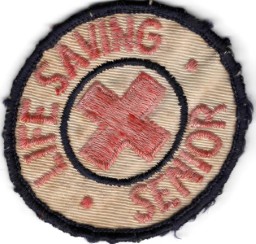
By my sophomore year in high school, I had learned several things.
First of all, unlike the other boys in my class (as far as I knew),
I wasn't interested in girls. At all. I mean, they were okay to talk to
but it was the boys in my class who were featured in my teenage fantasies.
But second of all, I knew I had to keep this to myself. From my perspective,
my classmates thought I was weird enough already. (Of course, from my
adult perspective, it was I who thought I was weird already, having been
told since I was 9 years old that I didn't act the way the other boys
acted—and I should.)
Something else I had learned was the word, queer
. I had absolutely no idea what
it meant, and looking back I'm not sure my classmates did, either. But I absolutely
knew that, whatever queer
meant, no decent person would want to be one.
It was clear that one way to prove
one wasn't queer, was to play sports.
Well, actually, that wasn't enough; one had to be good at sports.
But I hated sports, because, for whatever reason, I hated competition.
I was always a work together
kind of person. Not only did I hate to
lose, I also hated anyone else to lose. (I had no clue there was
such a thing as non-competitive sports, hiking and like white water rafting, until I was
an adult. And surfing was out because we couldn't afford a surfboard, which was
at least $100, worth about $813 dollars today.)
So, when, as freshmen, the other Paul in my class, Paul Bateman, announced he had joined the Lifeguard
Corps for a summer job, I thought, Wow, that's the most un-queer job I could
imagine. Plus, get paid to swim? Count me in! And so that's how I became a lifeguard.
And now, in my second summer of it, the head of the lifeguards relied on me to show the
younger boys the ropes.
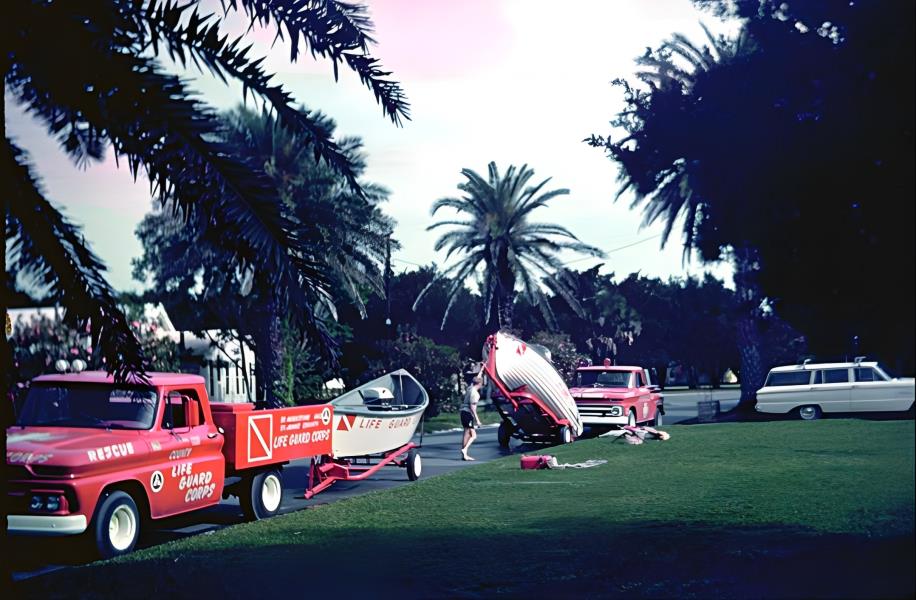
The head of the Lifeguard Corps was a guy named Bill Fulton. His daughter, Ginny,
also went to St. Joseph Academy, a year or two below me. His house had a pool,
and that's where he trained the lifeguard wannabes. Mr. Fulton was the director
of the St. Johns County lifeguard corps from 1966 to 1970. He was responsible for
training and supervising the lifeguards, as well as organizing events and competitions.
He was also a former lifeguard himself, and had a passion for the ocean and the beach.
He was well-respected and admired by his colleagues and students, and was known for
his dedication and professionalism.
And he never once told me I "walked wrong."
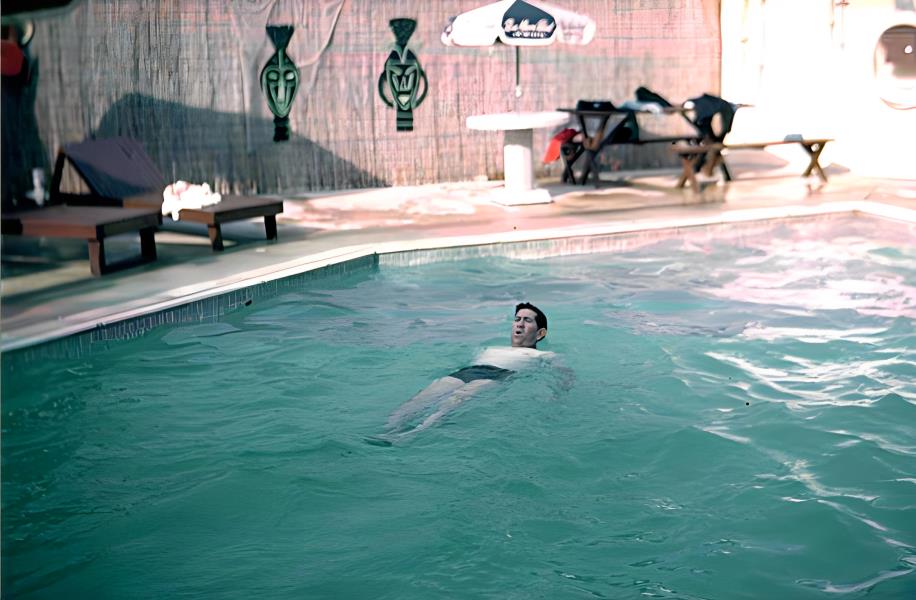
In his pool, Mr. Fulton showed us how to actually rescue people; he taught us
the sidestroke, which is basically the only way you can swim when one
arm is wrapped around someone who can't. He even taught us to dive deep if
a panicky victim wraps their arms around our necks. (They'll immediately let go.)
My best friend, Timmy Miller, joined too!

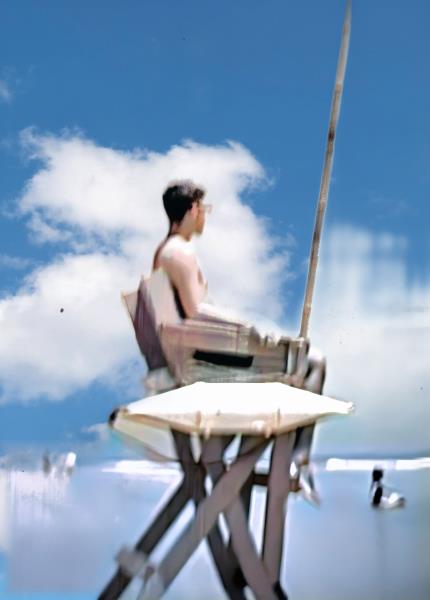
We didn't have walkie talkies (and of course this was decades before cellphones).
We just sat on an open tower; if the flag was upright it meant all was well;
but if we had to rescue someone, we threw the flag on the ground. A mile or two away,
there was a lifeguard shack on the St. Augustine Beach pier where someone was
supposed to check all the towers with binoculars; if one was missing a flag,
he would radio the lifeguard truck and send it to check it out.
In 1967 all the lifeguards were boys; and all the boys I saw at Mr. Fulton's
pool were white. I didn't know it for a long time, but there were actually
three Black lifeguards. They were sent to the (then-segregated) Butler
Beach to guard it. The only reason I learned this was on the day Mr. Fulton
pulled me aside.
I've got a problem,
he said. Two of the guys who usually lifeguard
at Butler Beach are on vacation, and the other guy just called in sick.
My first thought was, I never heard of Butler Beach. My second thought was,
They have three guys dedicated to just one beach? The rest of us were
sent to various beaches at random. I don't know where it is,
I told him, But sure, I'll go if you need.
So I got dropped off at Butler Beach. When people started to arrive, I couldn't
help but notice they were all Black people (or, as I was told was polite in 1967,
Negroes
). I of course didn't care, except I wondered why they all just went to
one beach—because, now that I thought about it, I had never noticed any
black people at the other beaches I guarded, except once, at Vilano Beach.
I liked Vilano Beach, because there was usually no one there! That's right;
I liked being a lifeguard but I hated having to actually rescue anyone because
I found being fussed over afterwards to be devastatingly embarrassing.
If no one was swimming, no one would need rescuing and I could enjoy the view and
the sun and water without any distracting actual swimmers.
So this one day, I was at Vilano Beach and a lady (Black) came with her two toddlers.
She walked up to me and asked, hesitantly, Is it all right if we swim here?
Well, of course!
I replied, having no idea why she asked.
Now, I know. It was a Black family, and the beaches had been officially
de-segregated just three years before (which no one had told me).
At the time, I was just puzzled why she felt she had to ask. I mean,
whoever heard of a closed beach? Especially one with a lifeguard present.
Well, I just love little kids. And there was no one else there.
So I climbed off the tower and played in the sand with the two little girls.
We had fun, and after a bit the older girl asked, Are you my cousin?
I just laughed, but before I could explain I was the lifeguard, her mom hurriedly
explained, She just said that because you're so nice.
Well, they're both just adorable!
I assured their mom. But I did pick up that
she was afraid I'd be insulted for some reason, and I was sorry that she would
think that.
So, when I found myself at Butler Beach, it was like the next clue in the mystery.
I knew what segregation and integration were; any kid in St. Augustine
in 1967 did. It just never occurred to me it would have anything to do with
swimming at a beach. But, obviously, it somehow did.
So it turned out I liked guarding Butler Beach as well,
because, even though it was crowded, everyone was respectful of the ocean.
Except for surfers, no one came close to trying to go too far out to
where it might be dangerous. And everyone was pleasant to me.
My other favorite was Crescent Beach, also because it usually didn't have a lot of
people. (It was mainly a surfing beach, and although of course I'd have rescued a
surfer who needed it, that never happened while I was guarding. Surfers are
good swimmers.)
There were a bunch of summer rentals along Crescent Beach, and one day a man
came up to me in my tower. Excuse me,
he said, in a strong New Jersey
accent. I've noticed that sometimes the water is way, way out there,
and sometimes it's way up here, like now. Do you have any idea what causes that?
I was not yet a junior in high school. But I had paid attention in science class,
as I naïvely assumed everyone did. So I imagined that the guy was just joking; and I joked back,
replying, Yes, isn't it amazing? The Coast Guard has installed giant paddles offshore,
and twice a day they push the ocean water onto the beach to clean off the trash.
I expected him to laugh. Instead, his jaw dropped; he muttered, Amazing!
and then ran to his friend to tell him, Guess how I just learned they're
spending our tax dollars!
So a couple weeks later, when a woman came and asked the very same question,
I was taking no chances. That's the tides, ma'am,
I answered; and when she
still looked blank, I added, The moon pulls the water towards it as the Earth spins.*
She stared at me with rapidly growing disgust. I don't believe in Astrology,
she
said. And if you don't want to spend eternity in Hell, you shouldn't either.
She then went back to her condo and returned with a copy of the Bible, page already turned
to Deuteronomy 18:9-14.
After that, when anyone asked, I would just shrug, throw up my hands, and say, Beats me.

Which is not to say I never rescued anyone. In the three summers I lifeguarded at the
beach, I made three rescues. None of them were dramatic; I saw someone floundering
where I knew the water was deep, threw my flag onto the ground, grabbed my buoy from the
side of the lifeguard tower, ran into the water, swam to them, and let them hold the
buoy while I towed them back into shallow water. That part was simple and non-dramatic.
What I hated was when the dad would come up to me, tears in his eyes, thanking me
for saving his kid. Which was okay, but I never knew what to say and, to me, that
was embarrassing.
In later years I discovered that more than half the people you meet at random don't know how to swim.
I just never understood that. A Gallup poll conducted in 1998 found that 62% of Americans are
afraid of deep water and 46% are afraid of water over their heads. The poll also found that
19% of Americans cannot swim at all, and 37% can swim only a little.
That's not me. I may not be good at catching a football or dunking a basketball or knocking a
tennis ball somewhere in my own court, but by golly I can swim so well I once dozed off
while in the water (and continued to float).
So, even though my job was lifeguarding, even when I wasn't working (there were more lifeguards
than towers so we got days off), I was at the beach. Any excuse would do. For example, my grandmother
wanted my wheelchair-bound grandfather to spend time breathing ocean air. So I volunteered.
(It was also a chance to drive.)
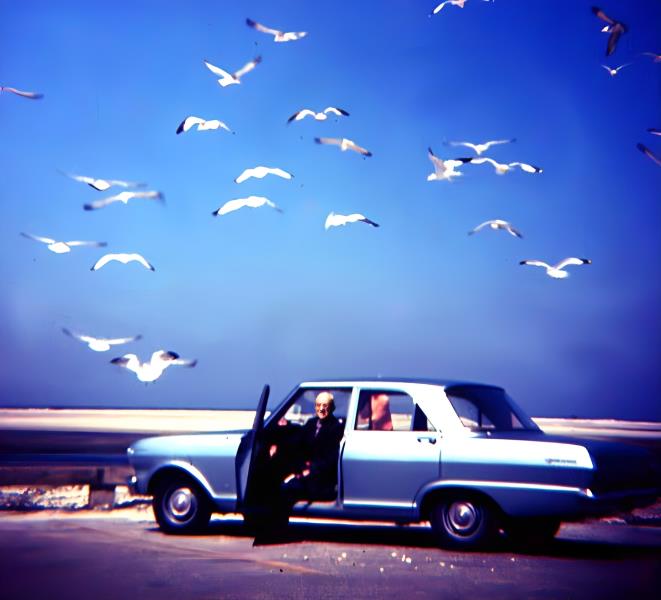
No, I couldn't actually go swimming while babysitting Grampa. But as long as I stayed near the car,
I could do whatever.
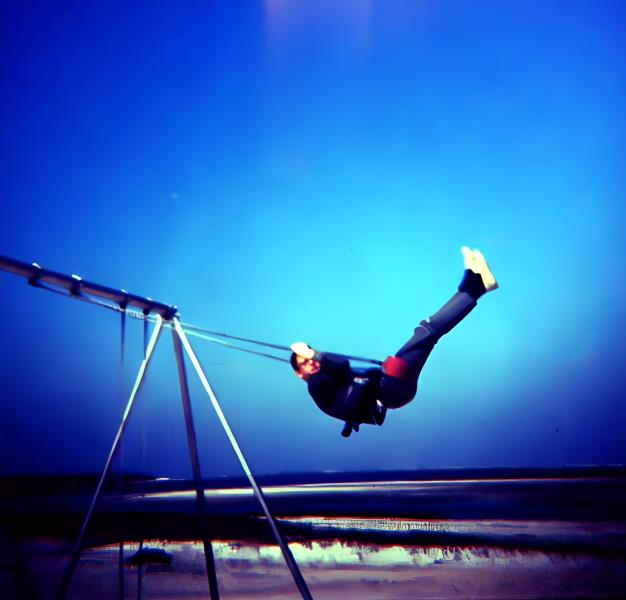
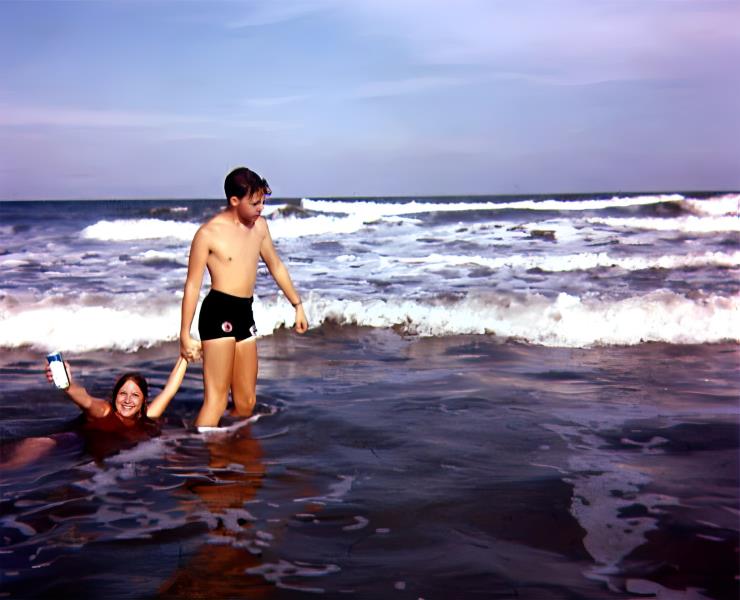
Of my two sisters, Louise was the one who also enjoyed water; so often it was she and I together.
(Mary Joan preferred to go on road trips with me.)
Every time we saw seagulls, Grampa would be reminded of a limerick he'd learned, and that
he repeated so many times it's now a part of me.

A wonderful bird is the pelican;
His bill will hold more than his belican.
He can take in his beak
Enough food for a week,
But I'm damned if I see how the helican!
Dixon Lanier Merritt
Yes, I know seagulls and pelicans are very different animals. But we often
are triggered to think of one thing by something else.

Although it was just a summer job (that I held for several summers), I'm a lifeguard!
has become a treasured part of my identity. I still swim (as I write this, I can barely walk
but by golly I can swim!) every chance I get. And although it's been many decades since I actually
had to save anybody, I note that, no matter what I'm doing or what's going on, when I'm near people
playing in water, part of my brain is always listening for the sounds of someone in trouble.
People in this universe can't fly or shoot heat beams from their eyes (as opposed to folks
living in the DC or Marvel universes). But we have heroes nonetheless. Some of them are
lifeguards. And, for awhile, I was one of them.