|
By: Paul S Cilwa |
Occurred: 1/24/2006 |
|
Page Views: 3,523 |
| Hashtags: #IntelligentDesign #Science #Evolution |
| I have a wisdom tooth removed. |
| Estimated reading time: 3 minute(s) (616 words) |
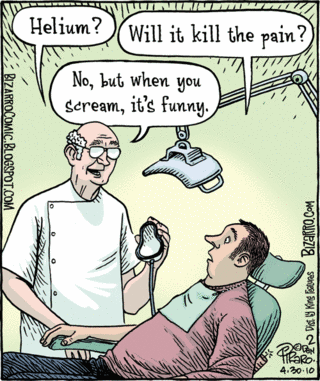
The Navy corpsmen who pulled my wisdom teeth back in the 1970s probably had
less experience than the young woman student. They made up for that with
strength. There were two of them, who at the most intense portion of the
experience had their feet up on my lap, yanking at my jaw with pliers. However,
that wasn't the most painful part, which was ramming a Xylocaine needle through
the roof of my mouth. Three times. That also had to be done this latest
time, as well; but the dental student performing the procedure somehow managed
to do it in a way that, while not pleasant, wasn't painful enough to have
qualified as a practice at Abu Ghraib.
In any case, this got me thinking about wisdom teeth. My mouth didn't have
room for mine, and neither did my children's or my ex-wife's or my husband's or
my mother's or father's. In fact, few humans can fit these teeth into their
mouths, which makes me wonder what the Creationists think of them. Granted, the
Creationists seem to have an image of God that is somewhat closer to Samantha on
Bewitched than the Great Architect, more of an impulsive Creator than a
brilliant Designer. Still, wisdom teeth seem like a really bad idea.
They aren't new problems. Aristotle described them 2300 years ago. Given the
lack of good anesthetics, having wisdom teeth removed when they come in around
age 20 must have been a rather dreaded rite of passage. By the way, Aristotle is
the first on record to refer to these teeth, officially known as the third
molars, as "wisdom teeth" (albeit in Greek, of course). The reason was that they
appeared when a person could reason—as he or she reached the full bloom of early
adulthood. Apparently, the ancient Greeks didn't think much of the brainpower of
their teenagers, either. ("No, you can not borrow the keys to the
chariot.")
But humans are not the only beings on Earth with wisdom teeth. All the
primates have them, though they come in at different times relative to the
lifespan of the individual. Our closest relatives, the chimpanzees, have the
same number of teeth as us and their wisdom teeth also come in with adulthood.
However, there is an important difference. Chimps have longer jaws than
we do. They have room for all their teeth. Chimps never have to worry
about impacted wisdom teeth, and if you think about it, you'll notice you've
never seen a chimp on TV or in the movies who needed braces.
Sometime during the evolution between the arrival of the common ancestor of chimps and
humans, and now, as our faces flattened, wisdom teeth became an issue. With
shorter jaws, there was no longer room for all those teeth.
In other species, with time, the "extra" teeth would have proven to be such a
disadvantage that they would have evolved out of the picture. However, in our
case, we simply evolved dentistry. Same result—most adult humans don't actually
have third molars in their mouths—but a different mechanism.
It's times like these, when I sit in a dentist's chair, that I wish God had
specially created the blueprint for my body. Instead, I have to deal
with the pain of having a third molar removed.
What's the wisdom in that?