|
By: Paul S Cilwa |
Posted: 6/28/2010 |
|
Page Views: 1,358 |
| Hashtags: #Toxins #NaturalHealth #EnvironmentalToxins |
| Blog Entry posted June 28, 2010, in which we change our home's air filters. Who says I don't blog EVERYTHING?! |
| Estimated reading time: 7 minute(s) (1551 words) |
So…where do you start?
For those of us with central heat and air conditioning systems, a
good place is simply your home's intake vents. They are generally
located on an upper ceiling, and you probably replace them a few
times a year, anyway. But not all filters are created equal, and the
cheaper ones are not likely clearing the air of enough inhalable
crap to make a difference in your toxic load.
What most consumers call "central air" is more properly known as
an HVAC system, for Heating, Ventilation and Air
Conditioning. HVAC systems draw air from your house into
themselves, warm or cool it, then blow it back into the rooms from
which it came. Understand, that means the air is recirculated—unless
you open your windows occasionally, the same old, toxin-laden air is
going to be breathed and re-breathed till the sun goes nova.
Eventually these toxins build up to the point that they are more
concentrated than the air from the street, even if you live next
door to a sheet metal plant or dairy farm. So do air out your
house as often as possible.
The air sucked into the intake vents of your HVAC must be
filtered, and those filters must be changed or cleaned periodically.
There are four basic kinds of filters.
Electrostatic filters are expensive but permanent;
you clean them off instead of replacing them. They carry an
electronic charge that attracts particles much like a magnet.
The primary job of cleaning the particles they capture is by
simply taking them out and vacuuming them. However, the
manufacturers recommend following that up with a cleaning
detergent and then hosing it off. Since heavy-duty cleaning
detergents themselves contain toxic chemicals, you'd want to do
this outside and make absolutely certain no residue remains. The
average price for a single, 20" x 20" x 1" permanent
electrostatic filter seems to be about $61. There are also
disposable electrostatic filters, such as the Filtrete, that are
more like $12 each.
Pleated filters provide more media, or surface
area, where particles can be captured. These can also come in
electrostatic models. The additional surface area also provides
easier passage of air, making these filters more efficient as
far as your HVAC goes.
HEPA filters were originally designed in the 1940s
and were used in the Manhattan Project to prevent the spread of
airborne radioactive contaminants. Its purpose is to allow the
efficient passage of air molecules, while blocking and trapping
the larger toxic molecules that float on the air. These filters
are commonly used in room air filters and vacuum cleaners.
However, because of their density, they are not efficient for
HVAC use.
Activated Carbon filters contain a component that
enables them to absorb chemicals, fumes, and odors as air passes
through your HVAC system, including formaldehyde, ozone, and
VOCs (volatile organic compounds, such as are emitted by wall
paint for years after application, as well as by common
cleaning supplies). These filters are quite expensive, but
consist of a permanent framework that holds a cleanable
electrostatic pre-filter (for particulates) and a replaceable
activated charcoal pack (for gases). Expect to pay about $75 for
one 20" x 20" x 1" filter.
In an ideal world—the one in which I won the lottery—I would go
for the activated carbon filters for all five intakes at our home.
And I might still try getting those one at a time—even one would
undoubtedly reduce the toxic gas burden in our home considerably.
But for now, I had to settle for disposable, pleated,
electrostatic filters.
Even those are available in grades. There are two measurements
I've found, either or both of which may be printed on the filter or
its packaging.
The
MERV rating: MERV stands for Minimum Efficiency Reporting
Value. The value typically ranges from a minimum of 4, to a
maximum of 20, used to create "clean rooms" for high-tech
manufacturing of critical components. A surgical room requires a
MERV rating of 16. Dr. Crinnion, my environmental toxin doctor,
urges a rating of at least 8 for the home. The MERV rating
primarily concerns itself with particles 1 micron or larger in
size. That's actually larger than the particles that cause most
allergies.
The MPR rating: MPR stands for Microparticle Performance
Rating. It measures how efficient an air filter is at capturing
particles between 0.3 and 1 micron in size, which make up 99% of
the air's particulate matter. Smoke, bacteria, and smog
particles fall within this size range, so if filtering these out
of the air is important to you, MPR is a good standard to
examine. The higher the MPR, the more efficient the filter is at
capturing these small particles.
We moved into our home at the beginning of last October; and, of
course, have no idea how often the previous owners may or may not
have changed the air filters. So we intended to change them right
away, and I bought a set from Wal-Mart. At that time I didn't
understand a thing about environmental toxins, or HVAC filters
either, for that matter. I bought a mid-range filter with, as it
turns out, an MPR of 700.
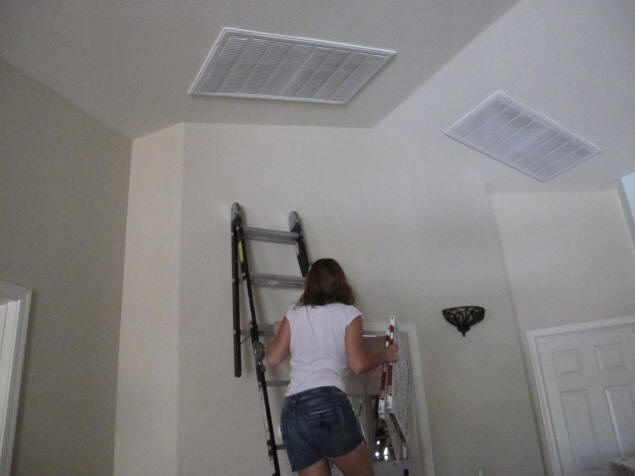
I also never got around to actually replacing them, until today,
because we didn't own a ladder tall enough to reach the upstairs
ceiling where the intake vents are located. I finally borrowed one
from our friends Barbara and Peter, and Jenny volunteered to do the
actual dirty work while I documented. (I did offer to let her
run the camera, but she chose to climb the ladder.)
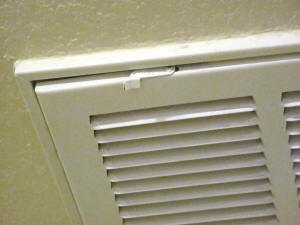
No tools (other than the ladder) were needed, because our intake vents
are equipped with a simple clasp for opening them or locking them
closed.
Since by now I knew a little bit about HVAC filters (I know more
now; I did this research after the filters were installed) I
was disconcerted to discover that the old filters had an MPR
of 1250—almost twice as good as the ones I had bought! On the other
hand, they were at least 9 months old, so the new filters
would still be an improvement.
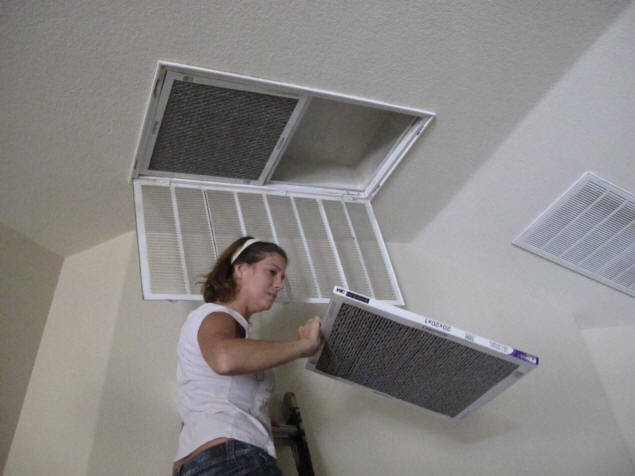
I was quite surprised to find the old filters were not as dirty as I
had expected. Oh, they were black, as you can see in the above
photo; but the accumulation wasn't as thick as I had thought it
would be. The filters in our last house were loaded up thick every
three months (which is the manufacturers' recommended time between
changes). I think that's because the house was in a newer
neighborhood and bordered the desert; plus, the back yard was not
landscaped. This house is in the middle of an established,
10-year-old development; it borders a golf course; and even the pool
in our backyard might be absorbing some particulates from the air.
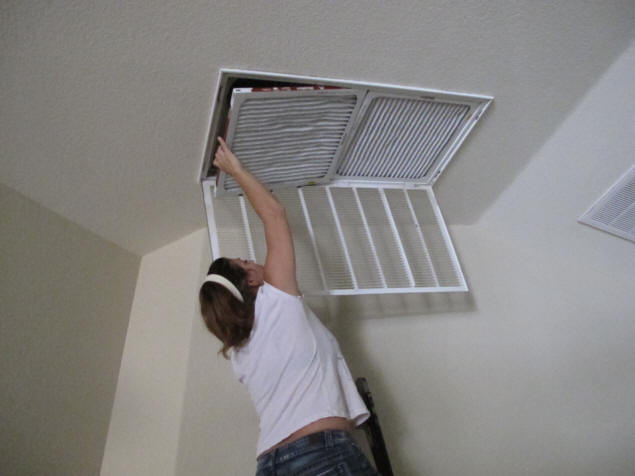
As is fairly common, our intake vents are "double-wide"; each one
(one for the upstairs HVAC and one for the downstairs) takes two
20" x 20" x 1" filters. Each comes with a directional arrow
printed on the side, that indicates direction of airflow. The
orientation of the pleats, on the other hand, is irrelevant.
Jenny then took a damp cloth to wipe the accumulated grime from the
vent cover, since she was up there anyway.
She had a little trouble closing the far clasp on the second
intake vent, due to the size of the ladder and where we had to put
it. She wound up borrowing one of Zach's weapons—a battle-ax—to
extend her reach.
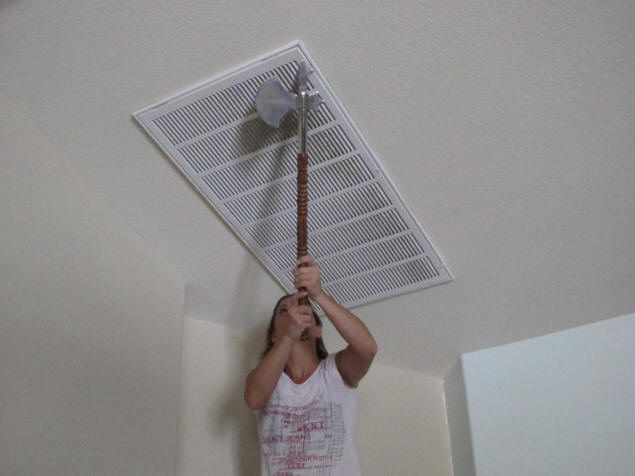
(By the way, this is not a toy. With his own allowance, Zach is
collecting an impressive array of real, medieval-style weapons. If
we should ever be attacked by the Black Knight, he'll be ready.)
We had one more vent to handle. This one is in the office space
Michael and I share. It didn't require as high a ladder but there
was no point in changing just one filter before. This time I
took the honors.
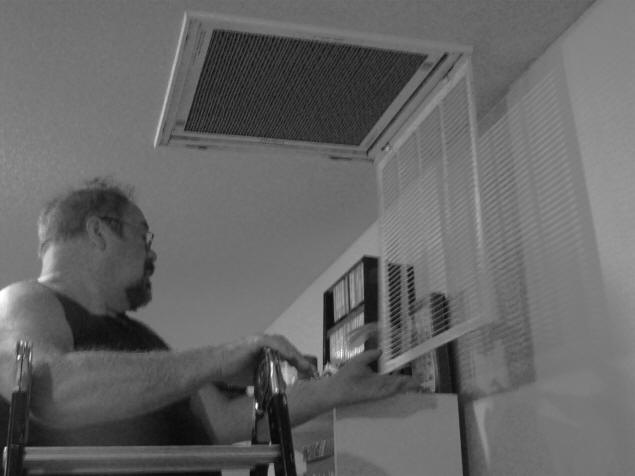
This intake vent only takes one filter, not two; the good news is
that it uses the same size filter as the other vents.
Dr. Crinnion recommends changing filters once every two or 3
months, but every month if there are pets in the home. That
means that I have 30 days to shop for more effective filters to
support my quest to de-toxify our home. We also need to hire someone
to clean the air ducts, which is supposed to be done yearly.
But, now at least, we have clean filters.