|
By: Paul S Cilwa |
Occurred: 10/14/2023 |
|
Page Views: 618 |
| Hashtags: #Autobiography |
| An eclipse is best appreciated with friends who enjoy having you explain it to them. |
| Estimated reading time: 5 minute(s) (1168 words) |
This is Lilly, waiting patiently at 4 AM for the coming eclipse.
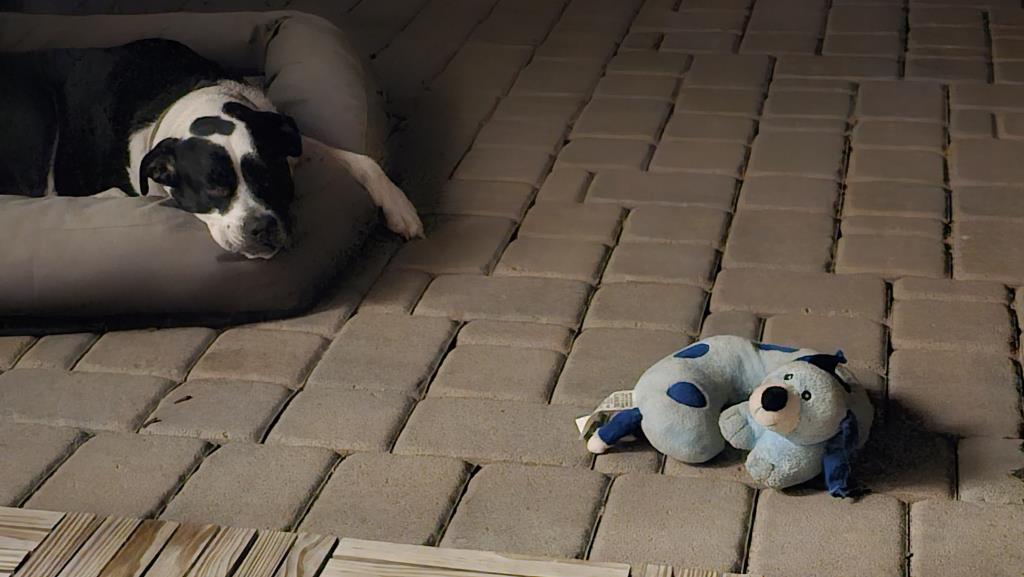
Not really, of course. And, although a study has not,
to my knowledge, been done on dogs, I'm pretty sure 100% of them don't know, either.
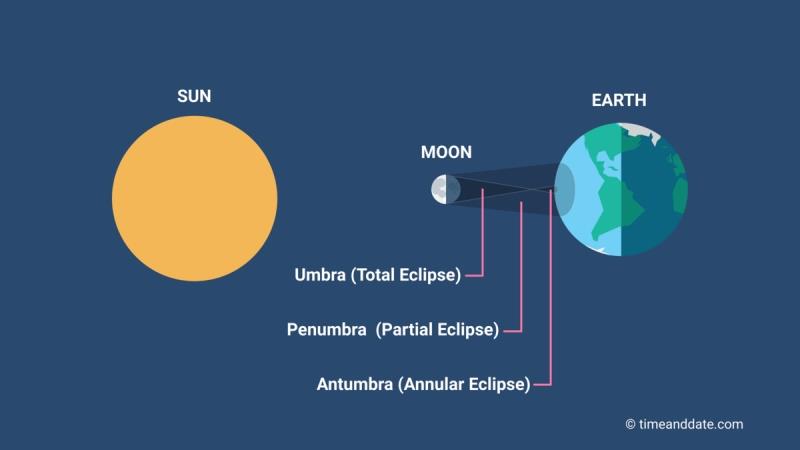
But we can fix this (for humans, at least). First, let's get our terms clear. If we are talking about solar
eclipses, you'll want to know the differences between the types of
shadows the moon casts upon the earth (because that's what an eclipse is).
First, consider something really bright. If it's a pinpoint source, like a star or black construction
paper with a pinhole in front of a light bulb, the shadows it casts are sharp edged. But if it's
bigger than a pinpoint, like the sun, shadows are fuzzy. That's because, if you stick your eye (or a camera)
at the fuzzy part of the shadow, you would see just part of the sun. The closer you get to the
completely dark part of the shadow, the less of the Sun's disk you can see.
The umbra and penumbra are the two parts of a shadow that are created when a light source is blocked by an object.
The umbra is the darkest part of the shadow, where the light source is completely blocked.
The penumbra is the lighter part of the shadow, where only some of the light source is blocked.
The next thing to know is that the Moon orbits the Earth, but not in a perfect circle, and not
perfectly centered. So, at some times the Moon is a little farther from the Earth than at others.
The average distance from the Earth's surface to the Moon's surface is about 238,900 miles.
However, this distance varies slightly due to the elliptical shape of the Moon's orbit around the Earth.
The point in the Moon's orbit that is closest to the Earth is called the perigee, and the point
farthest from the Earth is known as the apogee.
The difference between the perigee and apogee distances is about 31,000 miles. This means that the
Moon can appear up to 14% larger and 30% brighter when it is at perigee than when it is at apogee.
This phenomenon is sometimes called a supermoon when it coincides with a full moon or a new moon.
Now, the reason we have eclipses at all is due to two factors, one of which is such a startling
coincidence that it's historically been used both to prove the existence of gods, and,
alternatively, aliens. The first is that the Earth and the Moon both orbit along what's called the
Plane of the Ecliptic
, which is the imaginary plane that contains the Earth's orbit around the Sun,
and it is also the apparent path of the Sun across the sky over a year. That's not considered a coincidence,
as virtually all the bodies in the Solar System travel along the same plane.
The coincidence part is that the Moon is both almost exactly 200 times smaller than the Sun,
and almost exactly 200 times closer to us than the Sun! This is true of no other moons
we've been able to study. (Earth's moon happens also to be the largest, relative to its parent
planet, that we know of.)
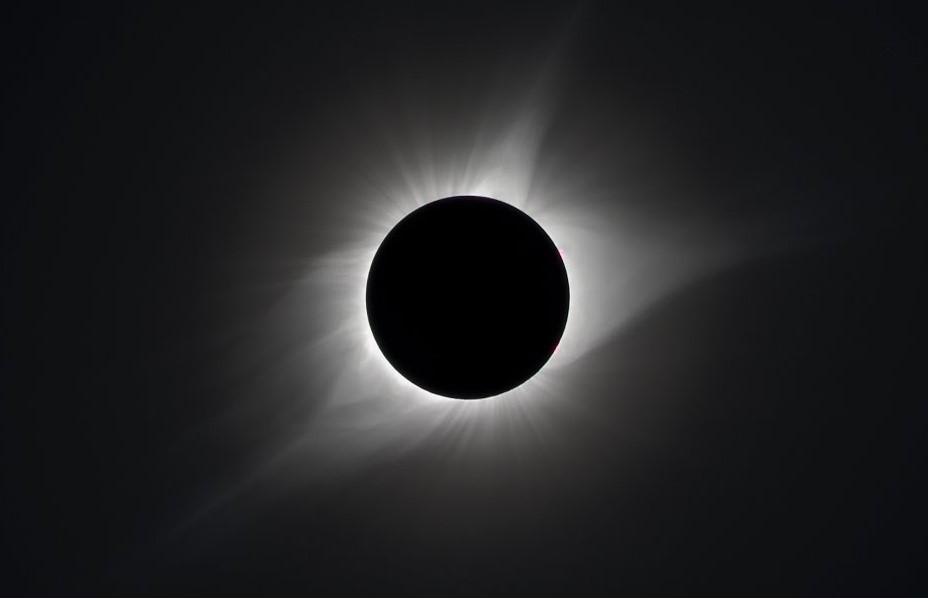
So, when the Moon is at perigee, and lined up between you and the Sun, it will exactly mask
the Sun's disk. Now, the Sun's luminous atmosphere is, of course, larger than the Sun itself;
we can't normally see it because the Sun's body is so bright. But when the disk is obscured
by the Moon, we can.
Three things have to align to make a total eclipse: first, the Moon has to be directly
between the Earth and the Sun (in other words, a new moon); second, it has to be at perigee; and,
third, you have to be located on the Earth's surface directly between the Moon and the Sun.
This makes total eclipses extremely rare, and is why eclipse enthusiasts will travel thousands
of miles to see one. That's why you'll see maps showing the path of totality.
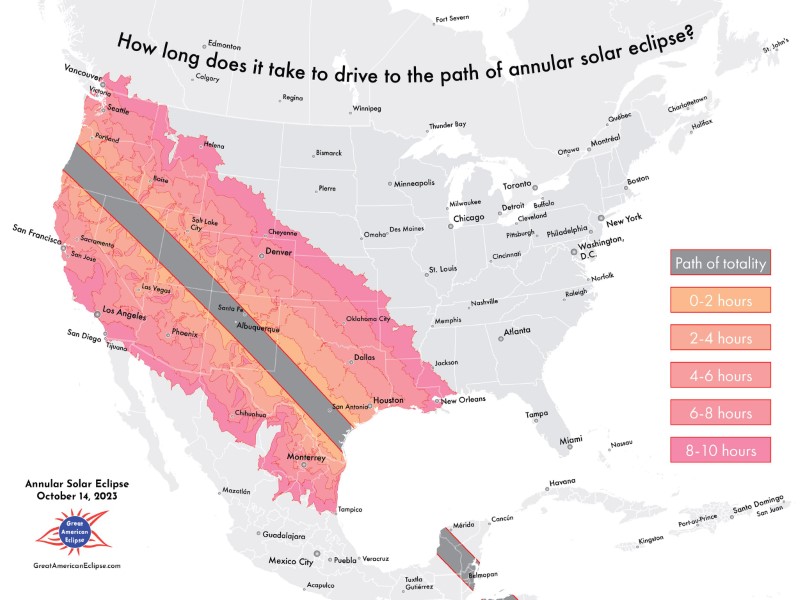
Now, as it happens, I'm the only human home right now, as my daughter and grandkids are visiting
Kauai for a couple weeks. So they're missing the eclipse completely, while I don't even have to
go outside my back yard.
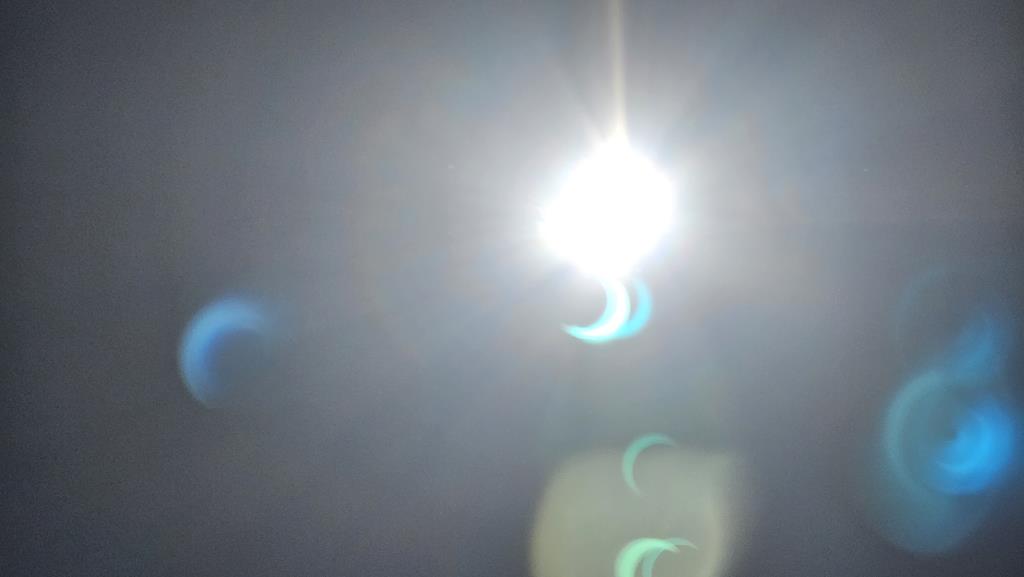
Notice, in this photo taken by my cellphone, the Sun itself is too bright to see
the bite taken out of it; but there are numerous reflections showing it.
So, at this point it is a partial eclipse. Every eclipse at least starts and ends with a partial.
Since I'm not on the path of maximum shadow—those folks will see an annular eclipse at
maximum—this is pretty much as much an effect as I'll see.

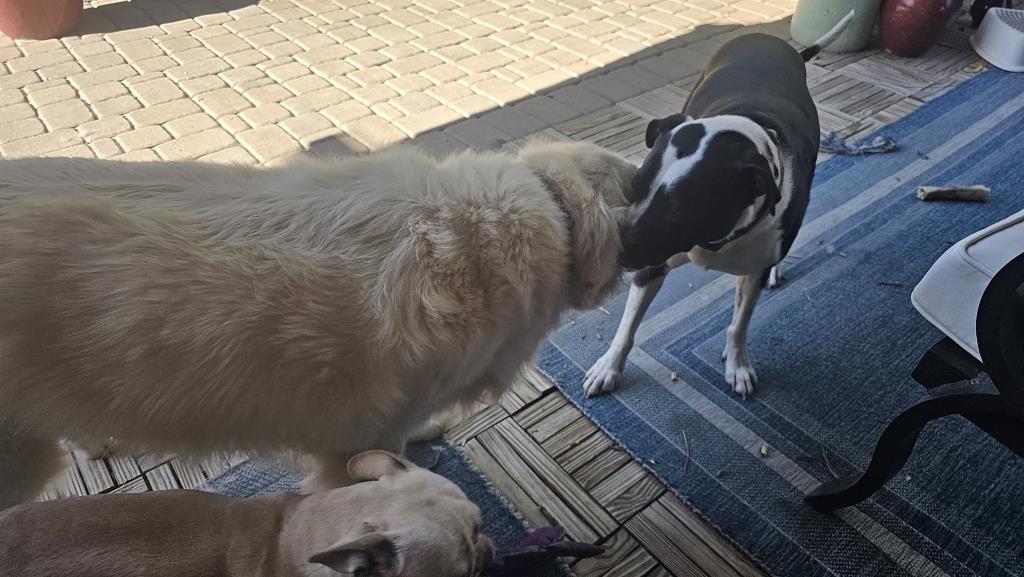
As the phenomenon progresses, the day did get a little dimmer. The dogs didn't seem to notice or care.
Unlike humans, dogs don't rely heavily on vision to make sense of the world. Their primary senses
are smell and hearing. When it comes to an eclipse, they might notice the dimming of light,
but it doesn't have the same significance for them as it does for us.
I didn't bother trying to get the extra-dark lenses that are strongly recommended before trying
to look directly at the Sun. I didn't get them because I had no intention of looking directly at the
Sun. Since I'm not, you know, the world's stupidest fake billionaire. Instead, I simply stood beneath
the branches of a tree.
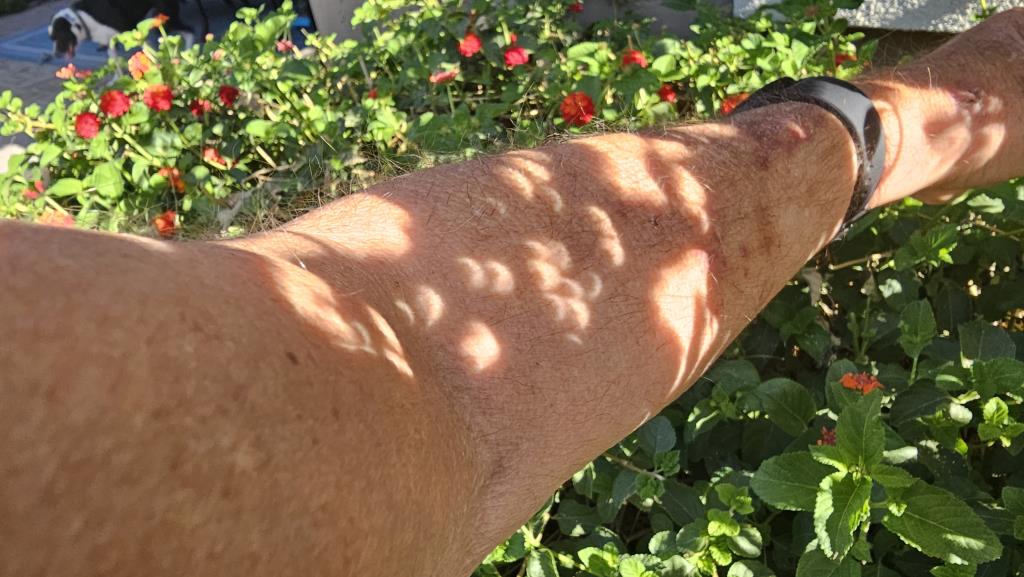
This is, of course, the easiest and safest ways to watch any kind of eclipse: to use a natural pinhole camera
made by the leaves of a tree. The gaps between the leaves act as tiny apertures that project the image
of the sun onto the ground, or any surface below them. By standing under a tree during the eclipse,
you can see many crescent-shaped suns on the ground, or even on your arm, that show the progress of
the moon across the sun. This is a fun and simple method that does not require any special equipment or eye protection.
So it was cool for me. But the best part for the dogs was simply being in the back yard with me.
Except for bathroom breaks, they seldom go outside to play unless I am with them.
Incidentally, the next eclipse will be total, along a path not too far from here.
And it's happening on my birthday!
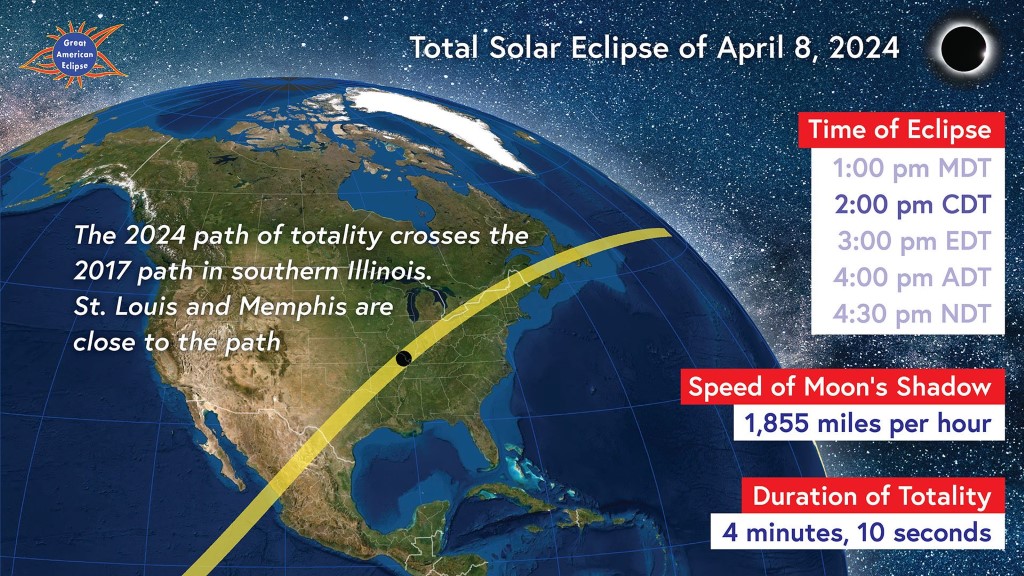
So, that's something to look forward to.