|
By: Paul S Cilwa |
Occurred: 10/31/2007 |
|
Page Views: 8,336 |
| Hashtags: #Zachary #Arizona |
| Zach's Cub Scout troop visit a dairy farm. |
| Estimated reading time: 6 minute(s) (1244 words) |
When the Stechnij farm was first purchased in 1979, it was located about as
far from anywhere as it was possible to be. Now the house we rent is in a
maturing neighborhood, minutes from three grocery stores, numerous gas stations,
a 12-screen movie theatre, a Wal-Mart, and an L.A. Fitness; and it is literally
a ten-minute drive away. The Stechnijes have other suburban neighbors even
closer than we, although their closest neighbors are adjacent dairy farms. Aware
that neighbors who don't know their neighbors have a tendency to become
suspicious and hostile, Casey Stechnij decided to address this potential problem
pro-actively and got the idea of giving a tour of the farm to neighbors, and
church and school groups. He promoted the idea and thought that as many as a
five hundred people
might show up. He was wrong. Two thousand tourists arrived,
straining the amateur tour guide's resources but validating the idea that city
folk do want to know where their food comes from.
We arrived at 6 PM as directed. The tour begins at the entrance to a
charming gift shop with farm-oriented curios, such as rechargeable
flashlights in the shape of a pig (the beams project through the
pig's nostrils), locally-made jams and jellies,fresh
eggs from the farm, and farm-oriented toys like plastic tractors and
dollhouse-sized barns. The gift shop, called "Mooster's Moo-tique",
was the idea of Casey's sister, Alison, who left the farm for the
world of retail before recently returning and, as Casey told me,
"reuniting the family."
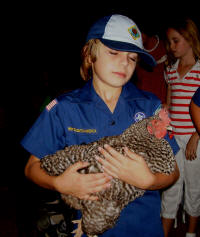
Casey manages the farm, but we met his mother Glenda (who introduced the kids
to a hen who, amazingly, likes to be held) and he pointed out his dad working
after dark in one of the many work sheds on this 1000-cow dairy. So it is
definitely a family farm.
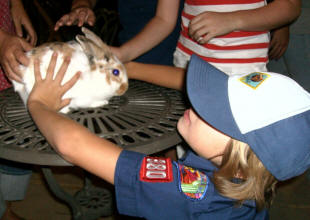
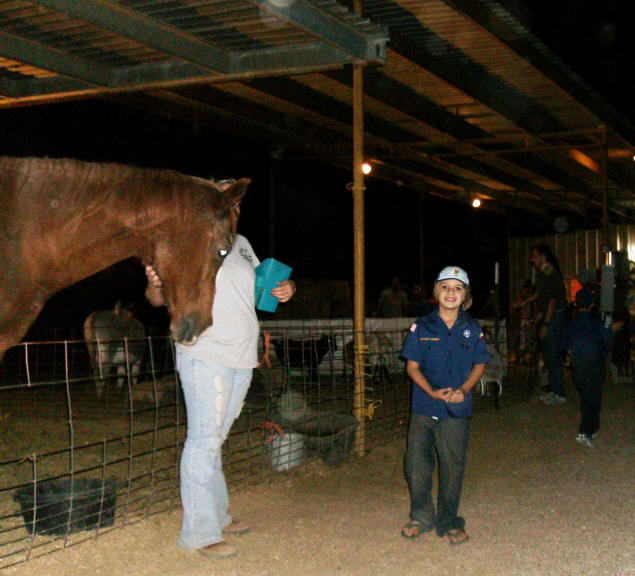
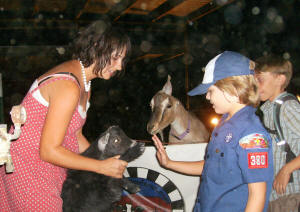
Outside, beyond the Moo-tique, is the tour gathering area and an enclosure
where petting-friendly goats, a donkey, and a horse wait to be caressed by the
eager hands of eight-year-olds. Actually, what they wait for is snacks, provided
by Casey, his mother and sister, and some employee-volunteers. In fact, Casey
started the tour with a stern warning to the kids not to feed them the Fritos,
chips and popcorn most of them had brought with them (presumably for
themselves). It hasn't occurred to most eight-year-olds that the nutritional
needs of animals
 aren't identical to those of eight-year-olds. (Actually, looking at the junk
food the kids brought with them, it apparently hasn't occurred to their parents
that the nutritional needs of eight-year-olds might not match what they see
advertised on Saturday morning TV, either.)
aren't identical to those of eight-year-olds. (Actually, looking at the junk
food the kids brought with them, it apparently hasn't occurred to their parents
that the nutritional needs of eight-year-olds might not match what they see
advertised on Saturday morning TV, either.)
But Casey knows what appeals to kids, and soon they were taking turns giving
the little goats (including a darling little black Nigerian Dwarf goat named
Oreo) their evening dinner.
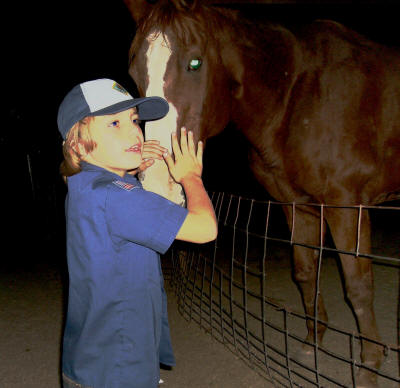
When Alison introduced Zachary to Lovey, a 28-year-old gelding, Zach immediately
gained the animal's trust by letting him sniff Zach's hand; then, where most of
the boys had shied away from the creature which is, after all, many times their
size, Zach stroked Lovey's nose like an experienced horseman.
"Have you ever met a horse before?" I asked him.
"Oh, yes, thousands of times," he asked. I have no idea when this
happened. One of these days I'll have to get up the nerve to ask.
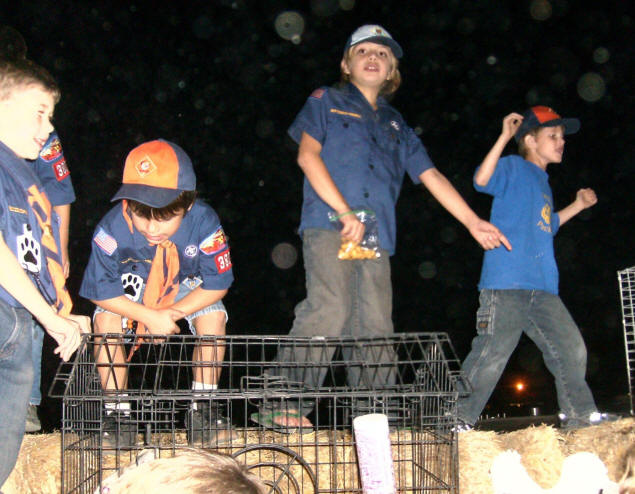
After petting and feeding the "farm friends", we boarded a hay wagon for a
"hayride" which circumnavigated the dairy farm. Glenda had already pointed out
to me that the place was clean: There were no flies and the smell, while strong,
was not overwhelming. In fact, I remember dairy farms in Vermont I had to hold
my breath for as we passed (though some of that may have been the exaggerating
of an eight-year-old drama queen). Actually, the hay dust in the air may have
been more of a problem; both Zach and I were still sneezing from it this
morning.
With Casey narrating while a young man named Ethan drove the towing tractor,
we saw the various pens in which "the girls" of various ages are kept. Pregnant
cows are kept separate from yearlings and cows who have delivered calves and are
therefore eligible for milking, to make it easier to feed each group
appropriately. We saw the piles of feed as Casey explained how parts of various
plants like wheat, corn and cotton that would otherwise go to waste, make
excellent components of the cows' meals. He also emphasized that the cows have
their own nutritionist who makes sure "the girls" get all the nutrients they
need for optimal health (and, therefore, optimal milk).
We saw the extensive misting system used in the summer to bring the
temperature down to the high 90s. That still may seem hot to some, but Casey was
quick to point out the exchange: Warm winters. He recalled a cow they'd
"adopted" from colder climes who'd lost her ears to frostbite. "The girls" are
much better suited to our weather than that in, say, the Midwest.
We saw calves who'd been born mere hours before we got there, already on
their feet. Ethan carried an 85 pound, 8-hour-old baby to the hay wagon so the
kids could pet it. Zachary was surprised at how soft the baby's fur was. Another
kid sitting near us was surprised that another, older calf in the pen was
smaller than the baby. Casey explained that the older calf was a preemie: he'd
been born two weeks before he should have. "In the wild, he'd have died." Casey
emphasizes the lengths to which the farm goes to honor the contract between
predators (humans) and our prey (the cows). Yes, when a cow can no longer
produce milk, she is "retired" by becoming steak, as well as clothing,
furniture, glue and any number of other raw materials—nothing is wasted,
just as in the plant parts we humans would throw away, but which make good food
for "the girls". But these cows, if they were not used in this way, would never
have lived at all. In exchange for having a known, useful, death, they enjoy
longer and much more pleasant lives than they would "in the wild"…and in far,
far greater numbers.
Metaphysically, it's a bargain. After all, if death (as I believe) is an
illusion, then it's an illusion for cows as well as for humans. Our souls and
theirs are immortal and all aspects of the Great Oneness…but, meanwhile, we've
still gotta eat.
So perhaps it was no coincidence that, when we got back home, it was to a
delicious steak dinner prepared by Michael.
As A. Whitney Brown once said, "I am not a vegetarian because I love animals.
I am a vegetarian because I hate plants."I do love animals. Especially
with A-1 Sauce.