|
By: Paul S Cilwa |
|
|
Page Views: 5,257 |
| Hashtags: #UFOs #AlienAbductions |
| About the odd goings-on in my family during the three years we lived in rural Vermont. |
| Estimated reading time: 17 minute(s) (3841 words) |
And so, at 7 years old, I moved from urban New Jersey to very rural Vermont.
With no phone, no lights, no motorcars other than our own and the very rare passing of a rickety
old truck on the unpaved road below our century-old house.
My folks waited until school was out for the summer, then packed all our stuff into an
open-framed trailer, and us into the Studebaker; turned the house over to the
family who had rented it from us, and headed North to a
century-old house in Victory, Vermont. At 7, I had no idea where Vermont was or
even what it was, much less why we were going. All questions were
answered with, "You'll see."
It was a long trip, and we'd gotten a late start and Dad had to nurse the car
which slowed us further. We finally arrived in Vermont's Northeast Kingdom very
early in the morning. I awoke after Dad had turned off Vermont's Route 2 onto
the dirt road to the township of Victory. The road followed the Moose River,
crossing it several times so that the river was sometimes on the right side of
the car, and sometimes on the left; most times, obscured anyway by the thick
pines that lined the road and continued, unbroken, up the mountain slopes.
What surprised me most, though—besides the fact that the road was unpaved—was
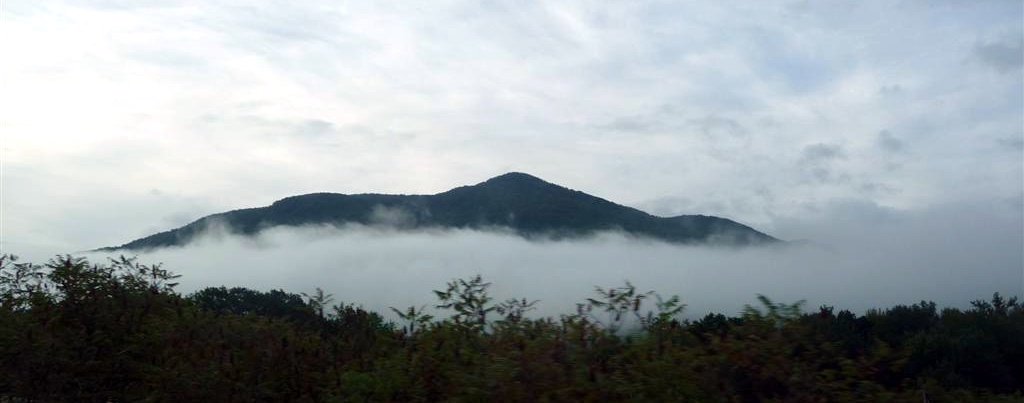
a type of fog I'd never seen before, and haven't seen since. It consisted of
rolls of fog, tubes of fog, draped out along the valleys and hillsides like
giant pipes.
After some 25 miles of road, we arrived at our destination: An old, mustard
yellow, two-storey house on the side of a hill, looking over the road with a
kind of forlorn pride, like the elderly king of a small principality sitting on
his front stoop waiting for petitioners who never come.
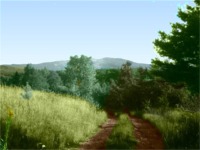
The driveway up the slope to the house was, if possible, in worse shape
than the dirt road. The owners of the house seemed to be expecting us and showed us through
the place. I don't remember much from that first visit, just the huge wood stove
in the kitchen, kerosene oil lamps in each room, and an organ that Mom called a
"melodeon" in the hallway. My littler sister, five-year-old Louise, found she
could (barely) reach the pedals that pumped the thing and play a few notes.
The house had no electricity, because Victory had not yet been wired for it.
It also wasn't connected to the national telephone lines. (Some houses had
access to the "fire line" telephone, a single line shared by all homes that used
it. But this was not one of them.)
Apparently the adults reached an agreement unknown to us kids, because Mom
and Dad agreed to buy the place from the current owners, the Hoveys. The
agreement included 65 acres of property, the house, the wood stove and the
melodeon, and various pieces of furniture including tables and beds.
Pets
Dad had bought the property with the idea that he would turn it into a lakeside
hunting lodge. Now, that would seem difficult considering there was no lake. But
the U.S. Army Corps of Engineers was planning to dam the Moose River and flood
the Victory Bog (also known as the Victory Basin). Local environmentalists
protested the plan, as Victory Basin is a unique ecological area containing
Vermont's largest boreal forest, and an enormous amount of wildlife. The hunters
Dad wanted to lodge would have had little to hunt if the dam had gone through.
In 1967 the Victory Basin Wildlife Management Association purchased the
Victory Basin from the New England Power Company, ending the dam plans. But in
1958, the possibility was still very much in the air. And in the meantime, Dad
decided we may as well farm the land, starting with a few cows, a goat, and some
barnyard pets.
First came the dogs. They must have been obtained over Mom's objections,
because she'd always been terrified of dogs. Sniffy, who was such a perfect
example of "mongrel" that in my dog book, the picture of a mongrel looked just
like him, became mine. A fat little beagle was to be shared between my
6-year-old sister, Joan, and 5-year-old Louise. Joan was a little vague about
the whole pet-naming ritual. When Dad said she could name the dog, she asked
what he meant.
"You can call him whatever you want," he explained. "Like Fido or Rover."
She went with "Rover."
Dad shored up the weak spots of the chicken coop and made it the home of two
rabbits. I named mine Whitey. Joan named hers Jumpy-Over-The-Mountains. Our
younger sister, Louise, was considered at five to be too young to have pets, or
at least that was the justification for buying two and "giving" them to the
oldest two kids.
I'm not sure what Dad had in mind for those rabbits' ultimate fate, though
I'm pretty sure it was not to eventually retire in some Old Pets Home. But
whatever it was, the dogs had a different idea. They found the rabbits
irresistible. And in spite of any common sense, the rabbits seemed to want to
get out of the chicken coop as badly as the dogs wanted them to. We usually
caught them first, and then would locate and patch the hole they'd escaped
through.
One morning Louise looked out her bedroom window and noticed a couple of bits
of white stuff on the driveway. Because we were so far out into the country that
there was absolutely no litter anywhere, it stood out. "Mommy!" she yelled.
"There's some Kleenex on the driveway!" Louise always had a very firm sense of
where things should be.
But when Mom returned from her investigation, she was ashen and wouldn't let
us go out to look. "It's the rabbits," she said. "The dogs got them."
I wanted to point out that this wasn't so much the dogs' fault as it was the
rabbits', who clearly had no sense at all. But Mom seemed too upset. This only
proved to her what evil creatures dogs were.
In any case, the chicken coop couldn't be wasted, and Dad promptly replaced
the rabbits with three ducks.
The ducks also got out of the coop on occasion, but the dogs seemed quite
disinterested in them. Mom would instruct me to run and gather them up; the
biggest one was the size of a five-pound bag of sugar and it wasn't easy to pick
up if it didn't want to be. But I managed to get them and put them back into the
coop.
I also got to feed them. I loved this part. Mom would make them some kind of
mush and put it in an aluminum pie plate. I would crawl through the little
door in the coop and place the plate onto the ground. The ducks definitely knew
what was going on; they would crowd me until I backed away, sticking their bills
into the mush and making little quacks of pleasure as they inhaled their meal.
But the biggest additions to the family were the calves and goat.
Apparently it's cheaper to buy a baby calf and let it grow, than to buy a
full-grown cow whose milk is immediately available. Dad bought two, Brownie and
Blackie. At the same time, he brought home Nanny, the goat.

Nanny had a definite and distinct personality. Actually, she reminded me a lot of Aunt
Al. Nanny immediately adopted the calves, who followed her everywhere. Now,
calves eat grass and say "Moo" and goats eat leaves and say "Bah." But Brownie
and Blackie ate leaves and said "Mah!" That's how into their adopted mother they
were.
Nanny was very curious and was fascinated about the big building her humans
went into. One day I came in and forgot to close the door. Suddenly I heard Mom
screaming, "The goat's in the house! The goat's in the house!" She didn't seem
to have any idea what to do about it. Little Louise didn't hesitate. She marched
right up to the goat, stuck her index finger in Nanny's face, and barked, "Back,
Nanny! Back!" Nanny backed right out of the house and into the yard. From then
on, she would do anything Louise told her.
But Nanny couldn't abide weakness, and she had no mercy for Mom, who she
could sense was afraid of her. One day Mom was in the yard, raking, when she put
down her rake, tines up, to pick up a rock. Nanny saw how the rake was arranged
and practically ran to it, jumping onto the tines with her front hooves so the
handle went flying, smacking Mom in the butt.
Lights In The Woods
Because "the grid" had not yet come to our remote bit of wilderness, there were no street lights,
or lights of any other kind. So the nights were dark as being in a blanket; not even the stars
were brilliant enough to light the way on a moonless night.
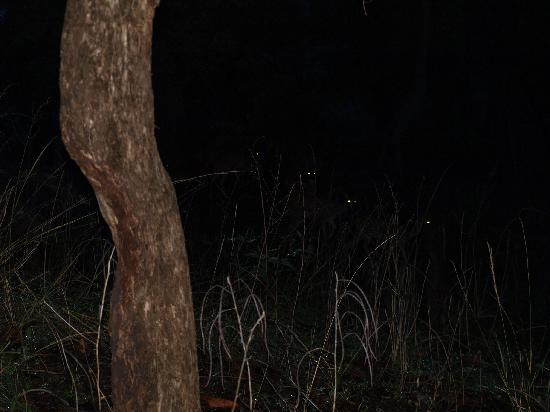
I remember us pulling into the driveway one night. The cousin who
drove us, and my mother, had seen a "funny light" near the house which they
announced was the reflection of our car lights in the eyes of a wild animal. We
sat quietly in the car for (it seemed like) an hour before my two younger sisters
and I quietly got out of the car and filed into the house and went to bed. We
were a rambunctious bunch; we never did anything quietly. But we did that
night, and looking back it strikes me as odd behavior.
Disappearance
Nanny and the calves usually hung out around the house, where there was
plenty of tall grass and bushes. But once in awhile Nanny would get a jones for exploring.
Usually she would head north up the dirt road towards Gallup Mills, a small
community at a crossroads about an eighth of a mile up, with the calves close
behind her. Mom and Joan and Louise and I would walk there and, sure enough,
there they'd be somewhere along the road, enjoying the taste of other
bushes growing on the side.
One day my sister, Joan, six at the time, turned up missing. We looked
everywhere for her, but she was nowhere to be found—certainly not in the house,
and not in the usual play places around it, either. Mom and Louise and I got the
idea she might have wandered to Gallup's Mills. We walked there and back, my
mother becoming more and more frantic as we failed to see any sign of her. Mom
had always warned us that we might be kidnapped (I have no idea where that idea
came from) and she was at a loss as to what to do. When we got back to the
house, she sat at the dining room table, put her head down and started sobbing
hysterically. Louise and I tried desperately to calm her down. Louise decided to
get a cushion from the living room for Mom's head—and found Joan, deep asleep on
the sofa. It took several minutes to rouse her. She swore she'd been sleeping
there all the time.
At The Window
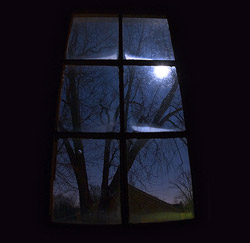
One night I got out of bed and went to the top of the stairs. My mother
and sisters were standing in silence at the foot of the stairs, staring out the
window. I joined them and asked what they were looking at. "The Northern
Lights," my mother replied, and I looked, but I couldn't see anything. Finally I
went back to bed, leaving them standing fixed at the window in silence. They no
longer have any memory of the incident at all.
Losing Daddy
"I quit," he said.
"Did you tell them?" I asked.
"They'll figure it out," he said.
We did return to New Jersey to spend Thanksgiving with Mom's father and her
stepmother, Grampa and Gramma to us kids. Dad drove, but spent most of the visit
sleeping. I developed (what I now know was) a migraine and also had to lie down during
the dinner. Afterwards, Gramma gave me my first black olive ever. It seemed to
settle my stomach, so she gave me another, and another. Within ten minutes the
headache was completely gone and I was able to enjoy the meal that she had saved
for me.
Mom had to drive back to Vermont. Dad stayed in bed upstairs. Mom instructed
me not to "let" him go downstairs, because he couldn't keep his balance. I stood
guard, and sure enough, he staggered into the hallway, wearing only a T-shirt,
announcing he had to go to the bathroom. I told him I wasn't allowed to let him
go. He swept me aside and promptly fell down the stairs.
So I thought it was my fault when my half-brother, Walter Joseph, came
to take him to the hospital. Walter Joseph drove a station wagon and I was
fascinated by the way a mattress could fit perfectly into the back of it, making
a traveling bed. Walter had driven up with Tommy and the two of them carried the
mattress with Dad on it, sliding it right into the vehicle.
I never saw him again.
My grandparents had arrived, and Mom went with Walter Joseph and Tommy to the
hospital. I didn't know it then, but the hospital was in New Jersey. Gramma and
Grampa explained that we were going to stay with them for awhile.
We kids weren't privy to the logistics that must have gone on behind our
backs. Someone came to take the goat and calves for the winter; a friend in
nearby Granby took Sniffy and Rover and someone else bought the ducks. It seemed
to us like coincidence that Walter Joseph and Tommy had shown up at the same
time as our grandparents.
It was some days later that Gramma solemnly brought us into her kitchen while
Grampa stood soberly behind her. Their kitchen table was set against a wall and
had just two chairs. Joan and Louise sat on one while I sat on the other.
"Do you remember Baby Dorothy?" she began, her voice breaking. Dorothy was
our littlest sister who had died of SIDS a couple of years before. We nodded.
"Well, you know she's in Heaven, and she's happy there even though we can't
see her. Well, your Daddy has had to go to Heaven, too."
Tears were pouring down her face, and Grampa looked as if he might cry, too;
but the girls and I just sat solemnly. We really didn't understand what was
happening.
"I know you don't know what a brain tumor is," she continued, probably under
pressure to not just stand there. "But your Daddy had one. And the doctors tried
to take it out, but it was too late and he died on the operating table."
By now the girls were crying, and Gramma hugged them, and then she
hugged me. I felt so sorry for her. I knew it was my fault. If I hadn't let my
Dad go down the stairs when he wasn't supposed to, I thought, he wouldn't have
gotten this brain tumor and died.
When Grampa hugged me, he said, "You're the man of the family now. You'll
have to take care of your mother and sisters."
It seemed only fair, since I had killed my father.
New Jersey Encounter?
With her husband now deceased, my Mom couldn't face spending a winter trapped in a house,
surrounded by snow, with no way to go for help should there be an emergency. So we simply
moved into Gramma and Grampa's apartment for the winter. And when January came, my
sisters and I were enrolled in a local school.
I do have an odd memory from this period that I can't pin to a specific date or event. I remember being in what I thought was a storage room at my school,
a room with metal walls and many stacked TV screens. There was another boy in the room, a dark-haired kid whose nose was bleeding. My own had been bleeding
as well, but had stopped. The boy was crying, so I did my best to comfort him. The memory ends there.
Decades later, when I was telling my life story to Michael, who I subsequently married, I started sharing this incident when he interrupted me.
He had the same memory—from the point of view of the boy with the bloody nose!
By April, Bloomfield's snow had melted. In what must have been an exquisite act of bravery, Mom bought a Ford Country Squire,
piled us kids into it, and returned to Vermont's Northeast Kingdom.
We made the most of Vermont; visiting lakes, and walking around the woods
unsupervised. My grandfather taught me to swim; and we took a two-week trip to Arizona with
Ray, whom Mom had hired to be the primary contractor on our home repairs. They also, it seems,
may have had a little affair. Ray certainly took the idea of being a stepfather seriously,
as he went out of his way to criticize what he perceived to be my effeminate traits and to warn
me against ever being "queer". This was, of course, utterly humiliating to me but it's the way
things were back then.
Harvey's Lake
We didn't spend all our time on the property in Victory or visiting in
St. Johnsbury. Mom enjoyed going for Sunday drives. We were already out and
dressed up for church; why not just keep driving? Also, Mom liked to visit
"other" Catholic churches than our usual one in Lunenburg; so sometimes we'd go
on a longer drive than usual and include Mass in the itinerary. We drove up near
the Canadian border, visiting—but not swimming in—Lake Memphremagog, Lake
Willoughby, and Lake Bomoseen. We were not allowed to swim in those places
because, according to Mom, they were "bottomless" and one of her great fears
(one of many) was that we might drown and our bodies never be recovered.
For some reason that was a worse fate, for her, than drowning but having one's
body be recovered.
Now that I was a sophisticated almost-fourth-grader, I hastened to educate
Mom as to the construction of the Earth; how no lake could possibly
be bottomless. To which Mom would reply that of course there was a bottom,
but it was so far down it had never been measured. We had the same conversation
repeatedly, every time we visited one of these "bottomless" lakes. Decades
later, when I drove Mom back to Vermont on a vacation, she began to go on about
the "bottomless" lakes again. "Don't you think they've measured them by now?" I
asked. "What with sonar and Doppler and other advanced exploratory devices they
now have?"
"How could they?" she retorted. "They're bottomless."
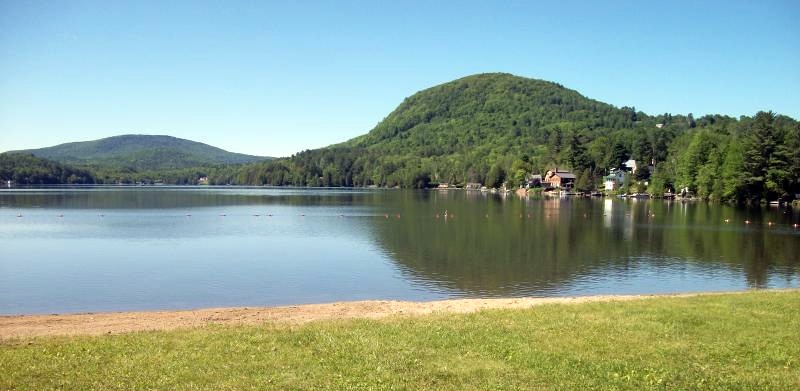
One of the places we visited several times was Harvey's Lake near the town of
Barton. I had a rubber knife which Ray had bought me in his continuing effort to
masculinize me, and on one of these trips I brought the toy knife with me. I
used to play Superman with this knife, which, when used to attempt to stab my
indestructible body, would turn aside just like in the comic books. At the lake,
I met another boy about my age and let him play with my knife awhile. But when
it was time to leave, I couldn't find him and so lost the knife.
Decades later, in early 1997, I learned that Michael, with whom I had just
fallen in love, had spent boyhood summers in Vermont near Barton and that he had
once met a boy at Harvey's Lake who loaned him a rubber knife and then
disappeared before he could return it.
Mom continued to let us play, unsupervised, in the woods behind the house. In
today's culture this would be considered tantamount to child abuse, or at least,
neglect. But we loved it. It contributed to our adult sense of competency, as
well as a love of nature. And the fact is, nothing bad ever happened to us: no
broken bones, no bear encounters, no lost children. I often wonder if today's
overprotective parents aren't raising a generation of adults who are truly
incapable of taking care of themselves? Or worse, afraid to even try?
I spent, literally, hours in those woods and in the meadows between them.
Frankly, I do not remember what I did in all that time. Sometimes I ate
berries—and there were always berries. Sometimes, I led my sisters along the old
wagon trail to see if we could find the end. Sometimes, I merely sat on a
boulder in the warm summer sun or read beneath a tree and laid in the grass
watching the clouds drift overhead. It was a solitary time, but I didn't feel
lonely. Instead, I grew comfortable being by myself or with my dog, Wrags, who admittedly usually
followed me anywhere I went.
Moving Again
By 1961, Mom had gotten tired of the Vermont winters (as a child she'd only lived in Vermont
in the summers) and the lengthy commute into St. Johnsbury when she needed anything, including
the company of her fellow adults. So, once again, we packed everything up, and Mom, my sisters, my
grandparents, and I, moved to St. Augustine, Florida, where I then grew to adulthood. There
were a few highly strange occurrences there, but since I was still a kid,
I just accepted them as another strange thing in an increasingly strange world.

And then, I married my high school sweetheart, Mary Ann Steinberg; we subsequently had four
children. I joined the Navy, and afterwards went to college on my VA benefits. Eventually I
made a career of computer programming; and then, technical writing and corporate training
in computer programming.
Just an ordinary gay guy in a heterosexual marriage. Back in the day, that was common.
But it was about 15 years later, when I began researching my novel and became increasingly convinced that
I had had experiences similar to those of actual abductees, that my world, and my life,
would begin to fall apart.