|
By: Paul S Cilwa |
Posted: 3/27/2006 |
|
Page Views: 6,913 |
| Hashtags: #AlienAbductions |
| All about the extraterrestrial species who are interacting with humans. |
| Estimated reading time: 9 minute(s) (1947 words) |
Okay…Now that we had managed to
make some kind of contact with our abductors, it was time to ask some
questions.
We had learned that, to make a statement, we needed to create a mental image
representing that statement and keep it in our heads while going to sleep. Even
though we'd been lucky enough to make contact the first night we tried, none of
us imagined that we, as individuals, were significant enough to the visitors to
summon them, like genies, whenever we wanted. But visits were occurring every
three nights or so; by keeping an image each night until there was a result, we
should be able to get our message through.
Now the only question was…what should that message be?
Some proposed "Leave me alone!" as an appropriate message. But, while
encouraging each person to send a message that seemed right to him or her, I
urged each member of the group to consider that, until we knew why they
were visiting, we should probably not decide the visits must stop.
And finding out why would require, not a statement, but a question.
I posted into the chat room my intuition on the subject:
"This is just a hunch, but I have a feeling that a question image
looks like an oil or watercolor painting with an unpainted area left for the
information you want. If they answer it, the image will be returned to you
filled in."
I had no idea where that notion came from, but I determined to
try it. I imaged, in painterly style, a picture of a visitor in a
spaceship leaving a planet—but did not fill in the planet, just left
a round, unpainted disc. I then imaged an alien standing on a
landscape with no details filled in.
I went to sleep with these images for two nights before awaking with my head
full of pictures I somehow knew the visitors had implanted. The planet was dark,
with land and sea masses but no sun. That struck me as unlikely in the extreme;
wouldn't a planet without a sun be covered by ice? Nevertheless, that was the
picture.

The second image showed a herd of aliens in a fenced-in field. The sky was
black; it was always night. Yet it wasn't cold, merely cool; and somehow I had
the impression that the aliens were grazing on fungi that covered the
ground.
After reporting my results (one other abductee had posted that he asked
similar questions and received similar answers), I turned to the most crucial
question: Why? For this I imaged myself in bed, with the alien hovering
over me, and the space between us unfilled.
The response came the next morning. In it, the alien was handing me a book
and I was handing him a book.
Trading knowledge?
I wasn't sure what I'd learned from these guys, but it was clear I could
learn from them if I could just figure how to phrase my questions in the form of
a photo. What a shame Alex Trebek wasn't an abductee! He'd have had a head start
on this, I was sure.
Some might wonder why we cared. After all, every few nights for several
years, and occasionally before then, beings had come into our bedrooms and taken
us against our will for some exploratory surgery. Moreover, thousands of other
Americans, and tens of thousands of people world-wide, were sharing the
experience.
But knowledge gives control, or at least the illusion of control. So I
think it is not surprising that, collectively, we desperately wondered who the
heck was doing this, and why.
At the time people joined the Abduction Support Group, most of them (not all)
had at least one experience of having seen their abductor in a
more-or-less-normal, waking, state. All of us had also experienced seeing the
aliens in a non-normal state; but we understandably didn't trust those
perceptions.

Virtually all of us had experienced the type of alien we called the "Greys". These are the
beings who had first come to public notice on the cover of Whitley Strieber's
book,
Communion.
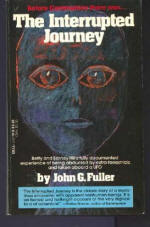
However Whitley was not the first person to describe these aliens. The first publicized
abduction in the world was that of Betty and Barney Hill in 1963; and in
The Interrupted Journey, the book describing their traumatic experience,
Betty Hill described her abductors as being grey-skinned, with almost
non-existent noses, lipless mouths, and four fingers (two long, two short). This
matched my description pretty closely.
Later, author Leonard Stringfield talked with military people who claimed to
see corpses of this species of alien. He added details that are consistent with
the Betty and Barney Hill description: The Greys' approximate height is three to
four and one-half feet tall, weighing about 40 pounds. They have almond-shaped
eyes, large heads, like the head on a 5-month old fetus, thin necks, and no
earlobes. Their noses consist of two nares with only a slight protuberance. The
mouths are a small "slit" without lips. The bodies are hairless, or with slight
fuzz. They have long, thin arms that reach to their knees, no thumbs, four
fingers (two fingers are longer than the others), and a slight webbing between
fingers. The beings also have short, thin legs.
This description matches the
"little guys" who tried to carry me down my stairs, one of whom I
kicked into the wall. The "tall guy" who generally accompanied and
seemed to lead the "little guys" was similar, but six-and-a-half
feet or more tall.
An obvious question was "Where are you from?"
That had apparently been answered by Betty Hill, who'd asked her
abductor that very thing. On their ship, she'd seen a screen covered
with white dots, and dotted lines connecting some of the dots.
"What is that?" she'd asked the alien who'd examined her.
"That's a star map," she was told. (Betty recalled the aliens speaking to her
in unaccented English, which conflicts with my conclusion that they cannot
speak. Perhaps she was mentally given the illusion they could speak; or
maybe some of them can.)
"Where are you on the map?" she asked.
Apparently amused, the alien replied, "First tell me where you are on the map."
When Betty admitted she had no idea, the alien said, "Well, if you don't know
where you are, what good will it do for me to tell you where we
are?" Nevertheless, he pointed to two nearby stars and said, "We come from
there."
Of course, Klass made up the figure of 20%. But in 1979, an
observatory in Australia published its semi-annual list of newly-mapped stars;
and almost immediately a program that had been running for a decade made a 1%-placement
match. Betty's map indicated the Greys came from Zeta Reticuli I and II, a pair
of dim stars located about 50 light years from Earth. Invisible to the naked
eye, they nevertheless existed.
I tried to justify a planet orbiting a pair of dim stars as having eternal
night, yet being warm enough to not freeze its oxygen-breathing inhabitants and
couldn't do it. Nevertheless, I went along with the majority opinion and began
calling the Greys "Zeta Reticulans." This is now widespread in the abduction
literature.

Some of the abductees reported humans assisting in the abduction. And Whitley
Strieber, in
Transformation: The Breakthrough, described how he, himself, in a state
that was almost conscious but not analytical, found himself assisting in an
abduction.
In the Support Group there was a small percentage of people who
reported contact with aliens who were not Greys at all. Although
their stories differed from the rest of ours in many ways, we took them at face
value because, after all, it was no harder to believe in two
species of alien than in one. These "other" aliens were more
humanoid, almost able to pass for us except for their eyes being
farther apart than ours, and their skin coming in unearthly shades,
such as blue or green. The other, outstanding aspect of these
humanoids, who called themselves Pleiadians, was that any human who
met one, was sexually attracted to it to the point that he or she
would practically stalk the alien, listening to its every word, all
but worshipping it.


A few months after I had encountered the descriptions of these beings,
actress/author Shirley Maclaine made headlines with
her book
Out On A Limb, in which she described meeting one of these
folk and following him to Peru. Previously, they had been described
only in an
obscure book about a one-armed Swiss guy named
Billy Meier, who had similarly fallen in love with a Pleiadian
named Semjase.
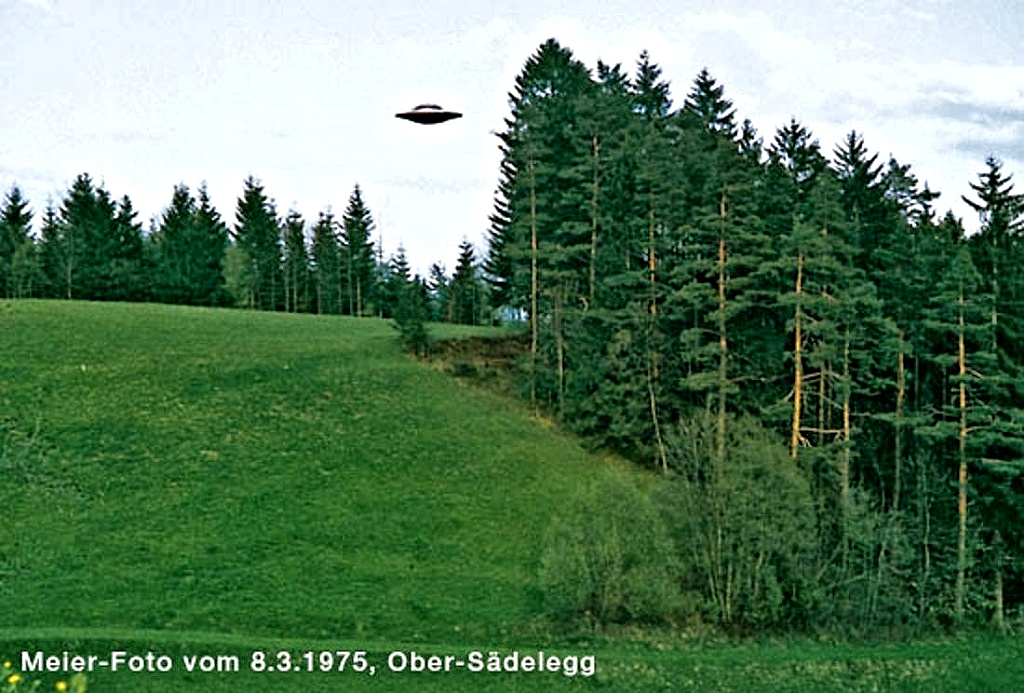
The Meier case was marked by the inclusion of
thousands of clear color photos as well as 8mm home
movies of Pleiadian ships. Although debunkers claim
they've proven these pictures to be fakes, they in fact have not.
(The CIA has tried particularly hard to assassinate Meier's
character.) And this marks another dramatic difference between the
Greys and the Pleiadians: The Greys generally work in secret and try
to hide their existence, while the Pleiadians seem to have an agenda
of gradually letting us know that we are not alone. Carrying out
this agenda would have minimal impact on our culture and is arguably
the most prudent way of doing it. Those who fear this knowledge can
simply refuse to read the books and ridicule those who do (which
they do). Eventually, they'll be dead and as years pass, more and
more humans will simply accept the existence of extraterrestrial
visitors.
Two other species that I heard about, though rarely,
were "insectoid" and "reptiloid" aliens. The former are supposed to
be six or seven feet tall, looking more or less like giant praying
mantises. You can laugh at this, until you discover that the Hindi
word for "teacher" is the same as their word for "mantis" (guru).
Hindi is one of the world's oldest languages, deriving almost
unchanged from Sanskrit. Why in the world would any ancient Hindu
have thought that teachers would remind people of mantises, or vice
versa—unless their teachers, whom they claimed to have come
"from the Heavens," in fact looked like the bugs they'd already
named?
I should mention that in Strieber's book Communion
and the movie, Whitley describes a hallucination he had in which a
Grey removed a mask, revealing an insectoid face beneath.
The reptiloids were another story. I never met anyone who, personally,
had encountered one. Yet everyone seemed to "know" they existed. In
the
TV mini-series "V" the aliens were reptiles able to wear
convincingly human masks. And author David Icke has his own take on
this species; but since I didn't know about him until recently I'll
save his conclusions for later.
Meanwhile, though I didn't know it at the time, I was about to meet a Pleiadian of my own.