|
By: Paul S Cilwa |
Posted: 4/20/2006 |
|
Page Views: 6,116 |
| Hashtags: #AlienAbductions #Nibiruans |
| Much of what you think you know, you actually only BELIEVE to be so. |
| Estimated reading time: 10 minute(s) (2203 words) |


One quickly realizes that we must operate on some degree of
faith if we are to get anything done. Belief is a necessary component if we are
to build on the work of others. Our technology just wouldn't be possible without
it.
And yet, belief is a two-edged sword. As often as it has made progress
possible, one could argue that our technology has been more held back by
belief than advanced by it. How much further along might we be if Galileo hadn't
been excommunicated by the Church; if people of the eighteenth century had been
less certain that there was no point in investing in heavier-than-air flight; if
even now biologists weren't forced to redirect their efforts into arguing that
"intelligent design" is so much nonsense?
The simple-minded person gladly sees all experience as divided into two
categories: That which is false, and that which is true. He or she unwittingly
accepts his or her beliefs as facts because, in that worldview, there
is no room for things that might be true. Personal evolution from
childhood to adulthood—a journey not all humans make, sadly—can be summed up, as
the King did in Rodgers' and Hammerstein's
The King and I:

When I was a boy
World was better spot.
What was so was so,
What was not was not.
Now I am a man;
World have changed a lot.
Some things nearly so,
Others nearly not.
Compounding the problem is the fact that so
many of our beliefs are built on top of others. If a fundamental
belief is proven untrue, everything else that relies on that belief,
must also be questioned.
As I said at the beginning of this series, as a young man I was absolutely
certain aliens had never visited Earth. I could point to any amount of
documentation supporting that position, in spite of the truism that it isn't
possible to "prove a negative." And yet, my personal experience in the 1990s
proved me wrong; and this change in such a fundamental belief sent me careening
into corners of reality that most people, not having shared my experience, would
dismiss out-of-hand.
So, having had the personal experience of being in contact with non-human
beings, I was driven to figure out who they are, where they are from, and what
they wanted from me.
I presented the story Sitchin told
of beings from the rogue planet Nibiru colonizing Earth and genetically engineering Homo sapiens
specifically to be their slaves. There are many other books published that
describe human origins, as well as books that claim to reveal the origin of
aliens. However, of those, only Sitchin's came with evidence. Okay, I haven't
personally seen that evidence. But Sitchin reproduced hundreds of photos and
drawings of Sumerian tablets, and demonstrated the rudiments of reading
cuneiform. Thanks to the web, I was able to read the traditional
translations of the Sumerian "myths" and compare them to Sitchin's. I was also
able to double-check his facts as to geography and known history. His timelines
often vary from those of conventional historians, never in sequence but in absolute dates
(which, remember, are estimated by conventional historians, as well).
In every case, however, his chronology made more sense to me than the traditional one.
Still, the claims he made for the "Nibiruans" were pretty fantastic. I didn't
want to waste time pursuing a red herring. Could I find any evidence that would
disprove Sitchin's theory? Or make a provable prediction based on it?
Sitchin's many debunkers had put forth their best efforts to disprove his theory,
as well as slander the man personally. Many of their "dis-proofs" were,
themselves, easily shown to be false; and the bulk of their arguments was that
he must be wrong because no specialist in the field had come up with the theory
before him. The general attitude was, "This can't be true because it can't
be true." But I had already been forced through that particular gauntlet.
On the plus side, a number of pieces of information had become available
after the publication of his books which supported his theory—which is
exactly how Scientific Method is supposed to work. I already pointed out the 223
genes possessed by Homo sapiens that are unique on Earth, a discovery made decades after
Sitchin published his first books—yet predicted in them. There was also a lot
of astronomical evidence that supported him. For example, as mentioned, the
Sumerians knew the orbital periods of Uranus, Neptune and Pluto—planets they
shouldn't have even known existed because they are invisible to the naked eye.
(This factoid is not controversial, by the way—it is well-known that the
Sumerians, who were avid astronomers, kept detailed ephemeredes on their
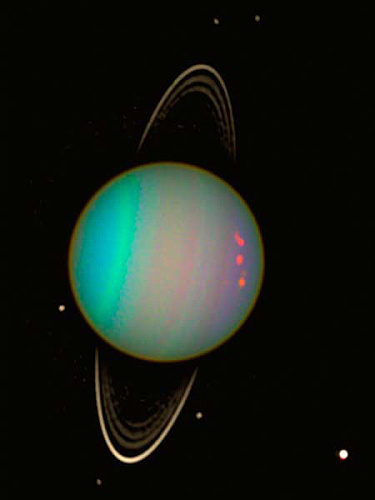
tablets, which have survived.) But the Sumerians also knew that Uranus
rotates on its side; they knew that Pluto was formerly a moon, not a planet with
an independent orbit; they knew that Neptune has a ring.
According to Sumerian cosmogony, when our solar system formed, it did so
without Earth positioned between Venus and Mars. Instead, in place of the
asteroid belt, there was a planet they called Tiamat (mother of life). When the
rogue planet Nibiru fell into the solar system, one of its four moons collided
with Tiamat, breaking it in two. The shattered half became the asteroid belt;
the other half fell into an orbit closer to the Sun and became Earth.
If true, one would expect Earth's crust to still bear the scar of this
collision—and it does: That scar is the Pacific Ocean, where the crust is only
about ten miles thick. (The crust is about twenty-five miles thick everywhere
else.) Even now, the continental mass that was left on one side of Earth after
the collision—Pangaea—having broken up, has pieces drifting toward the Pacific
to fill in the void.
But I got the idea that there might be another
way to prove, or disprove, the Nibiruans' existence: by attempting to validate
their cosmogony. After all, space travelers ought to get
that right!
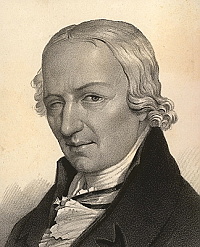
In 1772, the director of the Berlin
Observatory, Johann Bode, printed a theory that the solar system
formed according to simple geometric principles. (The theory, known
as Bode's Law when I was in fifth grade, was actually discovered by
Johann Daniel Titius in 1766 and is now known as
Titius-Bode's Law.) It proposes (in somewhat simplified terms)
that each planet of the solar system is twice as far from the Sun as
the one closer in.
This isn't quite true, but investigators of Bode's Law were still motivated
to see if it wasn't kind of true. Remember, in the 1700s science was
enamored of a "clockwork universe" in which all the parts followed simple,
mechanistic rules set down by a "Master Clockmaker." So they tweaked the numbers
and came up with a system that more closely matched the observation. In this
system, a mathematical formula,
a = 0.4 + (0.3 x k)
where k = 0, 1, 2, 4, 8, 16 (continuing with powers of 2) produces
values of a that nearly match the number of astronomical units each
planet's orbit lies from the Sun. (An astronomical unit, or AU, is the
Earth's distance from the Sun—about 93,000,000 miles.) That gives us the
following table:
| Planet |
k |
T-B rule distance |
Real distance (AUs) |
Miles |
Discrepancy |
| Mercury |
0 |
0.40 |
0.39 |
36,270,000 |
-2.56% |
| Venus |
1 |
0.70 |
0.72 |
66,960,000 |
2.78% |
| Earth |
2 |
1.00 |
1 |
3,000,000 |
0.00% |
| Mars |
4 |
1.60 |
1.52 |
141,360,000 |
-5.26% |
| (Asteroid Belt) |
8 |
2.80 |
2.77 |
257,610,000 |
-1.08% |
| Jupiter |
16 |
5.20 |
5.2 |
483,600,000 |
0.00% |
| Saturn |
32 |
10.00 |
9.54 |
887,220,000 |
-4.82% |
| Uranus |
64 |
19.60 |
19.2 |
1,785,600,000 |
-2.08% |
| Neptune |
n/a |
n/a |
30.06 |
2,795,580,000 |
n/a |
| Pluto |
128 |
38.80 |
39.44 |
3,667,920,000 |
1.62% |
The first thing we see from this chart is that the Bode's Law
prediction is pretty darn close to the reality in most cases. Of
course, we do have to include the asteroid belt as a
"planet". But it's interesting to recall that the asteroid belt was
discovered because Bode's Law predicted something should be
in that orbital space! More disturbing is that Neptune doesn't fit into the
pattern at all. That didn't bother Bode and his pals, because
Neptune wasn't discovered until 1846 (not including the Sumerians,
or Galileo who spotted it in 1612 but thought it was a fixed star).
Pluto, however, picks up with the next "slot", though its distance
from the Sun is misleading since it has a rather elliptical orbit—it
actually comes closer to the Sun than Neptune for part of
it.
(And, of course, Pluto would eventually be classified a "dwarf
planet". But so is Ceres, one of the four largest asteroids. It was
the discovery of Ceres that led to the discovery of the asteroid belt.)
In any case, as much as the fans of Bode's Law wanted it to
be true, the results were ambiguous enough that no one was certain
whether the formula revealed a numerical coincidence or if some
underlying aspect of celestial mechanics had been discovered.
Neptune's discovery, and the fact that Neptune—which is a big
planet—didn't fit into the pattern caused Bode's Law to fall into
disregard.
But now, with this newly-recovered astronomical
information from the ancients, it might be possible to revive Bode's
Law after all—that is, if Bode's Law described the celestial
mechanics of a forming solar system; and if the Nibiruans'
cosmogony was accurate.
I decided to see what I could do.
First, the table had to be redrawn, with
Earth removed and Tiamat put in place of the asteroid belt. Also, we
can remove Pluto, since the Nibiruans claimed it was a former moon
of Saturn that Nibiru had drawn away from that world into its own
orbit, after a few hundred thousand years orbiting Neptune. (Pluto's
orbit does intersect with Neptune's, indicating it was at least once
a moon of that planet.) I also decided to dispose of Titius' "fudge
factor" (k), hoping to find some simpler formula to predict
the orbits of the planets of the early solar system. I settled on a
factor of 1.91, which gave me the following table:
| Planet |
Real Distance |
Predicted Distance |
Discrepancy |
| Mercury |
36,270,000.00 |
36,270,000 |
0.0% |
| Venus |
66,960,000.00 |
69,275,700 |
-3.5% |
| Mars |
141,360,000.00 |
132,316,587 |
6.4% |
| Tiamat |
257,610,000.00 |
252,724,681 |
1.9% |
| Jupiter |
483,600,000.00 |
482,704,141 |
0.2% |
| Saturn |
887,220,000.00 |
921,964,909 |
-3.9% |
| Neptune |
1,785,600,000.00 |
1,760,952,977 |
1.4% |
With one exception (Mars), my calculated distances are much
closer to the reality than the original Bode's Law predictions. And
Mars, according to the Sumerian tablets, was knocked out of its
original orbit by another near passage of Nibiru. What's more, not
only is Neptune not an exception, as it was in the original
table—this result comes quite close to the actual distance.
Does this prove anything? No. The original version of Bode's Law
didn't prove anything, either. But I find here enough of a suggestion that, when
added to the other evidence in favor of Sitchin's theory being correct, to allow
me to believe that, of all the claims out there describing the origins of
our alien visitors, Sitchin's is probably more closely aligned with the truth.
So let us formulate an hypothesis.
-
An extraterrestrial species visited Earth in the distant past and
genetically engineered Homo sapiens to be a slave species.
-
While technologically advanced, these beings were not gods—but
would have seemed so to the easily-impressed humans they engineered.
-
According to their own story, these Nibiruans were extremely
long-lived; the same characters recur in adventures hundreds of thousands of
years apart.
-
They were ethically challenged in other ways (besides creating
slaves); they waged a nuclear war against their fellows (Sodom and Gomorrah
were bombed) that brought an end to the Sumerian culture and to their own
global enterprises.
If true, the Nibiruans came to Earth some 700,000 years ago and remained—the
same individuals!—active through somewhere around 2500 years ago.
But if their lifespan is such that individual Nibiruans could live 697,500
years…who's to say they aren't still here?