|
By: Paul S Cilwa |
Posted: 7/26/2010 |
|
Page Views: 5,620 |
| Hashtags: #Toxins #NaturalHealth #EnvironmentalToxins |
| How I replaced poisonous personal products with toxin-free choices. |
| Estimated reading time: 7 minute(s) (1554 words) |
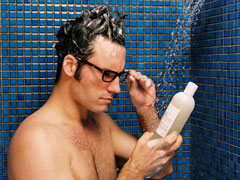
And that includes your scalp.
Big Pharma, which includes the makeup and personal care industry,
is not exactly known for its excessive honesty to its customers. We
know about their products that occasionally cause, as a side effect,
instant death. Products such as
Fen-Phen,
Zyprexa, and
Adderall all list "sudden death" as a known side effect.
In fact, in the case of Fen-Phen, that was apparently its only
effect, making it only suitable for prescriptions written by Dr.
Kevorkian.
So it shouldn't really surprise anyone that there are poisons in
the most common and popular hair and personal care products. They
aren't deadly poisons—that is, they won't kill you instantly
if you get any on you. But their effects are gradual, building up over
time, causing obesity, reproductive woes, skin and hair problems,
and, eventually, cancers. So, yeah, you might want to look for
alternatives.
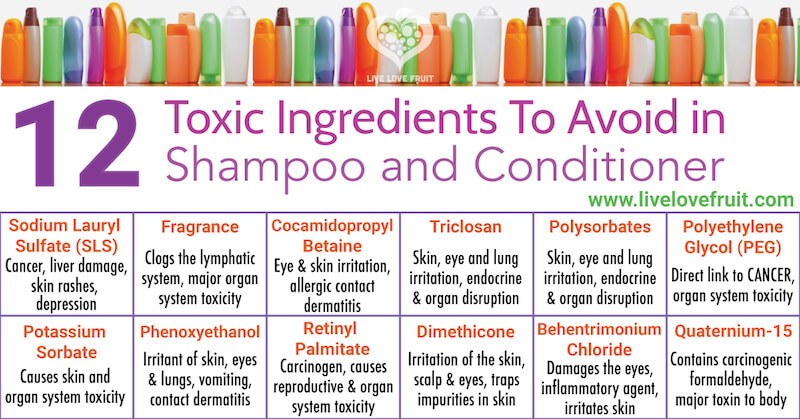
There are more than ten toxins used in most shampoos. I will bet they're in
yours, unless you have already cleaned them out of your bathrooms.
This list of the Top 10 hair shampoo toxins has been sourced
from official government and chemical databases. These include
CDC (Center for Disease Control), FDA (Food & Drug Admin.), EPA
(Environmental Protection Agency) and
Scorecard.org (Pollution
information).
| 1. |
IODOPROPYNYL BUTYLLCARBAMATE |
Reproductive system toxicity. |
| 2. |
LECITHIN |
Penetration enhancer. |
| 3. |
RESORCINOL |
Possible human carcinogen. |
| 4. |
FDC YELLOW 6 |
Possible human carcinogen. |
| 5. |
PARABENS |
Reproductive system toxicity. |
| 6. |
SODIUM LAURYL SULFATE |
Gastrointestinal toxicity. |
| 7. |
PROPYLENE GLYCOL |
Immune toxicant. |
| 8. |
TOCOPHERYL ACETATE |
Immune toxicant. |
| 9. |
FRAGRANCE |
Immune toxicant. |
| 10. |
DISODIUM EDTA |
Penetration enhancer. |
If you look up each of these chemicals in most mainstream
sources, they'll tell you that they are harmless…and then
point out the dangers of exposure! For example, Sodium Lauryl
Sulfate and its many close relatives is found in almost any sudsy
cleaner, because that's what makes the suds. Sodium Lauryl Sulfate
is irritating to the skin, though—just let some get in your eyes!
(They don't use it in baby shampoo, for just that reason.)
You should never let anything get on your skin that hurts your
eyes. Every little kid knows that instinctively. It takes years of
indoctrination by our parents to get us used to the idea that these
harsh chemicals are "good for us."
The thing is, you don't have to risk your life in the
pursuit of clean hair. There are non-toxic alternatives and they
aren't even expensive. So, why aren't all shampoos non-toxic?
Simple: Big Pharma would rather save a penny per bottle on cheaper,
artificial ingredients than admit by changing the formulas that they
might have been guilty of killing your mother by contributing
to the formation of her cancer.
Fine. You can easily ignore them, because the alternatives are
easy to find.
But you have to be careful. The first place I looked was
Hi-Health. (That was before
they starting paying Sean Hannity to promote their wares; I no
longer shop there.) I told the sales guy what I was looking for; he
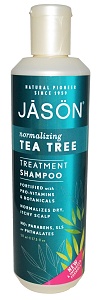
led me directly to a bottle of
Jason shampoo. I
carefully read the list of ingredients; none of the items on the
list above were there so I took it. (And, I must add, I like the
shampoo.) It was a bit pricey, though.
Now, I don't use conditioner—sadly, I don't have enough hair to
need it—but Jason does also make "70% Organic" conditioner, for the
same slightly high price. (The prices are high only by comparison to
Suave, which I formerly used. They are in keeping with any high-end
hair-care product.)
But, while I was there, and heady with success, I also bought
what I thought was going to a non-toxic bath gel. It was on the same
shelf, and bragged in big letters how "natural" it was. It wasn't
until I got it home that I discovered that its main ingredient,
after water, was the dreaded Sodium Lauryl Sulfate.
But today, after lunch together, Michael and I stopped by
Trader Joe's. I had never
gone shopping there specifically for organic products, since this is
a new thing for me. But we went hunting, and, sure enough, there
were Trader Joe's house brand shampoos and conditioners and shower
gels and even toothpaste without any of the toxic ingredients. There
was even dish detergent! And the prices were equivalent to those of
the toxic, bargain brands I used to buy.
Now, if you're like me, you might wonder what these toxic
chemicals are used for. How did they get into our personal products
to begin with?
Essentially, all shampoos and shower gels, as well as dishwashing
liquid and laundry detergents, fulfill the purpose of soap. And the
purpose of soap is to remove grease and oils from a surface that
wants to hold onto them.
Oils are made up of non-polarized molecules. That means,
They do not hold an electric charge. They will, therefore, easily
attract other non-polarized molecules. Water, on the other hand, is
made of polarized molecules. That is, the famous H2O
molecule is electrically charged; and so it repels oily,
fatty, greasy molecules—hence the saying, "oil and water don't
mix." If you try and wash your clothes, or yourself, in plain water,
you'll remove the water soluble substances, if any, but not the
greasy stuff.
Thousands of years ago, humans discovered that certain plant
roots, when crushed and mixed with water, produced a sudsy, slippery
material that would dissolve grease and oil splotches and allow them
to be rinsed away with water. What they didn't understand was the
chemical composition of those suds. They were composed of a long
molecule that was polarized at one end, but non-polarized at the
other! Oils would be attracted to to the non-polarized end, and
water flushed past it would attract the polarized end and sweep the
combination away. These plants were, collectively, called
"soaproots."
Later, people discovered that heating an alkaline and fat created
soap. By the time of ancient Babylon, a recipe for soap called for
ashes, cypress oil and sesame seed oil. The ashes, a strongly
alkaline material, reacted with the oils to produce molecules with
the required polar and non-polar ends.
In 1917, with the raw materials for soap being directed to the
war effort (I am picturing banners that read, "Support The War
Effort! Send Your Ashes To The Front!"), an artificial soap, or
detergent, was introduced in Germany. By the end of the second
World War (with another soap shortage), people had become accustomed
to buying the boxed detergents instead of simply making their own.
And so the multi-billion dollar cleaning products industry came into
being, adding another aspect of life that was forever changed by the
wars from simple and green to expensive and toxic—benefiting, not
people, but the global corporations.
Sodium Lauryl Sulfate is a detergent. It's responsible for the
sudsing and most of the cleaning attributes of shampoo, bath gel,
and the like. This chemical is known by a number of similar names;
"Lauryl" is often spelled "Laurel" or "Laureth" and either the
"sodium" and/or the "sulfate" part of the name may vary. What
doesn't vary is the chemical's harshness when exposed to human skin.
So the rest of the chemicals in your mainstream cleansing product,
are there to buffer the effect of the SLS on your skin.
Unfortunately, most of those chemicals are also toxic.
Another chemical that might have caught your attention is
tocopherol acetate. Isn't that Vitamin E? How can that be
toxic?
Well, Vitamin E—real Vitamin E—isn't toxic, of
course. But this isn't "real" Vitamin E, although the law allows it
to be called as such. It's synthetic Vitamin E, which while
displaying most of the same actions as the natural molecule, is
nevertheless shaped a little differently and has been associated
with damage to the immune system natural Vitamin E enhances.
(In other news, be sure the Vitamin E you take every day is natural,
not synthetic; or it's worse than none at all.)
The FDC Yellow #7 has no purpose other than to make the product
look more like you imagine a shampoo should look…whatever the heck
that means.
Since there are easily-obtainable, non-toxic substitutes, there's
no reason to risk your health using questionable products…unless
you own stock in Proctor and Gamble or Lever Brothers or one of the
other giants responsible for filling our homes with toxic chemicals.
And, if you do—shame on you!