|
By: Paul S Cilwa |
Posted: 8/20/2007 |
|
Page Views: 6,546 |
| Hashtags: #Cancer #Arizona #SaltRiver #Health |
| The sun is far less dangerous than the sunblock we use to 'protect' ourselves from it. |
| Estimated reading time: 8 minute(s) (1711 words) |
We managed to go on our almost-weekly float down the
Salt River again this Sunday, despite a very busy weekend for
all of us. But Jennifer really enjoys it; Zachary likes to
bring his friend Chris, and of course, I love it. Michael's been a
bit under the weather and hasn't gone all summer; Karen is somewhat
indifferent but decided to go. And even Mary, who's only gone with
us once (last year), decided she would go, too.
And wound up getting one heck of a sunburn.
It's funny, because I was commenting to Jenny as we drove to the river, how
well we all have managed to adapt to desert life. This is interesting to me
because there's nothing in our immediate genetic heritage to suggest we could do
anything of the sort. It's hard to imagine an environment more removed from that
of Poland, England, France, Ireland and Germany than Arizona's. Those countries
have rain, snow, cold, damp, long winters and heavy coats. Arizona has drought,
all the snow piled up in the north, heat, desiccating dryness, no winters (in
the Phoenix area) and shorts year round.
And yet we've all managed to adjust to 110° summer days (with July and August
afternoons occasionally as high as 118°) and while, yes, we complain, it doesn't
keep us from going outside to shop or go for the mail or even to walk the dogs.
(We walk the dogs at night but, especially in August, it's usually still over
100° even then.)
The sun is the most amazing part of the day, here. While I've been to many
places where you can feel the warmth of the sun on your skin (Florida, Texas,
Mexico), I've also been to places where the sun beaming on exposed skin cannot
compensate for a chilly breeze (New Hampshire, British Columbia, Iceland). But
Arizona is unique. Even in the winter in Flagstaff, where it gets quite cold,
should the sun hit your face you know it. And while any skier knows that it's
possible to get a sunburn while on the slopes, on Flagstaff's
Snow Bowl
that sunburn can conceivably require hospitalization.
To float the river on our own (not using the tubing concession), requires two
cars. Only one has to stay parked, however. The other could be driven by
a non-floater who leaves after dropping passengers off at the put-in. Sunday,
however, Michael was still asleep when we left (he's being staying up all night
doing genealogy for…well…years) and since Mary had, at the last minute,
decided to accompany us, we purchased two
Tonto Passes,
one for her car and one for mine. She transported all the
other floaters but Jenny, and I took Jenny and all the floats, which Jenny and
Karen had pre-inflated at home.
I had planned to use the low-SPF sun block I bought weeks ago. Last week I
got a bit of a burn, since I hadn't been out for nearly a month. It doesn't
bother me, but Michael hates it when I get a sunburn. He hasn't quite
divested himself of the lie that sunburn causes skin cancer. (More on that topic
shortly.) However, for some reason someone apparently removed the sun block from
the car; because we could not find it anywhere. I supposed we could have
taken forty minutes to run back home and find it and return; or twenty minutes
to run to the nearest store, buy another tube, and return. But Jenny and Karen
go to a tanning salon every week; I am brown now that last week's burn has
healed; Zach and his friend Chris are dark from playing outside every day (Zach
says he has a "base tan") and Mary's got such a naturally dark complexion the
rest of us tend to forget she isn't tan.
But in fact, since she was injured on our cruise in May, she hasn't been
outside much at all.
We put in at Blue Point, as usual; floated haughtily past the concession
take-out, and continued on in relative isolation to Phon D. Sutton, our usual
take-out. It's a leisurely float, taking about 2½ hours to complete. Along the
way we sometimes see groups of wild horses drinking at the river's edge and a
number of wild birds including egrets, herons and vultures in addition to
smaller finches. On this trip we didn't see horses, but there were a couple of
impressively-endowed women who had removed their bathing suit tops to the
applause of a group of teenaged boys who clapped and blew a bull-horn in
appreciation. Zachary and Chris didn't understand what the fuss was about; we
assured them that they would in four years or so.
By the time we got to the concession exit, Mary was ready to leave the river.
She had had all the relaxation she could stand. Of course, the car was five
miles further downstream; floating there in the cool water was much more
practical than hiking to the next parking lot in the days' heat.
Even with my butt in water (thanks to my mesh-bottomed pool-lounger float),
it was hot. Every five or ten minutes I scooped water with my cap and splashed
it on myself. Zachary offered to drench Mary, but she thought the water was too
cold and so declined his generous offer (much to his disappointment).
When we finally did take out and were loading our stuff into the car, we
could see Mary's legs were red; they didn't look very red. But at home
she took a cool bath and put aloe-based lidocaine on her burn and said she was
still was in too much pain to walk.
Now, sun block is not something I really recommend. And since to most people
that is heresy, let me explain why.
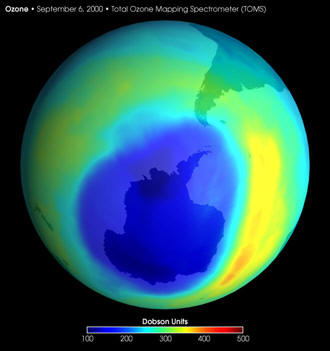
Since the 1970s, we've been told that the ozone layer, which protects the
earth's surface from being sterilized by ultra-violet radiation from the sun, is
being depleted by
chlorofluorocarbons that used to be used as propellants in spray cans. The
propellant molecules, once out of the can, floated upward into the upper
atmosphere, where each one has the ability to prevent a molecule of ozone from
forming from the action of the ultra-violet radiation on ordinary oxygen atoms.
This information is not incorrect. However, told that way, people have developed
the idea that the ozone layer all over the Earth no longer protects us
from the Sun; and that is not true. Instead of growing thinner
everywhere, a hole has
developed over Antarctica, where there is little life for the increased
ultra-violet to affect.
It's true that in the 1970s, no one anticipated this. Still, and with
mind-boggling good fortune, that's what's turned out to happen. While
sun-bathing at the South Pole would likely be disastrous, sunbathing in Arizona
is not…at least, not because of excessive ultra-violet radiation.
This is due to two facts. One, commercial
sunblock contains carcinogens. At least five, according to one count,
which includes carcinogens in the scent, color, and other ingredients. Second,
normal exposure to un-blocked sunlight causes vitamin D to form beneath
the skin. That's right: our bodies are designed to
make the vitamin D that is the number one cancer fighting agent in
our arsenal. (Technically, this is vitamin D3, one of several known
variants of this chemical.) Of course, that design was based on the assumption
we would live outside, nude, in a moderate climate. Hence, the
seemingly-impossible dilemma that we humans often develop a deficiency of a
vitamin we make in our own bodies.
But why can't that deficiency be ameliorated by the addition of vitamin D to
foods we eat or drink, like milk? Simply because synthetic vitamin D (actually
vitamin D2) isn't the same thing. Is margarine the same as
butter? Is nylon the same as silk? Is Britney Spears the same as Sophia Loren?
No, no, and no; and synthetic vitamin D isn't the same as the real thing,
either.
This isn't just my opinion. A 2002
study in the prestigious journal Cancer by Dr. William Grant came to
the same conclusion…a conclusion that was immediately challenged by the same
pharmaceutical firms that manufacture and sell sun block.
If we had to pay them for sunlight, I guarantee there'd have been no
argument.
Now, all that said, I don't recommend sunburn. If, as nature intended,
we were all constantly exposed to natural sunlight, we'd all have Malibu tans
all the time. There'd be no skin cancer and no sun burns.
Which means it's really important to get enough of that natural sun all
the time so that burning is never an issue. If you are currently a pale
shell of the bronzed god or goddess you should be, start today and expose
yourself to at least twenty minutes of the bright stuff. (Black people need a
little more time in the sun than whites, since they require more sunlight to
trigger vitamin D production.)
At stake is more than skin cancer, by the way. Dr. Grant found a correlation
with lack of sunshine and other cancers including tumors of the bladder, uterus,
esophagus, rectum, and stomach.
So, while I feel badly that Mary's burn has made her uncomfortable, I don't
regret that I didn't encourage the formation of skin cancer by providing her
with sunblock.
The best thing I can do for her, health-wise, is to take her out on a river
float again next week. If I can convince her to go…