|
By: Paul S Cilwa |
Posted: 1/25/2006
Updated: 1/25/2006 |
|
Page Views: 6,398 |
| Hashtags: #Biography #ElizabethJaneCochran #NellyBly |
| A short biography of early 'girl' reporter Nelly Bly. |
| Estimated reading time: 3 minute(s) (685 words) |
Nelly Bly! Nelly Bly! bring the broom along,
We'll sweep the
kitchen clean, my dear, and have a little song.
Poke the wood, my lady
love,
And make the fire burn,
And while I take the banjo down,
Just
give the mush a turn.
Those words were written by Stephen Foster in 1850. Intended to be a love
song, a modern listener can't help but note that Nelly is expected to do the
chores while her husband sings.
Fourteen years later, on May 5, 1864, Elizabeth Jane Cochran was born in
Cochran's Mills, Pennsylvania. Yes, that's right—her parents basically owned
the town. Her father was a judge, but when he died it was without a will; the
estate was sold and Elizabeth's mother had to scramble to support the family,
eventually marrying an abusive man to do it. This produced a budding feminist in
Elizabeth, whose letter to the editor of the Pittsburgh Dispatch
rebutting a sexist article she read got her a job as a journalist.
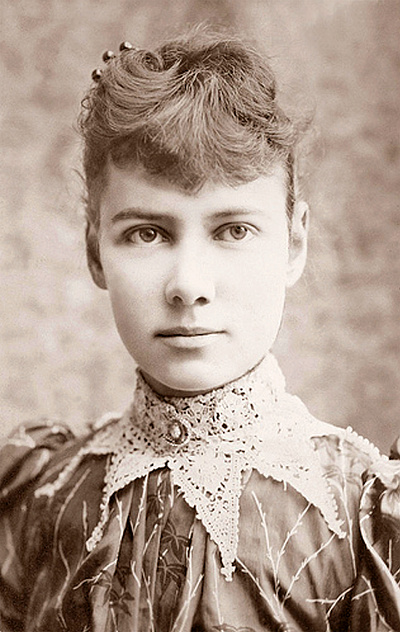 She went undercover and went to work at a
sweatshop, revealing publicly the dreadful and dangerous working conditions and
low pay. While the articles sold lots of newspapers (evidenced by the fact that
circulation rose when they appeared), that didn't seem to hold as much sway with
her editor as the fact that the sweatshop owners threatened to quit advertising
if the articles didn't stop. Nelly/Elizabeth was promptly moved to the "fashion
beat."
She went undercover and went to work at a
sweatshop, revealing publicly the dreadful and dangerous working conditions and
low pay. While the articles sold lots of newspapers (evidenced by the fact that
circulation rose when they appeared), that didn't seem to hold as much sway with
her editor as the fact that the sweatshop owners threatened to quit advertising
if the articles didn't stop. Nelly/Elizabeth was promptly moved to the "fashion
beat."
We'd like to think that the media—newspapers in the 1800s, and TV today—are
beacons of honesty, that their lights beam into the darkest corners and reveal
all to anyone paying attention. Unfortunately, this is a myth (spread by the
media, of course). Nelly Bly did her best, but it seemed whatever evil she
revealed simply cost her a job. When she exposed poverty and political
corruption in Mexico, the Mexican government extradited her and her newspaper
fired her.
Apparently, each paper that hired her thought they would be the ones
who could keep her under control. Joseph Pulitzer's paper The New York World
assigned her to be committed to the Women's Lunatic Asylum on Blackwell's
Island. This was a dangerous assignment, since once committed, Elizabeth was a
prisoner. However, the Asylum didn't advertise in the World so Nelly's
job was secure.
In the fall of 1888, the World got the idea of having a reporter
duplicate the feat of Phineas Fogg in Jules Verne's Around The World In 80
Days. They, of course, assumed a man would do this. They assumed wrong.
Elizabeth threatened to do it for another paper if the World didn't send
her. So, in 1889, send her they did. By train, boat, and rickshaw Elizabeth not
only traveled through England, Japan, China, Hong Kong, and others but also took
time out to visit the home of Jules Verne himself—and she still managed
to beat the fictional Fogg's record, by returning to New York on January 25,
1890, just a few hours over 72 days abroad. The fact that she had traveled
around the world without being accompanied by a man was another record, and made
her a role model for women everywhere.
The World's circulation having gone through the roof due to her
articles describing her travels, Elizabeth thought she deserved a bonus. The
paper disagreed, and Elizabeth quit. In future years, however, and for different
newspapers, Elizabeth covered a women's suffrage convention and World War I from
Europe's eastern front.
Today marks the 116th anniversary of Nelly Bly's triumphant, if financially
unrewarding, return from her trip around the world. I imagine she would love
living today, knowing that she could report whatever dirt her broom turned up—on
the Internet—without fear of being fired as a result.