|
By: Paul S Cilwa |
Posted: 3/13/2007 |
|
Page Views: 8,395 |
| Hashtags: #History #NorthAmerica #SouthAmerica #PreColumbianAmerica #NativeAmericans |
| North and South America were not big, blank wilderness when Columbus opened up the New World to the Old. There were already people here…lots of them. |
| Estimated reading time: 13 minute(s) (2988 words) |
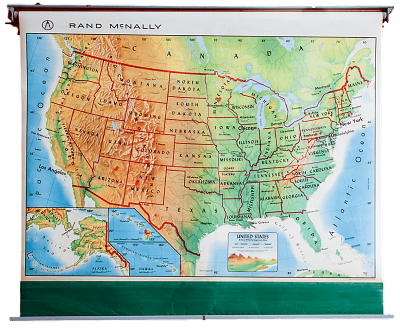
When I was in grade school—admittedly, much longer ago than I like to
think—we had a big map of the United States on a roll, like a window shade, that
could be pulled down whenever the teacher thought it appropriate to do so. In
fifth grade, we studied United States' history and geography; so there was no
World map, though there was a globe in the back of the classroom, generally
hidden behind odds and ends because it was so seldom used.
As a science-fiction fan—yes, even at that age—I was fascinated by the globe
simply because it was, in those pre-John
Glenn times, the closest thing we had to looking at the Earth as a planet.
And, of course, I knew generally where Europe and Africa and Asia were—even
Australia, which fascinated me because it seemed so lonesome, stuck 'way off in
the South Pacific like that. But if you'd asked me to locate Belgium or Vietnam
or British Honduras, well, I just couldn't have done it. I could find every one
of the United States, and quickly; but for me, then, everything north of the US
was Canada and everything south of it was Mexico. Essentially, the world ended
at the edges of the United States map.
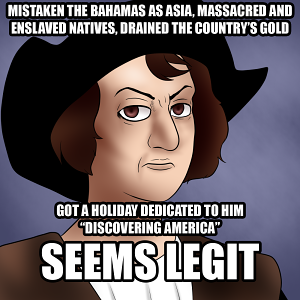
What was true for geography was also true for history, which had begun with
Columbus' "discovery" of America. Well,
Hmm, sounds a little arrogant, now. But at the time, I was simply reflecting
the attitudes of my parents and teachers, TV programs and movies and everyone I
knew.
That arrogance, ironically enough, had been imported to America by
Christopher Columbus himself, who had stumbled on an already-ancient land
(notwithstanding its "New World" moniker) with an apparent genetic
predisposition to perceive the peaceful and productive peoples he met as
"savages" who needed to be "converted" into his religion and slavery "for their
own good."
Since we are all, culturally, the descendants of Columbus, we shouldn't be
too surprised, then, that his arrogance was passed down to us.
In point of fact, Columbus didn't discover America; you can't discover
something that was here and inhabited all along. (Comedian
Paula Poundstone
has a cute bit where she imagines Christopher Columbus bursting through her
living room window, asking, "Am I the first one here?" When told, no, the
Poundstones are there already, he corrects himself: "I mean, am I the first one
here for Spain?")
To correct another misconception, the people who preceded Columbus to America
were not savages barely scrabbling out a living by hunting and gathering. The
hunters and gatherers knew exactly what they were doing and were very
good at it; but many other people were sophisticates who lived in spectacular
cities, while others populated a great many towns and villages, just as we do.
To be sure, their culture was quite different from ours—after all, they'd
developed independently for anywhere between 9,000 and 20,000 years (depending
on which
yardstick you use). Given a few more years, and it's quite possible that an American might
have "discovered" Europe.
Because the Spanish Conquistadores did their best to wipe out all
vestiges of the culture they found in the Americas, including destroying every
example they could find of Incan and Mayan writing, it's not easy to reconstruct
the political and historical context of pre-Columbian America. In fact, and with
an appreciation for the irony of it, one of the main sources we have is
Columbus, himself, who did make an attempt to catalog what he found,
however culturally jingoistic his observations might be.
Columbus made four voyages to the "New World". In none of them did he land
anywhere in what is, now, the United States; on only his third voyage did he set
foot on the actual continent. His final voyage was a disaster that left him and
his men stranded on an island for a year, before help arrived from a Spanish
colony on a neighboring island. Nevertheless, he kept copious notes of his
journeys, many of which survive, either directly or in paraphrase by his brother
or son. In addition, a 16th century priest named
Bartolomé de Las Casas published an edited version of Columbus' journal; and
his Historia de las Indias serves as an invaluable description of what
was here when Columbus arrived.
At the time of Columbus' first voyage, there were only legends as to what
existed to the West of the Canary islands. In point of fact, there is just one
island group in the mid-North Atlantic (the Azores), which may have given rise
to the mythic "Antilles Islands" which, in the 15th century, had no specific
location and were used as a term, the way we use "Mars" to describe any place
that was impossibly remote: "You've packed all those trunks? Where do you think
you're going, the Antilles?"
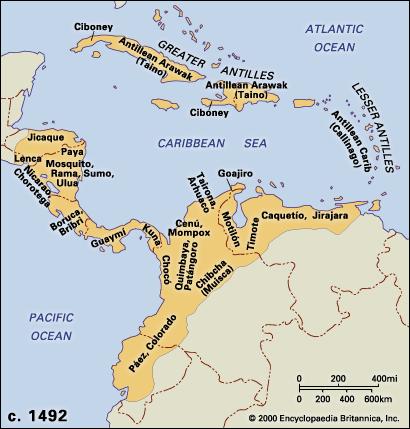
So, when Columbus, on his first voyage, came upon
the islands we now call the Bahamas, he called them the Antilles and
the name stuck. Currently the Antilles are considered to be the
islands of the West Indies (another misnomer, since Columbus thought
he had reached India). The Antilles are divided into two major
groups: the "Greater Antilles"
to the north including the larger islands of
Cuba,
Jamaica,
Hispaniola
(Haiti
and the
Dominican Republic), and
Puerto Rico; and the smaller "Lesser
Antilles" on the southeast, comprising the northerly
Leeward Islands, the southeasterly
Windward Islands, and the
Leeward Antilles just north of
Venezuela.
The
Bahamas
themselves, though part of the West Indies, are for some reason
generally not included among the Antillean islands.
Since Columbus thought he was in India, he of course referred to the
inhabitants of these islands as "Indians" and the name has stuck, in spite of
causing constant confusion for Europeans as well as irritation for Natives. But the
people didn't call themselves that, of course. Columbus reports that
they called themselves the Ta?no,
which in their own language basically meant, "The Good Guys," by which they
distinguished themselves from the minority residents with whom they shared the
islands, the Carib. On later
journeys, Spaniards who explored South America named the locals they found
Arawaks, after those peoples' name for the flour they cooked with. (Imagine
an alien species "discovering" America and referring to its inhabitants as the
"Hamburger Helpers.") Cultural anthropologists now believe the Arawaks and the
Ta?no were essentially members of one, widespread and diverse, culture. There were
five Ta?no kingdoms on Hispaniola alone, each with a king (cacique in the
Ta?no tongue) who collected taxes from his people. (Most references today define
cacique as "chieftain" and describe the taxes as "tribute", part of the
ongoing effort to trivialize the lives and culture of the pre-Columbian Native
Americans.) A number of towns on Hispaniola boasted populations of over 3,000
people, about the equivalent of most towns in Europe at the time.
The inhabitants of the Bahamas were also related to the Ta?no, but were part
of a later wave of Arawak seafarers that arrived in the Caribbean perhaps
centuries after the original Ta?no. They are therefore now called the
Neo-Ta?no; and
their right to a distinct classification is the source of
much current controversy as white anthropologists clash with Native descendants
struggling to maintain (or rediscover) a cultural identity. Those who deny the
Neo-Ta?no as a distinct group, simply refer to the former inhabitants of
Jamaica, Cuba and the Bahamas as "Western Ta?no."
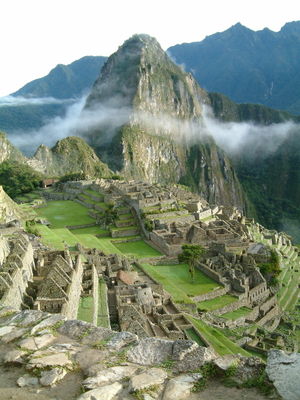
While the Arawak of South
America seemed content to live in a society composed of easy-going towns and
villages, where trade was as much a way of maintaining friendship as anything
else, on the West coast of South America was the more ambitious
Incan Empire, which was easily the equal of any number of European "empires"
that had come and gone. They called their empire Tahuantinsuyo, which
means "The Four United States," thus anticipating the great future neighbor to
the north. The borders of the four states intersected at
Cusco, which was the capital of Tahuantinsuyo and remains an important city,
today. The Incans built cities that were magnificent by any standard; they built
roads. Although it is generally considered they did not have writing,
new research
indicates that their "writing" may have been a binary code that stored
information as a complex series of knots. Although they occasionally made use of
conquest to expand their territory, they mostly used goodwill and the obvious
benefits of the protection and trade made possible by a powerful and benign
government to attract more peoples into the fold. Although the empire included
speakers of over 700 local languages, it encouraged a universal language,
Quechan, which is still spoken by a number of their descendants today.
When the conquistadors encountered the Incans, they thought the Incans had
never invented the wheel, because they had no carts or wagons. When the
Spaniards encouraged the Incans to use the wagons they had brought, the reply
was, "Why should we put a man out of a job?"—Because a respectable Incan
employment opportunity was that of porter. In point of fact, and despite the
good roads, wagons didn't make much sense in the steep Andes, where an animal
hitched to a wagon could never rest because there were virtually no flat places
to stop. A wagon would always want to roll downhill. Besides, no suitable draft
animals had evolved in South America. Archaeologists have found Incan toys with
wheels; so we know the Incans had not failed to "invent the wheel." They
merely had the good sense, in their environment, not to use it.
The Incan Empire ended with the Spanish execution of the last Incan emperor,
Atahualpa. The Incans,
peaceful people that they were, were utterly unprepared for the vicious Spanish
conquistadors, with their arrogance and determination to enslave and convert all
non-Christian peoples.
In Central America, the
Mayan Empire was in decline, though still very much alive. However, the days
of the building of its most magnificent cities were hundreds of years past. The
Mayans, unlike the gentler Incans, were as vicious as the Spanish, who were
lucky to not have encountered them at their prime. The picture below illustrates
a conquest of the Mayan king, which would reap him many slaves and human
sacrifices. Other surviving paintings show men and women engaged in sacred
bloodletting rituals. The cenote
at
Chichen Itza was
famously found to be filled with the bejeweled skeletons of human sacrifices,
including those of children.
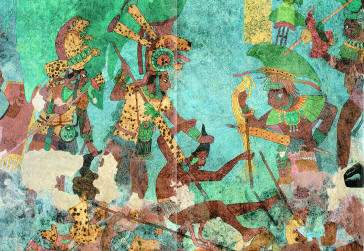
Between 800 and 900 CE, the Mayan civilization began a decline, according to
archaeologists, who note that no new buildings were constructed then (even
repairs were seldom done) and no new monuments or monumental inscriptions have
been found from that period. The use of the word "decline," of course, implies
that building is the height of purpose of a culture. And the reason for
this "decline" is unknown, simply because no records survive of it. Causes
ranging from the collapse of key trade routes to the spread of a deadly epidemic
have been advanced to explain it. But, personally, I think what happened was
that the people revolted against their bloodthirsty leaders. I have no evidence,
except that when the Spanish arrived, the Maya they found were peaceful people
who were more interested in art, literature and science than in human sacrifice.
In addition, the Maya of the 1500s had no central authority, no king or pope.
So they managed to hold off Spanish conquest for years, as each Mayan state had
to be conquered independently. That last ones, the Itza polity of
Tayasal or Naj Peten at
Lake Petén Itz?, and the
Ko'woj city of
Zacpeten;
finally surrendered to the Spanish in 1697.
Further north, in the Valley of Mexico, three tribes had combined to form the
Aztecs. (There was never an
Aztec tribe; the Aztecs were the combination of the triple alliance of
Tenochtitlan, Texcoco, and Tlacopan.) Following in the footsteps of the
Maya—indeed, cultural similarities make me suspect that the Aztec were, at the
least, inspired by legends of the fierce, bloodthirsty Maya of centuries
past—the Aztecs used fear and human sacrifice to induce obedience in their
neighbors.
Unlike those of the Maya and Inca, the Aztec writings escaped purging by the
priests so we have a number of complete books of these people. They traced their
origins to seven tribes from a place they called Aztl?n (Atlantis?), who left
their unknown home to colonize new lands. By the time the Spanish arrived, the
Aztecs had developed a nation of impressive cities and highly-developed trade,
with routes extending throughout Central and North America.
The conquistador Hern?n
Cortés knew he couldn't attack the nation as a whole. But, as is always the
case with cruel governments, it wasn't difficult to find a subjugated people
with whom to ally himself. In this case it was the Aztecs' long-time enemy, the
Confederacy of
Tlaxcala; they arrived at the gates of the city of
Tenochtitlan
on November 8, 1519, which reluctantly accepted them as guests. An awkward
relationship was maintained until the following June, when, as
Wikipedia describes:
The Spaniards and their
Tlaxcallan allies became increasingly dangerous and unwelcome guests in the
capital city. In June, 1520, hostilities broke out, culminating in
the massacre in the Main Temple and the death of Montezuma. The Spaniards
fled the town on July 1, an episode later characterized as
La Noche Triste. They and their native allies returned in the spring of 1521
to lay
siege to Tenochtitlan, a battle that ended that August 13 with the
destruction of the city.
Today's Mexico City was built on the ruins of the Aztec capital.
In North America, the northeast was ruled by the Haudenosaunee (referred to
by Europeans as the Iroquois). The name meant League of Peace and Power, and was
different from anything found in Europe because it was a civilization of forest
dwellers, rather than city dwellers. Nevertheless, the Haudenosaunee were
politically and commercially sophisticated; they were a union of five nations
(later, six) whose constitution, known as the
Gayanashagowa
(or "Great Law of Peace") was adopted on August 31, 1142 (the European date is
based on a coinciding solar eclipse). We modern Americans pride ourselves on
having the world's oldest constitution in use, but the Haudenosaunee lived under
theirs over twice as long as we have (so far) under ours.
When the European
invasion came their way, the Haudenosaunee were clever enough to
distinguish one group of Europeans from another, and to take sides
in the Europeans' internecine battles to their own benefit. With no
cities to lose, the Haudenosaunee survive to this day (as the
Iroquois Confederacy).
By comparison to the forest-dwelling Haudenosaunee in the North, were the
city-and-town-dwelling
Mississippians
in the South. Little is known of them because, although
Hernando de Soto
encountered them briefly, smallpox outraced the later Europeans, bringing the
culture to extinction before it could be studied. And, unfortunately for us, the
warm, moist climate of their lands—now the Gulf states—is not conducive to
preservation. We know they constructed enormous mounds for some unknown purpose,
and that their communities were built around them. The mounds are currently
being studied.
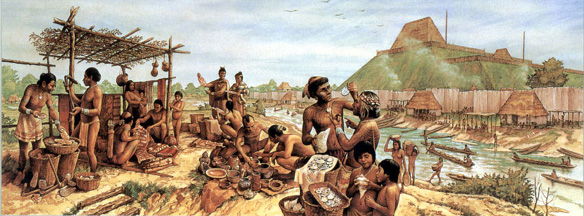
The fate of the Mississippians was shared by all the peoples of the New
World. Since they did, in fact, have extensive and well-traveled trade routes,
the new diseases from Europe introduced at their shores raced inland, causing
startling and catastrophic deaths among people who had never even heard of white
men. The newly-lowered populations, unable to maintain cities or even towns,
misled early anthropologists into believing that the New World had always been
sparsely populated, a belief that is only now, and amid great controversy, being
redressed.
To be sure, there were broad swaths of the two continents that were lightly
populated. Desert areas, such as one finds in New Mexico, Arizona and Southern
California, and in Argentina and in Chile, and very cold areas such as Alaska
and Tierra del Fuego, simply cannot support the density of life that one might
find where water is plentiful and the climate mild. Ironically, the isolation of
tribes eking out a living in such places may have permitted them some protection
from the onslaught of the new diseases, which might explain why so many tribes
still retain their identities in such places as Arizona and Alaska.
North and South America may not accurately be called the "New" World but they
certainly comprised another world, one in which the cultures had
developed in unique directions and with values very different than those in
Europe and Asia. We'll never know what irreplaceable knowledge we lost when the
Incan and Mayan books were burned, what spiritual insights and understandings of
ecology are only now re-emerging, that the Mississippians or Plains Indians may
have taken for granted. Old World progress was built on the shoulders of the
neighbors; the same was true in the New World, but the shoulders were broken
when the Europeans arrived. Whether intentionally, through book burnings and
enslavement and enforced conversion, or unintentionally through the spread of
disease, an entire world, one which had progressed independently for 20,000 years, was
destroyed over the space of two centuries. And the present world is much the
poorer for it.