|
By: Paul S Cilwa |
Posted: 3/31/2014 |
|
Page Views: 91 |
| Hashtags: #Noah #Sumer #Utnapishtim #Ziasudra #Nibiru #ZechariaSitchin #HumanOrigins #History |
| Examining the story of Noah, a man who loved his boat. |
| Estimated reading time: 16 minute(s) (3726 words) |
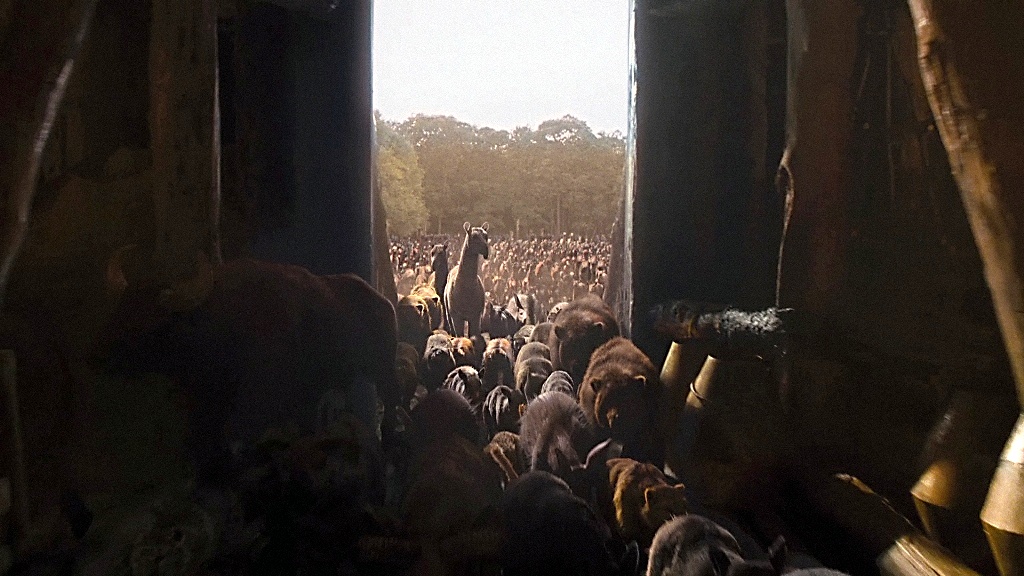
For many of us, it's one of the first stories we remember being told by our
mother or father or Sunday school teacher. It couldn't be designed better for
children if it had been done so intentionally. There's a fantastic supposition
(the Creator of the world capriciously decides to destroy it and start over), a
giant boat, a heroic father who manages to save his family despite the end of
the world, a parade of animals (the list of which has sent many a toddler in a
flannel onesie to sleep), and a happy ending that even manages to work in an
explanation for a natural phenomenon familiar to the child, as well as a warning
that the child never look at a naked adult.
As I said, perfectly designed to be told to a child, remembered by that child
all his or her life, and told to his or her own children.
Like Goldilocks and the Three Bears. Or Cinderella. Or (in my house)
Supergirl.
And even when there is little intercultural contamination, word values and
definitions shift over the centuries. An example can be found in the Biblical
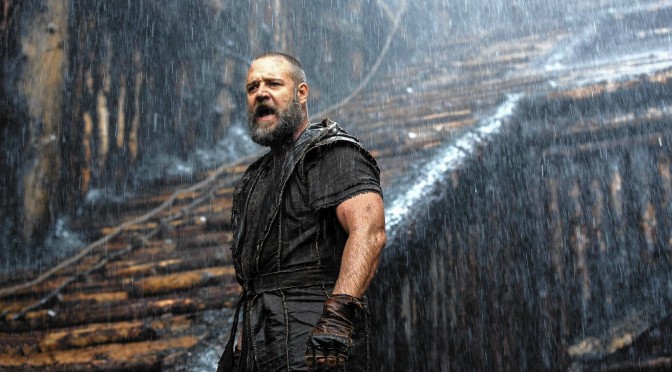
story of Noah. In the King James Version, Genesis 9:13, it reads, "I do set my
bow in the cloud, and it shall be for a token of a covenant between me and the
earth." This is the rainbow that many of us were told was the sign of God's
promise to never again destroy the world by water. I, personally, found that to
be a meaningless promise, given that at five years old I could think that God
could still destroy the Earth by fire, asteroid, volcano, or giant ants, right
off the top of my head. (Movies with giant ants were big in the fifties.)
But my point is, the Bible doesn't use the word "rainbow" at all. The word is
bow. In the original Hebrew, it's even clearer: The word קֶשֶׁת refers to
an archer's bow! Remember that; I'll be coming back to that point
shortly.
The words in the verse are spoken by the divine character
simplified to "God" in English, but represented by several distinct
terms in Genesis. The one used in the Noah story is
Hashem. This word is feminine plural, essentially
translating to "goddesses".
Another odd thing is that the word translated into English as
"ark" is the Hebrew word tevah. This is the same word
translated as "basket" when the baby Moses, inside one, is hidden in
the bulrushes. It's the same word used in "Ark of the Covenant" to
describe a golden chest light enough for six men to carry. Generally
a tevah isn't particularly large—not something you'd want to go
traveling in with your cat, much less two of every species on Earth.
I mention these things because they relate to a premise toward
which I am slouching even as you read. Be patient.
It's a mistake to try and take the Noah story at face value. It
ends up demeaning the rest of the Bible in the process. Feel free to tick off some of the
hoariest arguments here;
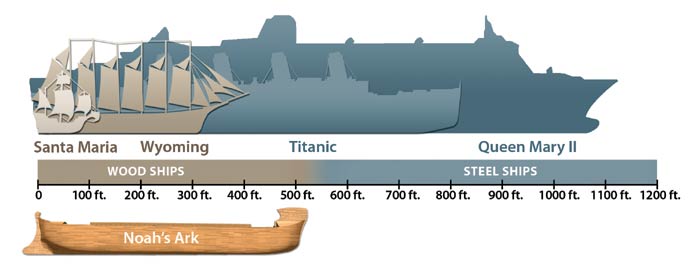
but consider that the dimensions of the ark make it substantially smaller than one of our modern ocean
liners, and not even a supertanker could hold within it two of every
single one of Earth's estimated 8.7 million animal species, even if
they did line up and board without supervision. Even if the silly
unicorns—or the dinosaurs—couldn't stop playing long enough to enter.
On the other hand, I believe it is a mistake to throw the Noah
story out just because it cannot be literally true. Certainly, many
Christians accept a metaphorical reality to the tale. But I would
propose that it might well be the report of a real event, told in
the manner of a children's story, to make sure it persists long
enough to send a message from the dimmest reaches of the past into
the future…(our present).
There is no evidence that Earth was ever completely covered by
water. Even when every single ice cap melts, there isn't enough to
cover Mount Everest. There's barely enough to cover Florida's
Mount
Dora (at 184 feet above current sea level).
However, the basin of the Mediterranean Sea holds the ruins of
dozens of drowned cities and towns that have been discovered; there
may be hundreds or thousands more yet to be found. There is a
theory, still hotly debated, that the Black Sea catastrophically
burst through the Bosporus Strait in
5600 BCE.
Yet another theory proposes that the meteor that created
Burckle Crater
in the Indian Ocean perhaps as long ago as 3000 BCE could have
thrown up a tsunami that might have inundated the Middle East.
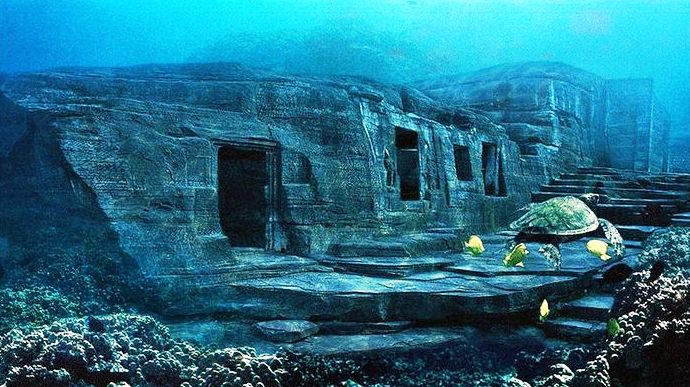
In any case…there was a Flood. Not worldwide, but certainly a
regional catastrophe of epic proportions.
So…if there are Flood myths from cultures all around the world
(there are), and stories get more confused with the passage of time
(they do), then, perhaps, if we could read the oldest of these
tales, we might get a story closer to the truth. How would we know?
Well, the story would make more sense, have fewer internal
inconsistencies.
So let's look at the source of all the tales in Genesis: the
writings of the Sumerians, the oldest known civilization, who
invented (they said they were "given") writing, and who wrote
prodigiously on clay tablets, hundreds of thousands of which have
survived and been discovered…and translated.
According to some of those tablets, copied by school kids thousands of times
(and saved by proud parents), Earth was discovered by aliens called
Nibiruans, because they came from the planet Nibiru. (NI.BI.RU in
Sumerian means Planet of the Crossing, because Nibiru has
an extremely elliptical orbit that comes close to that of Mars once
every 3600 years, spending the rest of its time in the dark, far
reaches of our Solar System.) The Nibiruans came on a quest for
gold, which in addition to its use in their electronics, also was
vital for repairing their planet's atmosphere, which had been
damaged by over-industrialization. Monatomic gold dust, scattered in
the upper atmosphere, would remain suspended for thousands of years,
acting as a shield when Nibiru approached the Sun, and providing a
greenhouse effect, keeping heat in when Nibiru was at the dark end
of its orbit.
In the Sumerian's mythology, there were many Nibiruans on
Earth—they were the "Nefilim" mentioned in Genesis. The word, both
in Hebrew and Sumerian (the Hebrew language derived from Sumerian),
means "Those who from the skies fell." However, there were just 12
Nibiruan "gods" who ran things. The chief was Enlil; it was he who,
as "Lord of the Gods" (Adonai Elohim, in the Hebrew version
of Genesis), walked in the Garden of Eden (in Sumerian, E.DIN means
"laboratory in the south," Kenya's
Great Rift Valley) with Adam.
But it wasn't Enlil who created Adam and Eve. That trick
was pulled off by Enlil's half-brother, Enki, and their sister,
Ninhursag.
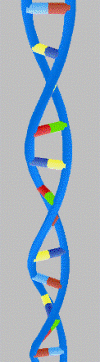

Enki's "symbol" was what we now call the caduceus: Two snakes intertwined.
That's right, it was Enki who was the "snake" in the
Garden! And it was Enki who took the original genome of the native
species, Homo Erectus, and added
223 genes from a Nibiruan to create Homo Sapiens…a slave
species.
And now, let's look at a model of a DNA molecule. Why, it's practically a
caduceus, itself! In fact, if you were a geneticist in need of a
logo, the caduceus might well be just the thing! And, in point of
fact, the caduceus has been the "logo" for doctors and medicine at
least as far back as 4000 BCE, where it has been found on cylinder
seals. The wings at the top is the symbol of Nibiru, itself.
 You still see this symbol all over as the Flying Disk symbol.
(I've even seen it tattooed on a guy's back!)
You still see this symbol all over as the Flying Disk symbol.
(I've even seen it tattooed on a guy's back!)
I cannot accept all this as coincidence. It isn't reasonable to
think that the Sumerians, who couldn't have known anything about
genetics themselves, associated the entwined snakes with their
genetics god by coincidence. But if the Nibiruans are real—and
there's plenty of evidence suggesting they are, or, at least,
were—and they understood genetics and the structure of
DNA, then the choice of the caduceus for Enki makes perfect sense.
Okay, so, there are several different stories in the Sumerian
archives about a Great Flood, told about something ancient even to
them. (Remember to picture the Sumerian kids in school, copying
these stories down, between passing little clay notes to each other
and making plans to get together at the Goat Milk Shake joint after
school.) We are going to focus on one
Ziusudra. He is
listed in the Sumerian King Lists as the last Sumerian king
prior to the Great Flood.
Ziusudra has had many different names as languages were changed and
centuries passed. He was called Atrahasis and Utnapishtim by the
Akkadians; and, of course, Noah by the Hebrews and Noe by the
Greeks. But the stories all have this in common: A man in his 800s
who is told by a god that the world will come to an end in a great
flood, and who is given the task of preserving land life and
humanity from the disaster.
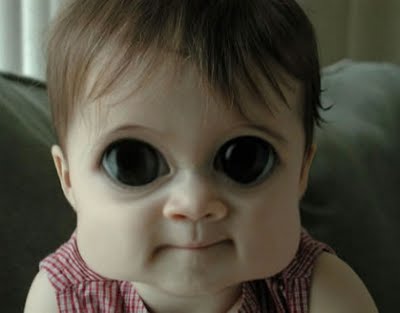
Going back to the earliest surviving version—and remember, that is still
told thousands of years after the event, itself—we learn that
Ziusudra is actually the son of Enki and a human woman. In the Book
of Noah (fragments of which were found among the Dead Sea Scrolls),
Noah's birth is described as being abnormal and his appearance, pale
and spindly, with wispy, pale hair, not only frightened his parents
but bears an uncanny resemblance to alien abduction stories about
hybrid alien/human children.
If the Sumerians were right and Ziusudra was a king (Lamech, Noah's
father in the Biblical version, was also a king, as the generation
lists of Genesis are actually Sumerian king lists), that doesn't
mean he lived in a palace. Beautiful brick temples were built for
the Nibiruan "gods" but the humans lived in reed huts. A "king" in
those days was merely a go-between for humans wishing to ask a favor
of the gods. In today's parlance, Ziusudra, even though he was a
half-son of a god, was basically an executive secretary—or a priest.
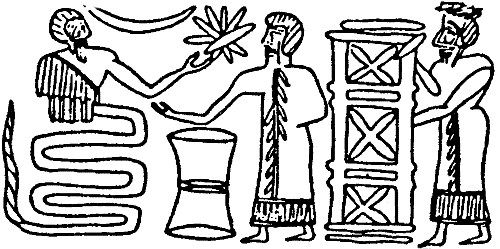
From the Sumerian: "When Ziusudra by the words was awakened, to him Enki said,
'Reed hut, a calamitous storm will sweep, the destruction of Mankind it will be.'"
The oldest stories of the Sumerians were said to have been dictated
to Ziusudra by Enki himself. Ziusudra wrote what he was told,
without understanding much of it. Enki communicated in mental
images, as did the other Nibiruans. The presence of half-Nibiruans
("The sons of the Gods saw that the daughters of Men were fair, and
took them unto themselves as wives…") may have been necessary to
translate from the Nibiruans' thought images to words. And,
obviously, without his father's vast understanding of science,
Ziusudra may have had to use metaphors to convey the meaning of what
he saw in his mind.
In any case, according to Ziusudra, and filtered through my
vast understanding of science (and my slippery grasp of Sumerian),
here is what happened.
An asteroid (or comet or meteor) was on a collision course with
Earth. It was a big one. It was going to cause an ELE, or
Extinction-Level Event. It's unclear where it was going to hit, but
I like theBurckle Crater
theory best, myself.
Enlil, commander of the Nibiruan presence on Earth, had never been
happy with the creation of a slave species on Earth. He felt the
karmic costs were too great. He had been especially unhappy
when the prototype humans had been given the ability to procreate.
(That's the "eating of the fruit of the Tree of Knowledge"
Adonai Elohim was so upset about, that he closed the E.DIN
laboratory. In the Middle East, even today, "knowledge" is a
euphemism for having sexual relations.) So when, almost magically,
this asteroid showed up, he decided it was the time to end the human
experiment.
So Enlil held a council of the twelve highest-ranking Nibiruans,
told them about the coming disaster, and made them vow to
not tell the humans. After all, why cause panic when there was
nothing to be done? The humans couldn't really survive, anyway; and
the Nibiruans, who had done a little procreating of their own while
here, would barely be able to fit in the ships that had brought them
here…that "to Earth from the skies fell."
But Enki, who had put his heart and soul into the genetics
experiment, had fallen in love with his creation and couldn't bear
to see it end like this, crushed by a mile-high wall of water. But
he had been forced to vow not to tell any humans! What to
do?
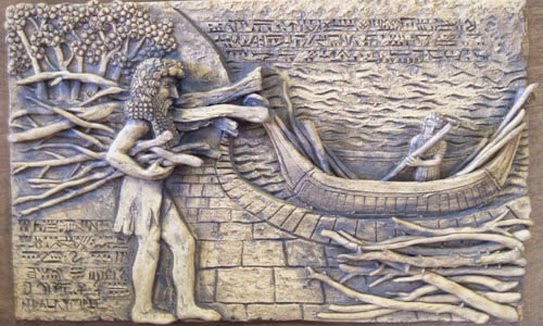
Speaking aloud was not easy for Nibiruans; it was not their natural
means of communication. But Enki could make sounds. In fact, he was,
in addition to being a geneticist, a linguist who had invented the
language Ziusudra spoke. And so, that evening, he wandered near the
reed hut of his hybrid son, speaking aloud. "What a shame," he said,
"that I have promised not to tell my children that the world is
about to be destroyed by flood! Because, if I could, I would give
detailed instructions to Ziusudra, my favorite, on how to survive."
He went on to rattle off details, which Ziusudra, listening through
the reeds and being no idiot, was quick to copy down. They were a
little on the vague side; but Enki also assigned a Nibiruan engineer
to assist in the project.
The core of the project was a genome library, a collection of frozen
embryos of every species the nearly-immortal Enki had studied over the past half-million
years as well as every kind of seed. There were also a number of
"birth animals," live animals that would be used as host mothers to
the fertilized eggs. (The species of "sacrificial" animals of which
Noah is instructed to bring seven pairs in Genesis, is the same list
as in the Sumerian version; and is similar to a list a geneticist
might select today.)
Even with the engineer's help, Ziusudra needed help building the
boat, which was designed to be a submersible. (Even today, the word
used in Hebrew-speaking Israel for a submarine, is the word for
basket—the word we translate as "ark".) In addition to his own
family members, Ziusudra as king had access to workers. The size of
the submersible was actually made to accommodate all the
people who worked on it. The animal embryos took up very little
space, not much more than the birth animals. (The pairs were so the
birth animals themselves could reproduce.) No room was assigned to
engines, of course. But there were probably battery-operated
electric lights, which are known to have existed at this period,
though only used by the "gods."
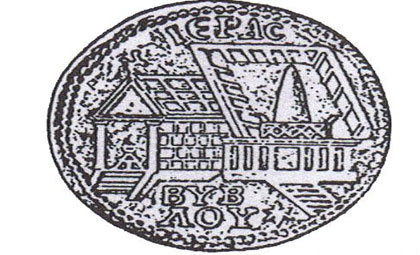
The signal (sign from "god") to enter the ship wasn't a long
rain—though, historically, Ziusudra lived in a time of climate
change, and there had been a severe drought for centuries. (The name
of the man in Genesis, Noah, means "respite" because his (adopted) father,
Lamech, hoped that Noah's strange appearance was a sign from God
there would be "respite," deliverance, from the drought.) Ziusudra
was instructed to watch for a wall of flame over Baalbek in
distant Lebanon, the Nibiruans' spaceport. That would mean the
Nibiruans were leaving the earth in their ships, and Ziusudra and
the other passengers must immediately enter and seal the
submersible.
The shape of the "ark" and its positioning had been calculated by
Enki with care. The wall of water slammed like a giant mallet over
the surface of the Earth, and actually triggered a tsunami that
circled the Earth. Water did not cover everything, as Enki had
feared. But the middle east was flattened and drenched.
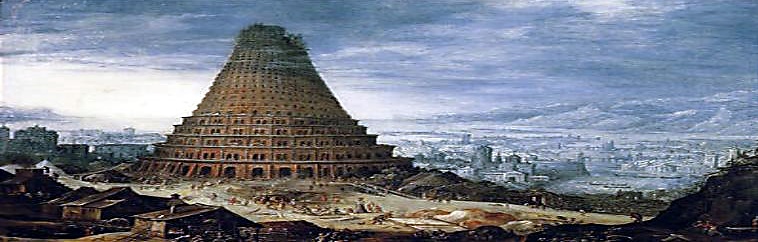
For those in the "ark", there was much fear; Ziusudra had to
constantly remind everyone on board that he was the son of Enki, and
Enki had promised to keep them safe. The ark was constructed in two
shells: A solid, waterproof outer shell, and an inner shell that
rotated freely so the passengers were always upright. The initial
slam of water must have been terrifying. But once the turbulence
died down, the ark was able to bob to the surface, and with the
outer shell aligned with the inner shell, Ziusudra was able to open
the upper hatch for air.
After a period of time, the waters receded. There was no sign of
wreckage or carnage. In fact, the flood laid down nine feet of mud,
which was discovered by archeologists in the 1800s. It was that mud
that was used by the Sumerians to make their clay tablets. The ark
came to rest at the Greater Mount Ararat, and the passengers exited
to find rather bleak surroundings.
But the "sacrificial" animals had another purpose. Ziusudra
butchered one to make a celebratory barbecue.
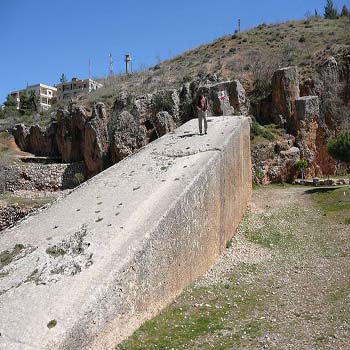
Meanwhile, the Nibiruans in their spaceships weren't much better off. They
couldn't go home because Nibiru was at the most distant part of its
orbit, so they remained in orbit around Earth. Cramped, running out
of supplies, they gazed down at Earth, trying to determine where, in
their old territories, they might be able to land. (A stable
surface, like that of Baalbek, with its unbelievably huge cut
stones, was required; but Baalbek was still underwater.)
When their sensors revealed the top of Ararat, Enlil led the first
landing party. The Nibiruans were starving by this time, as, due to
the drought, they hadn't been able to bring adequate supplies. But
Enlil found something he never expected: Survivors. Human survivors.
Human survivors…with food!
Ziusudra, of course, offered to share his goat meat with Enlil and
the others on his ship. And Enlil, startled to find the humans he
expected to be extinguished still alive, and with food, yet—well,
he took this as a good omen. Relaxing by the fire with Ziusudra
after dinner, he made a promise. "Never again," he told Ziusudra,
"will I allow humanity to perish from a global flood. And," he added pointing up to
the sky, "there is the mark of my promise: That bow." Ziusudra
looked up in the direction of Enlil's oddly-shaped fingers, and saw
the constellation Sagittarius, the Archer, and the stars that make
up the archer's bow. He knew, having been Enki's secretary for so
long, that somewhere in that constellation was the current position
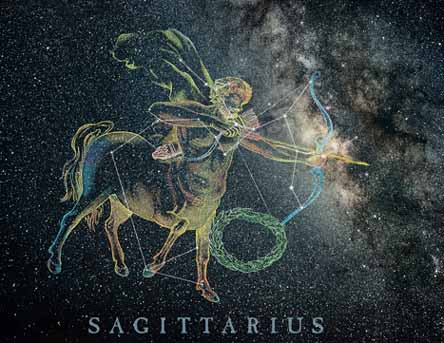 of Nibiru, thought it couldn't be seen. Enlil was telling Ziusudra
that other "gods" from Nibiru itself would scour the solar system
for errant asteroids and comets and make sure none would ever strike
Earth again.
of Nibiru, thought it couldn't be seen. Enlil was telling Ziusudra
that other "gods" from Nibiru itself would scour the solar system
for errant asteroids and comets and make sure none would ever strike
Earth again.
Enki was in another ship, and he landed in South America, which had
largely survived the tsunamis and food could be had. That's where he
was called Quetzalcoatl, the "white god" who stayed for
awhile before leaving on a promise to return. (Nibiruans had almost
dead white skin.) That promise is why the Incans, when the
conquistadores showed up in the 1500s, just handed them the gold
Enki had requested them to mine.
In any case, Ziusudra reproduced the animals that had been lost in
the flood and planted the seeds to recreate the flora, which quickly
spread in the new, barren environment. Predators were re-introduced
after vegetarians had filled the landscape to keep their numbers
down. Enki managed some mercy food runs from the Americas to feed
the small number of surviving middle-eastern humans and Nibiruans until the humans' crops
could be harvested. The Nibiruans built new cities, relocated from
the old, which had used Greater Ararat and Lesser Ararat as landing
landmarks, to new locations in an identical pattern, but using the
newly built great pyramids in Egypt as the landmarks. (Those
patterns have been found and identified by modern archaeologists.)
Is this, in fact, what happened? Well, I think so. It fits
all the observable facts, including many that I've omitted here for
brevity. Obviously, there are serious implications here—not least
of which is there is evidence for a flood, but not for the Hebrew
god Yahweh to have been its cause. But, then, Cinderella's shoes
were originally fur. Stories change, and evidence, such as the
archaeology and Sumerian writings, is the only way we have of trying
to find the original truth of them.