|
By: Paul S Cilwa |
Posted: 9/1/2015 |
|
Page Views: 4,553 |
| Hashtags: #Metaphysics #Reincarnation |
| How an understanding of reincarnation can dispel fear of death. |
| Estimated reading time: 9 minute(s) (2028 words) |
One night a number of years ago, I was driving along a New Hampshire
highway and found myself behind another vehicle. I was just beginning to pass
it, when from my vantage point slightly to the other driver's left I saw—something—in
the road ahead of him, dimly lit by his headlights. It was a pair of raccoons
crossing the road from right to left. One was safe, almost all the way to the
shelter of the forest on the left. But the other was confused by the headlights
of the oncoming car. The driver swerved, but so did the trailing raccoon, who
was struck by the driver's left front tire, and then his back tire, bouncing
lifelessly into the air and dropping into the space between his car and mine.
I jammed on my brakes and swerved to miss the poor creature's body. But
something unexpected happened. The lead raccoon, who was out of harm's way,
turned around. I could see the creature hesitate. He was safe, but his
mate was in danger. He must have known she was already dead, but in an
incredibly human act of despair and desperation, he turned back to get her out
of the way of the next oncoming car, mine. I couldn't dodge in time; I hit him,
killing him as instantly as the car ahead of me had killed her.
There was no point in stopping. I could see by the glow of my taillights that
both animals were dead, having died together during a routine foraging
expedition in the New Hampshire night.
I had once been a passenger in a truck that struck and killed a dog. I cried
the rest of the way home. But this was years later, and I no longer was slave to
my childhood belief in a joyful heaven that somehow compels most Christians to
wear black and cry at funerals. Now a reincarnationist, I felt I had been
attracted to the situation, that the greater Universe brought together a pair of
raccoons whose soul contracts were at an end, and a pair of drivers willing, on a soul-contract
level, to assist, however unintentionally at the Earth-conscious level.
Thus, this time I didn't cry. I no longer perceived what had happened as a
tragedy. In fact, I felt privileged to have been allowed to participate in such
a sacred event, the passing of two creatures from the life to the afterlife. I
have since come to understand that humans' fear of death is based on a series of
lies.
Now, don't misunderstand me. I'm not saying that animals don't avoid
death if they can. But we've been told, so often that people accept it as true
without questioning it, that Man is the "only animal" that understands
death, or least grasps the concept of his own mortality. This is based on the
observation that animals don't bury their dead, build churches, or engage animal
psychologists to help them deal with the resultant depression. But that
observation, itself, is built on the assumption that such reactions are the only
possible ones when one encounters proof of one's own mortality. And I don't
believe this is so.
The raccoon that turned to aid his mate certainly understood the stakes.
Animals, especially in the wild, understand death all too well. Every predator
lives off death. And any potential prey is constantly threatened by it. While
I'll grant, tentatively, the possibility that lower-level animals such as
snakes and ants might be reacting out of pure instinct, at the same time
I saw that raccoon make a fatal hesitation. Instincts don't hesitate.
That requires an awareness of the complexities of a situation, and the desire to
take the most beneficial action possible.
Thing is, the most beneficial action for the raccoon—within the human context
of death-is-always-bad—would have been to keep going. He'd have been safe that
way. Obviously, for him, trying to rescue his mate took precedence over his own
safety. To me, that is convincing proof that raccoons understand the existence
and significance of death as well as love—without, as a result, inventing burial, funeral homes,
or archbishops. And, by extension, it seems very likely that other mammals at
the same or higher level of intelligence as raccoons, understand it as well.
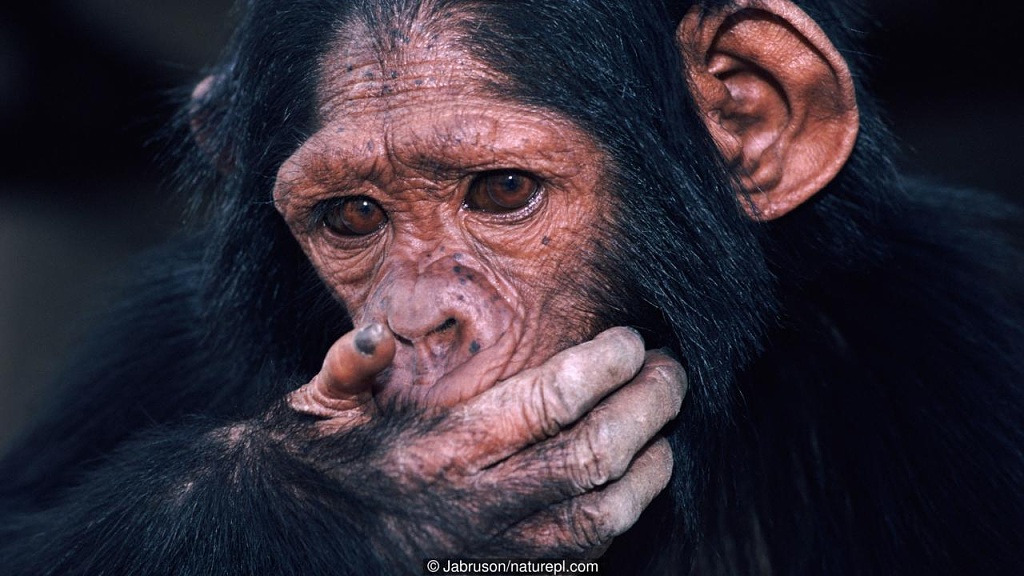
It's well-documented that chimps and gorillas in the wild mourn the death of
mates as well as friends when other chimps or gorillas die. Yet they don't bury
their dead, either, or try to convert other chimpanzee colonies to their style
of mourning. So let's let go of this lie that only humans understand death, once
and for all.
In fact, once we do, we can make a point that it is humans alone who
misunderstand death.
In all mammals, various
endocrine glands produce certain hormones when the animal experiences
stress. While these hormones are not identical between species, they are
analogous. Experiments have shown that any animal, in a laboratory, can be
sufficiently mistreated over time so as to produce chronic stress. That is, the
animal is made to live in constant fear of pain or mistreatment; and this fear
causes a constant trickle of stress hormones to be generated.
The same thing happens to dogs with abusive owners.
Yet, even though animals in the wild are certainly aware that death occurs,
and (as my experience with the raccoons demonstrated) know that death can strike
a loved one or themselves at any time, they do not exhibit the levels of
constant stress that humans do.
Humans have certainly developed unique perceptions of death, as well as
reactions to it. Think of how much time our species spends contemplating it, or
avoiding it, which is really the same thing. St. Peter, the Pearly Gates, the
streets of gold; Lucifer, "Give Up All Hope Ye Who Enter Here," fire and
brimstone—our culture has these elements so deeply engrained that, while few
actually know what brimstone is, everyone knows they can find it in Hell.
And we are so terrified of death that, while we joke about it ("Einstein,
Picasso, and George W. Bush showed up at the Pearly Gates…"), we no longer
allow people to die at home (we send them to retirement communities or hospice)
and we have the meat for our dinners killed so far from us that when we get it,
it's wrapped in plastic and refrigerated, looking less like a dead animal and
more like the mass-produced product it's become.
It wasn't always this way. In the distant past, the evidence is that death
wasn't so feared. Men engaged in battle for the sport of it. The risk of death
simply represented the high stakes of the game. Think I'm mistaken? As recently
as the last century, a few humans persisted in this attitude, based on their
participation in such games as Russian Roulette. Read the writings of Julius
Caesar to gain an understanding of the game of war. In Caesar's day, the
generals fought alongside their men, so Caesar's talk of bravery isn't like the
prattling of our own president or vice president, who send men to their deaths
without ever personally having seen a battle.
And I know from my own studies of Florida's extinct Timucuan Indians, that at
least some Native Americans, before the European conquest, felt the same way.
Men and, occasionally, women, participated in inter-tribal warfare the way we
now play football or rugby.
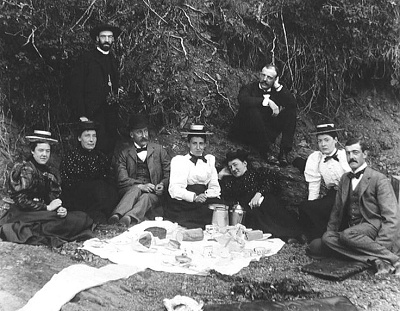
Important note: These battles of old did not involve innocent
bystanders, other than it sometimes being a way to obtain brides or slaves in
some cultures. Reporters were present at the Battle of Gettysburg; locals took their
families to the site so they could picnic while watching the war!
Atheists often describe an almost religious experience, in which they
have a flash of understanding that there is no God, Heaven, or Hell. The reason
this brings them such relief is because it frees them of a good portion of the
burden of this lie. Like the other animals in the forest, they acknowledge death
but it no longer seems to be an enemy that must be defeated.
But there's another lie: That the choice is between belief in the stock
God, and atheism.
The next flash of insight, at least for some of us, is that you don't
need to have an authoritarian God or a carrot-and-stick afterlife, in
order to nevertheless be, essentially, an eternal spirit in a Universe full of
other eternal spirits.
Personally, I do believe in a God; but I believe that God is, simply,
the underlying reality out of which the Universe, including ourselves, arises.
Such a God is not a parent; doesn't issue commandments; doesn't punish (or
reward). Instead, each of us is free to do all that to ourselves…or not.
The test of this came when my mother died last year. I didn't see it as a
tragedy. I neither cried nor suppressed tears. I was able to rejoice in my
mother's life, and to perceive her spirit and memory in all the places
she visited and loved. Like an animal, I am aware of death but no longer
chronically stressed by it. (Even if I am fooling myself, my health can't help
but be improved by this belief!—Certainly, the quality of my life is.)
What's more, my perception of spirits around me—very real to me, since I
don't make the effort to ignore and deny the perceptions, as most people seem
to—allows me access to the part of my mother that I loved in life, as well as
the spirits of my grandparents, my father, my baby sister, and the others whom I
once loved in the flesh and continue to love in their essence. I could define
this essence in many ways—as my memories of them, or the ways in which they
changed the world by being in it, or even the recognition of that certain
feeling that allowed me to recognize them and to still sense their presence
on occasion. But however you define it, it's undeniable existence shouts that
we are all more than our bodies, and therefore outlive them. And this is not
a faith born of terror, an attempt to deny the unbearable. It's an awareness
that is, I believe, a side-effect of acknowledging death as an aspect of Earthly
life as ubiquitous as but no less tolerable than rainy weather, static
electrical shocks, or reality TV shows.
It's a fact of physics that when any two entities come into contact, both are
changed by the experience. My participation in the death of that raccoon all
those years ago, is an example. Obviously, I (or the car under my control) was
the instrument of his death, one he chose by returning to the side of his
partner when she died. In return, he gifted me with an understanding that, far
from my being superior to the members of the animal world, I had much to learn
from them.
And thus, whenever I ponder issues of life and death, and the spirits that
permeate both, I am reminded of that raccoon's spirit, which continues to
guide me with a gentle humor and a love and self-sacrifice that would be the
envy of any human, chronically-stressed, saint.