|
By: Paul S Cilwa |
Posted: 7/18/2013 |
|
Page Views: 2,964 |
| Hashtags: #GrandCanyon #Arizona #Hualapai #whitewaterrafting |
| All about the time I took my grandson and his cousins whitewater rafting in Grand Canyon! |
| Estimated reading time: 15 minute(s) (3455 words) |
So, of course, I offered to take them. But the only takers were
Zach and the cousins, Brianna and Patricia.
Jimmy offered to cover costs and to loan me his GMC Denali for
the expedition. Of course I agreed with delight, and we left
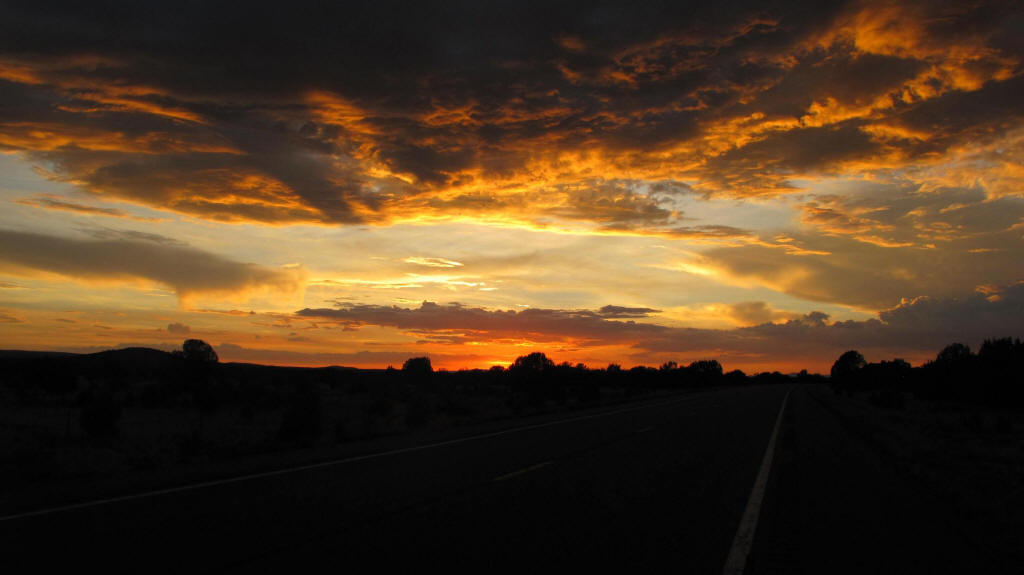
yesterday afternoon, driving through Prescott and enjoying this
sunset just about the time we reached I-40.
Our destination was the Hualapai Nation. The Hualapai are Native
Americans whose reservation extends from its capitol, Peach Springs,
Arizona, to the south rim of Grand Canyon. Like their neighbors, the
Havasupai, they have chosen
to support themselves in this desolate yet beautiful land, through
tourism rather than casinos.
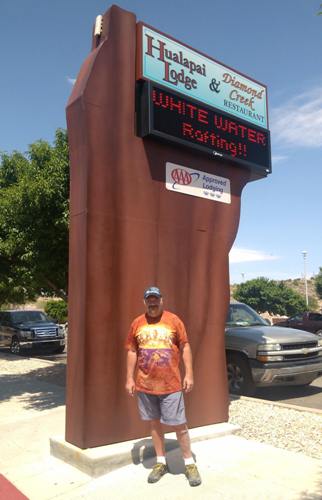
Thus we arrived at Peach Springs and the Hualapai Lodge about 9 PM. The
place looked like any other upscale motel, with a cafe, a gift shop,
pool, and exercise room. Our room was clean, with an HDTV (that the
kids instantly set to South Park).
We lucked out, numbers-wise, because the Hualapai had a special
going: Four people rafting plus a room at the Lodge, and a
continental breakfast.
After our long drive, it didn't take long for the kids to fall
asleep. I assume; I fell asleep first.
In the morning we had to get up at an ungodly hour. Zach and I
declined to shower—after all, we would be wet all day anyhow—but
the girls took a little time to make themselves lovely and we
grabbed our continental breakfast ("upgraded" to include eggs and
bacon, added to the Danish that had been imported from whatever
continent Sara Lee bakes on). We then rushed back to our room to
pack our non-river gear and load it into the Denali; barely getting
back to the door in time to catch the Hualapai bus to the river.
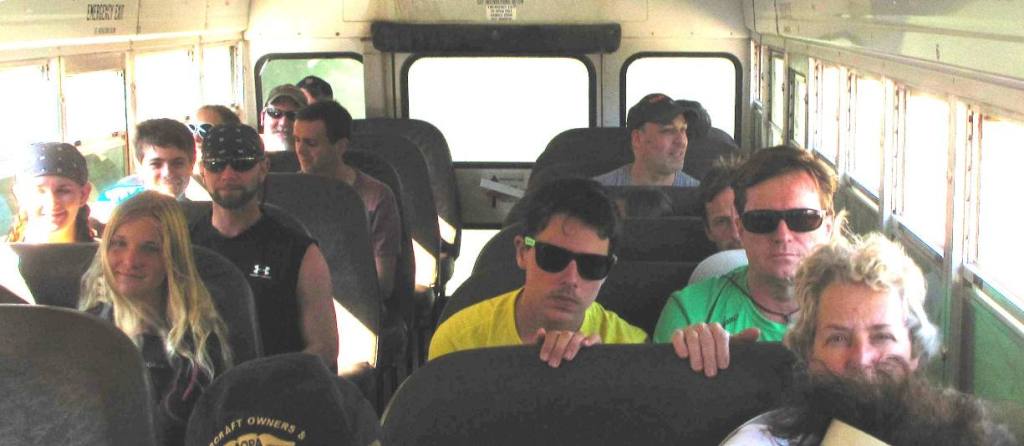
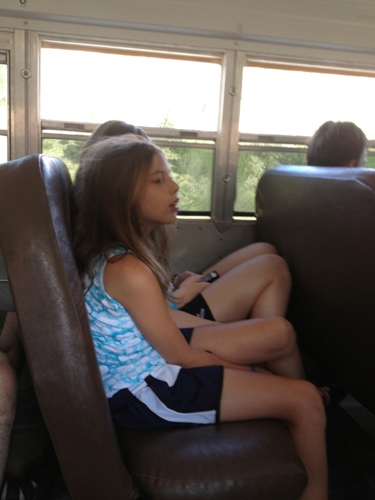
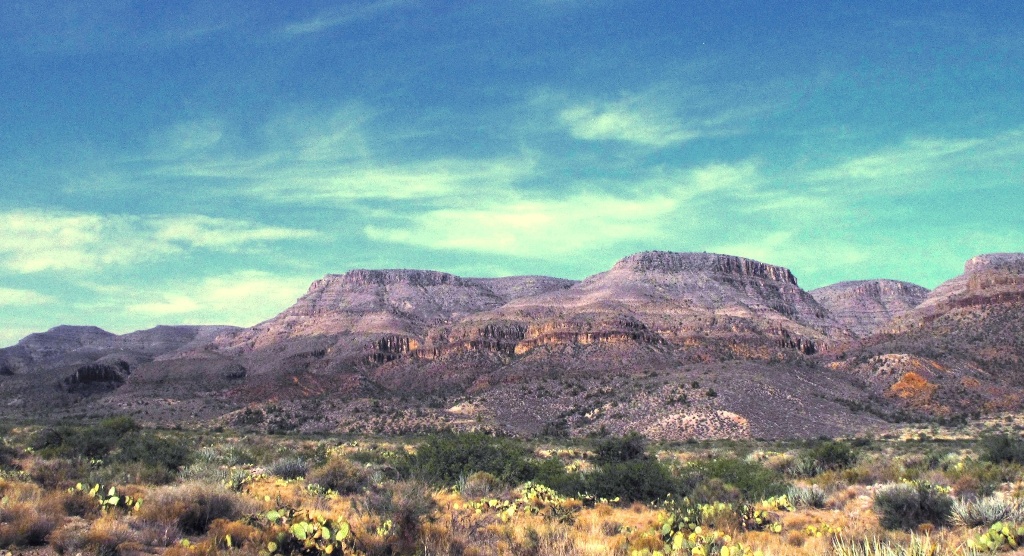
The bus was, basically, a re-purposed school bus. Anything fancier would
have been destroyed by the road, and I do not exaggerate. While the first
few miles were not so bad, the conditions deteriorated rapidly. The
road parallels, and in some places is crossed, by Diamond Creek. We
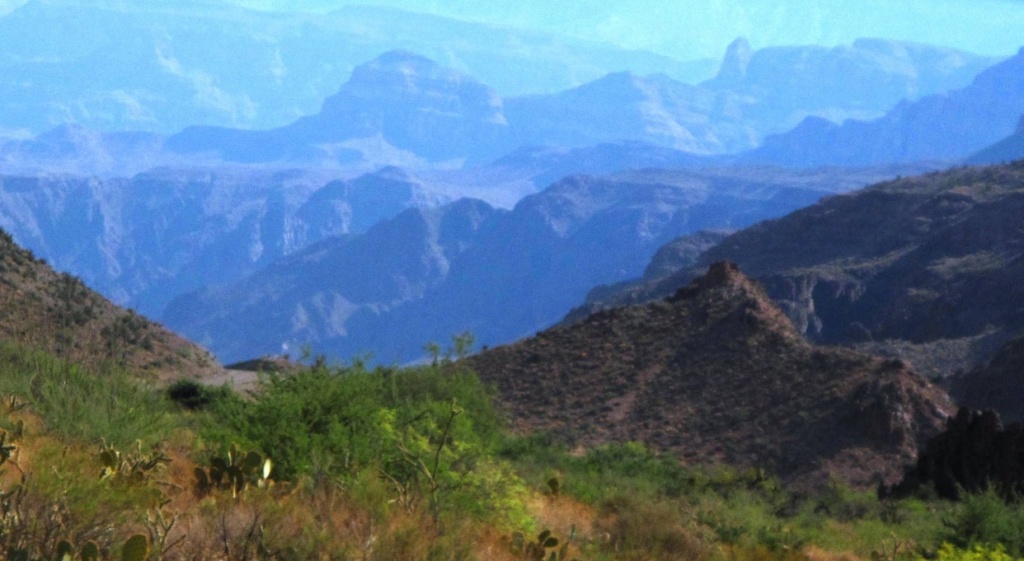
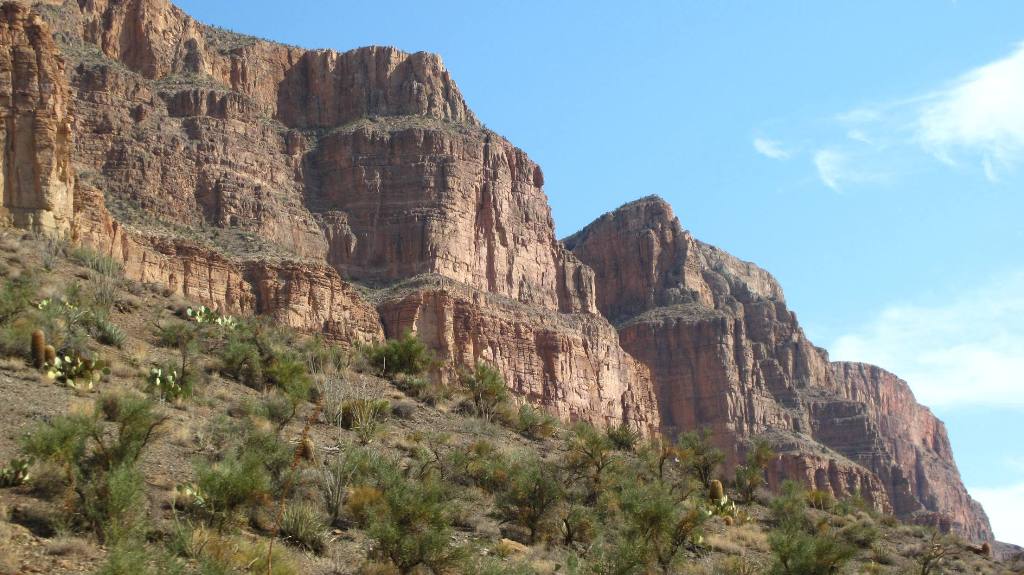
splashed right through the water! The view out the windows grew more
and more spectacular as we got closer and closer to the Colorado
River, but also harder and harder to photograph because the bus was
jouncing so badly. I probably took 30 pictures but had to throw out
25 or so because they came out as multi-colored blurs. Still…after
using software to align the horizon, I did manage to save a few…
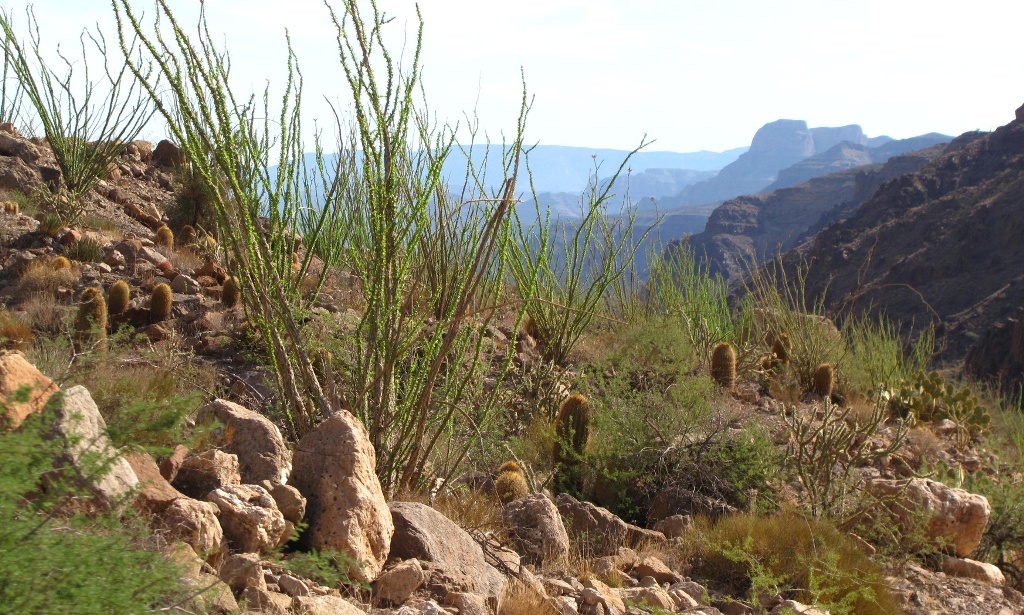
One of the more interesting plants we have out here is called the
ocotillo (pronounced, "ah-ko-TEE-yo"). It consists of spiny branches
extending from a common center, and grows beautiful orange blossoms
in spring. This wasn't spring, but I still got a nice shot of one as
an example.
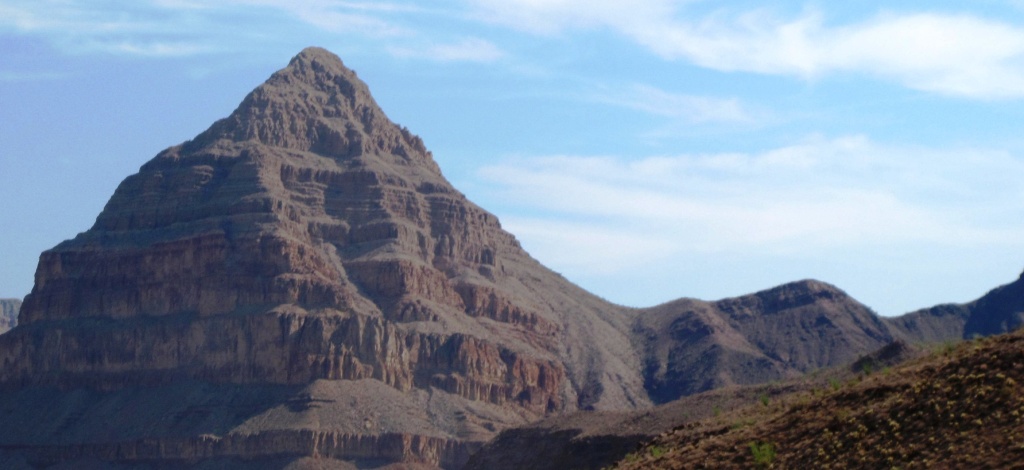
Diamond Creek is named after Diamond Peak, a triangular-shaped
outcropping that can be seen for many miles upstream, long before
actually coming to it.
Anyway, after a half-hour or so, we finally reached the river and
exited the bus, where we found the Hualapai River Runners had gotten
all the rafts ready for the trip, and life jackets laid out in
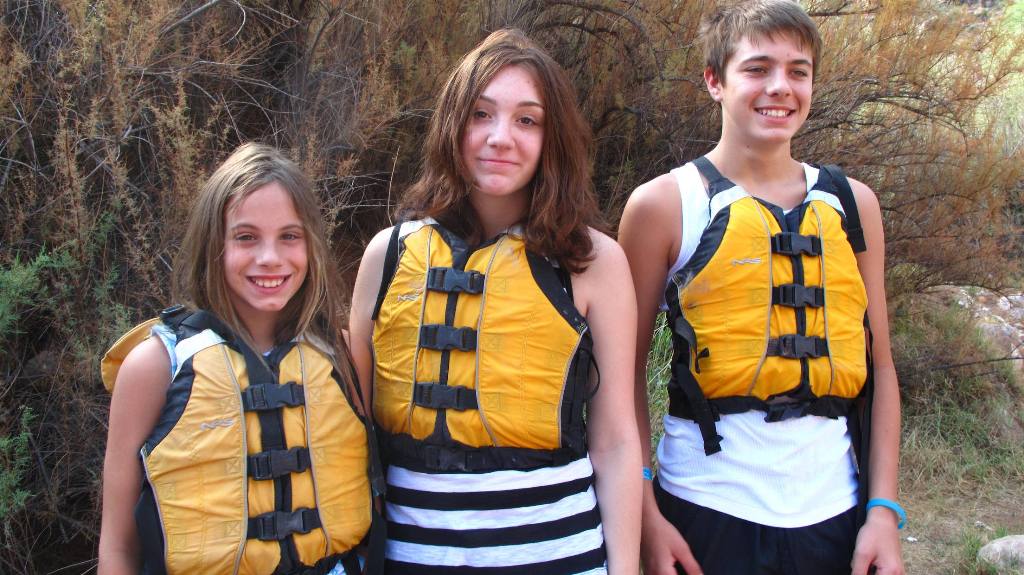
piles. We were assigned Boat #5 and donned our jackets. Here are
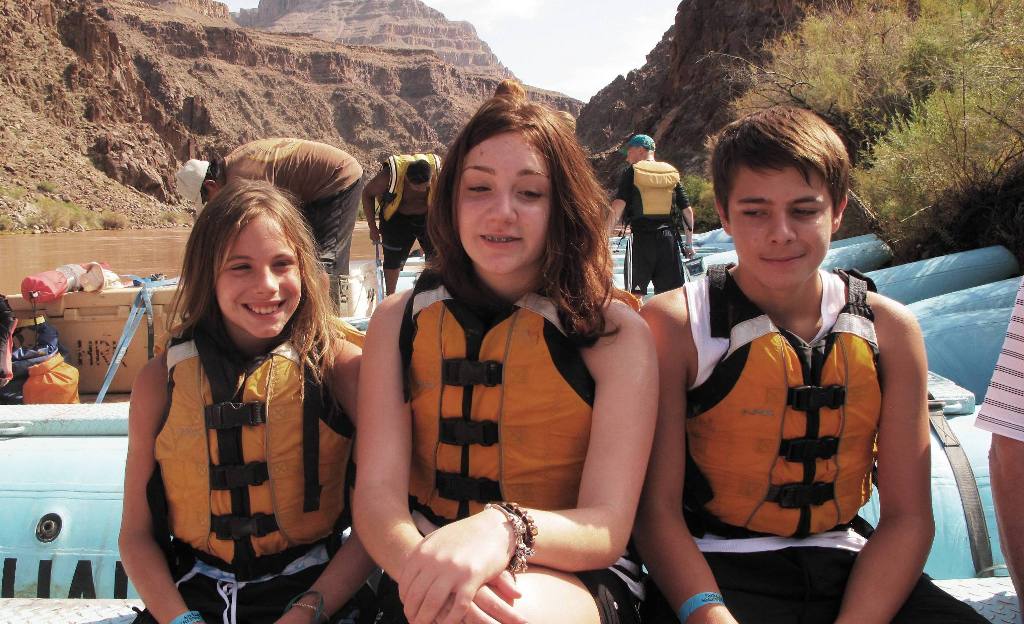
Patricia, Brianna, and Zach, posing in theirs.
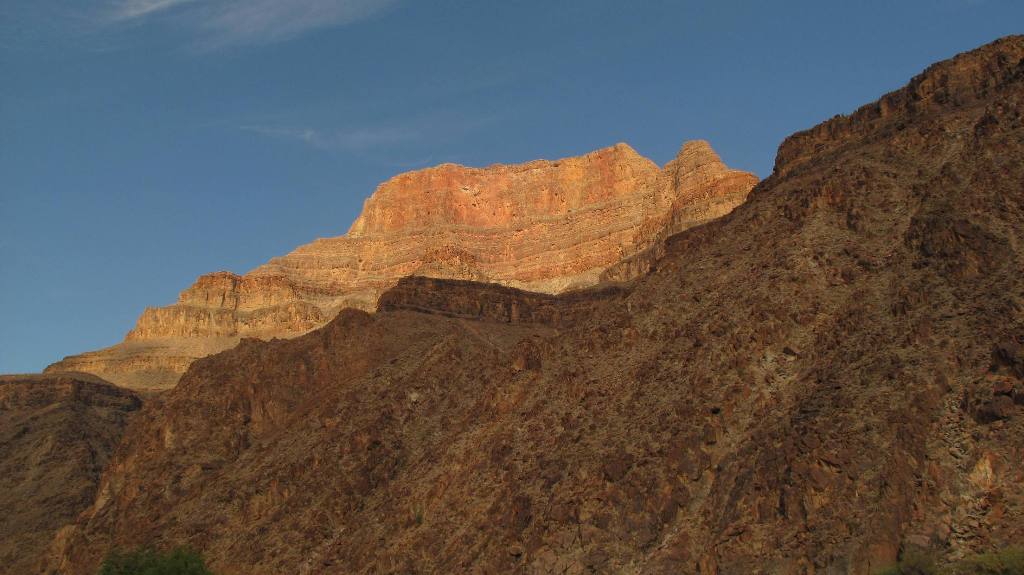
It was still quite early, and although the sun had risen well above
the horizon, it was still hidden deep in the Canyon as we were. So
it was cool to see it begin to kiss the Canyon's upper reaches as we
prepared to shove off.
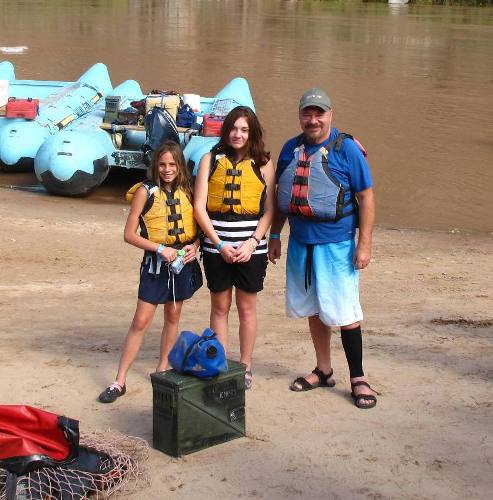
I needed a little extra help with my jacket, which is very tricky to
adjust on oneself. And I'm afraid I settled, not making the waist as
snug as it should have been, which caused a bit of an issue later.
We were given am ammo case to keep our need-to-be-dry stuff like
cellphones.
Our guide, Kesley (spelling is correct), invited us aboard Raft
#5 and we were ready to go! And, as you look at the kids'
expressions, remember that only Zach had ever been rafting
before.
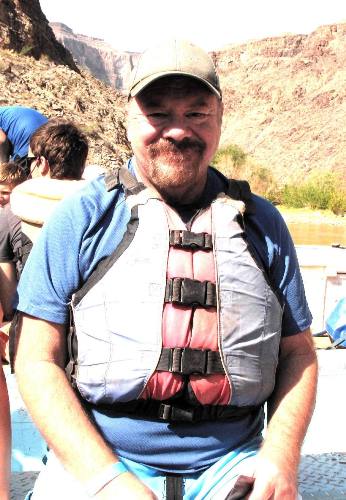
I, on the other hand, have been rafting many times…but not since my
bout of necrotizing fasciitis, over two-and-a-half years ago. And I
hadn't gone rafting in Grand Canyon since 1996. So I was pretty
pumped up!
This was my first motorized rafting trip. We were going to cover
some 43 miles in a day. (On an oar-powered raft in Grand Canyon,
20-25 miles in a day is considered pretty good.) However, Kesley led
us through one rapid—where he maneuvered so that everyone but him
got thoroughly soaked—before pulling off for a morning hike.
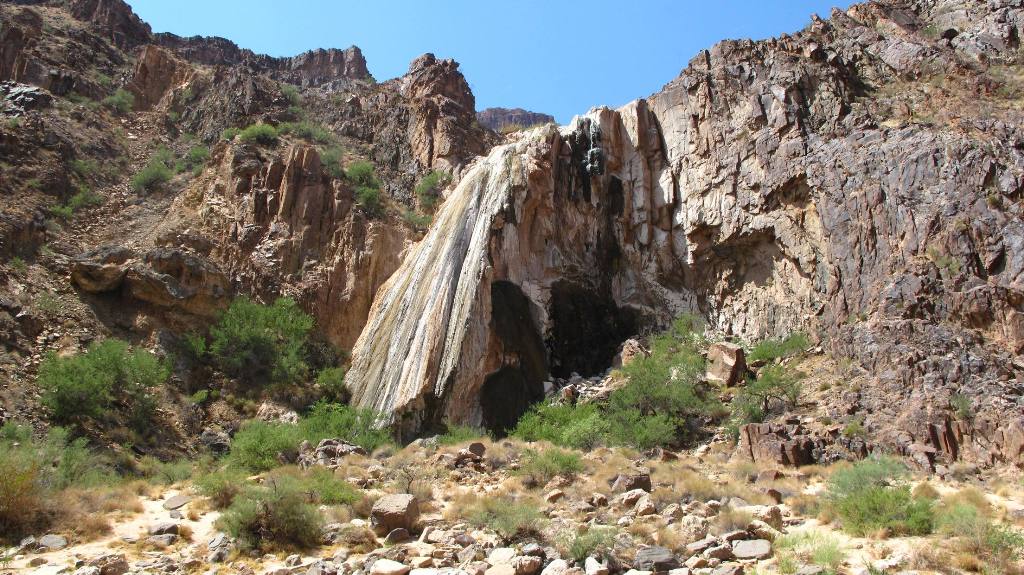
This hike was to visit Travertine Falls. I had been there once
before, and found climbing up the steep, rounded granite with no
support but a rope to be a real challenge to my fear of unsteady
heights. (I have no problem with stable heights, like a cliff or a
roof.) My fear of looking like an idiot was also challenged.
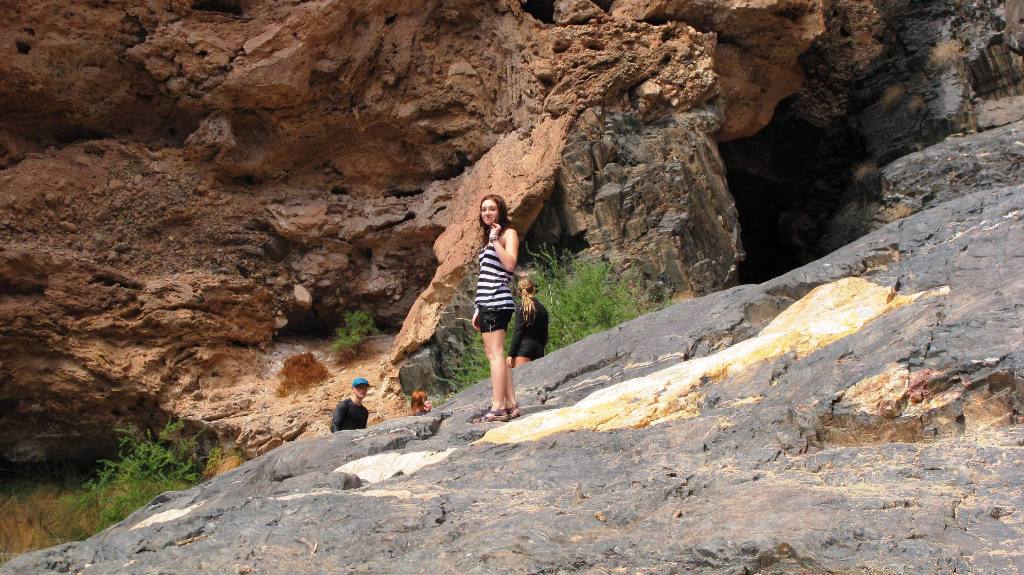
The first part of the approach is easy enough; here's Brianna posing
on it. (Not really posing; she was hiking and I yelled, "BRIANNA!"
until she turned.)
But it gets steeper, and a rope has been placed to assist hikers.
And even then, it needs the assistance of a river guide to angle it
so that it's useful.
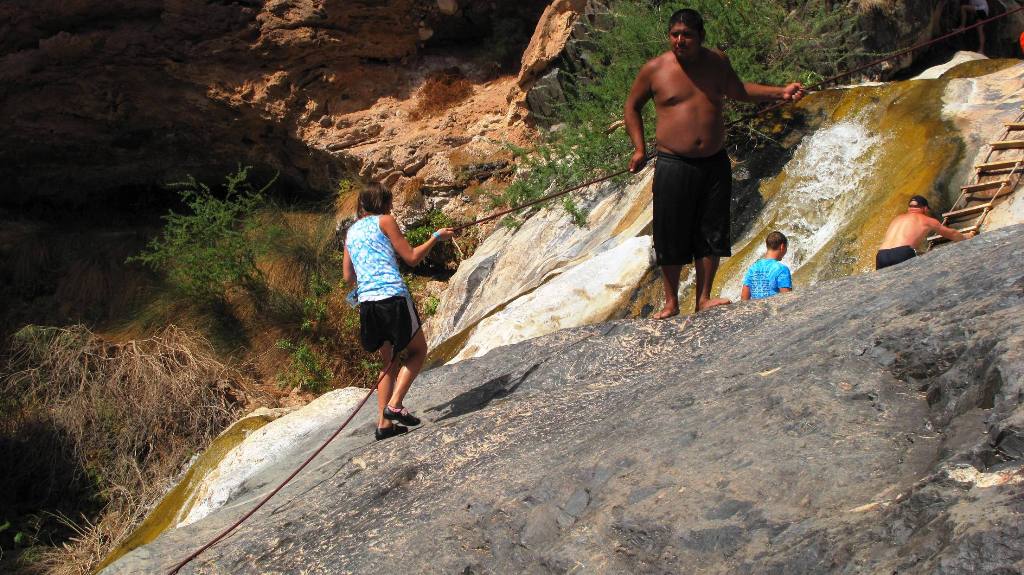
This rope used to be the only aid to the top, when I was here last.
Fortunately, as you can see in the above photo, they've added a
rope-and-wood ladder to the steepest section, the one I had the most
trouble with on my previous visit. The ladder made it much
easier, and while there was never any doubt as to the kids' ability
to scramble to the top, even I was able to make it without
the aid of a derrick.
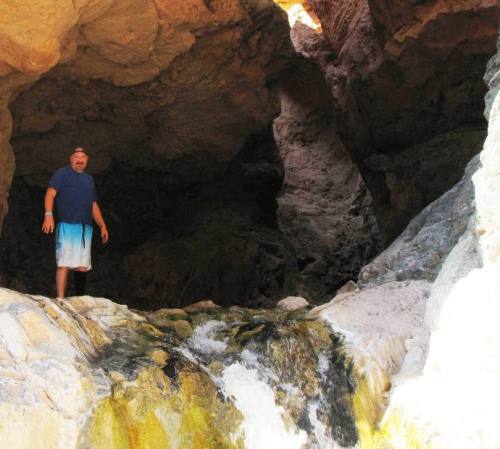
At the top of this hill, there is what looks like a cave from which
water gushes. However, this is not the waterfall; and it isn't
really a cave because it is open at both ends. It's a grotto, and
there's another ladder to assist climbing into it.
By the way, in the above photo to the left, I am not
missing a leg. I am wearing a black calf stocking to protect the
scars from my necrotizing fasciitis.
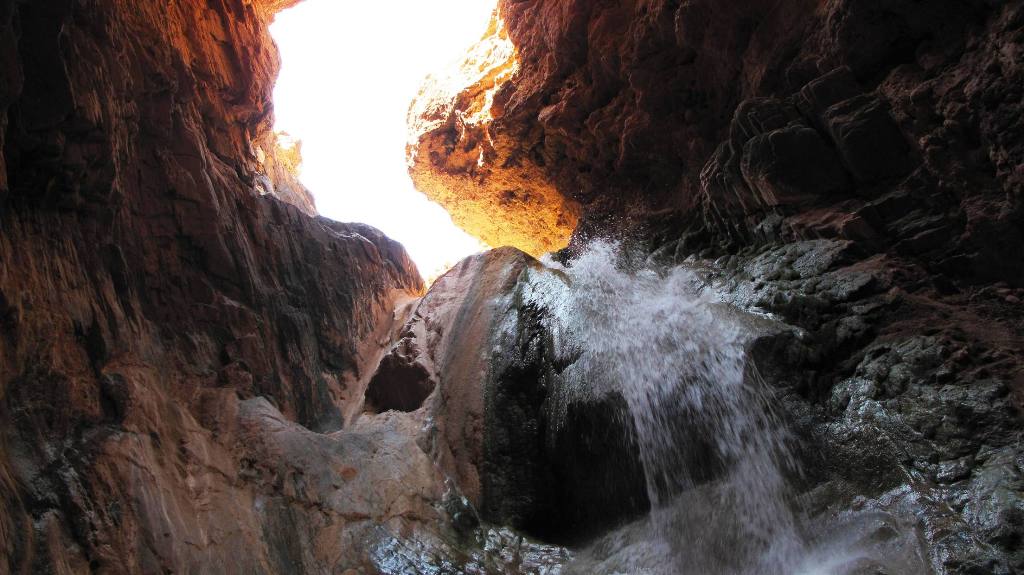
So…what do we see when we enter the grotto? An amazing light show,
as beams of light peer in from the two openings and bounce against
the travertine walls and puddles of water.
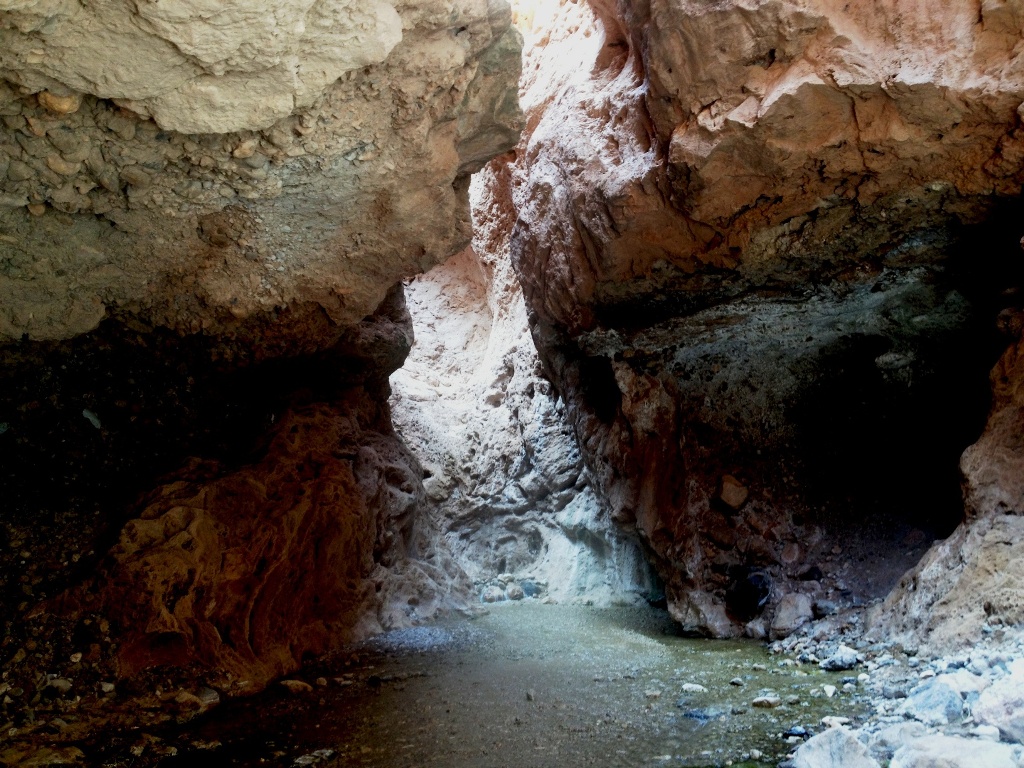
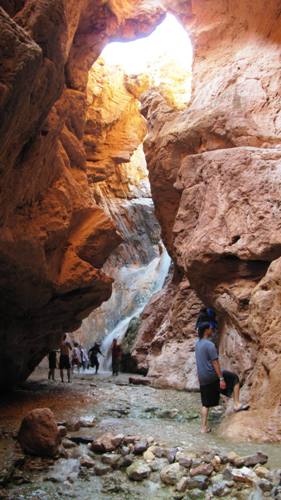
And it gets even more beautiful as you continue further in. This
is what the designers of cathedrals had in mind, but were never able
to duplicate.
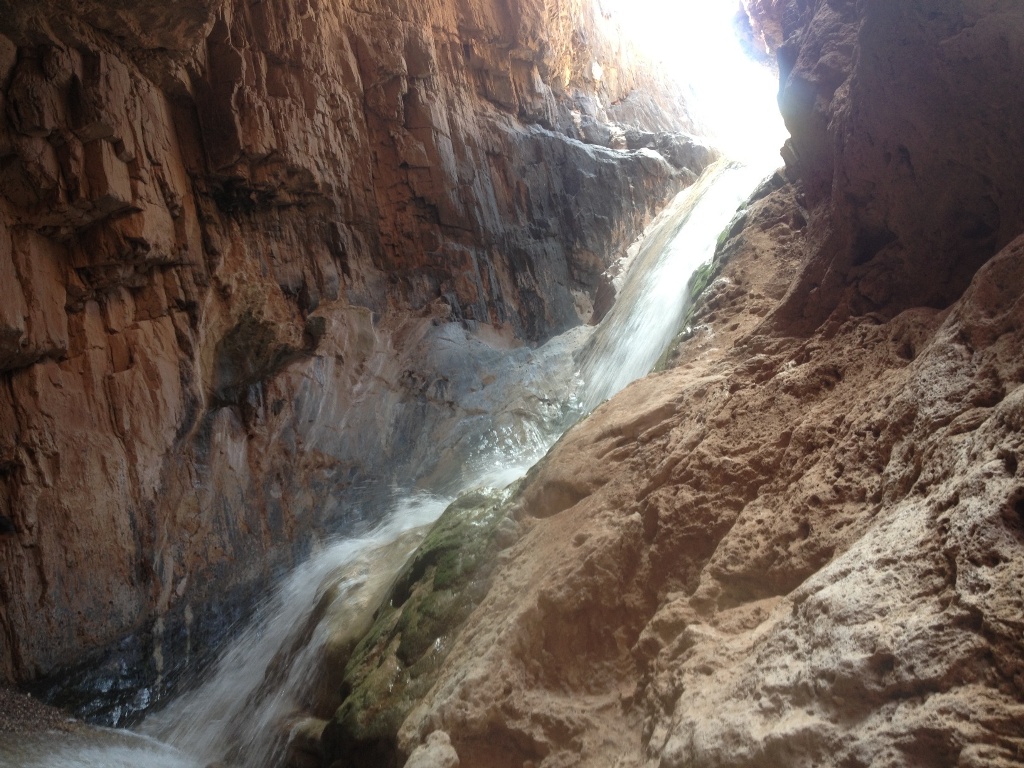
Travertine is a mineral deposit, mostly, calcium, laid down by this
creek over millions of years of flooding and flowing. It picks up
colors from other minerals that are dissolved in the water with it.
The grotto is gently curved, hiding the actual waterfall from view
at first, then gradually revealing it until, at last, you stand at
its base, unable to not look upward.
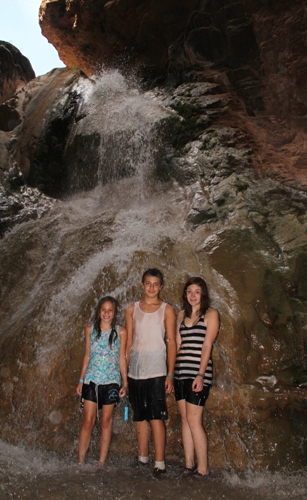
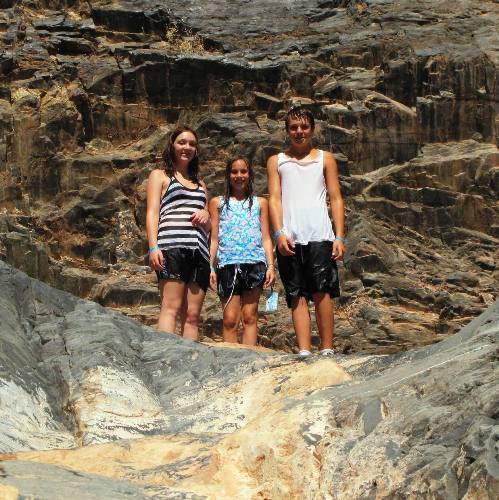
A Hualapai photographer was waiting at the falls to take photos of
anyone who wanted one. He took this good picture of the kids, but
the shot of me was so awful I didn't buy it, as it kind of made me
look like a serial killer who's just hidden a body in a waterfall.
Not the photographer's fault, of course!
The girls went back, but Zach and I hung out, me to take a few more
pictures of this stunning waterfall, and Zach to climb it.
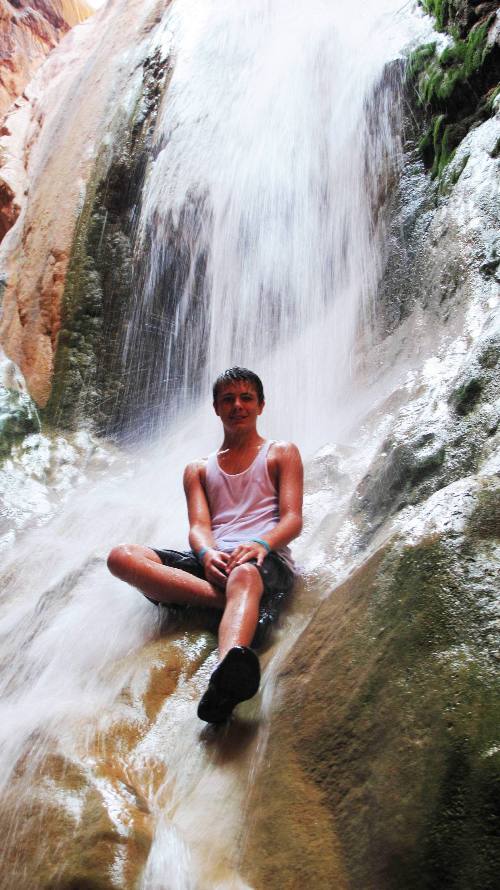
It's the nature of travertine that it tends to form very climbable walls.
Zach wasn't the only one climbing; and, indeed, I had gone up two or
three feet myself on my previous visit. But Zach left no wall
unclimbed. And, of course, he had to start with the toughest one,
through the waterfall itself.
But, after living in the Phoenix area all his life, and having
left it at about 105°, the cool water (not as cold as the river
water) was no doubt very welcome.
Walking up to the grotto, I had been so focused on dreading the
rope climb, I hadn't thought to look behind me. No matter; on our
return—after sliding down the grotto opening in the secondary fall,
and climbing back down the ladder (but taking a simpler path,
without the rope)—I realized that there was another, typical but
precious, view of the river.
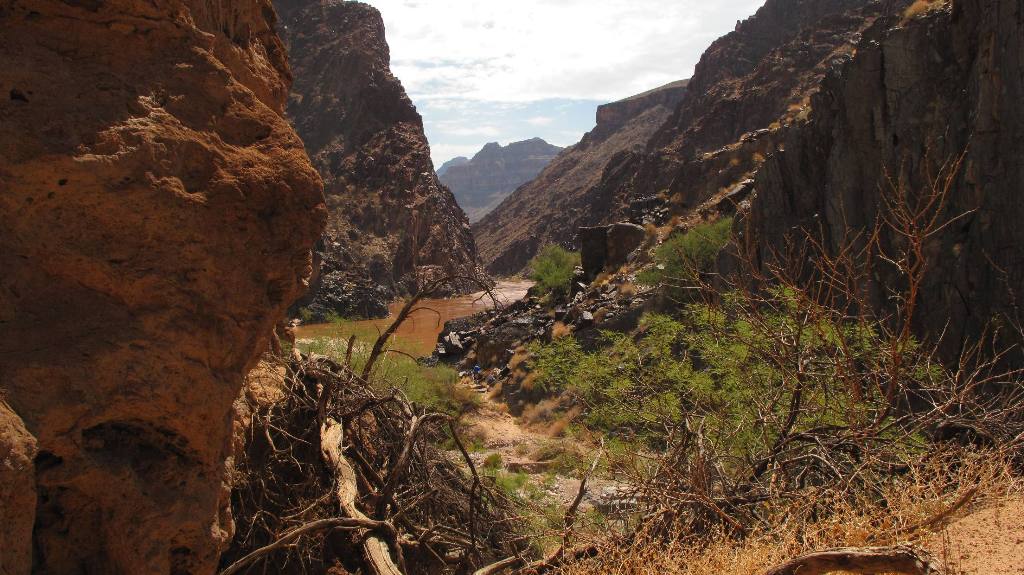
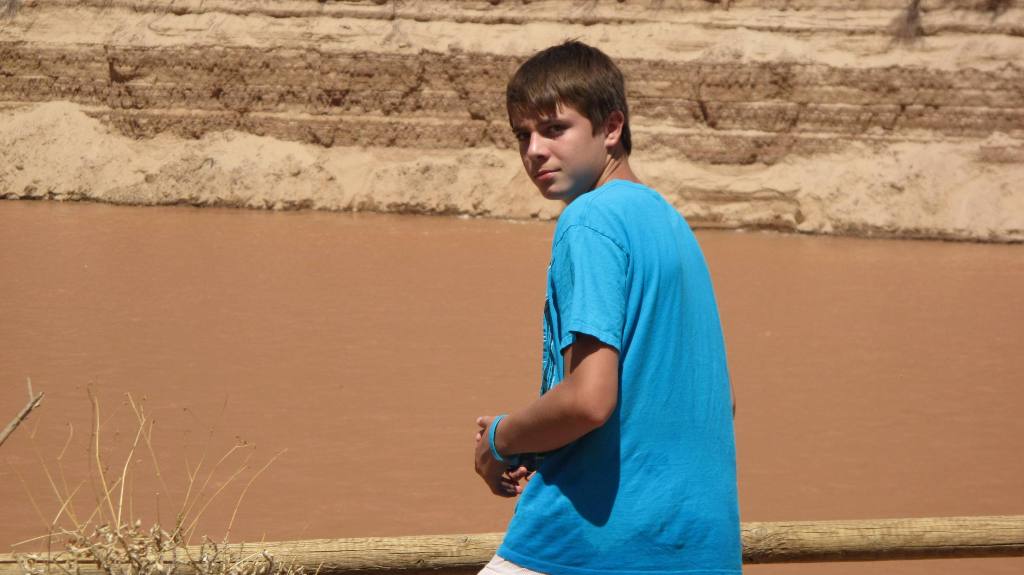
Yes, that brown ribbon is the Colorado River. This far downstream
from Glen Canyon Dam, the water is always this color, as it was
along the entire river's length before the dams were ever built. The
name of this color in Spanish is colorado, and was the name
given this river when Spanish explorers began exploring the
Southwest. The state is named after the river.
Our hike over, we returned to the boats and cast off. As before,
we came upon rapid after rapid—only one of which was anything that
would have challenged an oar-frame—but Kesley always knew just
where to hit for maximum soakage to everyone aboard the raft, but
him. That's okay, though, because the kids loved it. And, in between
rapids, there were more spectacular views and opportunities to share
my interest in geology.
I think it was Brianna who suddenly asked, "What's that noise?"
Indeed, there was a roaring up ahead that could be heard over the
sound of the motor.
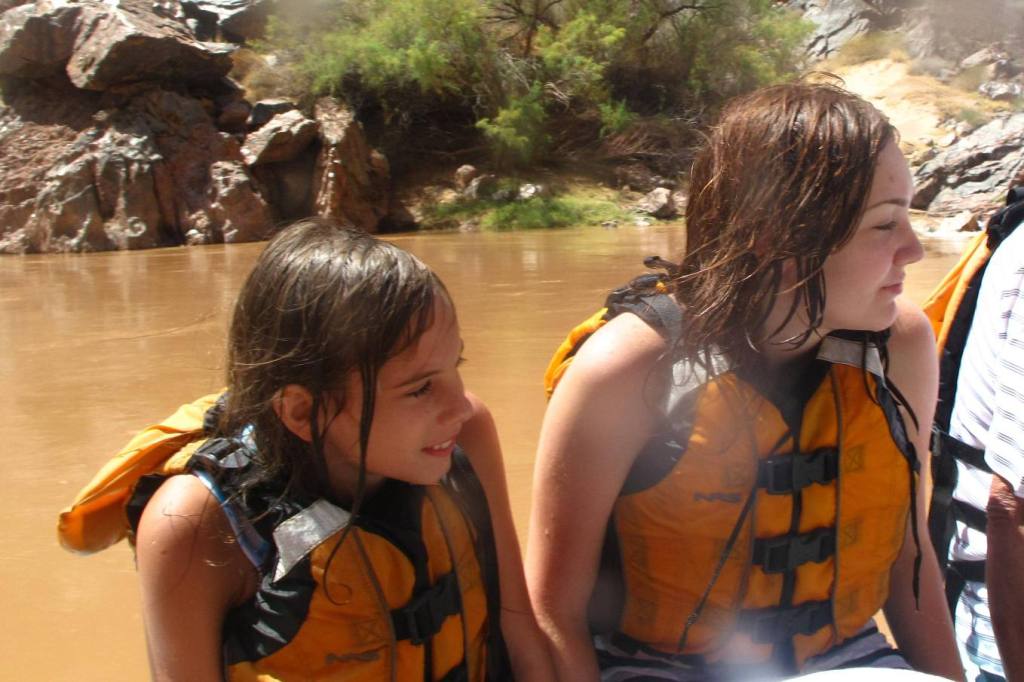
It was our final, big rapid and this one was big. Oh, no
Lava Falls (Grand Canyon's most notorious) but still, a definite 7,
(Grand Canyon rapids are measured on a 1-10 scale, rather than the
more common I-VI scale used on other rivers.)
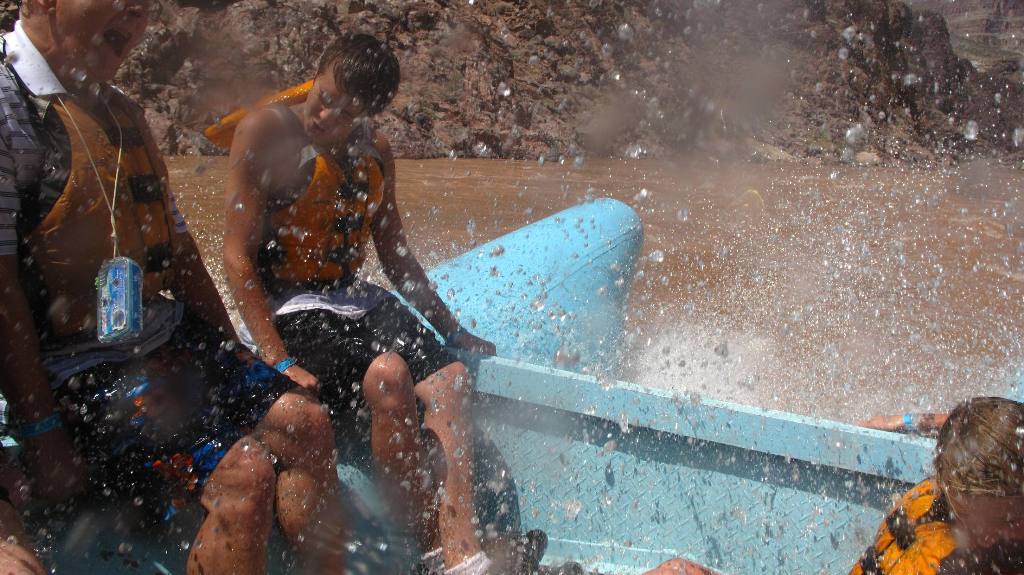
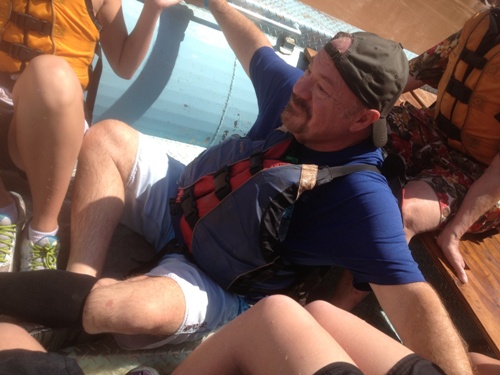
Kelsey warned us that this one would be rough, and that it might be easier
to hold on from within the raft, rather than by sitting on
the pontoons. So I took him at his word. The next thing I knew, a
tsunami of Colorado water poured into the boat, and pretty much all
into my mouth.—Which was not captured by the Hualapai
photographer, now on the river, trying to capture hot whitewater
action.
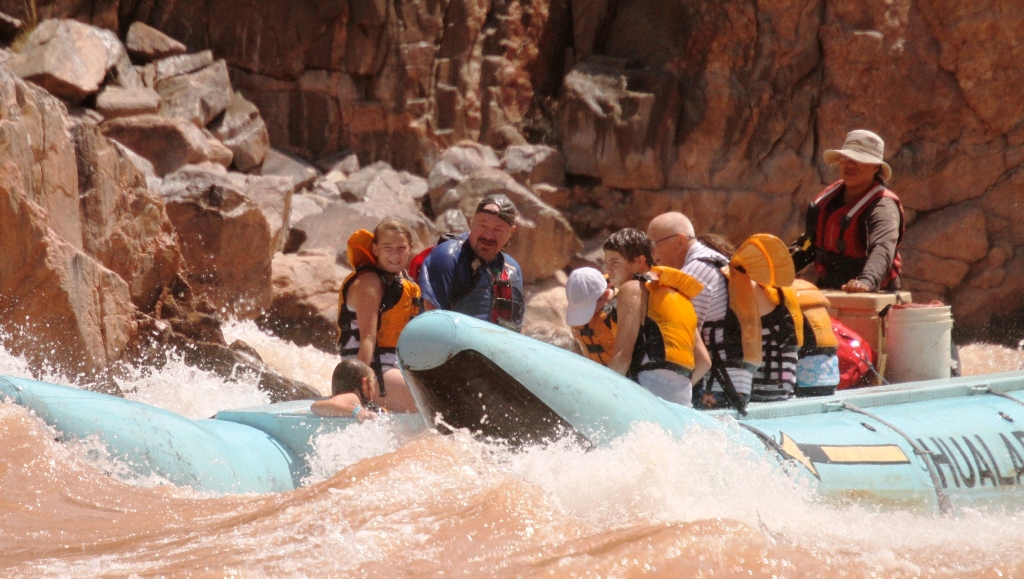
Once past the rapids, he took another stab at getting a good shot
of everyone in the boat. Note to self: If you want a good raft
photo, be sure and sit in front.
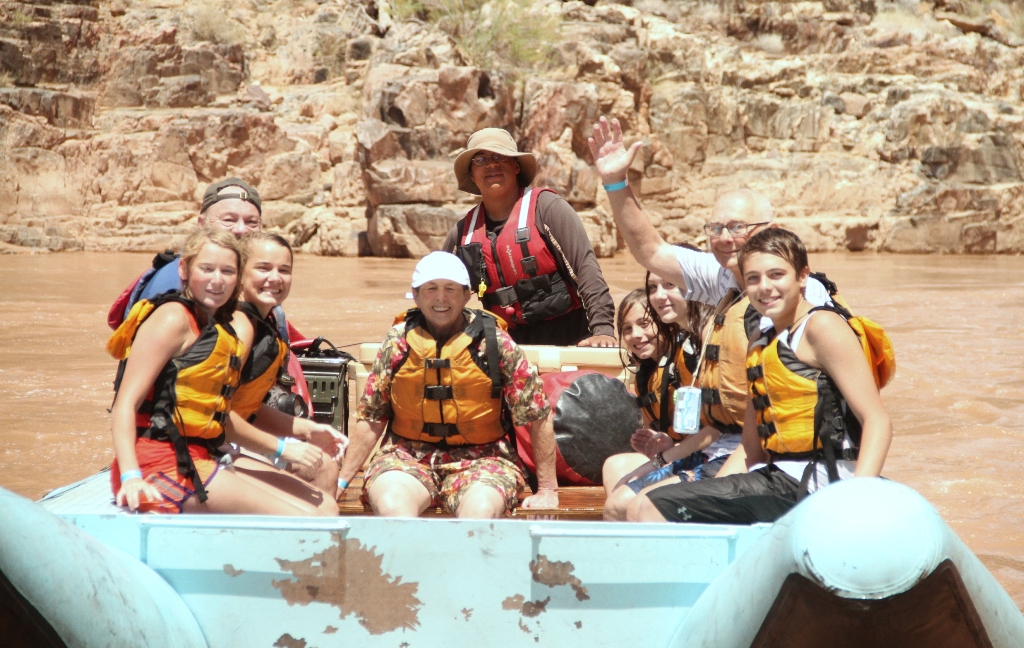
But at least the kids were well-represented, as Patricia was
clever enough to lean in.
That concluded the whitewater aspect of our trip. It was time to
break for lunch, after which we would cover some 20 miles more of
smoothwater and scenery.
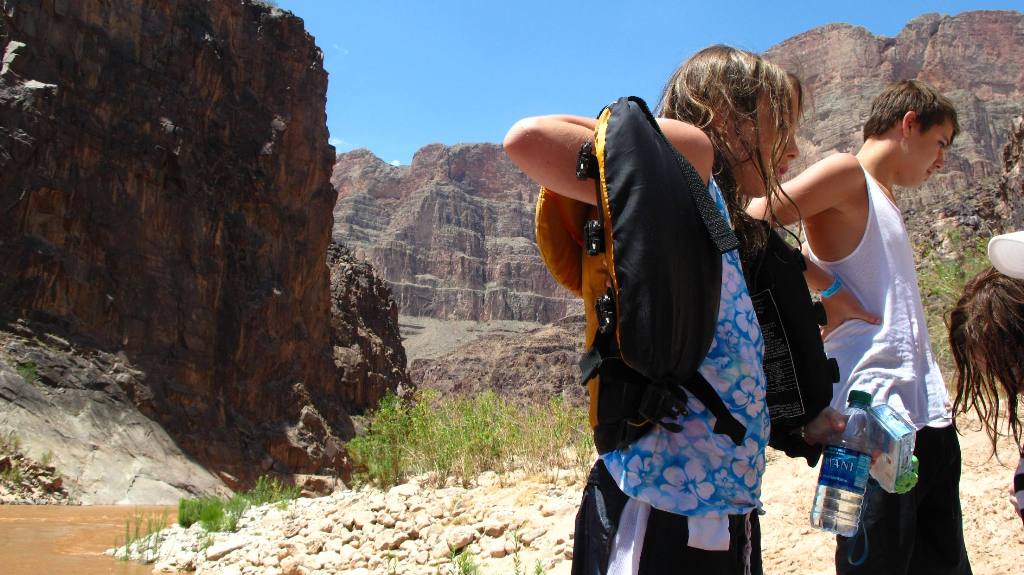
Yes, it definitely felt good to peel off the life jackets!
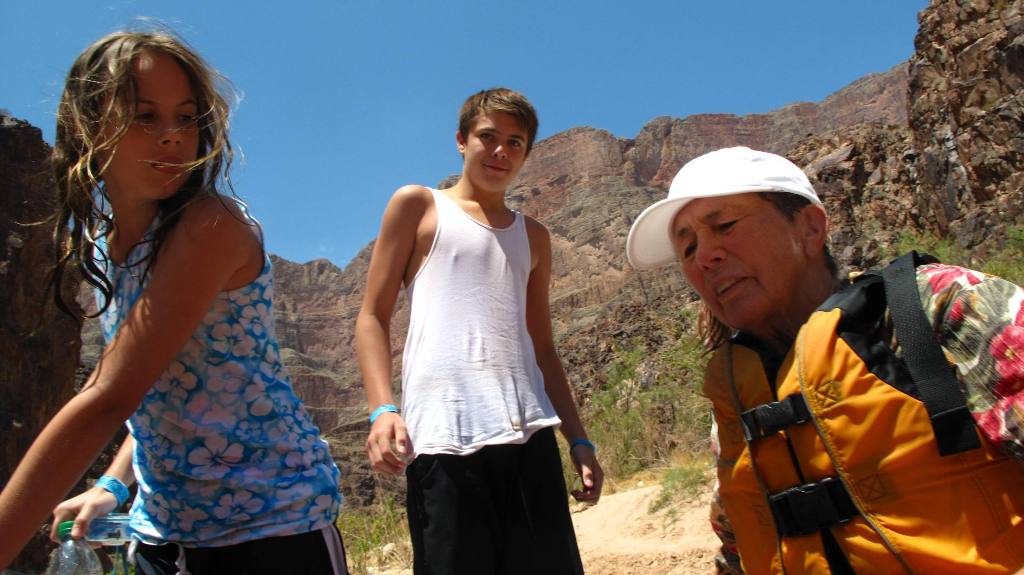
Lunch was distributed by the Hualapai guides, who had brought it
with us. It consisted of delicious sandwiches (I had ham and
cheese), chips, and water and sodas. The kids and I found
comfortable rocks to sit on, so we could enjoy our food and the
scenery at the same time.
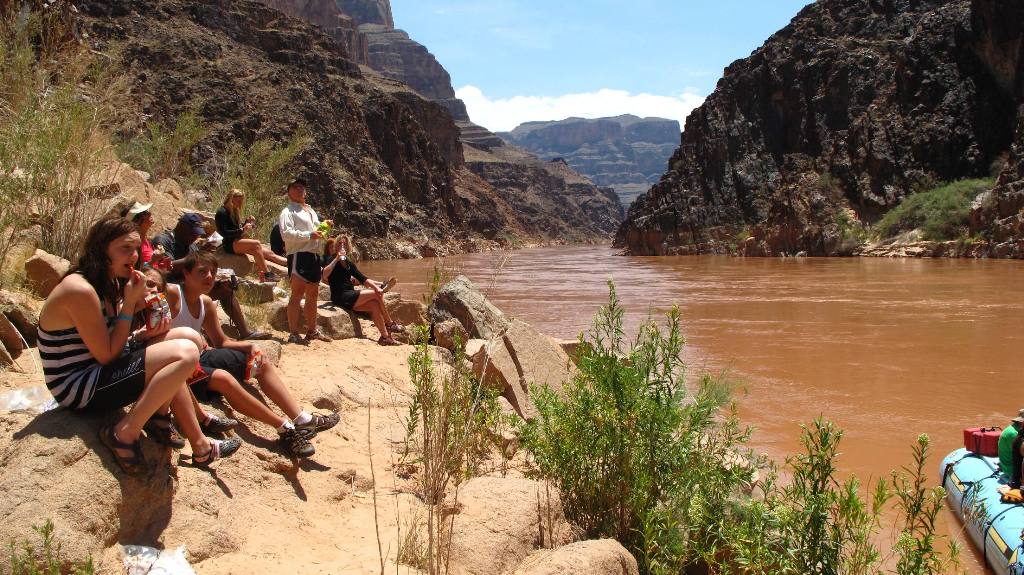
Actually, I was amazed at the number of people who did not
eat on shore. They remained on their rafts, seeking safety, I
suppose, from rattlesnakes and scorpions they assumed must be crawling
all over the place. (In reality, of course, rattlesnakes are very
shy and will never hang around where a bunch of people are gathered;
and scorpions are active at night so as long as you don't stick a
finger under a rock where one is resting, you won't see one in the
day.
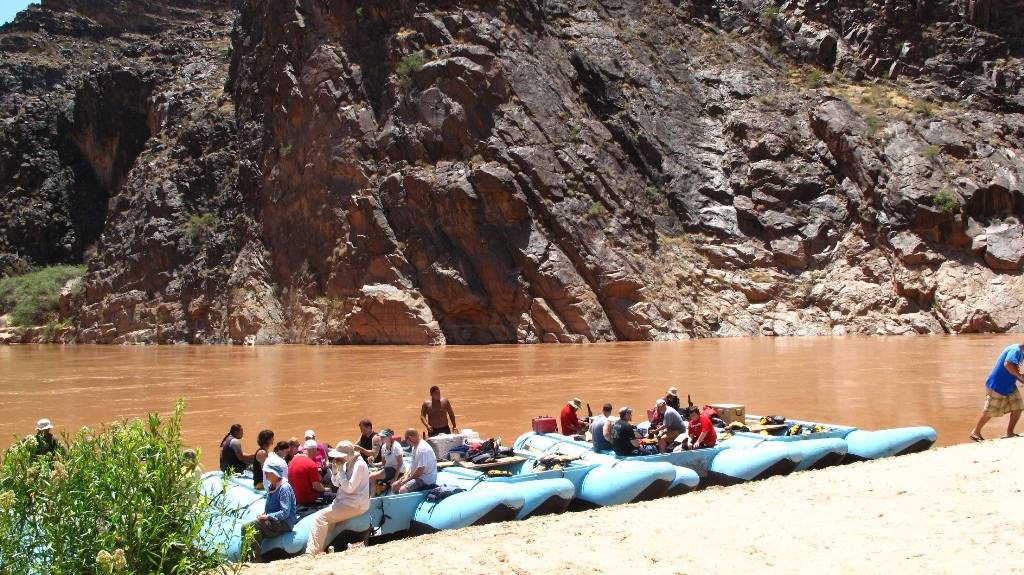
The Hualapai could not have picked a prettier place for lunch.
We were on a promontory that jut out into a curve in the river, so
there were different river views on three sides, plus a side canyon
behind us. Fast eaters had plenty to see while waiting for their
slower chewers.
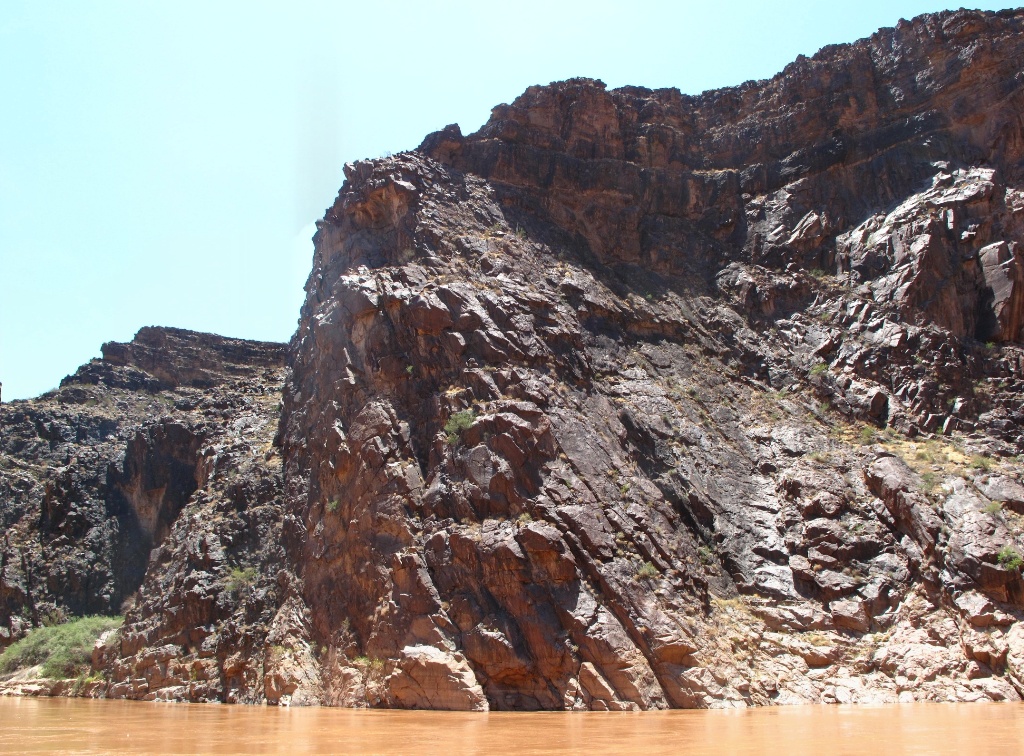
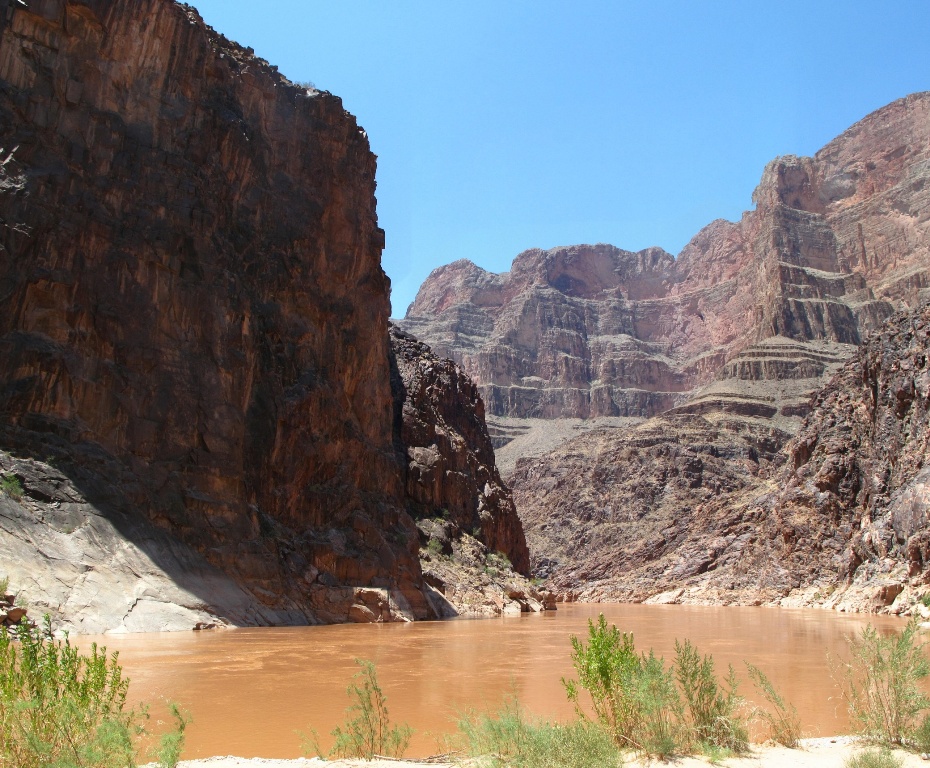
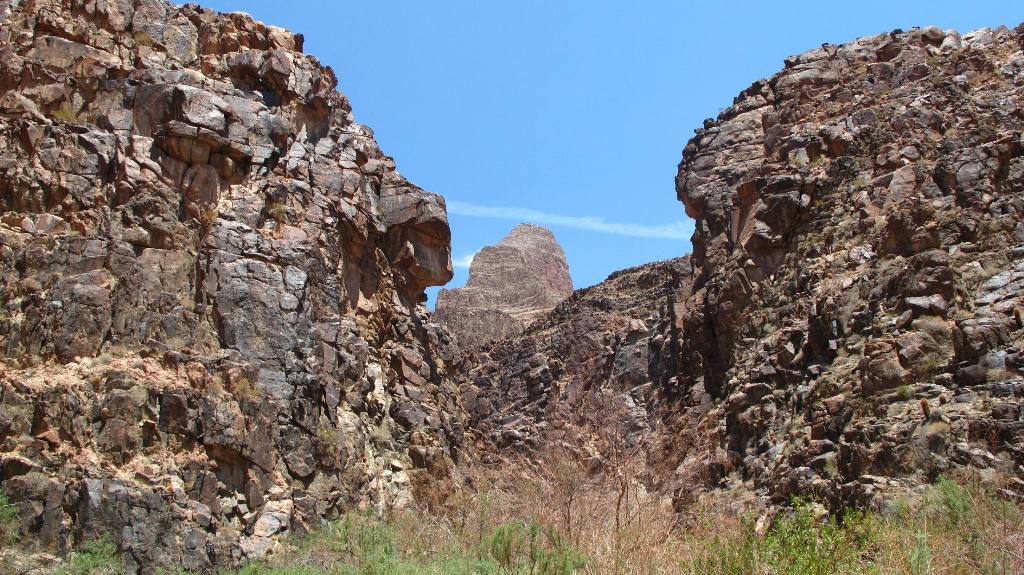
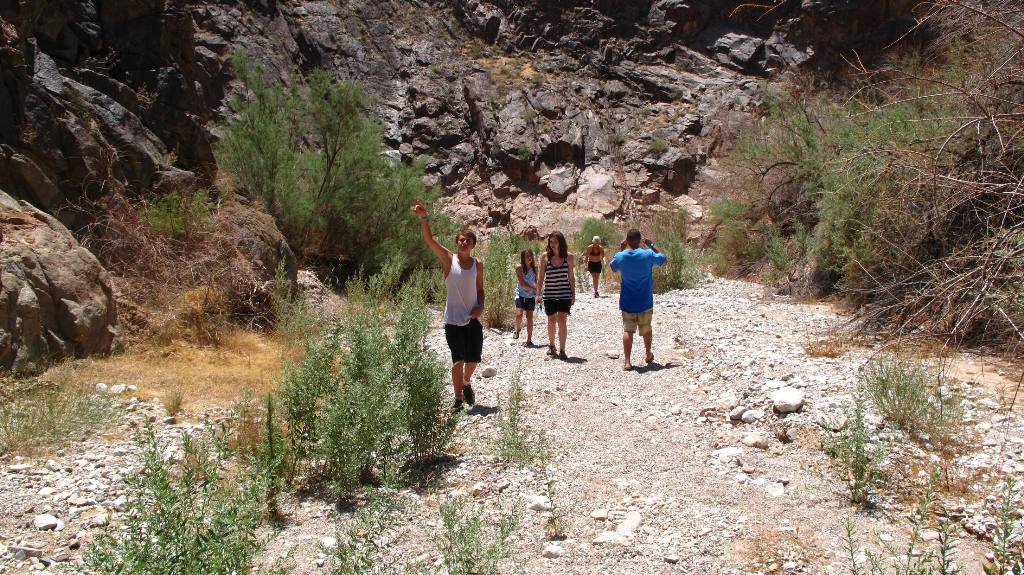
The side canyon doubled as a lavatory. Easier for the guys to use
than the girls, of course; on my previous trips girls generally
stepped into the water to relieve themselves. But our guides had
actually not said a word about bathroom etiquette ("Boys upstream,
girls downstream!") and the girls in my charge didn't ask. Besides,
the one downside of our picnic spot was that there was no shallow
water to safely step into. So the side canyon was pretty much our
best bet.
So, after lunch and local siteseeing, we re-boarded our raft and
continued to gaze at the most amazing rock formations, ranging from
lava/granite/basalt to sandstone and limestone, sometimes all mixed
together in a conglomerate.
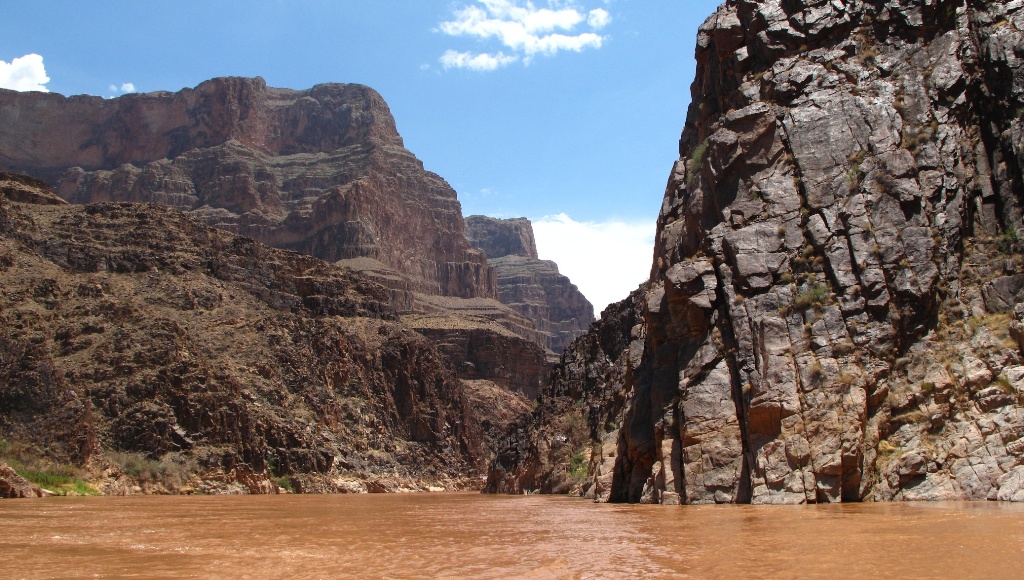
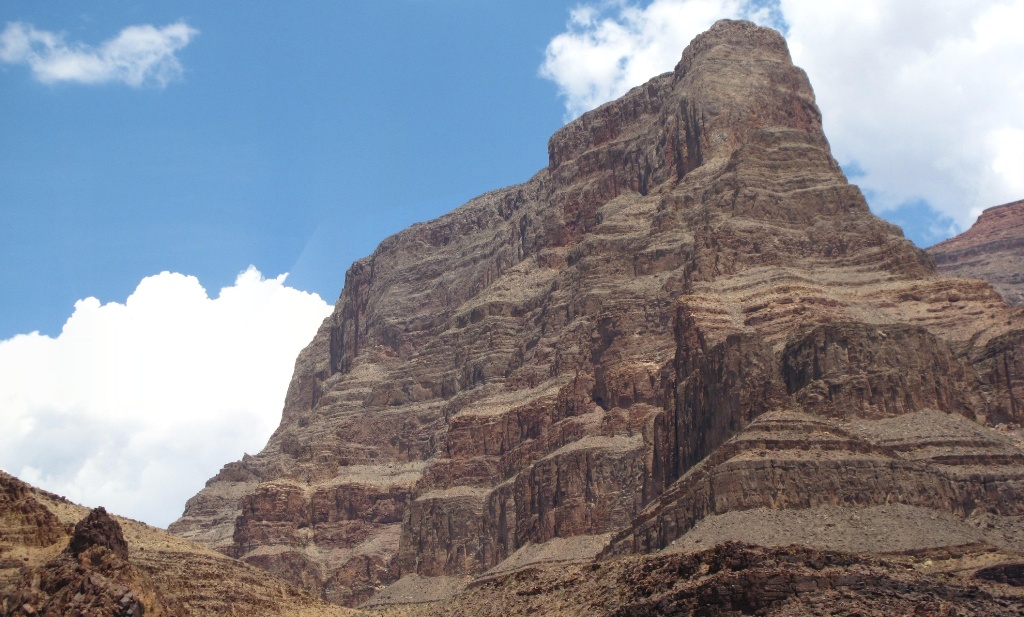
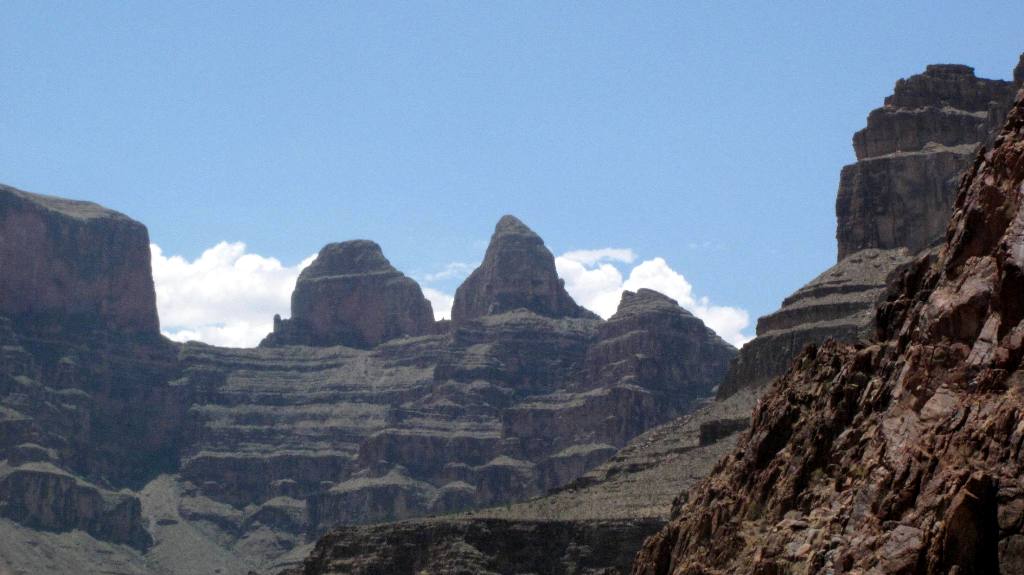
I've been told that all the formations have names; many
have more than one as they've been identified by more than one
person, each unaware of any previous monikers. But some of the
formations are so obvious that you can almost guess at the
name and be right. Below, for example are The Three Sisters.
(The third sister is really short.)
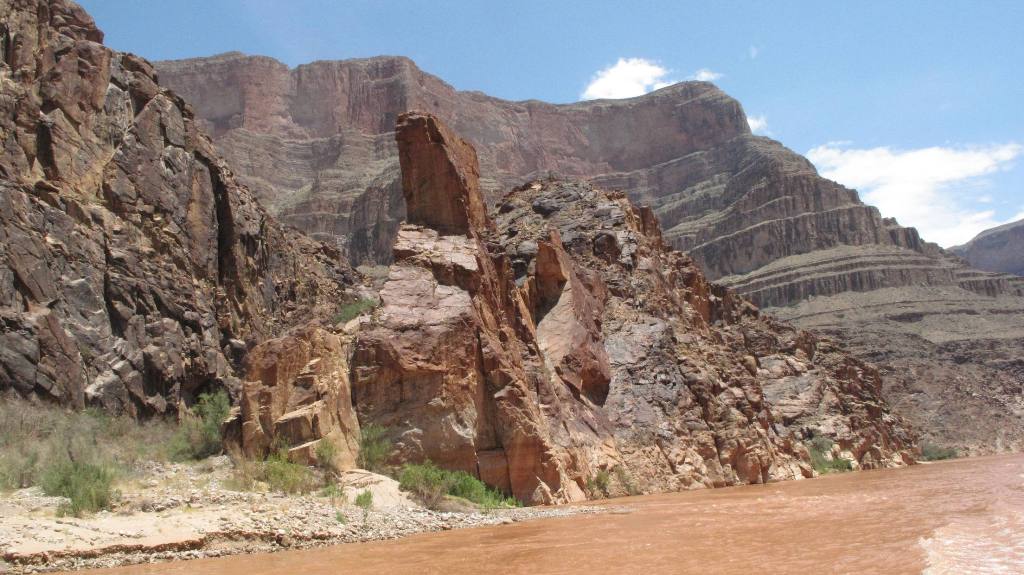
I was particularly taken with this sandstone outcropping, which I
named The Anvil. (It looked more like one when I first
noticed it, but by the time I could get the camera ready we had
passed the optimum photo angle. Still…should you ever go by this
area, and you notice this formation, be sure and tell everyone it is
called
The Anvil. That's how you get these names to stick.
Besides me and Kesley, there was one other adult male on the
raft. Nice guy, but he never quite seemed to grasp the scale of the
place. He had done his homework and knew about the Anasazi granaries
(which are far upstream), and kept pointing to this or that
limestone niche in the distance, asking Kesley if that might be a
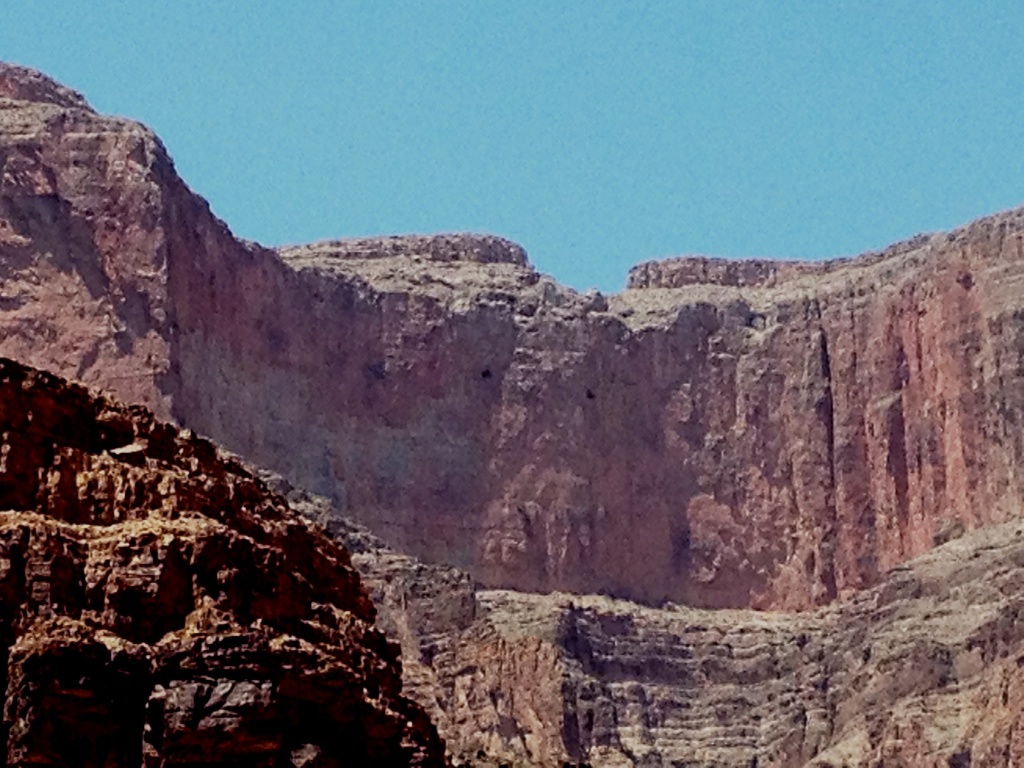
granary. I've been to the granaries, and they are about the size of
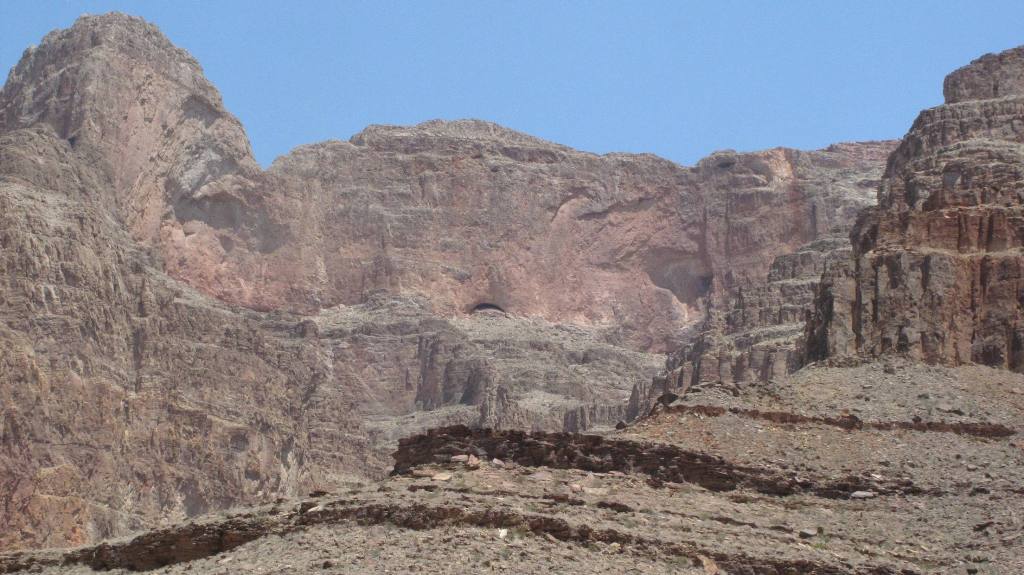
a modern 5x5 storage unit, though not so tall. The limestone niche
in the photo below is about the size of a grand ballroom, but he
kept thinking it must be small since it looked nearby to him.
The niche in question is shaped like a sideways parenthesis, and
is dead center in the photo. It's also probably a mile or more from
the boat.
So we reached a stretch of flatwater and Kesley announced that we
could swim if we wanted. By now it was pretty warm and the idea of a
dip, even in 50° water, sounded delightful. So I jumped in,
immediately followed by Zach, Patricia and Brianna. (The other
family did not indulge.)
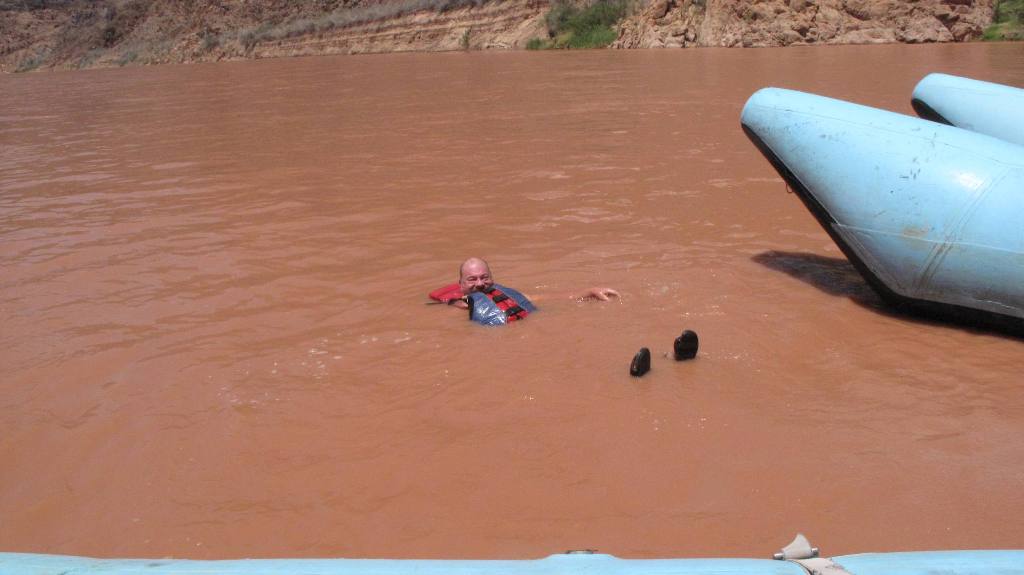
It wasn't until I was in the water, that I learned that
Kesley did not have a means for getting back into the raft.
The motorized rafts ride a lot higher in the water than the
oar-frames I am used to. With those, a good kick and you're halfway
in the boat; anyone handy then tugs on your life jacket and you're
the rest of the way in. Not here, though. Kesley tried to pull me up
by the straps, but because the waist wasn't as tight as it should
be, the jacket just pulled over my head. We tried it from the stern
as well as the bow. Finally, I found a place on the motor that
wasn't too slippery, put my foot there, put my back against a
pontoon, and forced my way up like a rock climber between two sheets
of rock until I was close enough to be pulled the rest of the way.
I got in, but when I asked Kesley why they didn't have a little
rope ladder, he said it would be too big and heavy. I was thinking
one with, like, ten rungs; but, whatever.
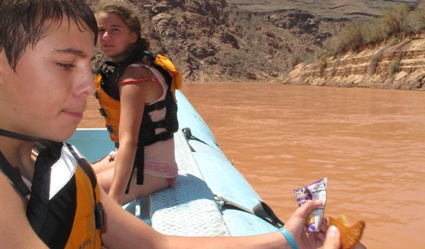
After the excitement of being landed like a tuna, Kesley passed out an
afternoon snack of cookies and chips.
And then, finally, we reached Grand Canyon West, the Hualapai's
hub for tourism. Or, rather, we reached the river below it.
We got off the raft at a real dock, and climbed a rock staircase to
a clearing large enough for three helicopters to land at
once.
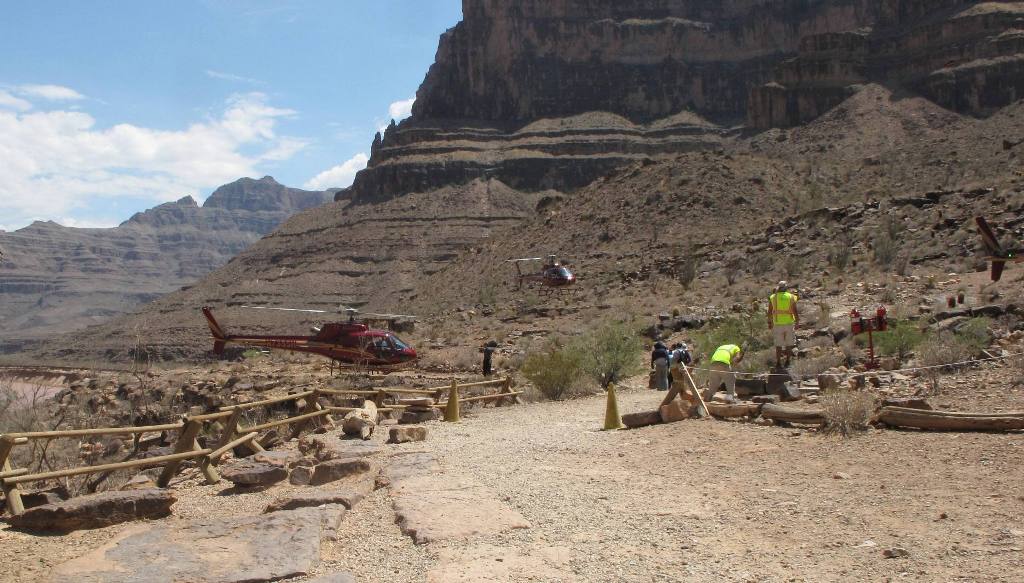
There were no signs so it took a few false starts before we
figured out where to check in. They had to weigh us with our stuff,
so as not to overload the helicopter. It was gratifying to learn
that I've lost enough weight since my last helicopter ride, that no
one urged me to buy extra flight insurance.
All three kids were excellent travelers, dealing well with delays
and such. Which was a good thing, because despite having six
helicopters at their disposal, three of which could land at a time,
there were so many rafting passengers as well as tour boat
passengers, that we had to wait over 20 minutes for our turn.
And there wasn't a single complaint from any of the kids, who
used the time to play with their phones or simply enjoy the view.
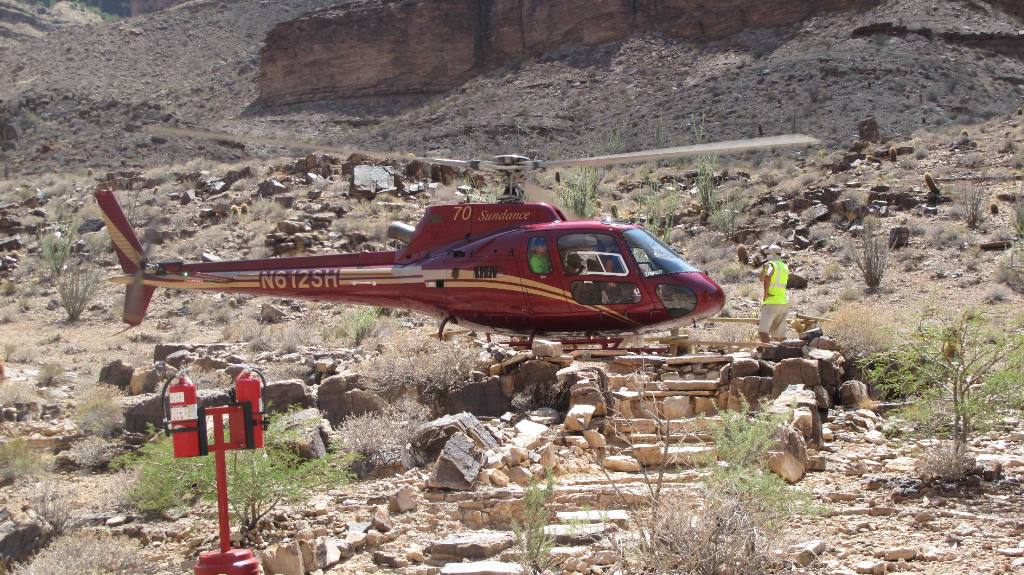
Presently, the manager of the helicopter operation called us
("Raft number 5!") and we stood a few yards away as our chopper
landed.
Passengers were moving both ways; so we had to wait for the previous occupants
to exit before we could board.
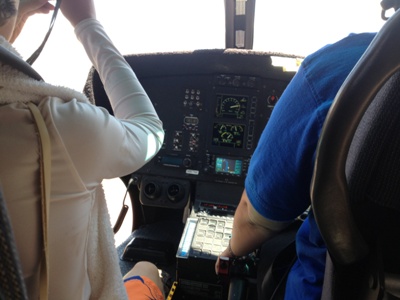
They loaded all four of us in back, with three passengers and the
pilot in front.
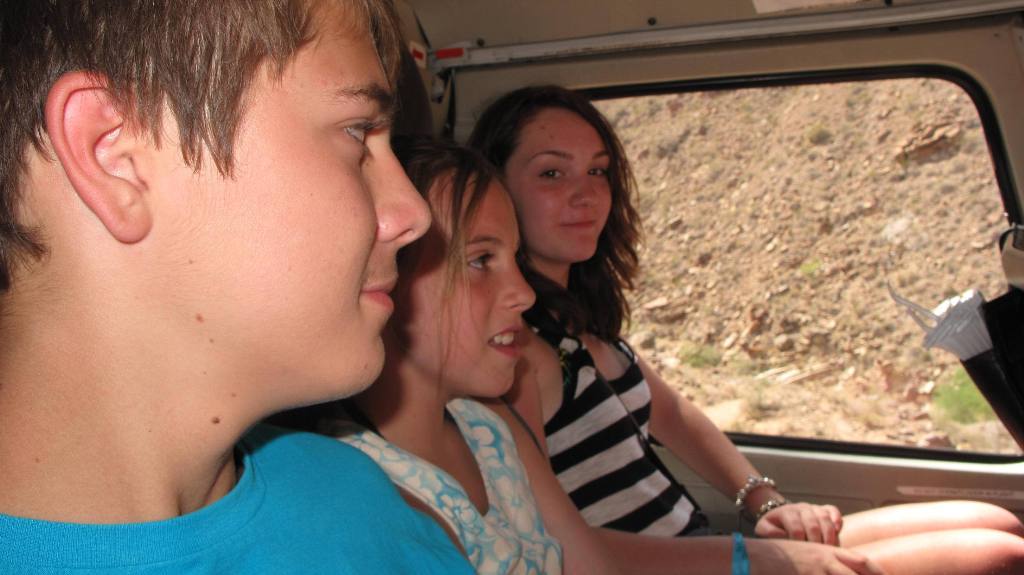
As we ascended, and looked down on the river, watching it seem to
shrink, I was reminded of Garc?a L?pez de C?rdenas, head of the
small contingent of the first Europeans to see the Grand Canyon.
C?rdenas, who apparently suffered from the same inability to
perceive scale as my raft-mate, was unimpressed, assuming the
Colorado River to be about six feet wide. (He also thought the
Canyon was about 300 feet deep. It's actually about a mile.)
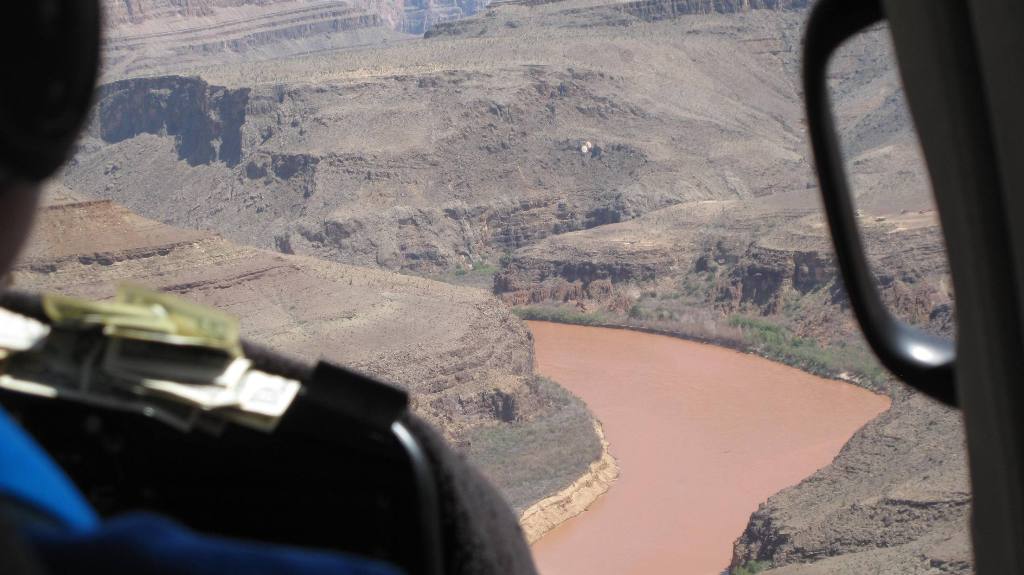
It only took about five minutes to climb to the rim.
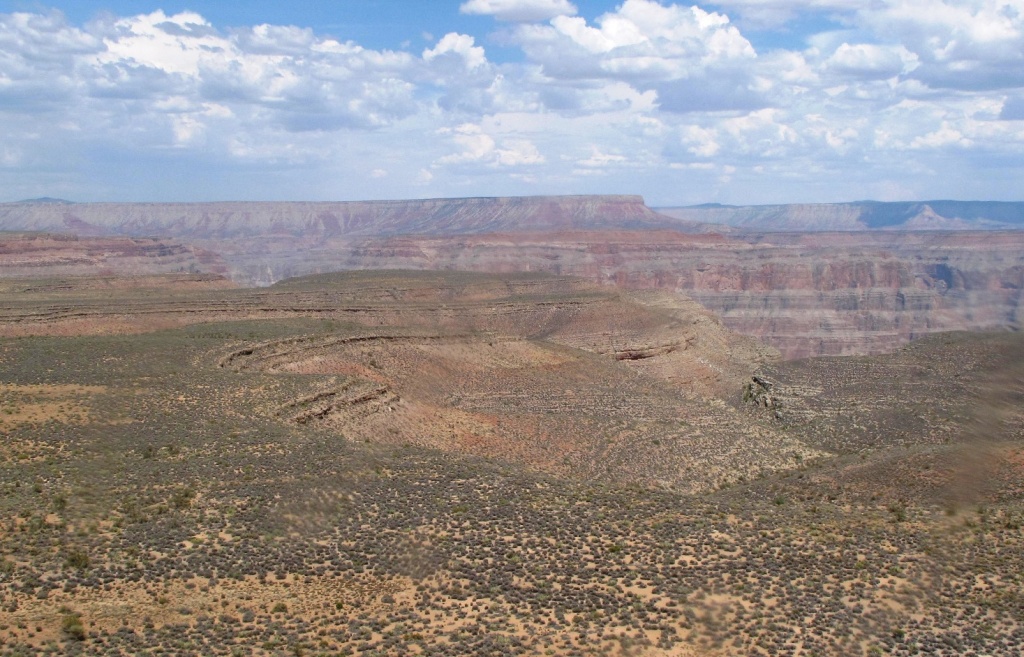
We landed without incident and headed to the Grand Canyon West
complex to wait for the photos taken by the Hualapai photographer to
be made available, and then to catch our bus back to Peach Springs.
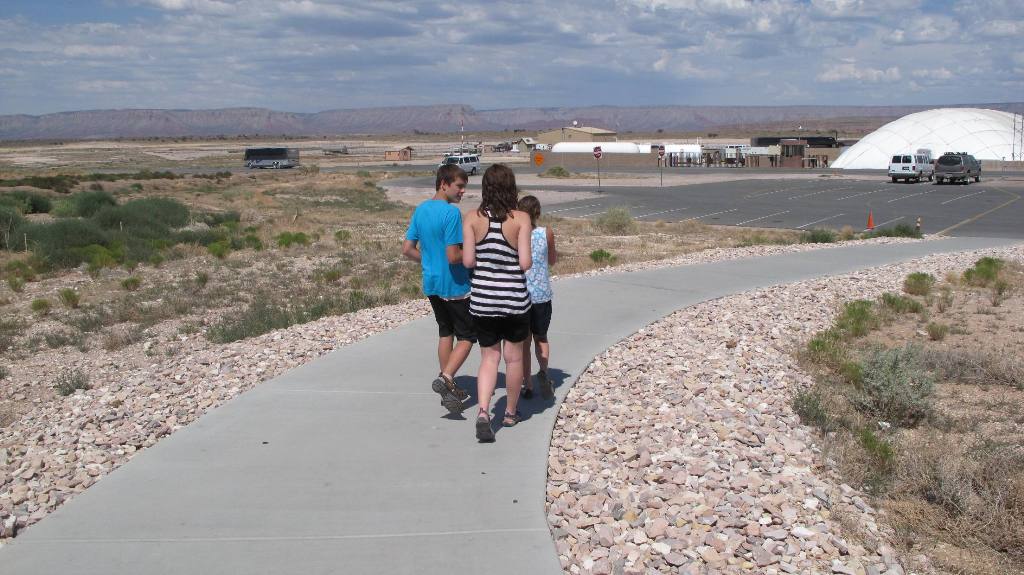
They took forever getting the photos ready. They were
digital, so I don't know what the holdup was. True, there were a lot
of photos to present. The photographer had been with us all
the time—I think he was also a river guide—and had taken many
photos. Sadly, he hadn't quite mastered whitewater photography.
Several pictures would have been very exciting if they'd been taken
one-tenth of a second sooner. Instead, they were simply photos of
splashing water, with the boat and passengers completely obscured.
They do have a nice way of selling them, though. You can either
pay for a print, or buy a $5 flash drive with the photos you select;
and those photos are just under $10 each. You can buy the entire set
for $133, but that will be pictures of everyone on all the
rafts, none of whom you know. I bought three pictures, on the flash
drive, so the cost was quite reasonable.
I also got Patricia a dream catcher she liked, as a souvenir.
Brianna couldn't find anything she liked, though. (And later, I got
Zach a wooden flute.)
I also picked up a couple of cool T-shirts and a Hualapai River
Runners ball cap.
Our bus was air conditioned, which is good because it took
two-and-a-half hours to return to Peach Springs.
Before we arrived, Zach's mom, my daughter, Jennifer, called.
"I'd be more comfortable if you stayed another night,"
she said.
"Then leave in the morning."
I agreed, because I had hoped to take the kids on a little more
sightseeing before we got back. I learned later than Jenny thought
we would have to drive the Denali over the rough Diamond Creek road
in the dark, not realizing that the Hualapai Lodge, where the bus
returned us, is right on Route 66.
And we lucked out. The lodge had exactly one room left,
which we got. After unpacking (again) and having an awesome dinner
in the Lodge cafe, and after the kids spent a little time working
off steam in the exercise room, we turned in, promising each other
to sleep in late, before continuing on tomorrow's adventure: Seeing
Grand Canyon from the Rim.