|
By: Paul S Cilwa |
Occurred: 9/26/2010 |
|
Page Views: 1,160 |
| Hashtags: #MonumentValley #Arizona #Utah #FourCorners #DigitalPhotography |
| Michael and I take his sister, Surya, to Monument Valley. |
| Estimated reading time: 7 minute(s) (1533 words) |
Monument Valley is located at the Four Corners region, where the
northeastern tip of Arizona touches the tips of New Mexico, Utah,
and Colorado. It is not right at the corners. The area is actually
part of a huge, state-straddling Navajo reservation, which means
its sovereignty is Navajo. Thus Monument Valley, which would be a
"national park" anywhere else, is a "tribal park", with more
reasonable prices, even in the gift shop and restaurants.
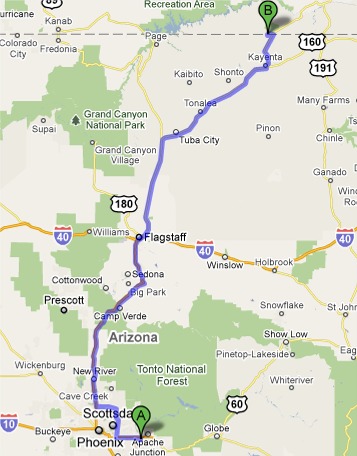
We started out by picking up Surya from church, where she had
just finished teaching Sunday School. We then returned to the church
to pick up Surya's forgotten glasses. But then we were on our way.
It took an hour to get "out of the Valley", another to reach
Flagstaff (where we fueled up and got lunch), another to Tuba City
(on the reservation), and another to Kayenta. We really made pretty
good time, mostly because I did not stop to take pictures all
along the way. There was plenty of beautiful scenery to catch our
attention (and our breaths) but I wanted to get to Monument Valley
by sunset, arguably the best time to view the rock spires after
which the place is named.
Monument Valley was born of Jurassic era sandstone, made of mud
from sea sediments. When the land uplifted, erosion wore away all
but the oddly placed spires. Erosion continues, of course, so that
each year the monuments have been altered by fractions of an inch.
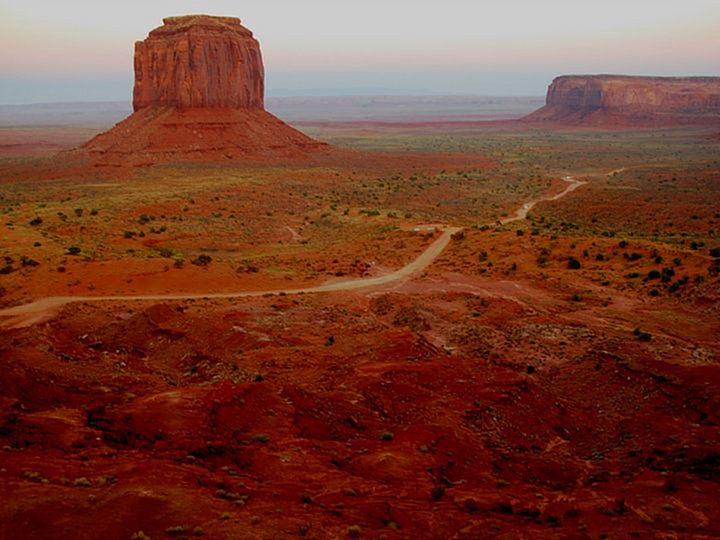
The monuments begin, sporadically, before you actually get to the park.
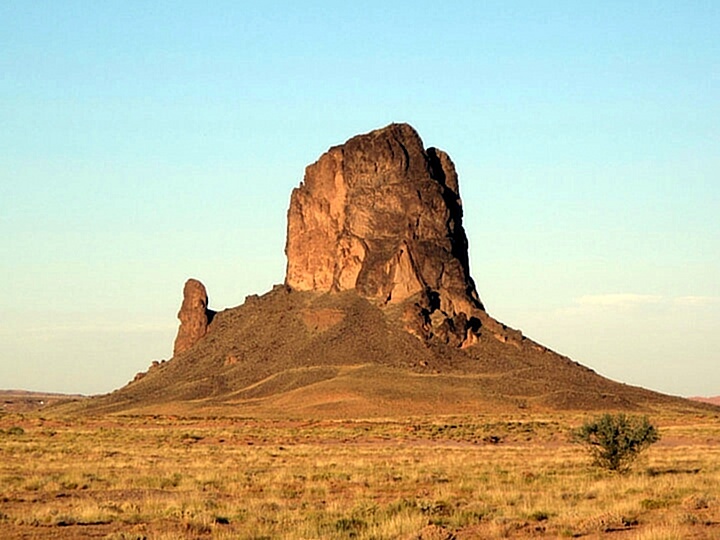
Although the monolith above originally caught our attention, you
have to realize that there are others near it.
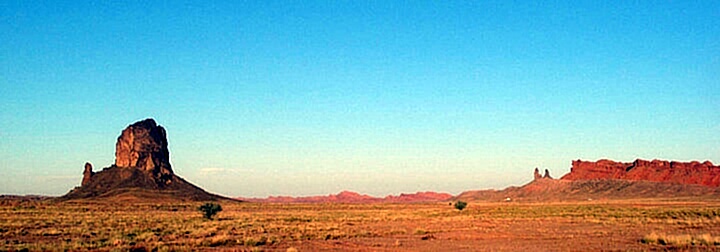
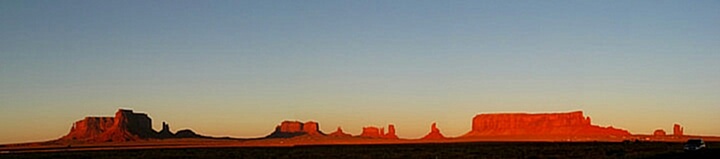
And, in fact, as we got closer "monuments" (monoliths and massifs)
increased in frequency, and the red of the sun added to their
naturally ruddy hues.
The Navajo Nation adheres to Daylight Savings Time (since it spreads
over four states, only one of which does not), so it was 7:30 pm
local time when we pulled up to the entrance kiosk. The entrance fee
was only $5 a person. Since closing time is listed on the park's
website as 8 PM, I asked if we had to be gone by then.
"Oh, no," the gate person said. "Stay as long as you like.
But the gift shop and restaurant will close at 8, and no one else can
come into the park until morning."
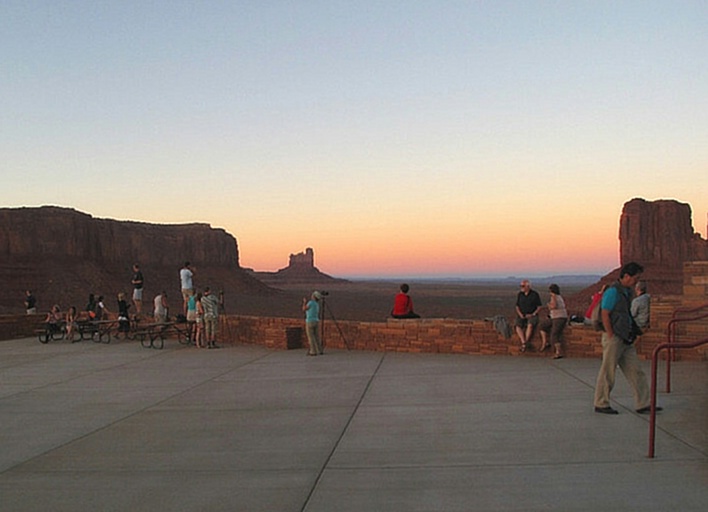
The visitor center includes a beautiful hotel called The View, a
restaurant and café, a gift shop, and a large deck from which one
can look into the valley and see the monuments set off to best
advantage. Plus, the sun was just setting so the view of The Mittens
and Merrick Butte was breathtaking.
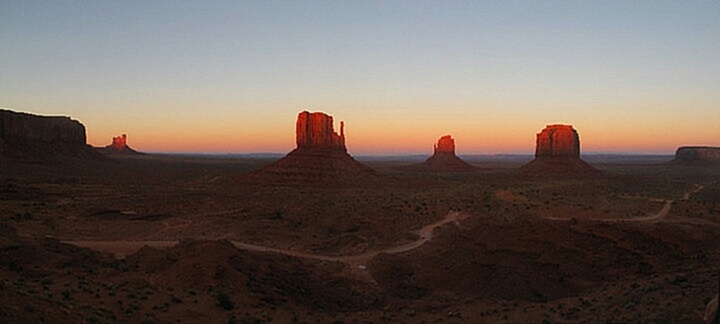
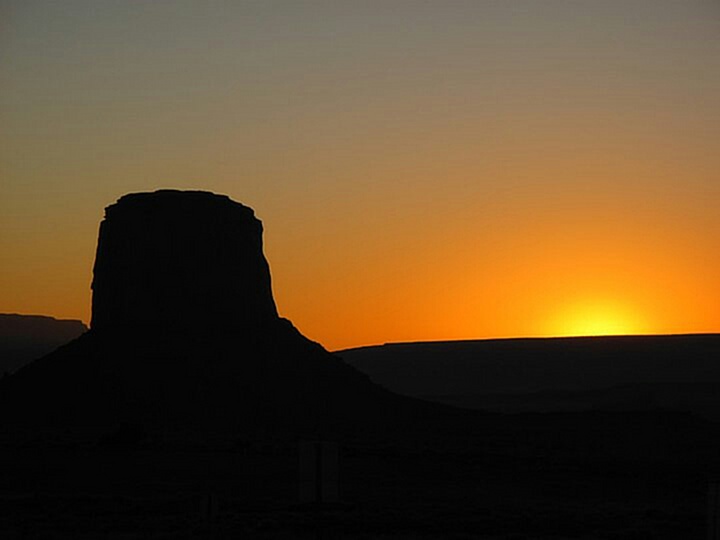
We were looking east with the sun declining behind us.
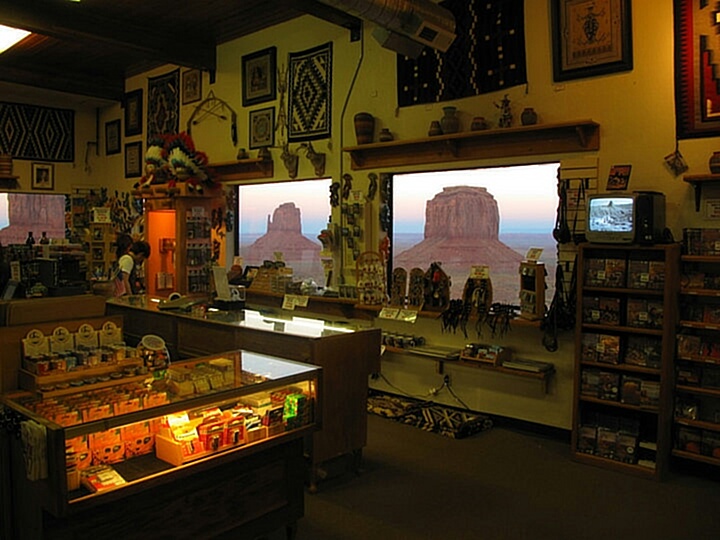
Of course, the twin facts that there was a gift shop, and that it would
be closed in a few minutes, proved irresistible to Michael and
Surya. How delightful to find that even the gift shop was designed
to show off the monuments: Those are windows in the photo,
not paintings!
Not being as interested in curios as in the pace itself, I left
Michael and Surya shopping to take a look over the edge of the deck
at one stretch of the road we'd shortly be driving.
If this place looks familiar, it's because John Ford shot all of
his Westerns here. It has thus become the quintessential idea of
what the West was/is like.
There were a pair of Navajo women taking turns dancing, in
traditional garb, on the deck. I know that Navajo dances are
ceremonial and laden with meaning; but there was no signage
indicating the meaning of the dances they were doing. Still, based
on the outfits, I would guess they described a visit by the
Thunderbird.
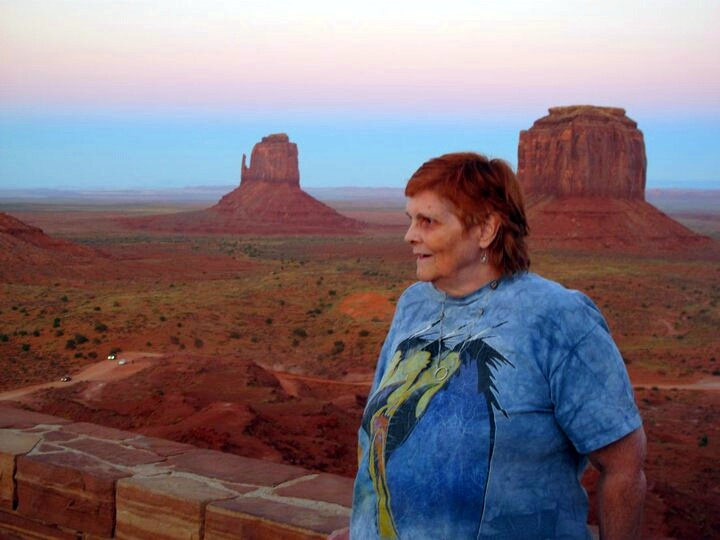
Finally, Surya emerged from the gift shop and we waited for Michael. It was a
beautiful place to wait, and a pleasant time of day to do it.
After Michael rejoined us, we got into the car to take the road
that winds around the monuments. This road is dirt and quite rough,
as the sign warned us. I switched to 4WD but it really wasn't
necessary; any car should be able to navigate this road though I
wouldn't recommend trying to thread a needle while doing it.
The sun having already set, it was quite dark before we had
descended into the valley. Still, I was determined to take as many
pictures as I could. After all, there probably aren't many nighttime
photos of Monument Valley. Certainly, there were no other tourists
on the road.
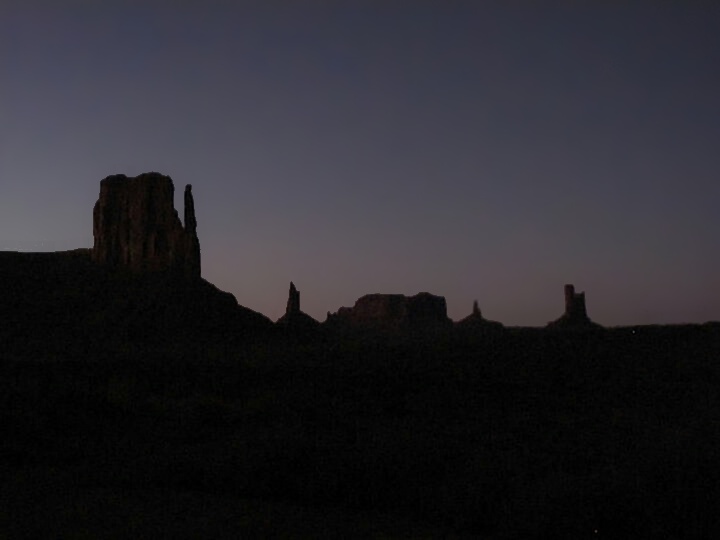
The buttes are clearly stratified, with three principal layers. The
lowest layer is Organ Rock shale, the middle de Chelly sandstone and
the top layer is Moenkopi shale capped by Shinarump siltstone. Of
course, at this hour, only their outlines were visible.
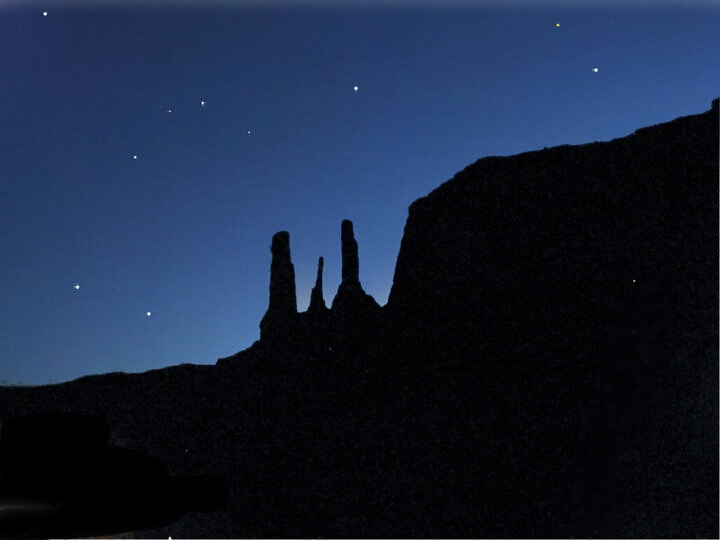
The first "star" to be seen was, of course, the amazingly bright
conjunction of Jupiter and Uranus.
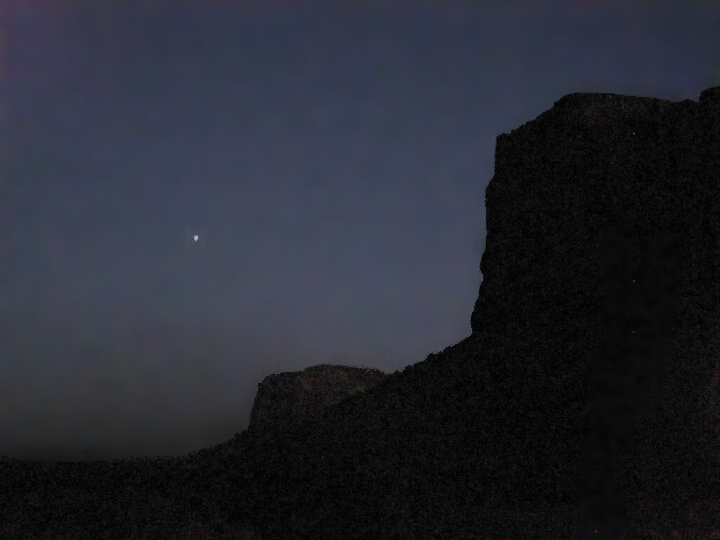
By now the darkness was such that I had to end my reliance on ISO
3600 "film" in my digital camera, and switch to actual time
exposures to capture enough light to create an image. This would
have been easier with a tripod; I own two full-size tripods but the
"quick-connect" component of each is missing. So I had to use the
car itself as a stable foundation for the camera.
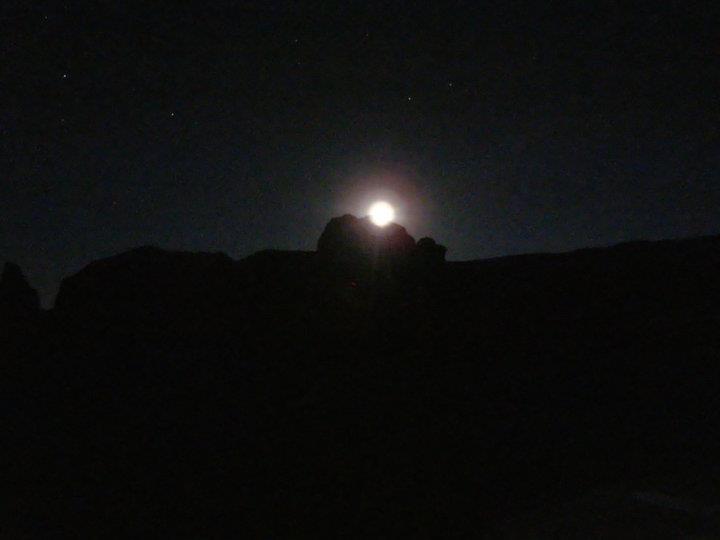
And then the moon rose over one of the buttes.
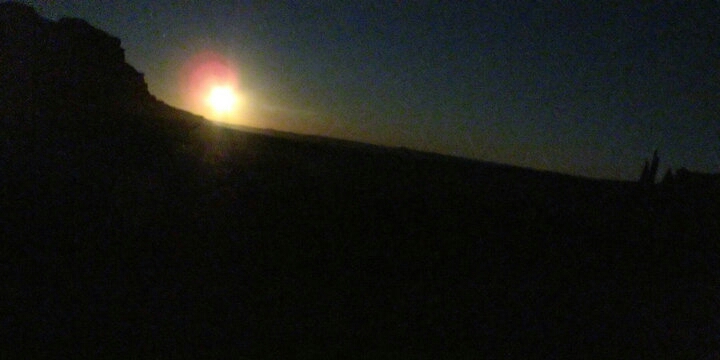
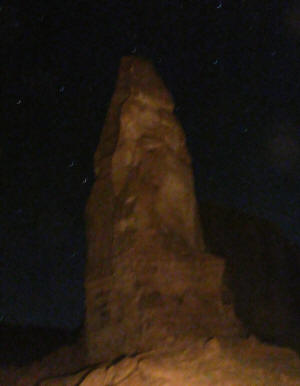
We had waited for the moon to rise at a scenic turnoff. It had been so
dark we couldn't tell what was so scenic as to require a turnoff.
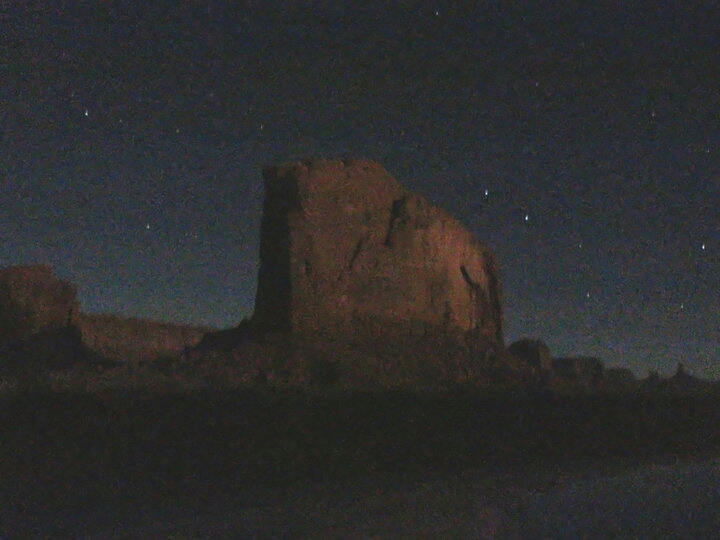
But by moonlight we could see a huge spire just ahead of us. A sign
said it was "Thunderbird Butte".
I tried capturing its image by moonlight alone, but the moon
wasn't yet high enough to make it possible. I got the photo on the
left by using my headlights to augment the natural lighting.
We made our away along the road, literally stopping every couple
hundred feet as a new aspect of butte and moon made for a compelling
image or at least a gasp of breath. We would stop and turn off the
car lights, and then exhale with awe as a new wonder came into view.
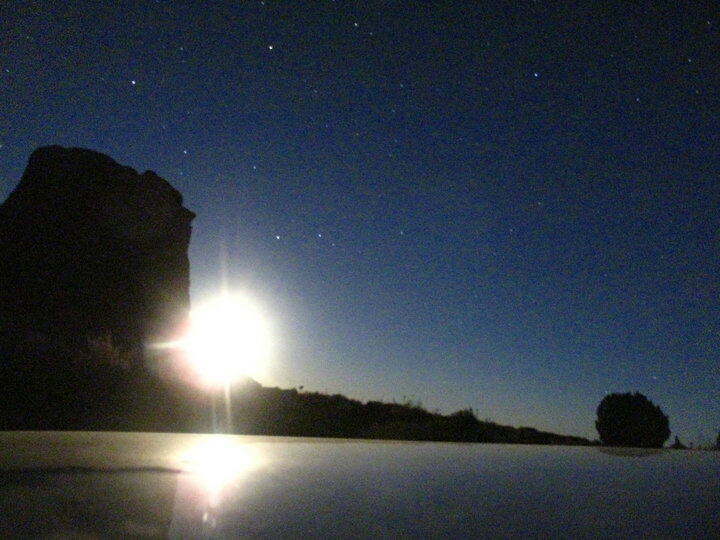
At one point we were treated to a textbook-perfect view of the Big Dipper.
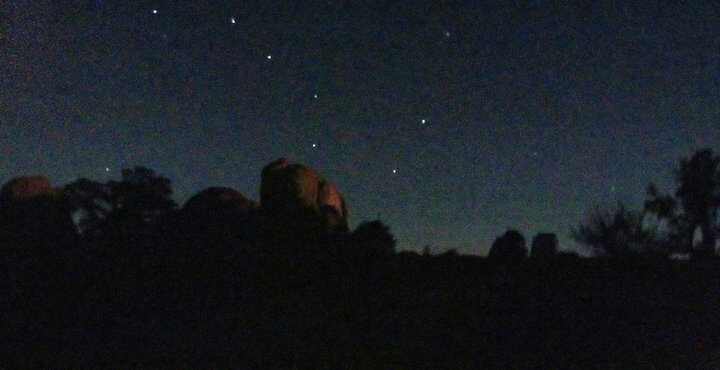
Artists' Point is either the name of a place frequented by artists,
or of a pointed butte that artists like to paint. In any case, a
fifteen-second exposure captured it for me.
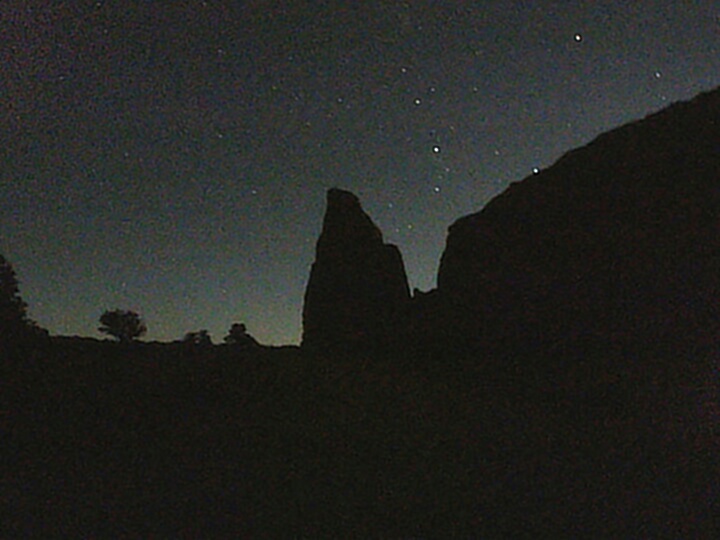
The reddish color of the rocks, visible even by moonlight, is due to
iron oxide in the sandstone. Where there are red rocks there are
usually "vortexes", or energies brought up from deep in the earth
that can be sensed by people who learn to do so. Sedona, Arizona, is
famous for its vortexes. We all sensed vortexes here, too, but
agreed they were more subtle than the ones in Sedona. Still, their
presence explained Monument Valley's traditional status as sacred
ground.
As I took each photo, I showed it on the camera's display to Surya
and Michael, who appropriately oohed and ahed. Surya's favorite,
though, was one in which the moon seemed to be cradled by rocky
hands.
I liked the composition of one showing the road, illuminated only by
moonlight, even though the long exposure meant a little blur.
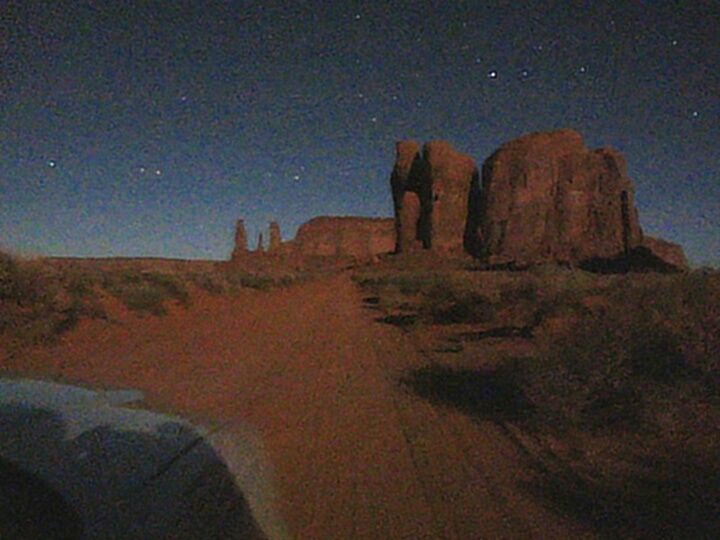
Following the map we'd been given at the park entrance, we came to
Elephant Butte which seemed to me to have multiple parts, none of
which looked very elephant-like. But maybe it does during the day.
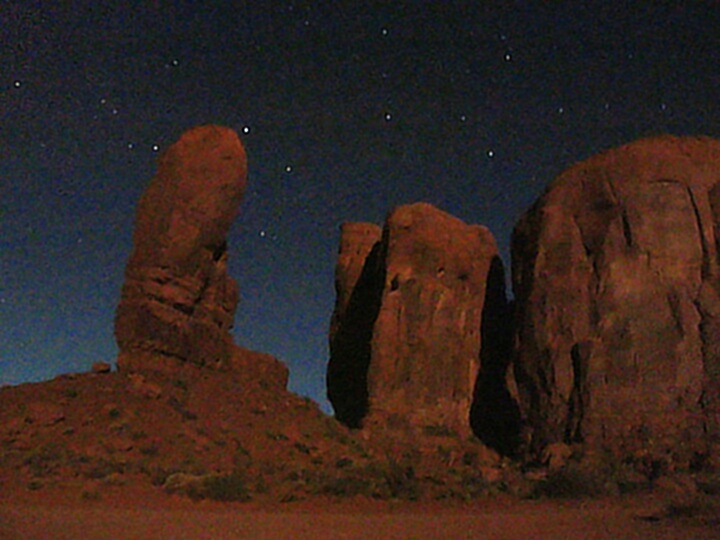
These long exposures, by the way, resulted in a lot of "noise" in
the picture that resembles film grain. Ironically, film grain also
increased in low-light situations. There's software that processed
digital photos afterwards and minimizes the noise, which I've
applied to these pictures.
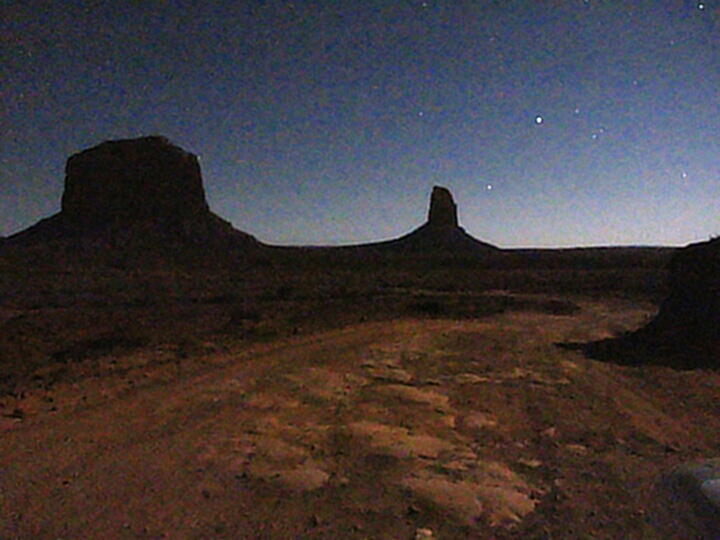
The road curved back toward the visitor center which, despite the
hour, was still brightly lit. It resembled more than anything one of
the UFOs from Close Encounters of the Third Kind.
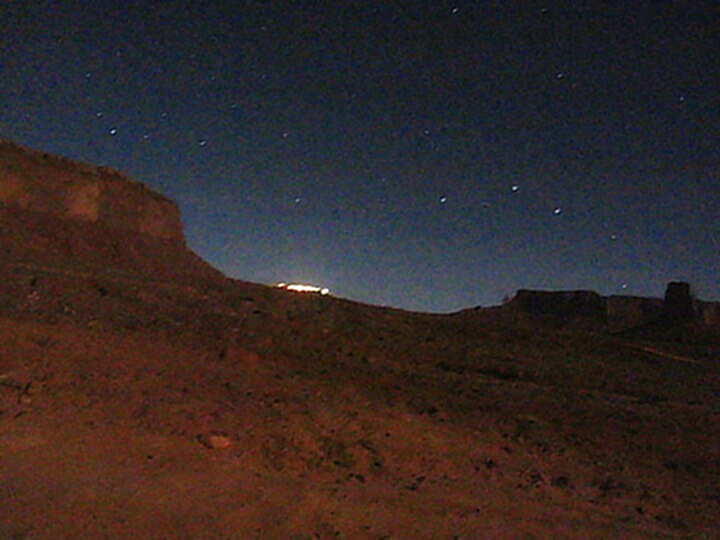
Around midnight, we came to the end of the loop road when it climbs
out of the valley and back onto the level of the visitor center.
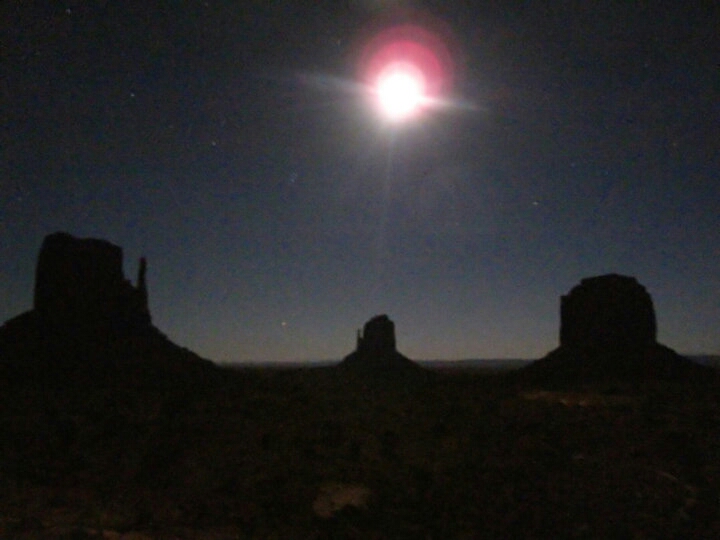
Just before getting back onto the paved parking lot, I turned back
toward the valley and got a last photo of the moon over the Mittens
and Merrick Butte, which were the first we'd seen when arriving.
So, just after midnight, we left Monument Valley. We'd spent four
hours creeping along the road taking pictures. But Surya had loved
every minute of it; and, truly, so did Michael and I.
Even though we would not make it home until about 5 AM.