|
By: Paul S Cilwa |
Occurred: 5/22/2010 |
|
Page Views: 1,262 |
| Hashtags: #NorthCascadesHighway #Glacier #Washington #BirchBay #Metaphysics |
| I experience endings and beginnings in northern Washington state. |
| Estimated reading time: 7 minute(s) (1460 words) |
I won't give every detail here because it's Ann's story to tell.
But Jim had been a victim of chronic depression. He was seeing a
psychiatrist and being treated medically for it, but it got the
better of him and, one night when he knew that Ann and his step-kids
would be away for a few hours, piped the exhaust from his truck into
the passenger section and took the Only Way Out in his driveway,
where Ann eventually found him.
That was over four years ago.
To say Ann was devastated is an understatement. Losing someone to
cancer or even a car wreck is perhaps less painful to the survivors
than suicide, because suicide seems so preventable. And, yet…Jim
apparently couldn't help himself.
A website, SurvivorsOfSuicide.com, points out,
"Time heals all wounds" is not necessarily true for survivors
of suicide. Time is necessary for healing, but time is not enough.
It's natural for the survivors to alternate between blaming
themselves for not seeing it coming, and blaming the suicide for
being too weak to resist. The pain felt by survivors is surely equal
to the pain the suicide was trying to escape. Yet for the survivors,
the pain never ends, though with luck and love it can diminish.
And so, Ann didn't pick up Jim's ashes from the funeral home
until months after the cremation, and then stored them in her shed
where she wouldn't have to think about them…yet couldn't stop
thinking about them.
So, last year, I offered to fly up to Washington state to help
with the scattering. Unfortunately, the logistics didn't work out
then. But today, I was here. And we set out, remains box in the back
of the Kia SUV, towards the Cascades where Ann had determined Jim
would want his ashes to be.
Her first choice was a spot called Artists' Point. However, I
checked with the Forest Service and that road is still closed for
the winter, not to be opened until next weekend. Still, we
set out in the direction of the North Cascades Highway, figuring we
would recognize the right spot when we came to it. I was also
interested in finding a remote, deep-woods hot spring and Ann
thought that would be nice, too. So we brought bathing suits just in
case. (Ann and I love each other dearly but neither has a desire to
see the other one naked, as most bathers in a remote hot spring
generally are.)
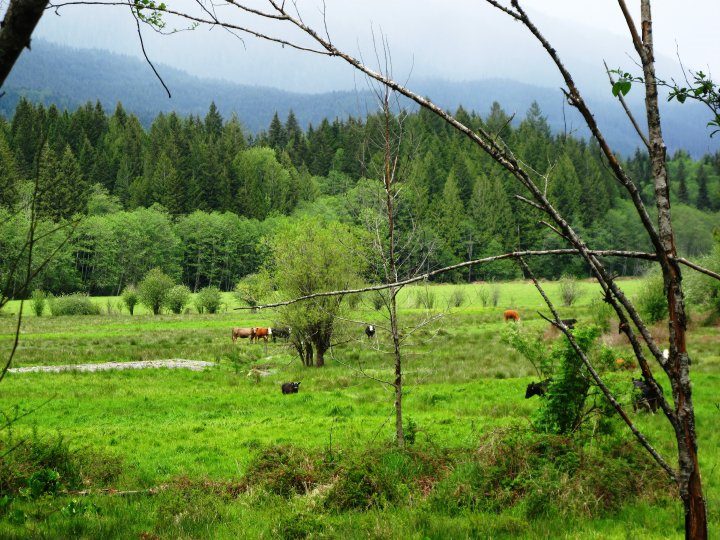
We took State Road 20 (also known as North Cascades Highway)
north, passing tranquil farms with dramatic, mountainous, backdrops;
but came to no cliffs or drop-offs that matched Ann's expectations
of how this would be.
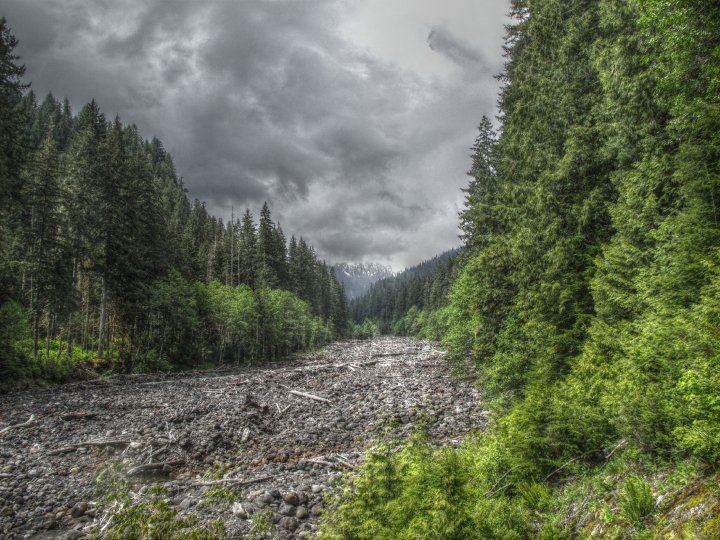
Eventually we found ourselves on a remote Forest Service road,
gravel, pot-holed, crossing a river that must have run wildly enough
to take down timber when the seasonal melt first started, yet was
now just a stream that couldn't even fill its own bed.
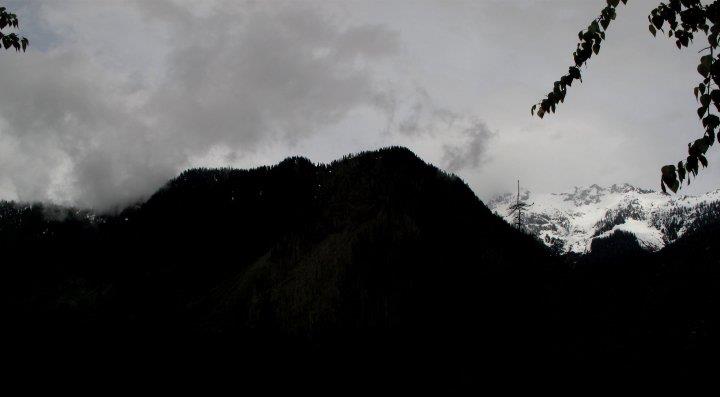
Finally we got to the trailhead for the hot springs, but two things
discouraged us. 1) Due to our late start, we now had just a couple
of hours to be back in Birch Bay for a dinner engagement; and 2) A
truck arrived just behind us, containing four men with guns and two
hunting dogs. I was pretty sure they intended to hunt elk; but Ann
seemed pretty certain they were there to hunt us. So, instead
of getting out of the car, we turned around and headed for the
northern slope of Mount Baker.
My rental Kia had a USB port for the stereo, and I had been playing
James Taylor albums I loaded on my flash drive. But Ann became
convinced that the proper music for the day would be by Yes, a group
she and Jim had enjoyed; so we switched to the satellite radio
Classic Vinyl station; and, sure enough, they shortly began to spin
an old Yes album.
After passing through the charming village of Glacier, we came
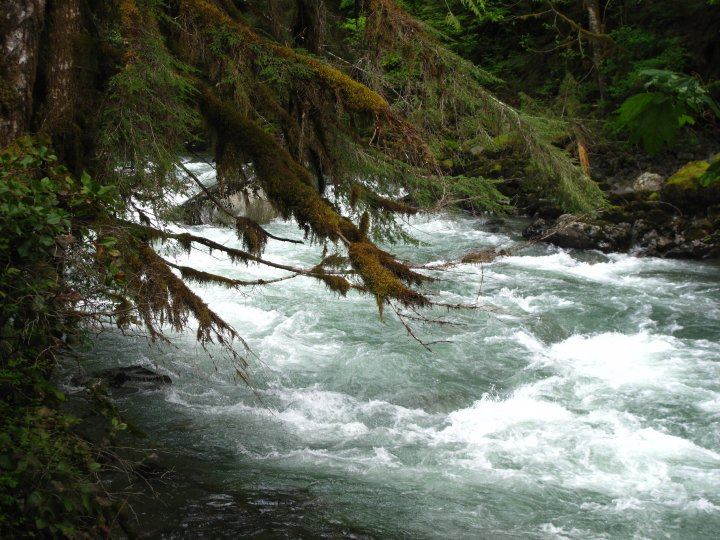
upon a picnic area just off the road at the rushing Glacier Creek.
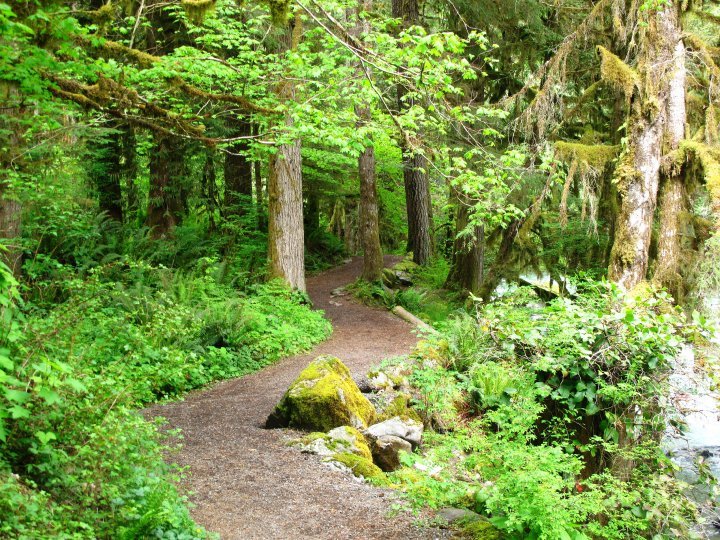
Ann recognized this as a spot where she and Jim had once visited. At
home, she had a picture of Jim cavorting in the river, which was
running lower then—probably taken in late summer. Now, of course,
in late spring, the "creek" was runnable by rafts or kayaks.
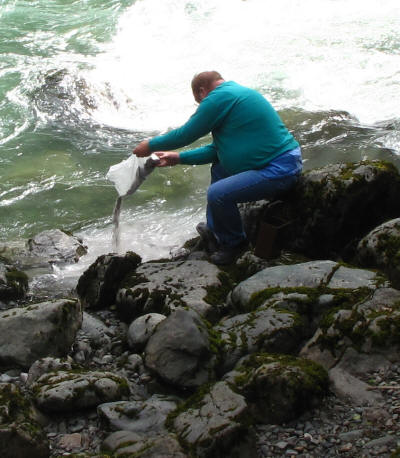
And so, Ann decided, this was the place. I took the plastic box, about
shoebox volume, down to the river. I had a little difficulty opening
it; I think you're really supposed to use a tool but I just had my
nails. However, I was able to pry it open. Inside was a plastic bag
and, in that, the ashes; Jim's earthly body reduced to its mineral
components. (Ann had asked if there would be bits of bone or
anything. Having done this before, I could assure her there would
not; just a homogeneous half-gallon or so of powder.)
People expect that ashes will "scatter in the wind". (I once did
a cartoon advertisement for an "aerosol urn" for people who really
wanted to "cast their fates to the winds.") However, it would take
quite a gale to do that, as the particles are relatively heavy. They
generally tend to pour rather than waft. Ann chose a small eddy at
the edge of the river, and that's where I let Jim's physical remains
go. Eventually they would disperse, travel downstream, and make it
to the Pacific Ocean.
Dispersal is what it's about. Not just of the remains, but of the
hurt feelings, the regrets, the agonizing pain of wondering what the
survivors could have done differently. In the shock of sudden loss,
people hang onto the pain only because it seems better than the hole
left behind in the heart. But holding that pain blocks anything new
from coming along: New opportunities, new happiness, new love.
Eventually, it must be let go. And scattering the deceased's
remains helps do that.
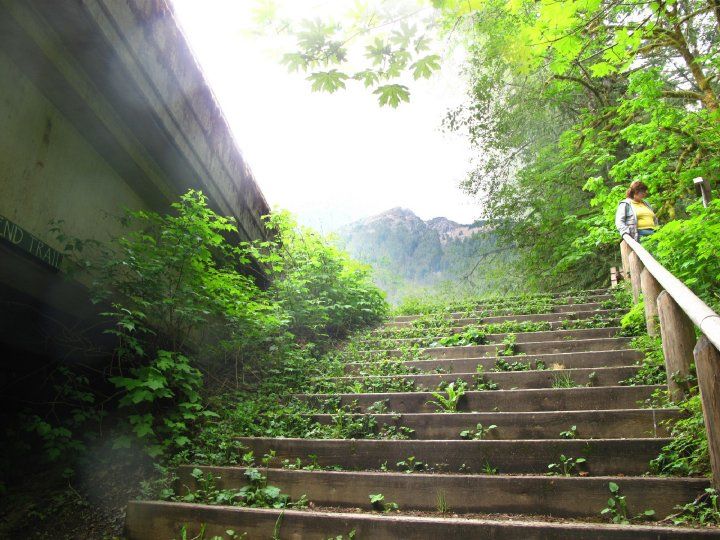
The river's edge was at the bottom of a rustic stairway. After
the ashes had been scattered, and tears had been shed, Ann preceded
me up the stairs, which seemed to me to represent her new choice: To
move up, and ahead, with her life.
But now we had to hurry back to Birch Bay, and our dinner reservations.
Ann's daughter (and Jim's stepdaughter) Devan had just received
her high school diploma. Devan is 20, but Jim's suicide had impacted
more than Ann. Devan and her brother had both been psychically
jolted by the blow to their family. The immediate result to Devan is
that she, who had been a brilliant student, dropped out of high
school. But now she had taken her GED and was finally a high school
(equivalency) graduate. She could now look forward to college, and a
career, and a life.
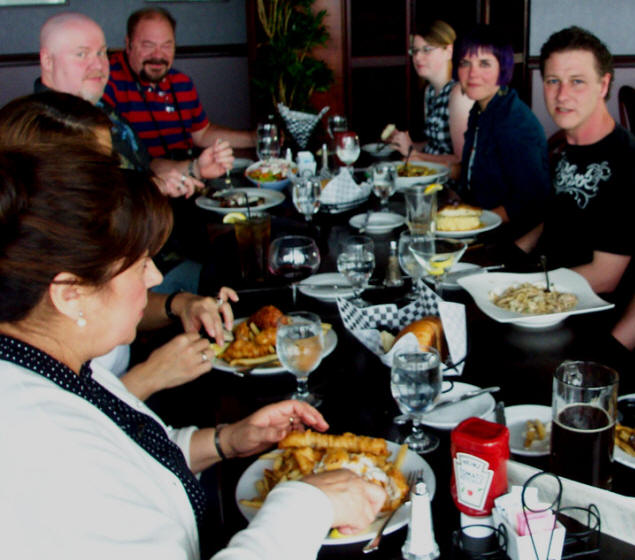
This was supposed to be a surprise party. Devan had been told just she
and I and her mother would be there; but in fact a whole group of
family friends were coming. However, Ann kept accidentally dropping
hints and Devan, being as smart as she is, figured it out. Still,
she looked surprised and pleased when we entered the dining room of the Semiahmoo Resort's
Packers Restaurant
and found a table full of friends.
Dinner was excellent; there were a lot of laughs. Ann and I did
share our adventures finding a place for the scattering, but it was
not a weighty part of the conversation. It was as if the tragedy
that had, for so long, dogged their lives had finally been released.
We stayed long after our dinners were eaten, and stepped onto the
deck to enjoy the sunset.
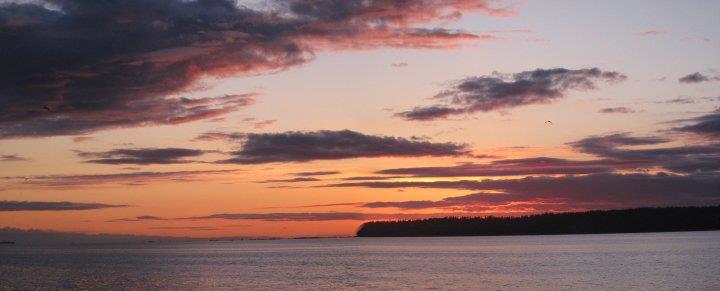
The spit of land in the above photo is part of British Columbia. We
had celebrated Devan's accomplishment, and, secondarily, the
resolution of Jim's remains, at the place where the United States
ends and Canada begins. And that's what this day has been about:
Endings, and beginnings.
Every beginning implies an eventual ending. But every ending
implies a new beginning.
Just as we were about to go inside, a great blue heron flew up to
us and landed on the railing.
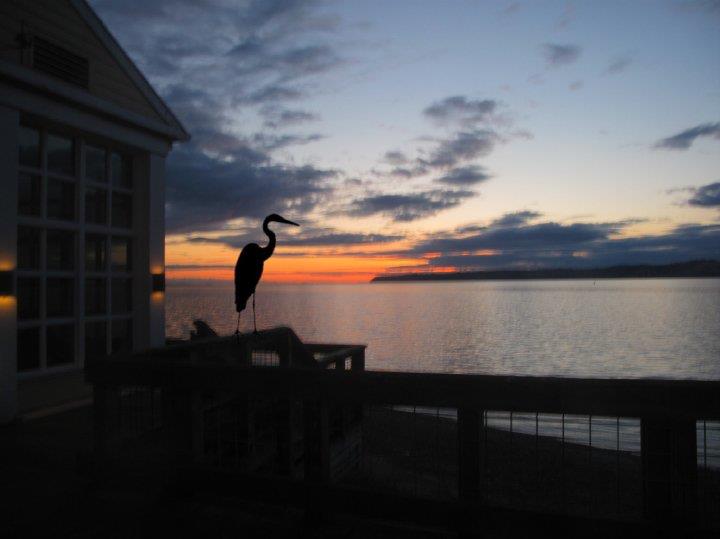
Those who follow the metaphysical concept of messages from animals,
know that the message carried by the Blue Heron is one of balance,
evolution, and progress.
Ann's new life, and Devan's, has just begun.