|
|
Occurred: 8/1/1993 |
|
Page Views: 1,669 |
| Hashtags: #Canada #GaspeacutePeninsula #PerceacuteRock #StLawrenceRiver #Travel |
| A tour around the periphery of Canada's beautiful Gaspé Peninsula. |
| Estimated reading time: 8 minute(s) (1717 words) |
A Visit to Canada's Gaspé Peninsula, and Quebec
August, 1993
Instead, we would be making a three-day, two-night auto trip that would take
us from my townhouse in Manchester, New Hampshire, through Maine, New Brunswick,
and around the perimeter of Gaspé Peninsula, then to Quebec city, and back to
Manchester.

At Karen's request her mother Mary joined us, as well as my mother Edna Mae.
We got an early start and, despite a stop or two in Maine, managed to make it to
New Brunswick and a Canadian motel by nightfall. Since residents of New
Brunswick speak English (with an American accent), Karen didn't really feel
like she was yet in another country.
But then we crossed into the Province of Quebec, and that all changed. Most
signs were in French only; when there were secondary signs in English they were
very secondary, being small and almost invisible.
Once in Quebec, the start of Gaspé peninsula was not far away, as determined
by the beginnings of Chaleur Bay on the right side of Canada Highway 132 which
hugs the coast all the way around the peninsula.

As you can see, the sun was still low—we'd gotten another early start, by
some miracle. We passed village after village, each quaint and tidy.

Between frequent stops for photos, souvenirs, and eating, we only made it to
the village of Bonaventure by mid-afternoon, but decided to spend the night at
the lovely H?tel and Restaurant Ch?teau Blanc, whose brochure said,
Situated in the Baie-des-Chaleurs, in the heart of picturesque
Bonaventure village, Ri?tel Ch?teau Blanc offers a calm and relaxed
ambiance. Let the whisper of the waves rock you to sleep! Originally built
in 1906, and reconstructed in 1961 after a fire, the Ch?teau Blanc has been
an inheritant part of the Baie-des-Chaleurs. In the beginning of the
century, it was a summer residence for Quebec's business elite and American
salmon anglers. To this day, the Ch?teau Blanc still perpetuates the Acadian
tradition of hospitality and charm.

I suppose it was the whisper of the
waves that appealed to me; but Karen was more taken by the French signs in the
hotel, and the fact that we had shared bathrooms.
Since the hotel had an attached restaurant, that's where we had dinner. But
no one wanted to stay in and watch TV, even though it would presumably be in
French. Instead, we went for a walk, first down to the nearby waterfront, then
through a cemetery where Mary and Karen felt free to be amused at the
French-language gravestones.

After a comfortable night's sleep on thick, downy comforters, we were ready
for a new day.

We had put off breakfast since we'd already had dinner at the hotel and we
wanted to eat somewhere different. Or, as Karen put it, "somewhere French." We
finally came upon a large white building labeled, "Patisserie" which I knew
meant bakery. By now we were famished (and by "we", I mean "me") so we parked
and went in.
It was, indeed, a restaurant and no one there spoke English. So Karen
really felt we were in another country at last!
The ladies in our party all ordered breakfasts by pointing at items on the
menu at random, but I had a more specific idea of what I wanted. It was
scrambled eggs, and I meant to have them. The problem was, none of us could
remember the French for "eggs", let alone "scrambled". But I found an
item on the menu that was something like "Roties". To me that sounded like
"rotisserie", which reminded me of "turn", which is something you do repeatedly
to scramble eggs. So I told the waitress, "Roties, roties, roties." Then I said
it again, just to be sure.
She looked surprised and unsure she was hearing me right, so I repeated
myself…several more times.
She went away, and returned presently with our breakfasts. She had plates of
eggs, bacon, and pancakes for the ladies. For me, she had…seven plates
of toast.
But it was delicious toast, slathered in real butter.
And now I knew what "roties" meant.
Water always makes for picturesque spots, and as we were following the coast
there was one photo op after another.

Even the railroad was separated from the road by a tidy little fence. No
barbed wire for Gaspé!

It was while photographing a field of wildflowers that I first spotted
something…odd…in the distance.

It was, I assumed, some sort of island but it had an odd shape to it that
only increased as we approached.

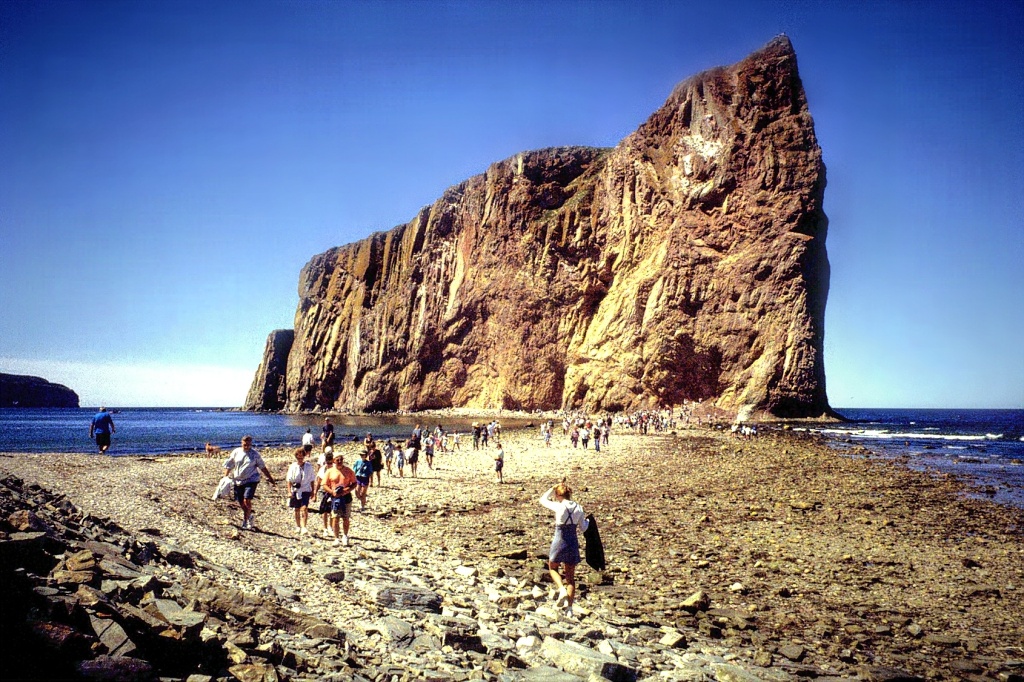
This was, we learned, Percé Rock ("pierced rock"), an island and sheer
limestone rock formation in the Gulf of Saint Lawrence just off the tip of the
Gaspé Peninsula. The "piercing" is the natural arch out near its end, one of the
largest and most spectacular in the world.
As we got closer the rock took on more of its massive look. It was so odd and
out-of-place that completely natural photos including it look pasted up (but are
not, I swear!).


By now we could see that
swarms of people were walking out to the end of the rock, which, though
it appeared to jut directly out of the water, actually had a bit of a shoreline
around it.
So, of course, we had to go.
I found out later that the opportunity to do this only lasts about four hours
each low tide. (Update: In 2008, a law was passed requiring a guide to make this
trek.)

Mom wimped out fairly early on, choosing instead to visit a gift shop for the
20 minutes or so I estimated it would take us to walk to the end and back. I
underestimated this, of course, by about two hours, partly because the way was
so rocky, partly because the tide was coming in, and partly because there were
so many rocks and shells to be examined.

Not even I was immune to the spell of those whispering waves.

We finally got to the arch, which is about 50 feet high.

There used to be two arches. The one closer to the end collapsed of
natural causes in 1845, leaving just the spike at the end of the formation.
By the time we decided to return, the tide had risen considerably and it was
no longer possible to return without getting our feet wet.

Fortunately, the water wasn't too cold. In fact, I gave my shirt to Karen to
hold and actually swam a short distance.
The rising tide had signaled an exodus and the visitors were all hurrying
back to their cars.
Karen allowed herself one last, lingering look.

We met Mom at the base of the rock, who of course had been wondering where
the heck we'd been.

So we got back to the car and continued our journey, bypassing the
easternmost tip of the peninsula and then returning to the water's edge, this
time the water of the St. Lawrence River, while the mountains at this
northernmost reach of the Appalachians became more interesting.

And then came sunset, and a spectacular one it was!

We spent our last night at a motel on Gaspé Peninsula, and in the morning
found ourselves aboard a ferry crossing the St. Lawrence.

Even though it was a little early for lunch, we had some in the ferry's café.

I asked Karen to pose for a shot of the shore from the deck, and she gave me
this:

I'm afraid I shared Karen's amusement over the French signs. For example, I
could figure that this box stored "life vests" but the picture of a box full of
"savage brassieres" tickled me.

Once off the ferry, we found ourselves driving in the Laurentian Mountains,
which are geologically similar to the Norwegian fjords. Unfortunately, the road
was so narrow and traffic heavy enough that I couldn't find a place to pull over
for photographs.

About 35 kilometers northeast of
Quebec, we came upon a church that Mom insisted on visiting. It was dedicated to
Sainte Anne de Beaupré and was located in a town of the same name.

St. Anne was the Virgin Mary's mother, according to apocryphal sources; so
the statue of her above the altar shows her holding the baby Mary in a pose very
similar to the ones in which Mary is usually portrayed, holding the infant
Jesus.

(As a kid taking religion courses in Catholic school, I was told unequivocally that Mary's
parents were St. Joachim and St. Anne. As it turns out, this is found nowhere in
the Bible. Apocryphal books, that is, books not accepted into the Bible, include
the Gospel According to James, which states that Anne and her husband Joachim,
after years of childlessness, were visited by an angel who told them that they
would conceive a child. Anne is the patron saint of Quebec, and its indigenous
Mi'kmaq peoples.
It should also be noted that "Anne" is the Greek form of the Hebrew name
Hannah.
By whatever name, to Anne has been attributed many miracles, especially
regarding healing of the lame. Inside the church we found a whole wall of
crutches, ranging in apparent age from very old to more modern, which had been
discarded by people who believed they no longer needed them after being
miraculously cured by a visit here.
The present-day Basilica of Sainte-Anne-de-Beaupré
was built of cut stone in 1926, paid for largely by pilgrims who believe they have been healed there.
After our visit to the Basilica (no healings, but we weren't sick to begin
with), we continued on to the city of Quebec.

We took a last meal in a little restaurant.

And then, one last photo, and it was farewell to Canada…until the next time!
