|
By: Paul S Cilwa |
Occurred: 1/16/2009 |
|
Page Views: 2,018 |
| Hashtags: #Places #Photography #CaboSanLucas #LosCabos #PosadaChelaba #BajaCalifornia #Mexico |
| I take Michael to spend three days in a Mexican paradise. |
| Estimated reading time: 26 minute(s) (6177 words) |
On Christmas Day, Michael opened his present from me, an oddly light-weight
box. It contained a custom-made travel brochure that read, in part,
We have just returned from that trip.
Cabo San Lucas is located at the southernmost tip of Baja California, that
peninsula that extends south of the United States state of California.
Baja California is bounded on the west by the Pacific Ocean, and on
the east by a body of water that American maps generally call the
Gulf of California. However, we soon learned that locals prefer to
call it the Sea of Cortés. In fact, people who actually live on Baja
are unsure what the Gulf of California
is.
Because of my flight privileges (thanks to my flight attendant daughter,
Karen), I could fly free but not directly from Phoenix, as United has no direct
flights from Phoenix to Cabo. On the other hand, I had to buy Michael's
tickets; so while he took a short, two hour flight, I had to go by way of Los
Angeles.
Because there were two segments to my flight, and because my
previous flights had
been so problematic, I decided to leave a night early and spent the night at an
inexpensive Travelodge near the airport. That flight turned out to be no
problem, and the next day my flight to Cabo also went smoothly.
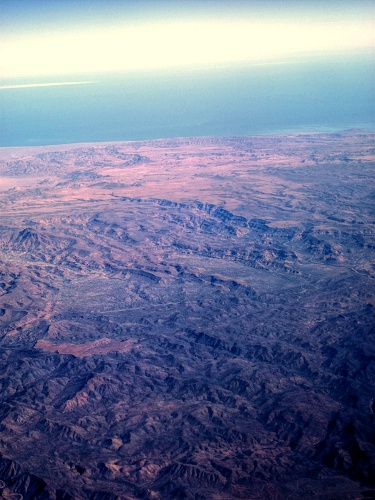
Baja California is sparsely inhabited and mostly barren. I could attest to that
simply looking at it from the plane window.
Just to be on the safe side (in case I had a problem making my standby
flights), I had given Michael the computer printout with the information
regarding where we were going to stay and the car rental reservation.
As I later learned, there are two "Cabos" at the southern tip of Baja
California. One is Cabo San Lucas, and the other, a little east of there, is
Cabo San Jose. Together they are known as Los Cabos or (in English) The
Capes. The airport is closer to Cabo San Jose but serves both towns. It is an
"international" airport but somewhat primitive by American standards; there was
no jetway. We had to walk down a flight of portable stairs. (Later, Michael
reported to be that he was concerned that his stairs might not be able to
support him. Mine were quite sturdy however.)
We were ushered into the Mexican Customs and Immigration area, where a dozen
kiosks awaited us. All but one was labeled, "Foreigners". The remaining kiosk
was labeled, "ciudadano mexicano" (Mexican citizens). One woman from my plane,
pre-vacation dressed in a flowered dress and a large straw hat and sunglasses,
seemed confused. "Where do I go?" she asked an attendant, who gestured toward
the Foreigner kiosks. "I'm no foreigner!" she retorted indignantly. "I am an
American citizen!"
A man near her said, "To the Mexicans, that is a foreigner." Then when
she stared at him blankly, he added, "We're in Mexico now." She still
didn't seem to get it, so he added further, "That's not in America." At
that, the woman seemed to slowly get that she was no longer in a place where she
could claim to be a local citizen. She went on through the Foreigner kiosk, but
still seemed put out by the whole thing.
When it was my turn, I discovered that 1) I was required to tell the Customs
official where I would be staying; and 2) I had no idea where that was. Michael
had the papers. I explained to the man that my friend had come on another
flight; that he knew where we were staying but I didn't. The official
kept my passport and sent me into the terminal to find Michael, with
instructions to return when I had the information.
Unfortunately, Michael wasn't outside waiting for me. (It turned out there
are two terminals and he had landed at the other one.) I found the Dollar
Rent-A-Car kiosk (I remembered that much) and they did have my name on
their manifest but of course they didn't know where I was staying, either. The
man let me peruse a list of accommodations in the area. We were staying at a
very small bed-and-breakfast; I didn't really expect it would be on this list
and it wasn't. But I also realized the Customs agent didn't really care.
So I ran back to him with one of the names from the list, the Cabo Surf Club; he
wrote it down on his paper and returned my passport and sent me on my way.
By now Michael had walked from the other terminal; we met at the Dollar
shuttle.
In the nearby Dollar Rent-A-Car office, I was prepared to rent the economy
car I'd reserved over the Internet. However, I remembered that Rose Ann, the
proprietor of the bed and breakfast, had strongly recommended we rent a Jeep.
That choice hadn't been on the web site menu. But I asked about it, and the
clerk had one. Michael whispered to me that I should "haggle". I didn't, but the
clerk did give us a Jeep SUV for under $200 for two days, including auto
insurance.
We drove the beautiful road from the airport toward Cabo San Lucas. At this
time I didn't really realize that we would be staying in the nearer town of Cabo
San Jose. I was also thrown by the kilometer numbers on the highway, and the
conflicting numbers that seemed also to be speed limit signs. It wasn't until we
were leaving that I figured it out: The signs were the speed limit; the numbers
on the road were the equivalent of mile markers. It was just a coincidence that
the first kilometer marker I saw, 100km, was the same as the 100kmh speed limit
sign next to it.
Not that it really mattered. I never once saw a police car pull over a
speeder, and all the other cars were driving at least 20kmh over the posted
limit.
The road we took was a toll road. The dollar is worth approximately ten
pesos, and dollars are freely accepted at that exchange rate anywhere in the
area. However, the actual exchange rate is lower than that, so pesos are
more efficient for Americans to use there. The toll was 27 pesos. But I didn't
have any pesos yet, so the collector accepted $3.
Our instructions said to locate the Havanas Club and turn right on the dirt
road just past it. As near as I could tell, that was a wash under an overpass.
We passed riders on horses, and followed the road into a narrow canyon.
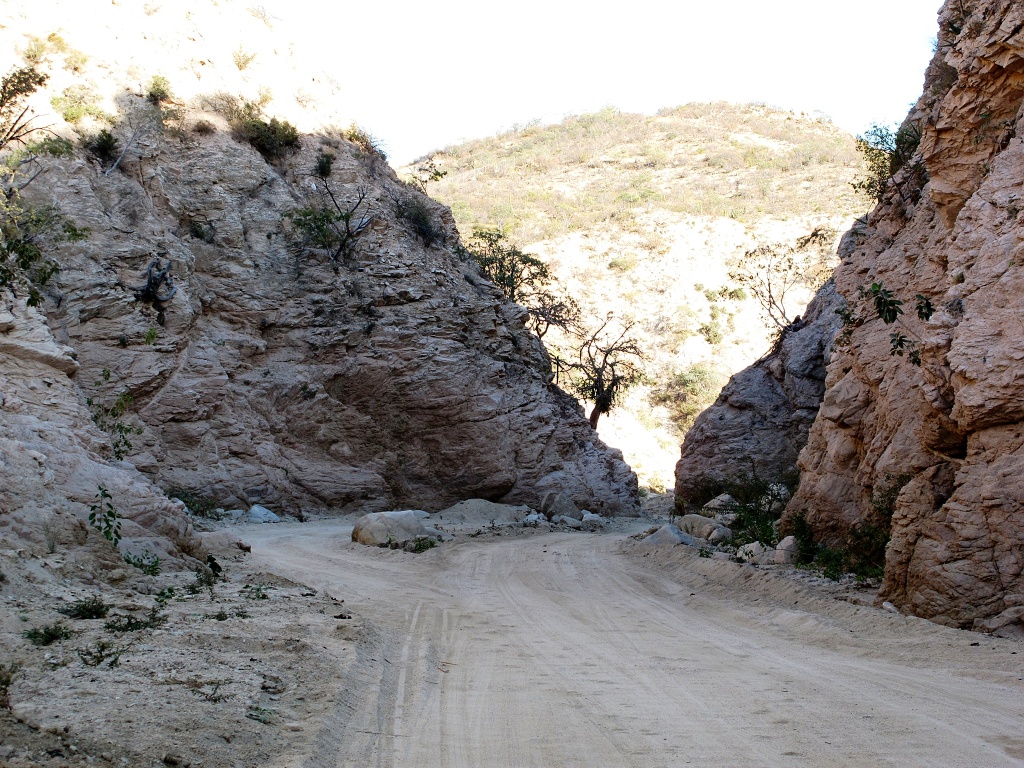
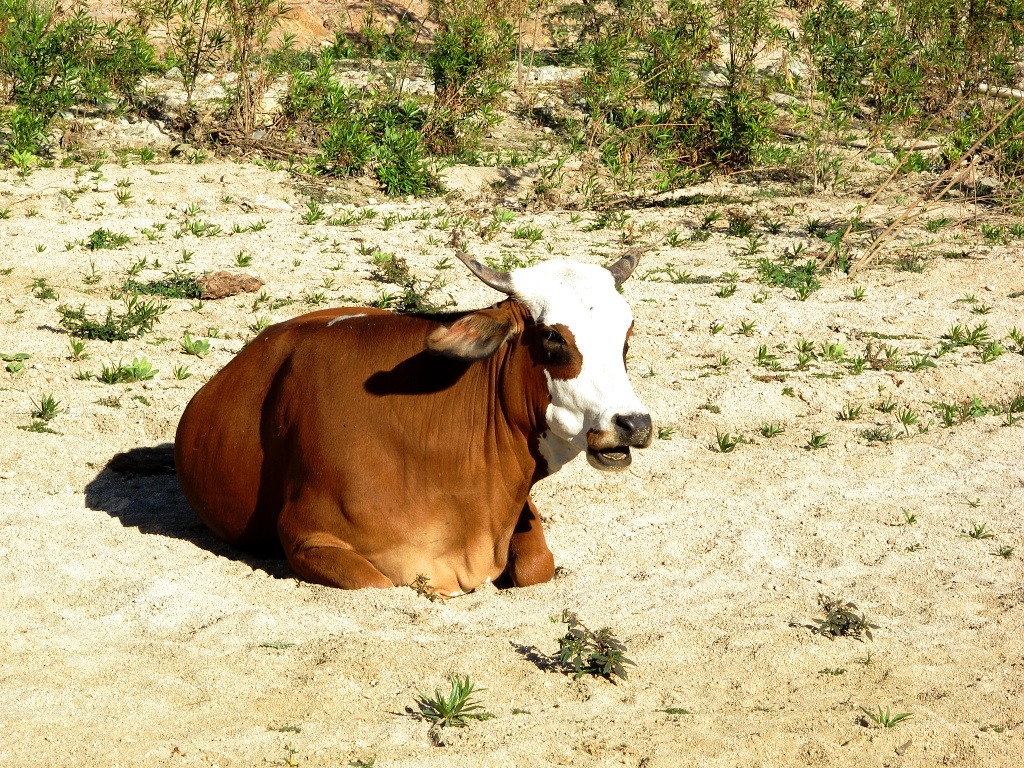
We also encountered cattle along the way, at which point I began to
wonder seriously if I'd misread the directions.
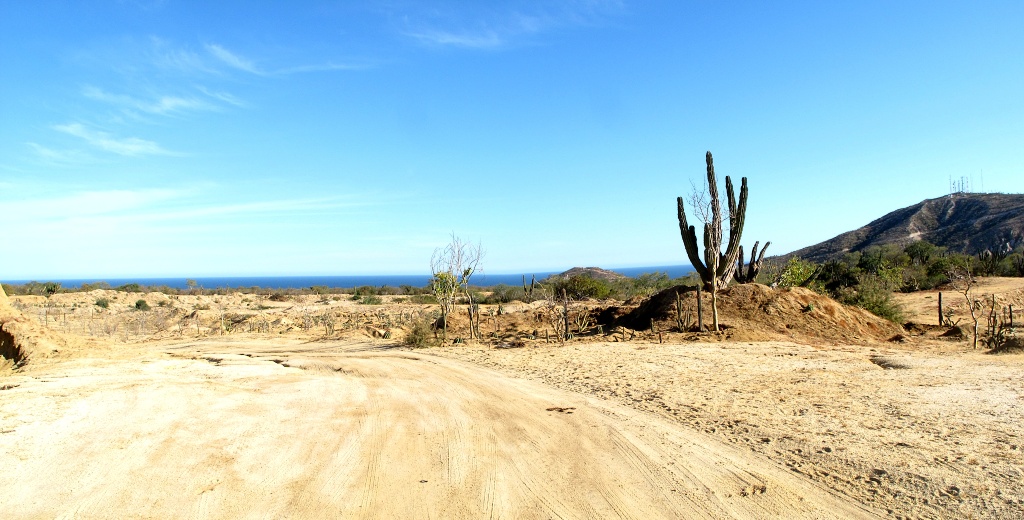
Finally, we came to the top of a rise. Despite the exquisite view,
we were, in fact, in a garbage dump. It's not easy to make out in
the photo, because the desert heat and sun had bleached everything
to the same color as the ground. But surrounding us were old bed
springs, tires, and bags of household waste.
Since it was now inescapable even to me that this wasn't the road to
our bed and breakfast, we returned the way we came and got back on
the highway, again heading to Cabo San Lucas and looking for
another Havanas Club.
An hour later we decided we weren't going to find one, and returned to the
first. It turned out there was a steep dirt road immediately next to it,
that I had dismissed as a driveway. Now that we looked more carefully, we saw
that there was even a sign for our destination, the
Posada Chabela.
Now that we were on the right road, it was fairly easy to follow the
directions (although we still had to stop and ask an English-speaking neighbor).
I rang the bell and was promptly greeted by a young golden retriever, followed
shortly by a handsome woman in her late fifties. She unlocked the gate and we
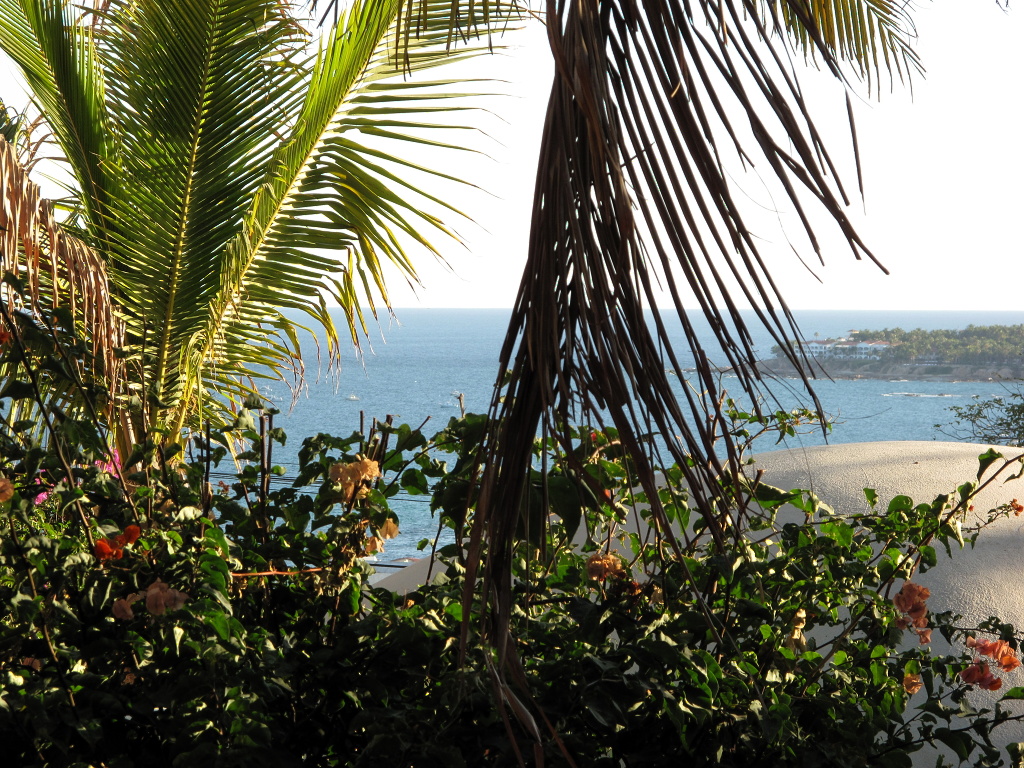
followed her into an exquisite enclave of casitas and flowers.
We had signed (and pre-paid) for a queen-sized room with external bath. Since
we were the only guests that weekend, she "first" showed us the larger king-size
room with attached bath. It was a lot prettier and roomier than the one
we'd planned for, and only another $50; so we agreed to take it—mostly for the
view from the private porch.
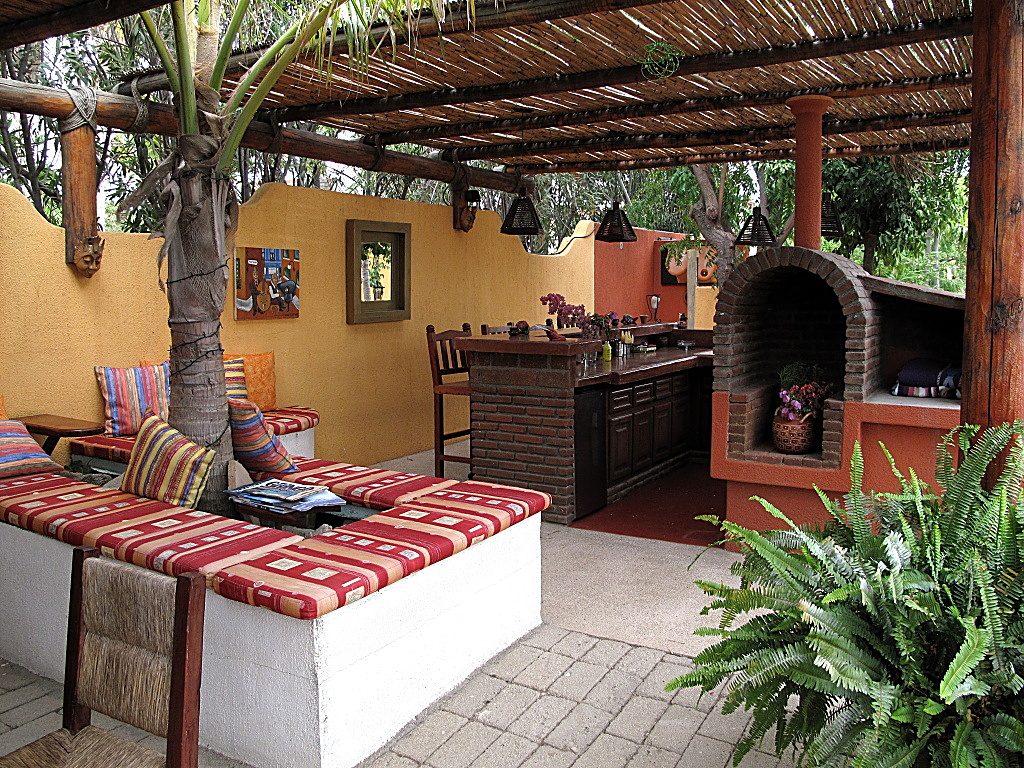
Our hostess, Rose Anne, then led us to an outdoor bar where she had
prepared a pitcher of Margaritas to welcome us. Michael declined; I
seldom drink but she'd gone to so much effort so I went ahead and
had one. Then another.
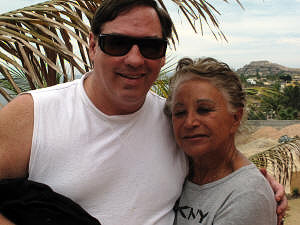
My first question, of course, is why a straight widow from Brooklyn
would open a gay bed and breakfast in Cabo. She explained that she
was the adventurous sort, had owned and run retail stores in New
York; she and her husband had many gay friends and her children "had
no problem with it." She saw a need for a place where gay men could
go in Cabo to feel comfortable, a place secluded enough where they
might feel free to hold hands or kiss without fear of ridicule.
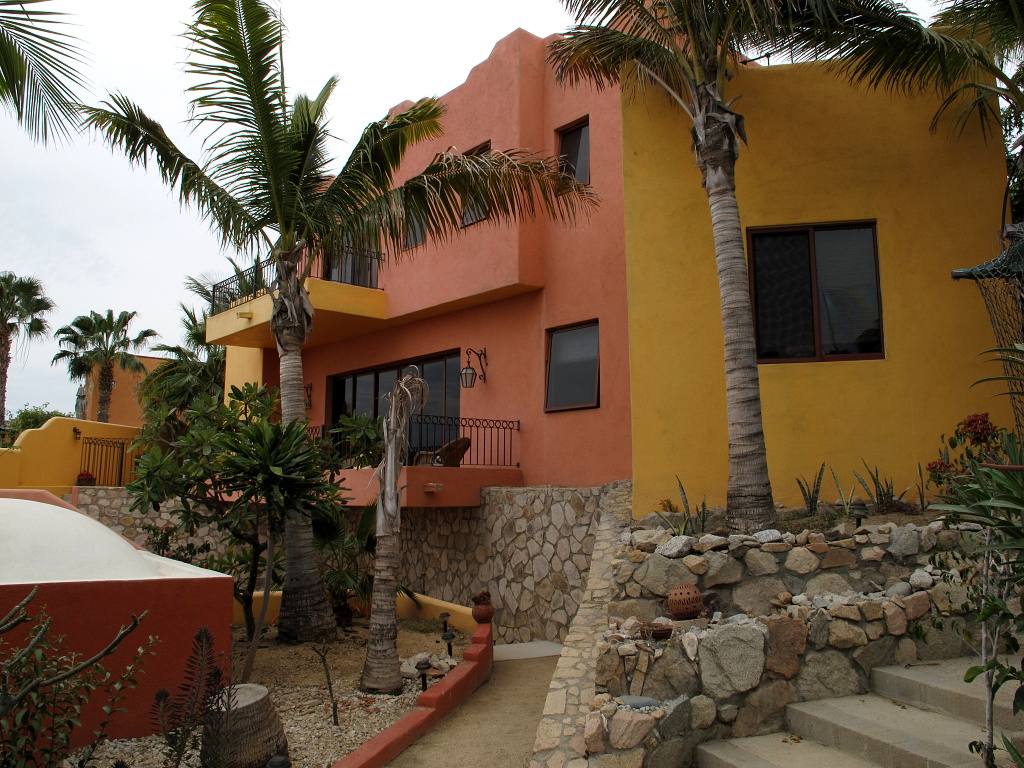
She had purchased the place three years earlier. It was a shambles.
The casitas were falling apart and there was no home for the
host—the previous owners had lived in a trailer. Rose Ann got rid of
the trailer and had a house built to her design, including a pool in
front. She was now ready to sell and enjoy the next phase of her
life. "This is my year!" she told us. "I feel it. I expect romance
and excitement!" She told us the only problem was finding a man her
age who could keep up with her. I started to assure her that many
gentlemen in their fifties are in excellent health, when she
corrected me. She was 74 years old, and most men her age are dead.
But she hoped to land one nevertheless.
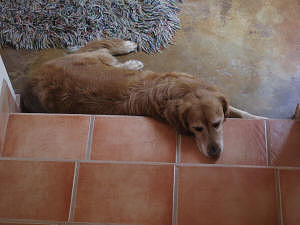
She showed us the home she'd built. It was airy and beautiful. That Rose Anne has
exquisite taste cannot be denied. She also has a loyal companion in the form of
Tulo, the dog, who waited patiently at the foot of the stairs.
Rose Anne urge us to have dinner across the street at a place called Zippers,
which was right on the beach. She warned us, however, that they did not take
credit cards; and I hadn't had a chance yet to get to an ATM. The main road is
Federal Highway #1 and is a limited access road. Once on it, you can only turn
around by using a "retorno". So from the Posada we had to drive a mile or
so toward Cabo San Lucas, then over an overpass and back to where we started.
Zippers was mostly a sandwich place but I wanted to stop there first just to
figure out how many pesos I should withdraw from the ATM. The prices were
reasonable but neither Michael nor I really felt like burgers or Philly-style
cheesesteaks. So when we found an Appleby's next door to the ATM, we gave in to
temptation and had dinner there.
As we were enjoying our salads, I suddenly realized that eating salads rinsed
in Mexican water had been our downfall on a visit to Monterey some years back.
But it was too late now. Fortunately, neither of us developed Montezuma's
Revenge on this trip. (And, in fact, figuring the damage, if any, was done, I
proceeded to drink tap water for the remainder of our visit.)
Before retiring we also visited Mega, a discount grocery/department store not
unlike Wal-Mart at home. They were notable for the huge displays of pastries
that we miraculously did not sample. They did look marvelous, though.
So we returned to our room about 10 PM. I was pleased to note our room did
not contain a TV set. And it was open and breezy, with its own porch with a
built-in table and benches and a hammock. The bed was very comfortable, firm but
soft. The only odd thing was the two framed pictures of Marilyn Monroe taken
from her infamous nude spread done for the first issue of Playboy.
Odd for a gay men's B&B, but not odd for the sophisticated Rose Ann who had done
all the decorating.
I especially looked forward to taking my shower in the morning in the shower
stall which had no ceiling and opened directly onto the crystal clear sky.
We turned off the lights and settled in to sleep…until Michael started.
"There's a mosquito in here!" he cried.
"No, there's not," I assured him. "This is a desert, even if it is a little
lush. Besides, with the open windows and porch door and the shower with no roof,
any bug that came in could immediately leave."
Michael complained about his mosquito several more times, and I rebuked him
each time—foolish man! Always has to complain about something!—And then
the little whining devil of a bug dive-bombed my ear. There was a
mosquito. It didn't seem to be biting, but it was terribly interested in our
ears. And it must have been very small, because when Michael heard it I could
not; and when I heard it, he could not.
I finally decided to sleep in the hammock on the open porch. Sure enough, the
mosquito stayed in the room; every now and then I heard Michael yelp and once,
in an effort to squash the bug, he punched himself in the eye.
It did seem like morning would never come; but eventually we did fall
asleep and slept heavily until a loud knock sounded at the door. "It's 11
o'clock!" Rose Anne called. "Do you want breakfast? I usually serve it from 9 to
10."
"Yes!" I called, still groggy but also hungry. "We'll be right there!"
Breakfast was served at a table near the bar. There was fresh fruit including
papaya and bananas, toast made from the most marvelous, thick slices of bread,
granola, coffee and fresh-squeezed orange juice. As we ate we chatted more with
Rose Ann. We mentioned the mosquito, and Rose Ann apologized and promised to
turn on the "bug zappers" before we returned from our day's adventures.
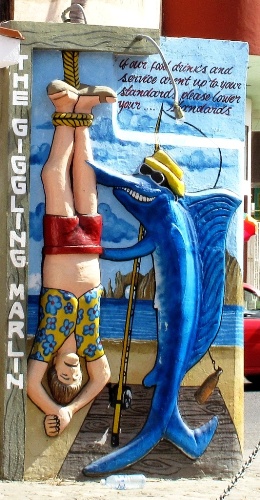
Now it was time to take a shower. I was really looking forward to this, a
shower in the open air. Unfortunately, it turned out there was no hot water.
That wasn't obvious at first, since the cold water is more of a tepid
temperature than a chilly one. But it was soon clear (after I was soaped up, of
course) that there hot water was no more or less tepid than the cold.
Still, if anything that led to shorter showers; and soon Michael and I were
back in our rented Jeep and heading for Cabo San Lucas, about twenty miles west.
Cabo San Lucas is known for its unique rock formations that stretch out in a
mini-archipelago that is the southernmost tip of Baja. These rocks are known as
Land's End (Finis la tierra) and attract visitors of all kinds to the area. It
was my intention to rent kayaks and paddle out to the end to take photos.
Finding a road to the beach made this a little problematic, however. We were
still making use of Federal Highway #1, so whenever we thought we saw a road it
would be on the other side of the highway, and we'd have to drive a mile or two
past it until we got to a retorno and could turn around. Then the road
would turn out to just be a driveway or a dead end, and we'd have to make
another stab.
We wound up in old town Cabo, complete with narrow streets, throngs of
tourists, and trinket shops were actual haggling was the norm. Also, many
places to eat. It was interesting to note that there were as many signs in
English as there were in Spanish.
And then, at one point when I thought we might at last be nearing the beach,
Michael got all excited and starting wagging his tail. I knew what that meant:
He'd discovered an actual Wal-Mart, complete with McDonald's.
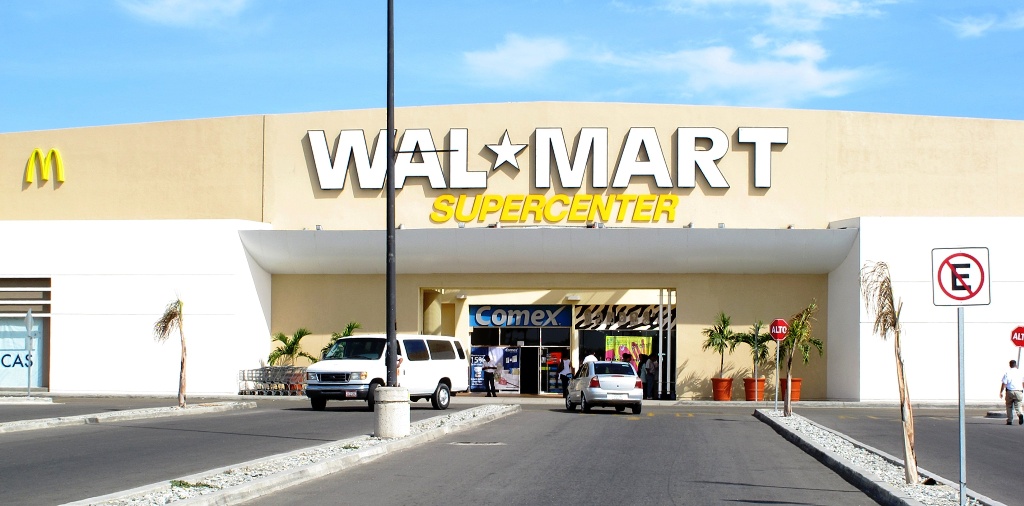
So for lunch in Mexico we had a couple of quarter pounders with
cheese. Excuse me, I mean cuartas libras con queso. But it
tasted pretty much the same. One shock for me was that McDonald's
didn't sell Diet Coke. Apparently the people in third-world
countries can't see the value in purchasing a drink with no
nutritional value whatsoever.
We could tell we were getting closer as Land's End appeared in the distance.
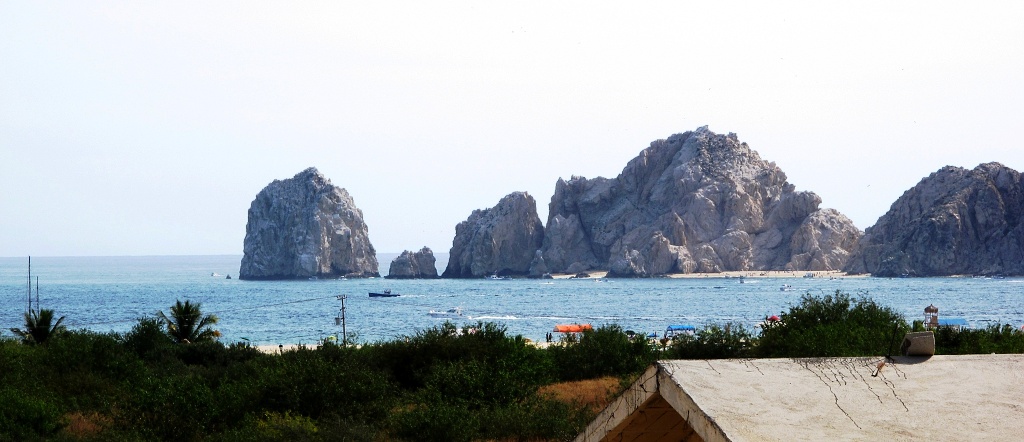
It finally took us a drive of about a mile along a sandy unpaved
road, then a turn into and out of a hotel parking lot, to get to the
beach where the raft, snorkeling, kayaking and other concessions
were located. As we approached the beach, a woman walked assertively
up to meet us, introduced herself as Erika, and offered to take a
picture of the two of us together.
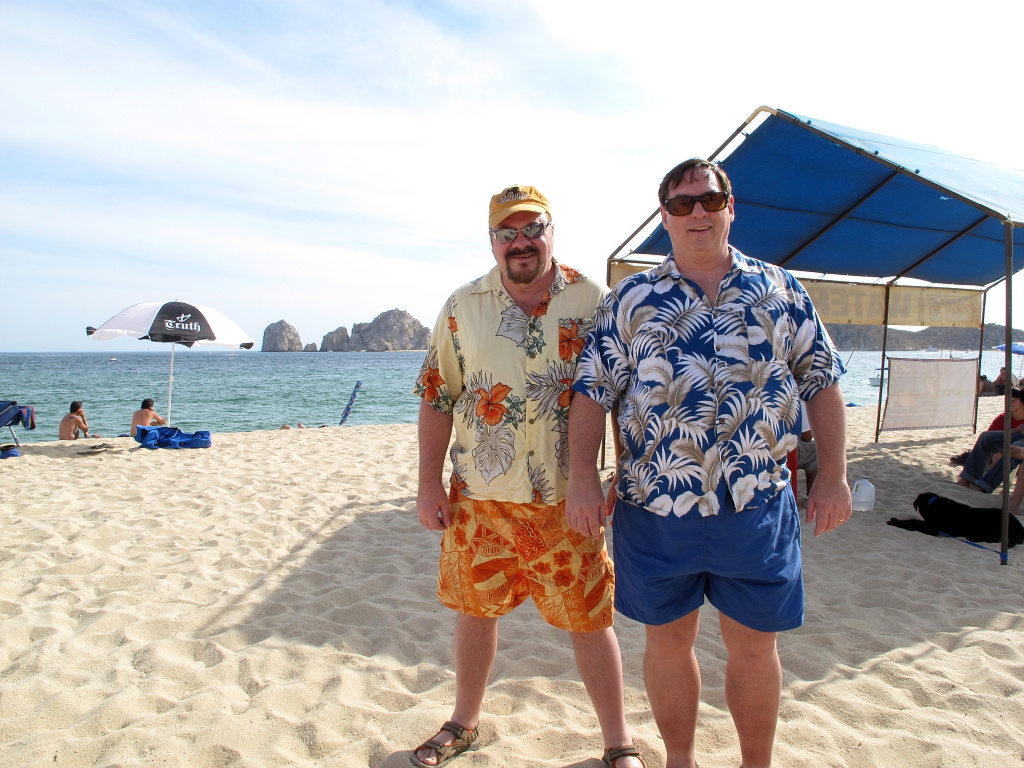
I explained to Erika that we wanted to rent kayaks to paddle out to
Land's End. She pointed to the kayak concession, but then added that
it would take an hour and a half for us to paddle out that far, and
another hour and a half to return. She, on the other hand,
had a glass-bottom boat that would take us there in 20
minutes, include a tour, and even drop us off at the beach and pick
us up later when we were ready to return—all for just $20, or 200
pesos.
We decided to take the boat.
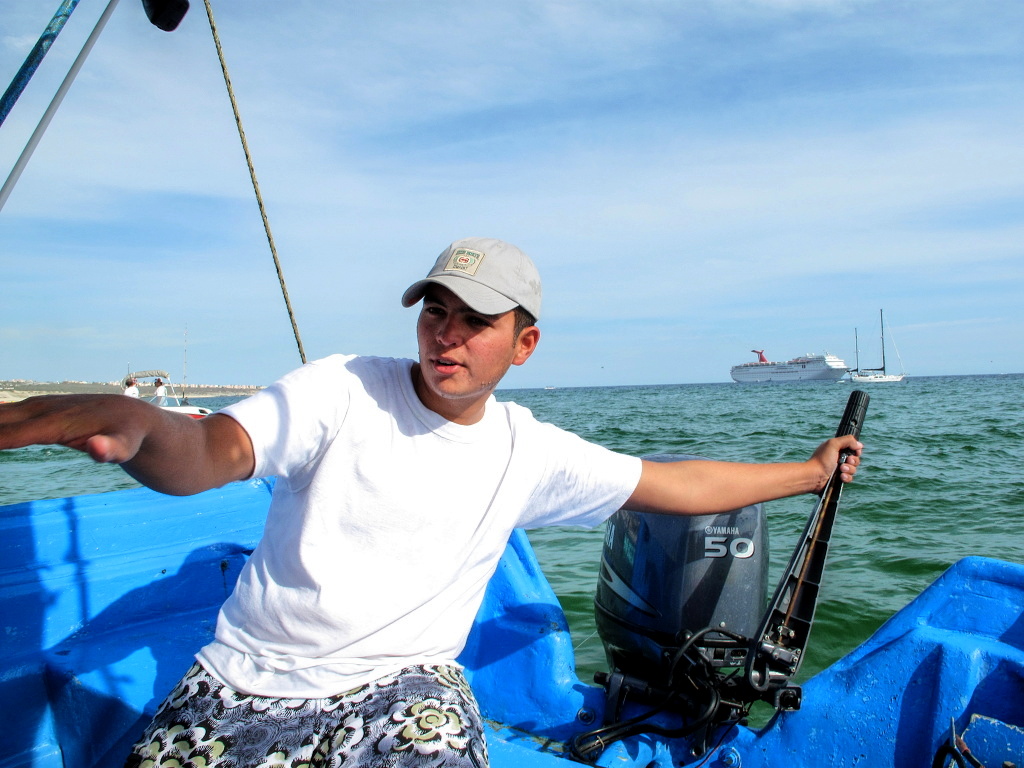
The captain was a young man named Daniel (he used the Spanish pronunciation
which sounds more like "Dan-YELL") and he had an assistant named Caesar
("Say-SARR"). Neither assisted us in climbing the ladder into the boat, which
rocked crazily in the waves pounding the beach. (Erika had touted the ladder as
the defining advantage of her glass bottom boats compared to the other
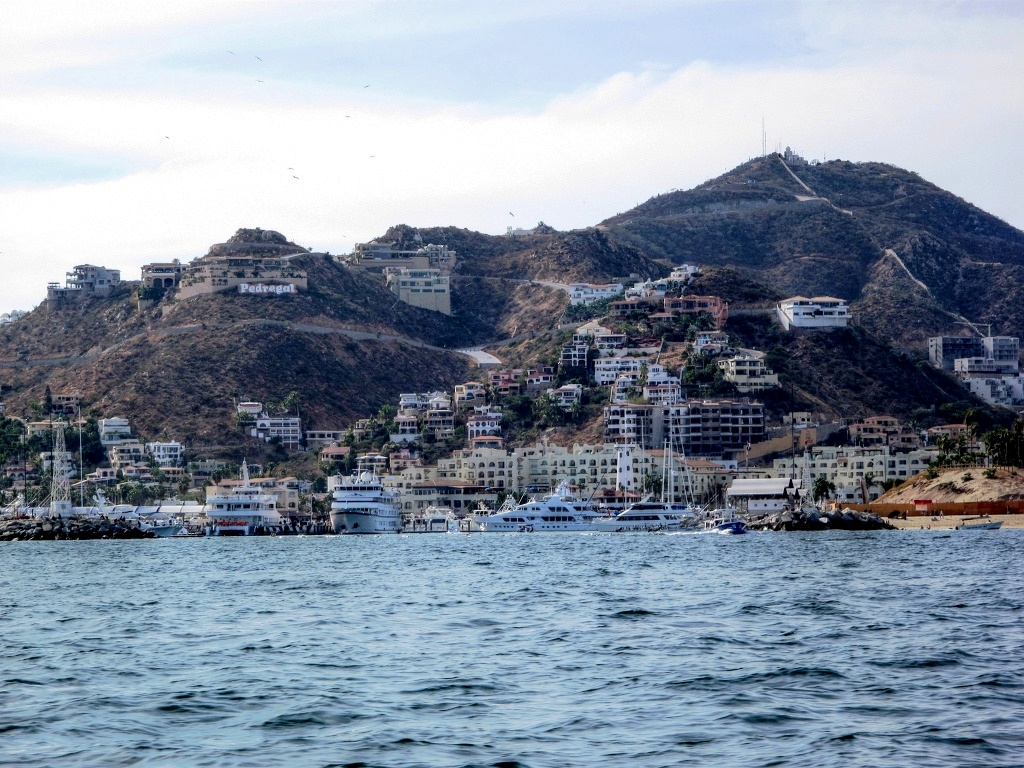
vendors'.) As we sailed past the shore, the condos, which are all relatively new
(built within the past decade) came into clear view.
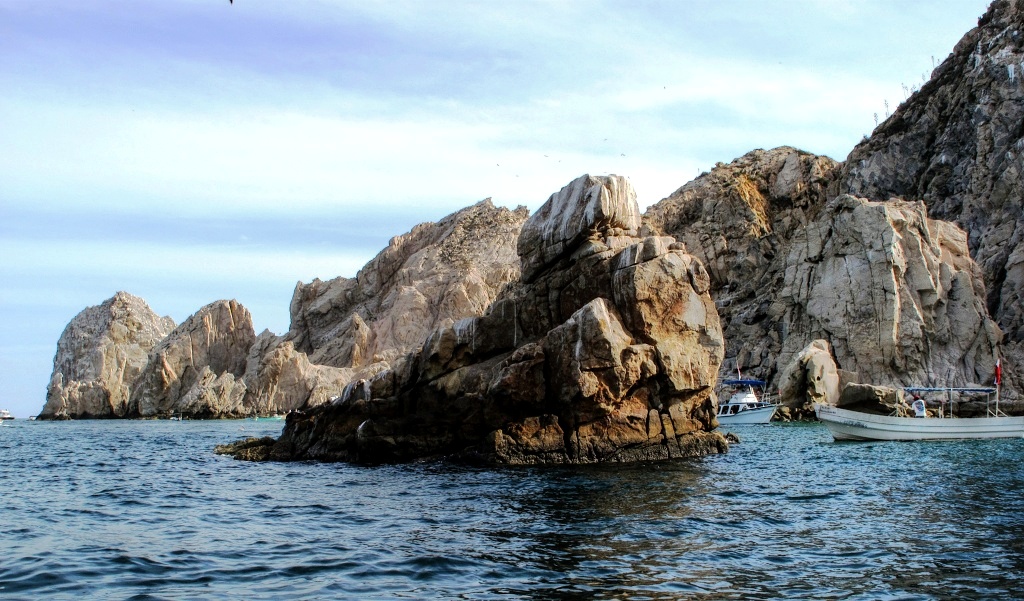
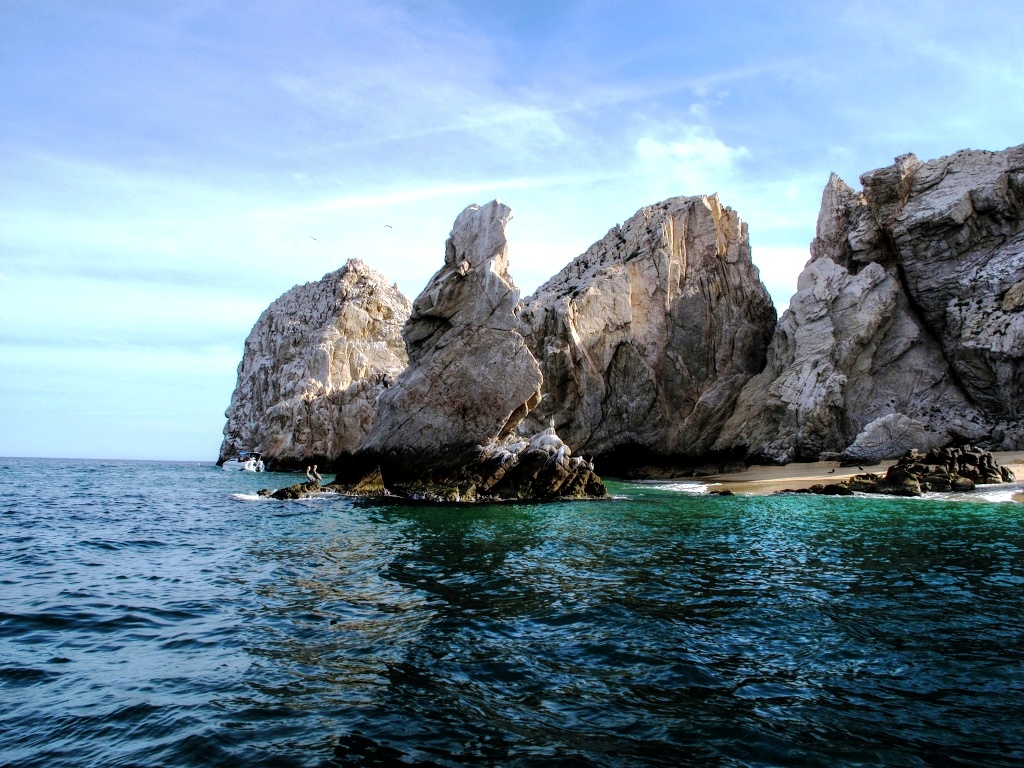
But soon we were out near the weirdly-shaped rocks and hoodoos of Land's End
(and the other boats and tourists also come to gawk).
The smaller islands of the archipelago—that is, the ones too small for
tourists to sunbathe on—attack hordes of seabirds, especially pelicans, which
use them to roost.
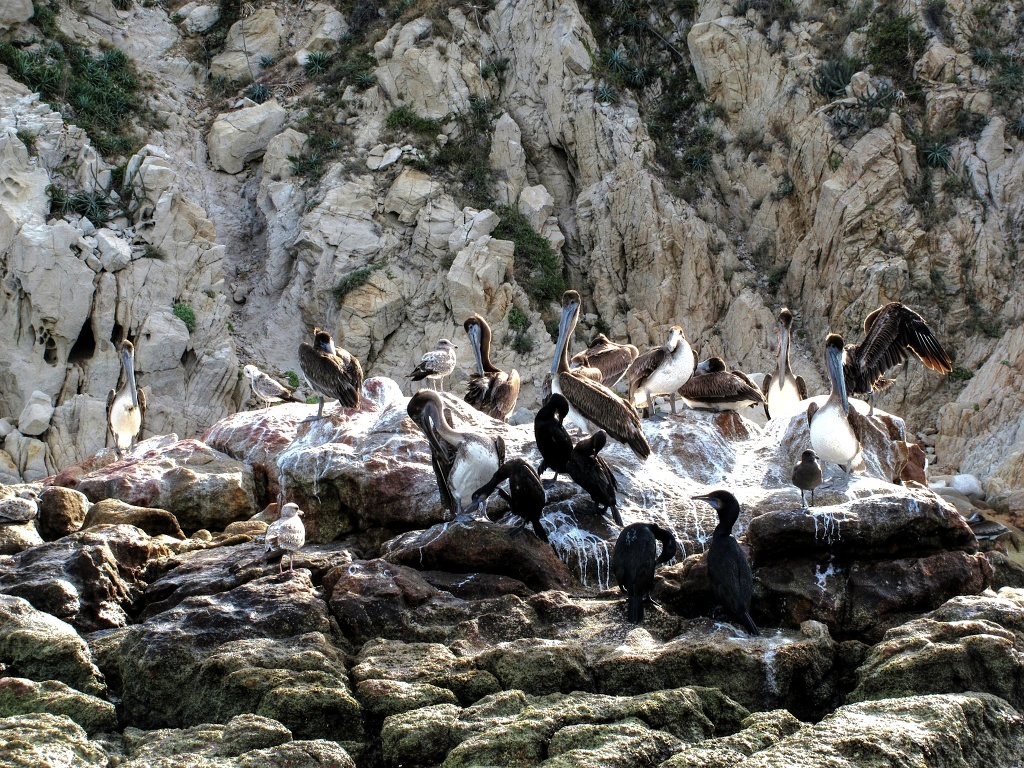
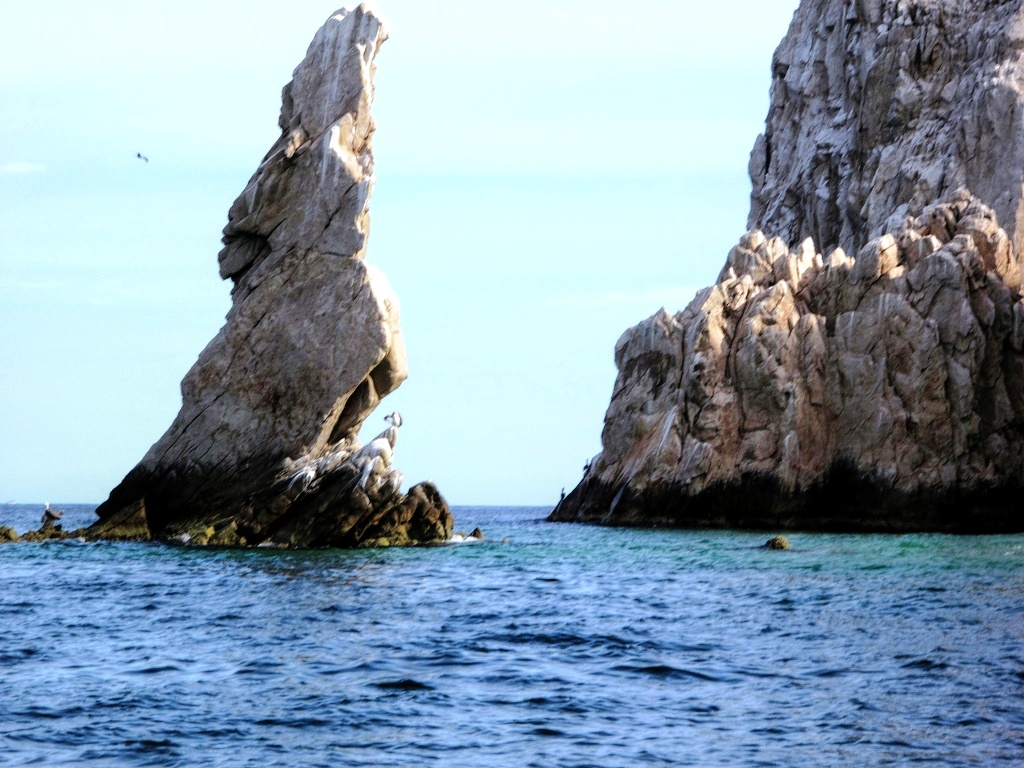
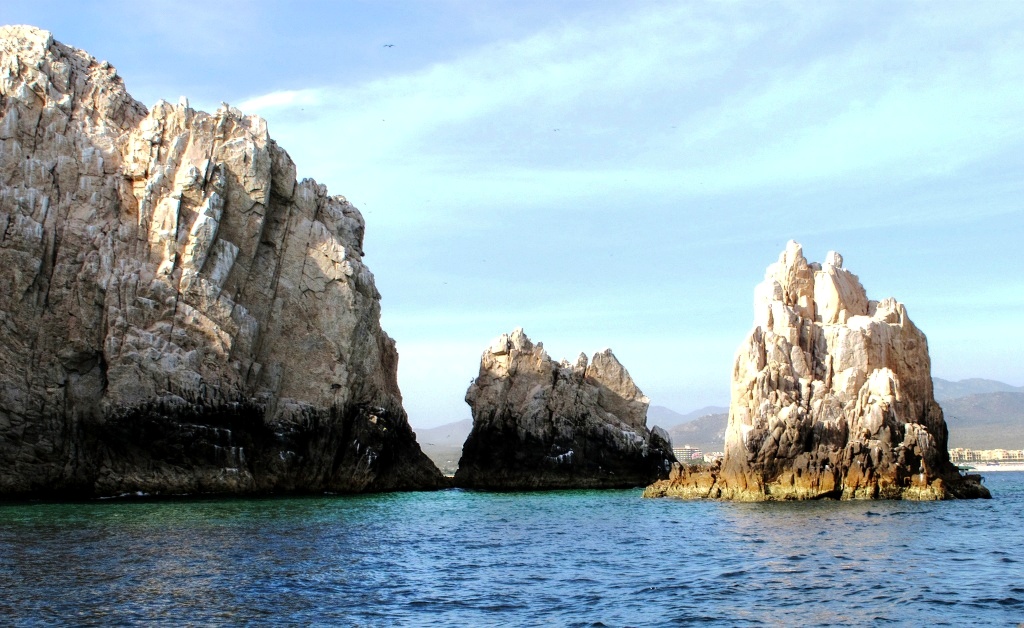
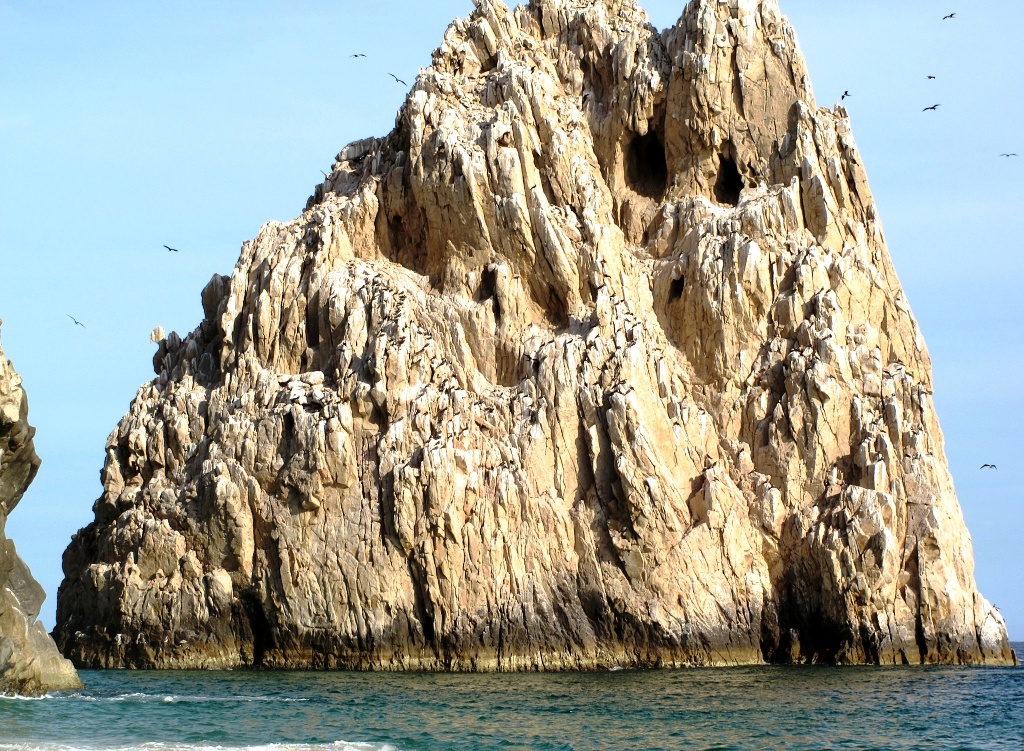
One small island makes up in height what it lacks in land area. It's called
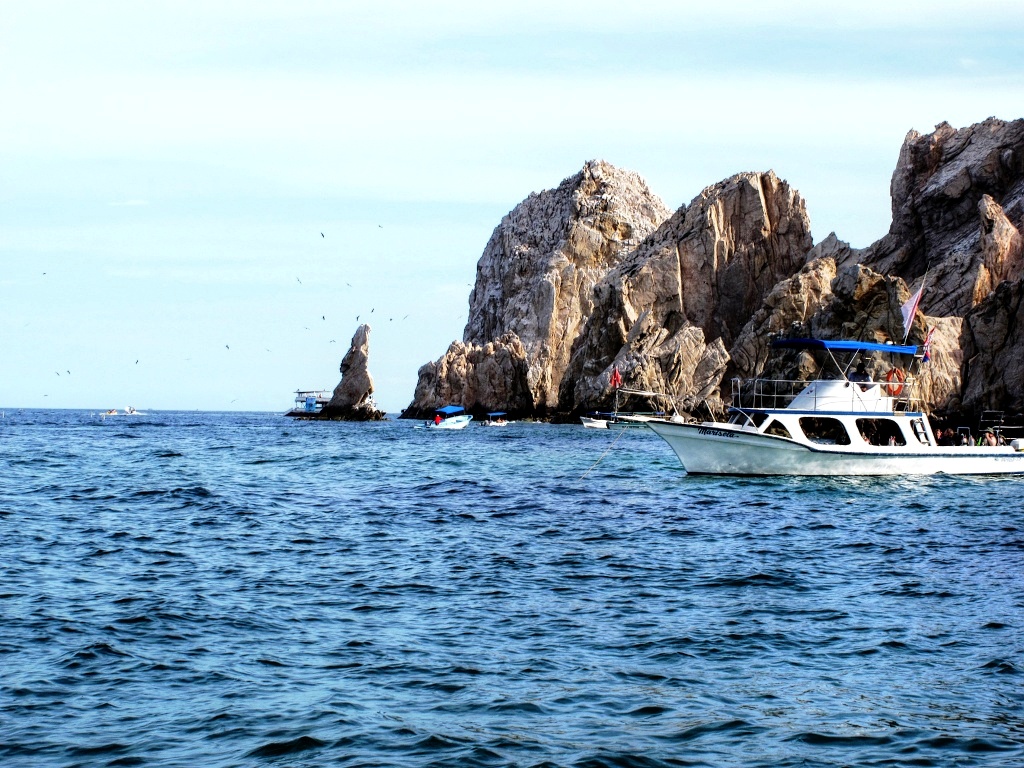
Neptune's Finger. (Our captain took pains to explain it was Neptune's middle
finger.)
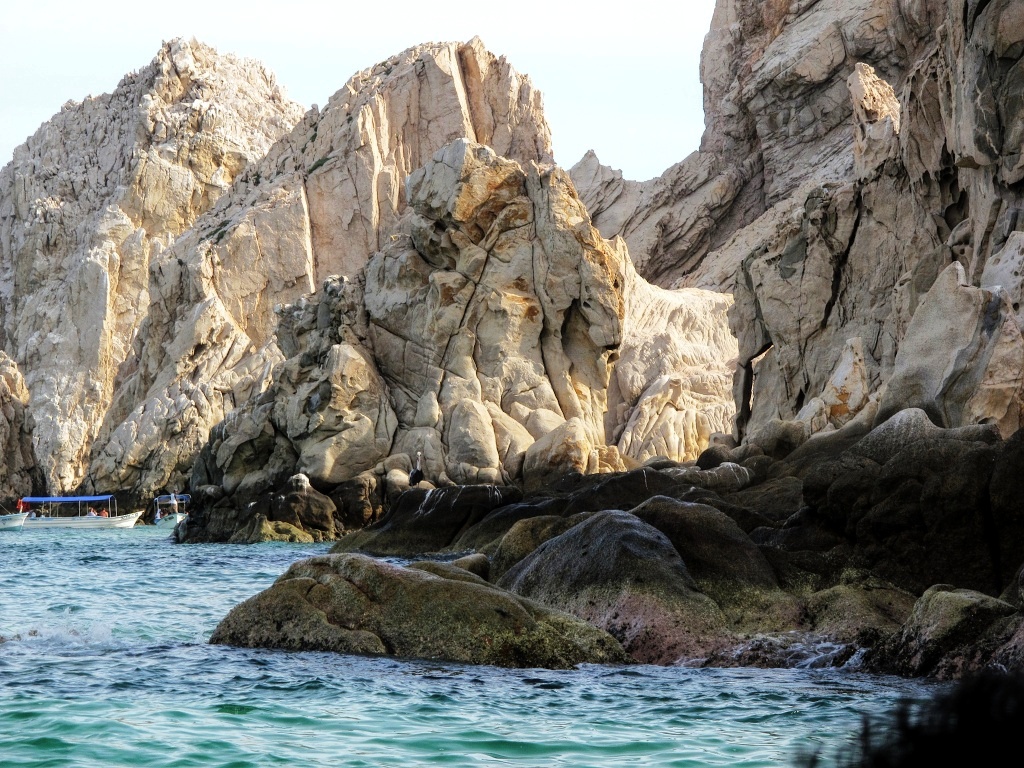
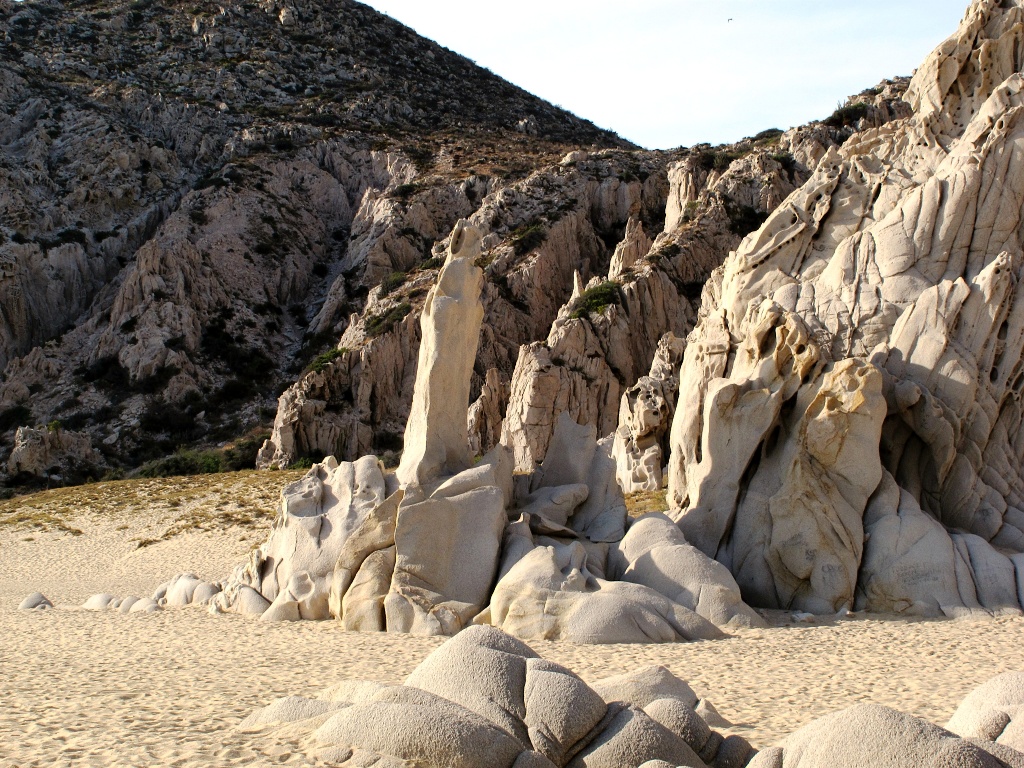
The many levels of absurdly carved rocks made for interesting views at every
turn.
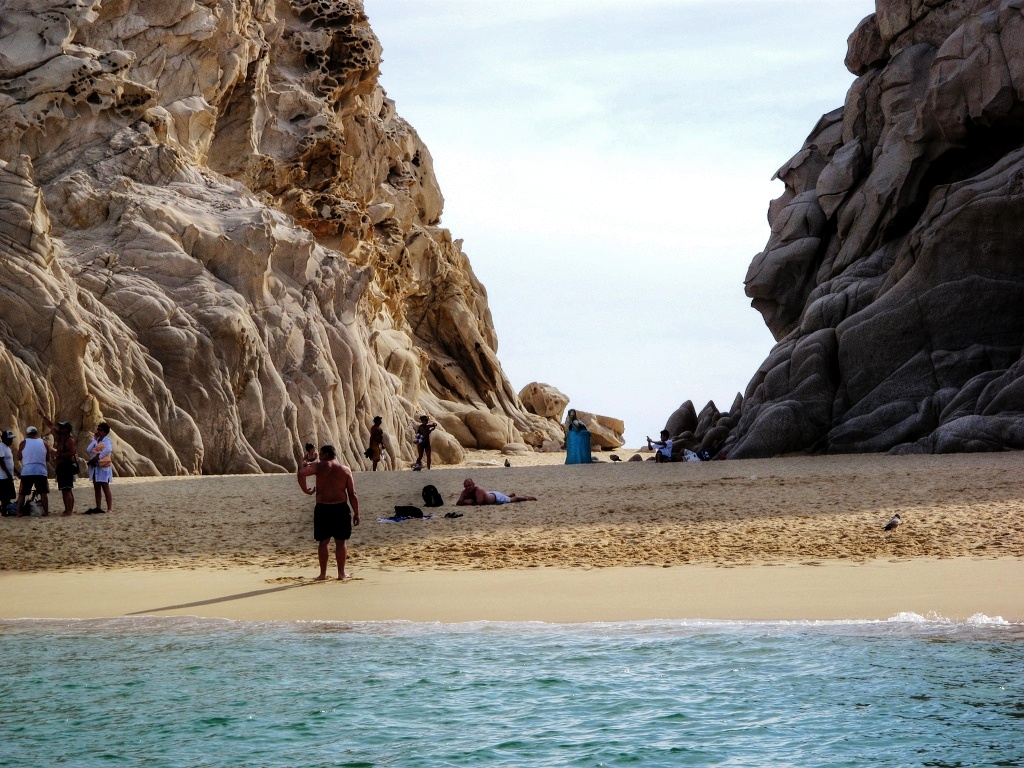
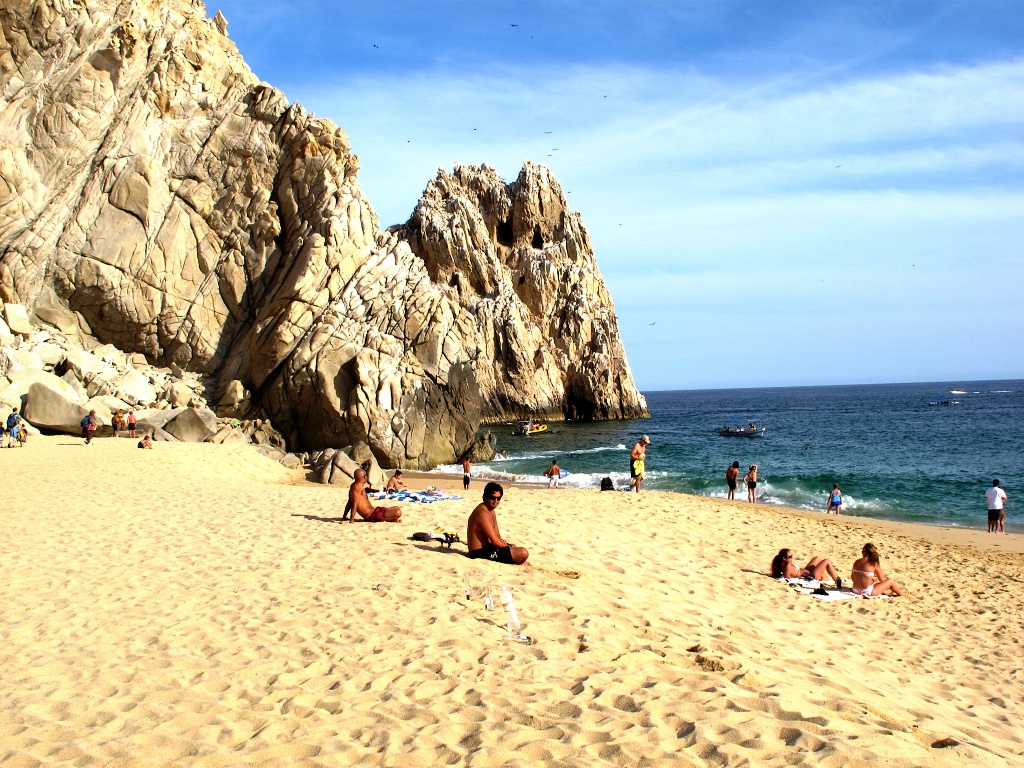
On the largest island near the last, a sandy beach cut through from the Sea
of Cortés to the Pacific Ocean. Because the Sea-side is calmer, it is called
"Lover's Beach". The rougher, Pacific side is called "Divorce Beach".
As we got closer to Neptune's Finger it only came to look more
amazing. Remember, all this carving was done by water over the last
several million years!
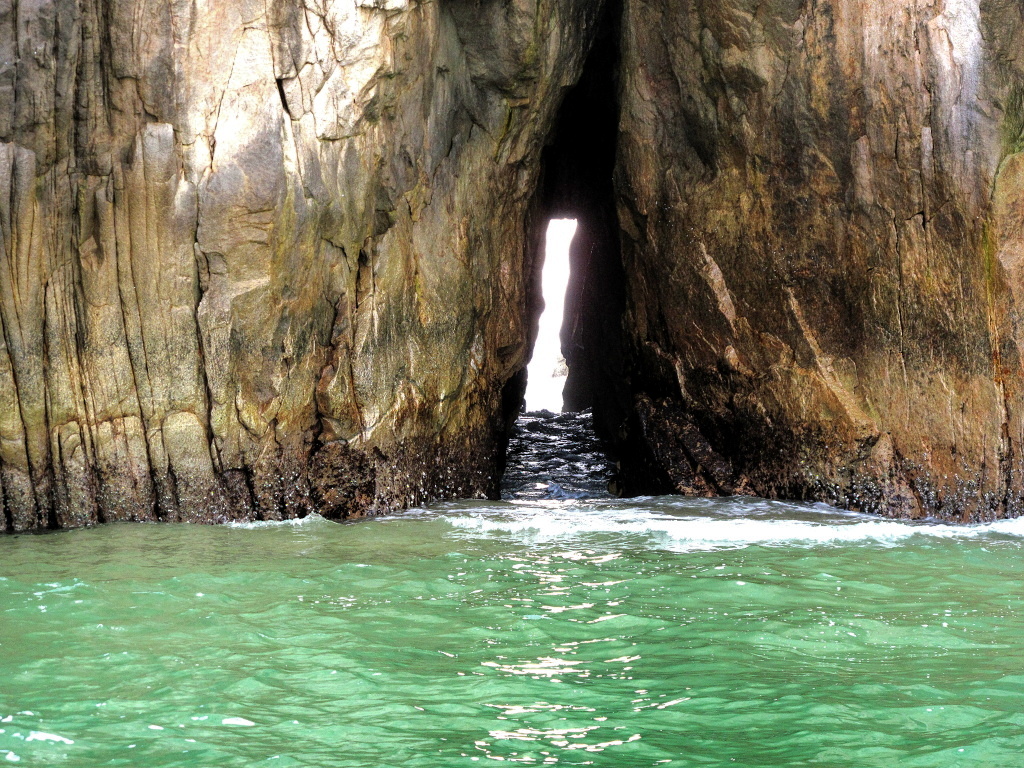
A narrow cleft in the rock wall allows the waters of the Pacific and those of
the Sea of Cortés to intermingle.
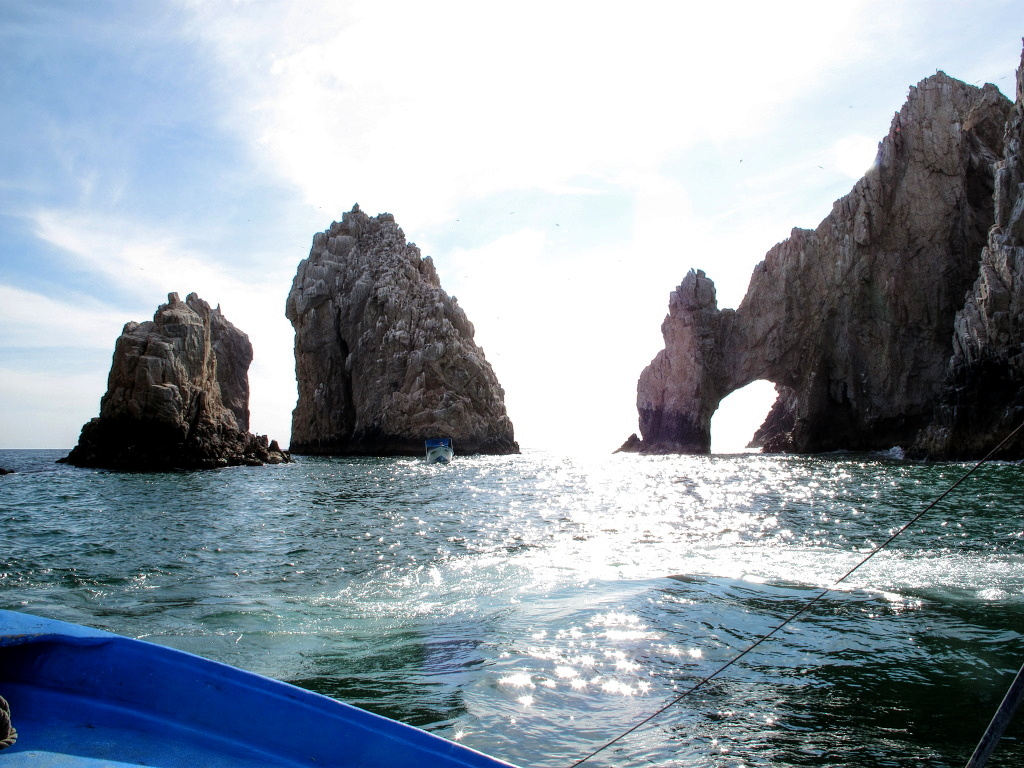
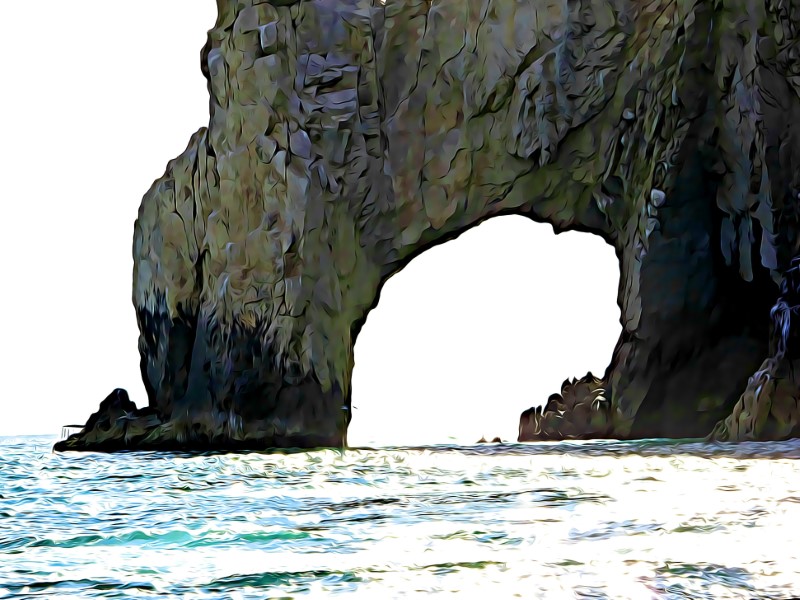
We finally came into sight of the most famous of the formations, El Arco,
the arch.
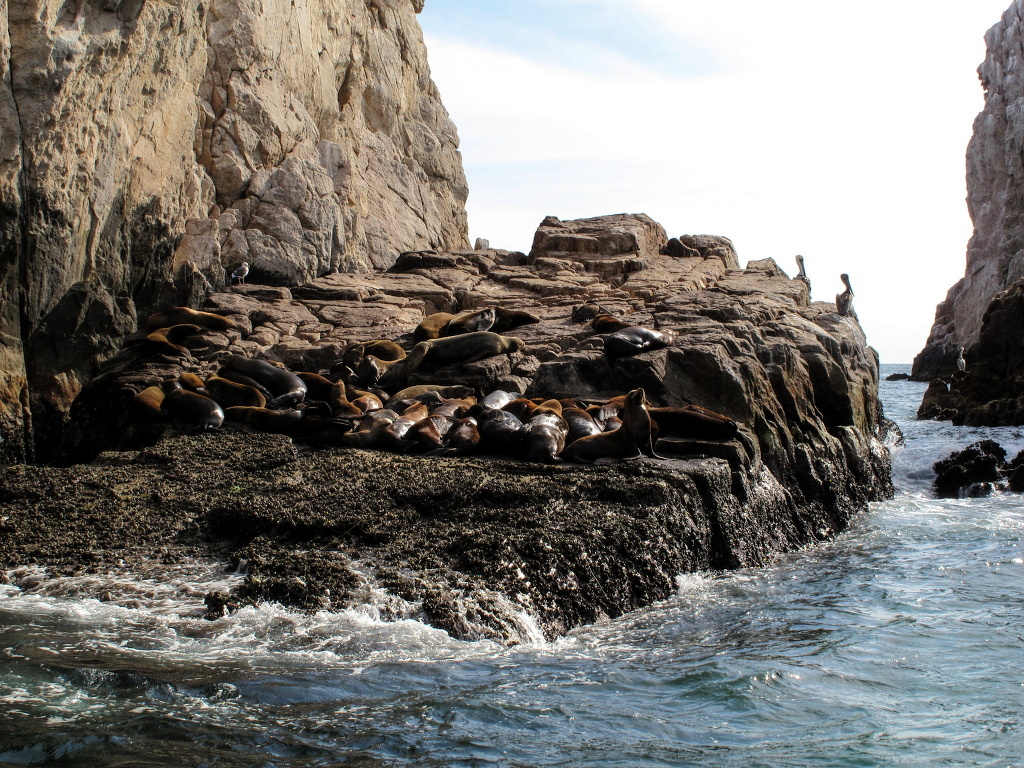
A sea lion colony occupies another of the small islands. We approached it
closely enough to smell the decaying fish parts the sea lions discard
after getting the good stuff. Trust me, you wouldn't want these guys as your
next-door neighbors, no matter how cute they look.
From its white color, I was guessing these liths were limestone; but I was
wrong. They are granite, bleached pale by millions of years of sunlight and
pelican droppings.
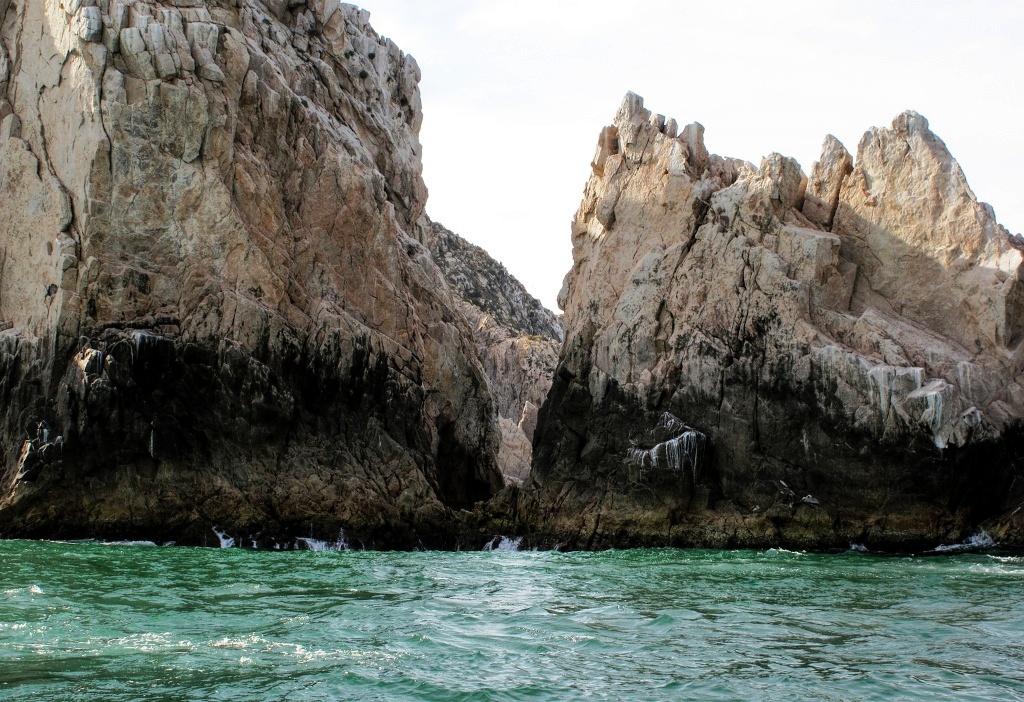
We finally came to the outmost of the islands, the southernmost piece of
Land's End. (According to Daniel, some people say that this is "Land's
End" and the other islands are just unnamed islands on the way to it.)
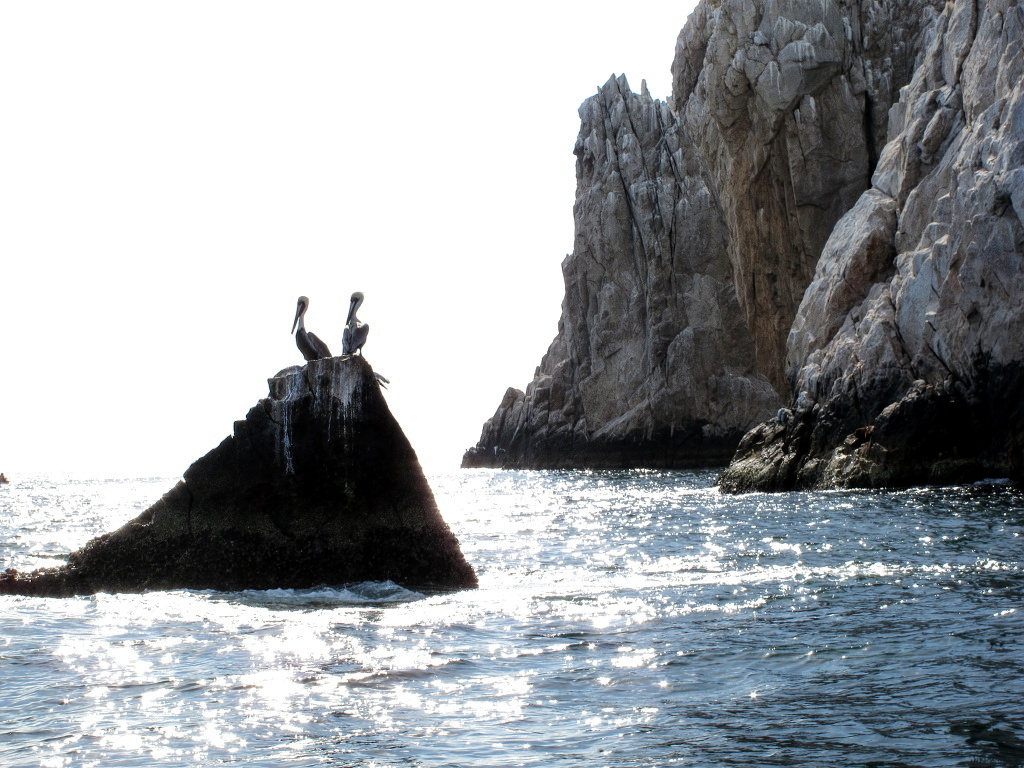
We continued on around to the Pacific side where the water was, indeed, a
little rougher. Daniel remarked that at one time these hidden coves and caves
were the home of pirates.
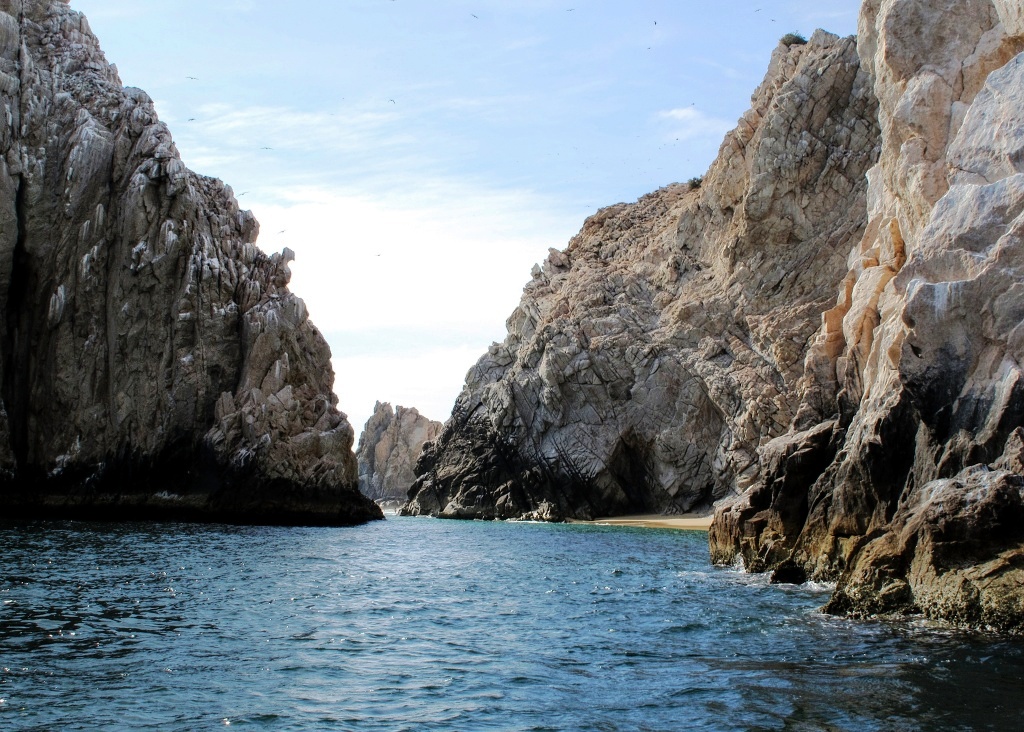
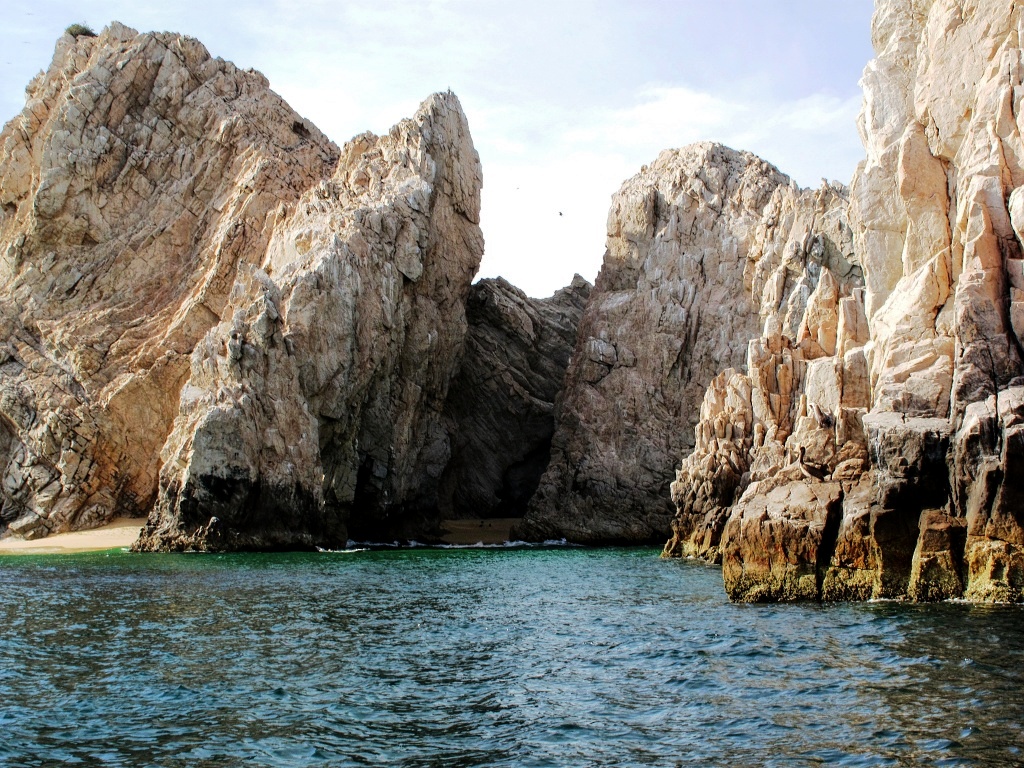
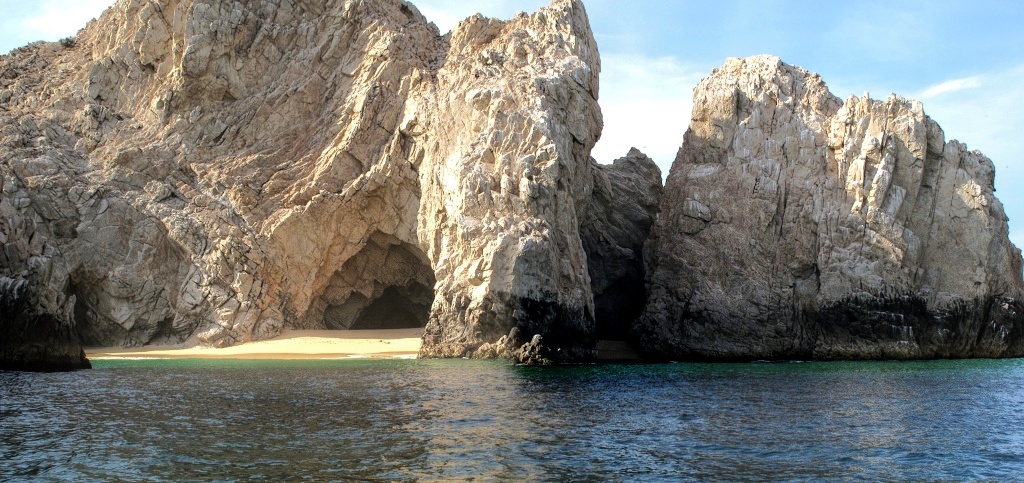
Because it had taken so long for us to find the beach, the sun was shining
from the Pacific side. And photos of the rocks now included the mainland behind
them.
It was on our return to the Sea of Cortés that I got the obligatory picture of El Arco.
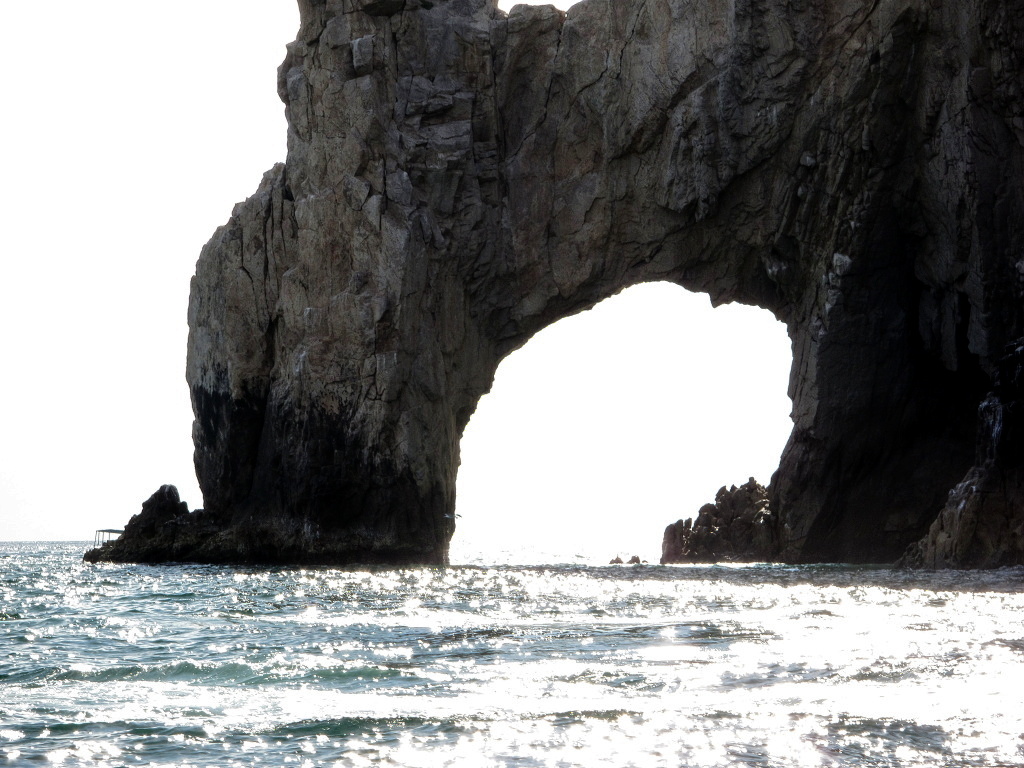
Once every few years, the Sun and Moon align in such a way to form unusually
low tides. This last happened last November. At such times, sand is revealed at
the base of the arch and people can walk there. Normally, though, it's deep
enough for a boat to traverse—though few attempt it, since the random currents
of the mixed Pacific and the Sea of Cortés nearly guarantee such a boat would be
dashed against the rock walls.
Daniel didn't try.
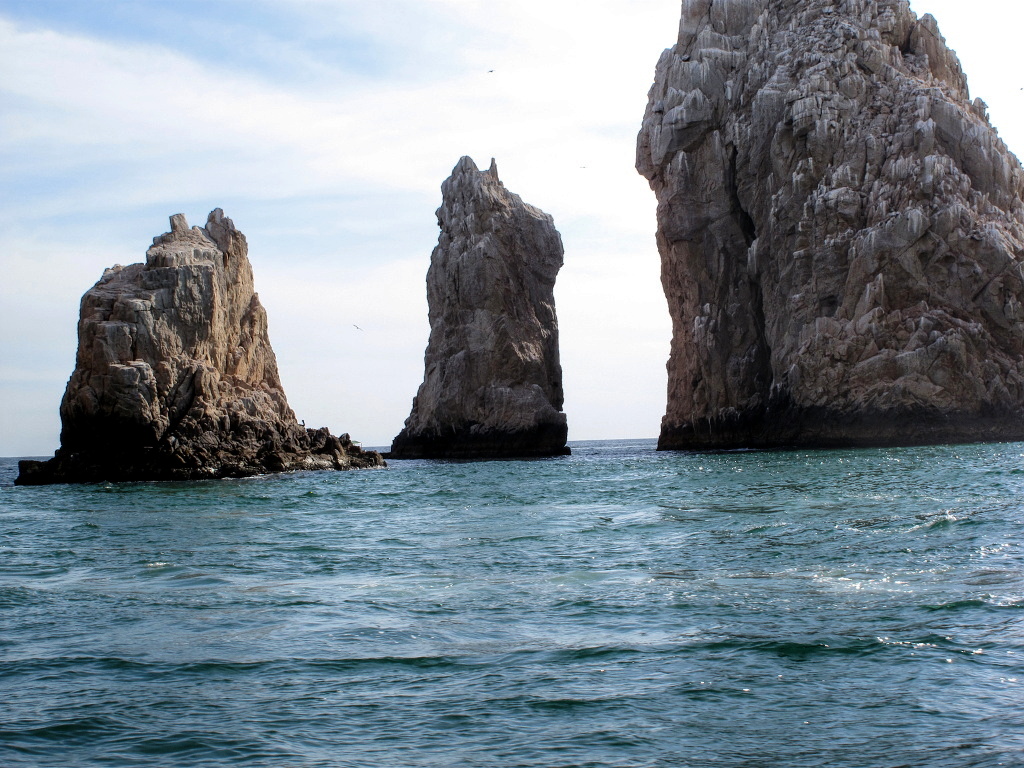
Back on the Sea of Cortés side, Daniel pulled right up to Lover's Beach to
let us off for a swim and a little exploring, promising to return at 5 PM. A
gangly, pock-marked man was waiting and took my towel and camera to "help" me
off the boat. He also helped Michael, then declared, "Acepto tips!" in
that weird pastiche of English and Spanish.
"Of course you do," I acknowledged, and handed him a 200 peso bill—$2, almost
certainly too much for such a very small (and unrequested) service. But I hadn't
been prepared for the degree of tipping expected here. (You are also supposed to
tip grocery baggers and even gas station attendants.)
But now we were on Lover's Beach, on the shore of the Sea of Cortés and a
short walk to the Pacific Ocean. It was now, on close observation, I realized
the islands were made of granite. The sand was coarse; if the grains had been a
shade bigger they'd have been pebbles. But it was comfortable to walk on, with
little garbage and no shells or other impurities to injure the foot. And
everywhere there were hoodoos (I am using the Arizona word, because I don't know
what they are called locally), irregularly-shaped mounds of granite protruding
here and there from the ground.
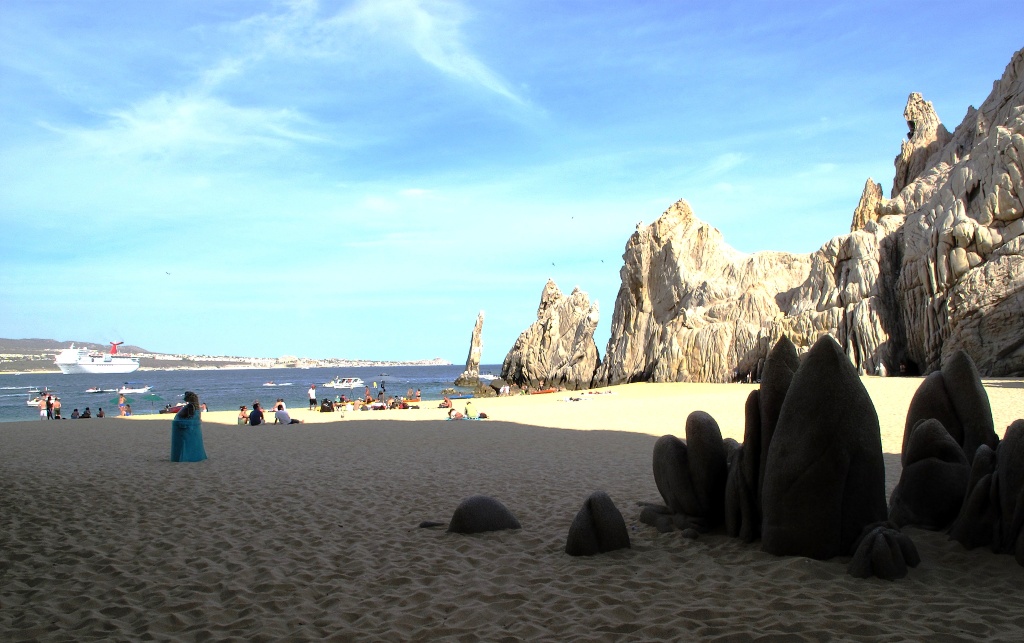
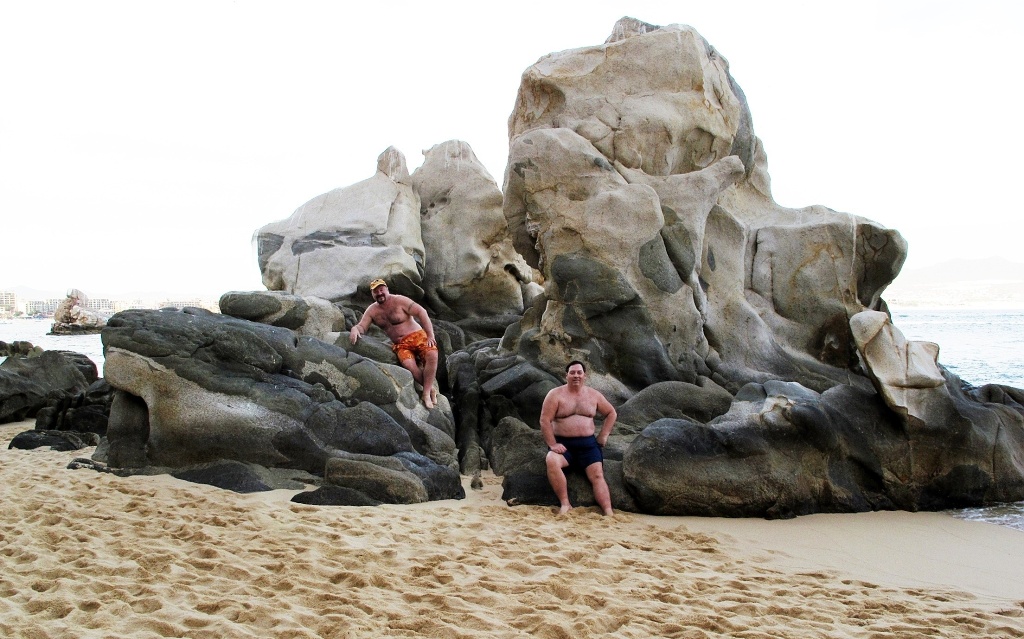
This gave Michael and me a chance to take pictures of each other.
The walk to Divorce Beach on the Pacific side was short but spectacular.
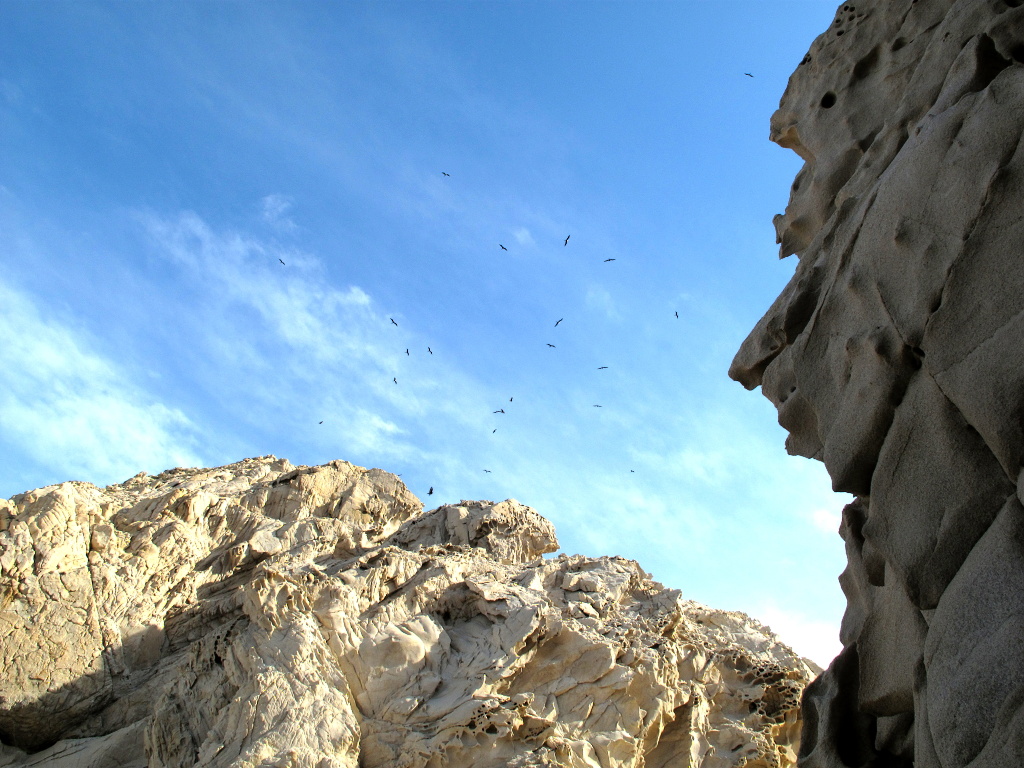
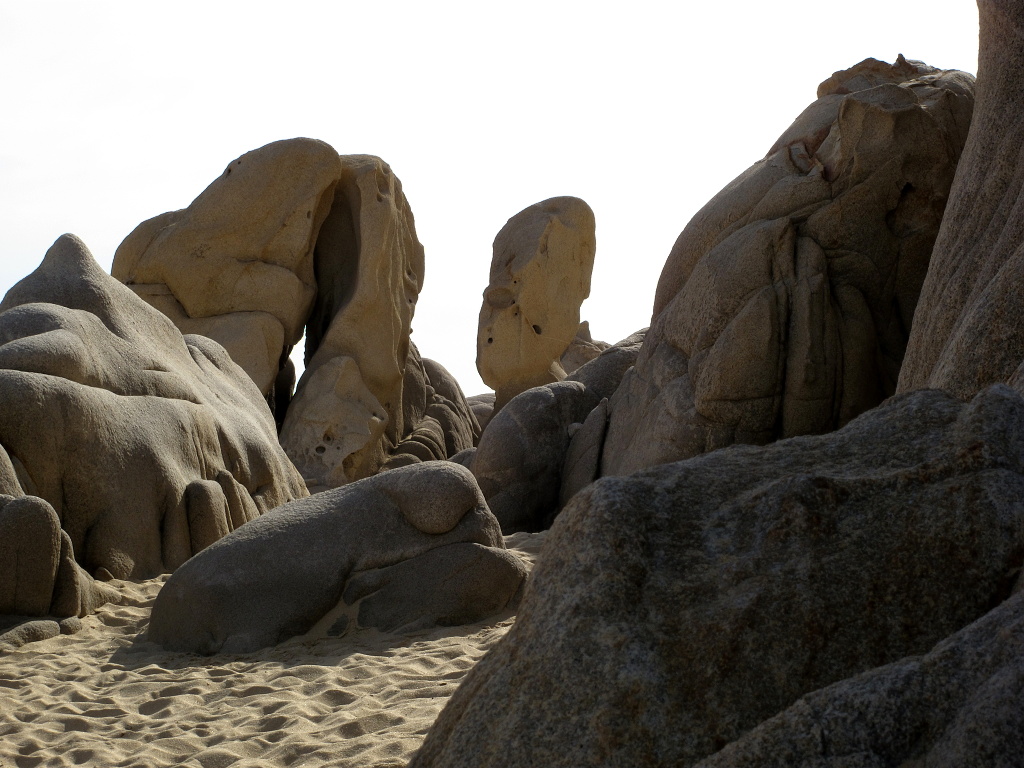
The Pacific water was too tempting a blue to stay out of. Michael and I both
waded out, we couldn't go far because the ocean floor fell away sharply. The
waves were perfect for body surfing even though they did tend to grind us into
the coarse sand. When I left the water, my bathing suit pockets were full
of the stuff, as was every orifice I possess.
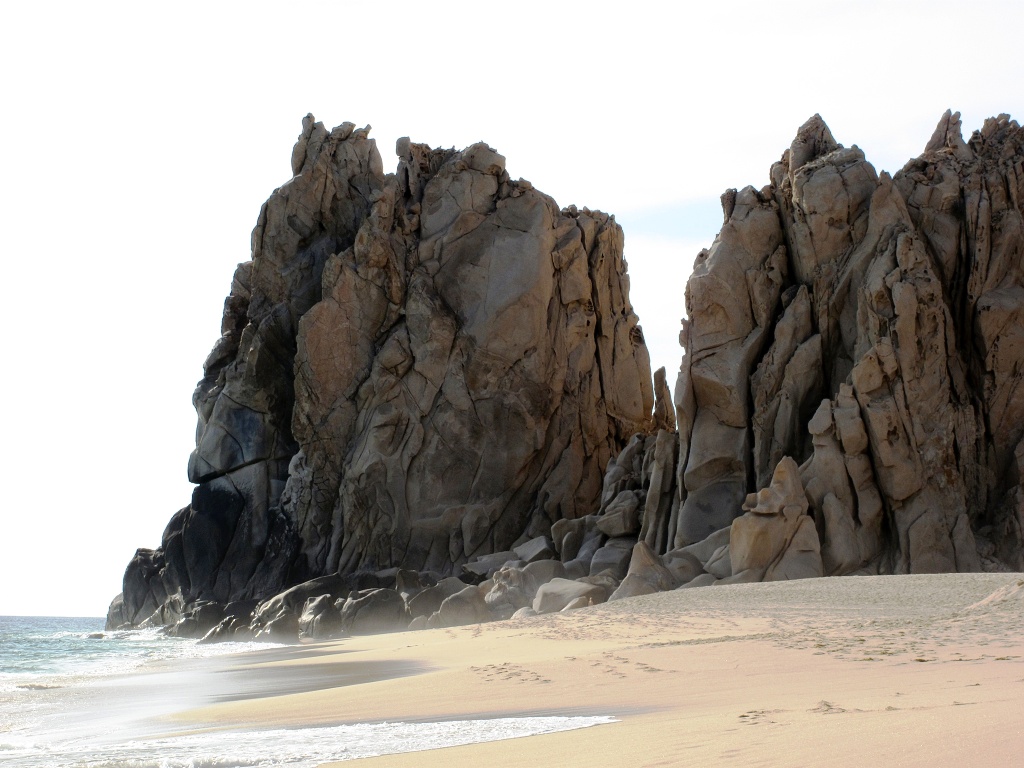
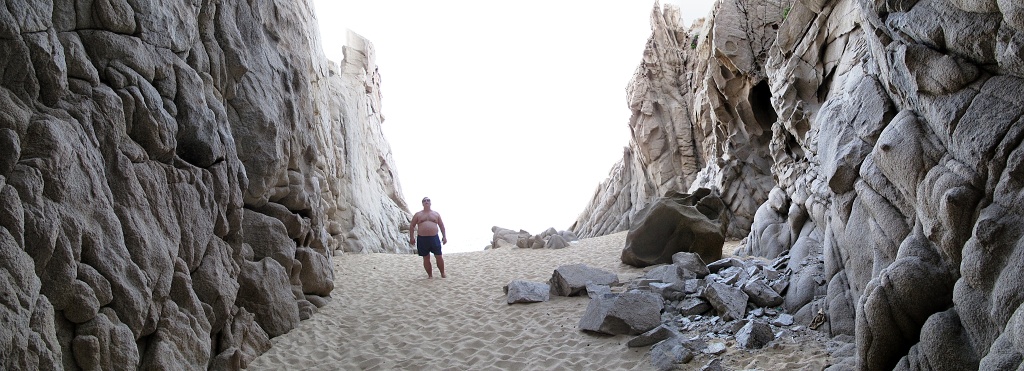
Divorce Beach was hemmed in on both sides by seemingly insurmountable walls
of granite.
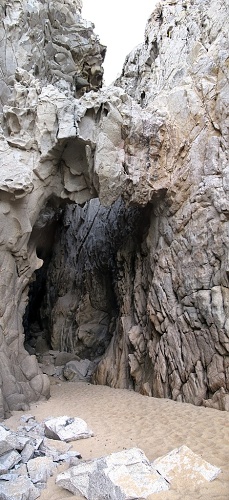
After our swim, Michael and I returned to the Sea of Cortés and wandered
along the shore, finding one secluded beach after another, many with their own
caves. The roof of one had collapsed some time in the past, allowing in a
ghostly light to play on the tortured walls.
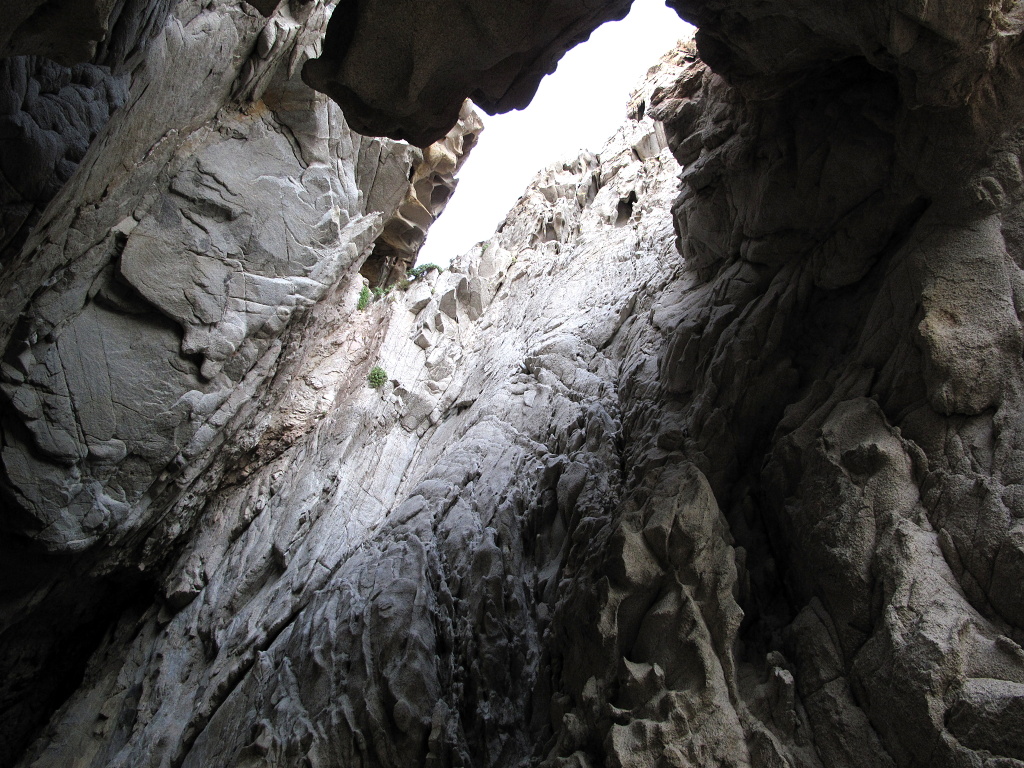
All these caves were formed, of course, by millions of years of ocean waves
pounding on the granite slabs of which they're made, same as all the other weird
shapes. Once an indentation was made in the wall, subsequent waves would pound
even harder on it, amplified by the depression, however slight. In time the
depression became a cave. This is common in limestone, but granite is much
harder so the process takes a lot longer. What's unusual about this archipelago
is that it's been around long enough to display such a history.
Finally, it being (I thought) close to 5, we got in one last photo op and
returned to Lover's Beach to be picked up.
As it turned out, we were about a half-hour early. Michael made himself
comfortable on his beach towel and I remained standing, enjoying the view and
looking for anything else I might be able to take a picture of. (I took 137 of
them altogether; I've included only a few here!) We had a great view of
Neptune's Finger from where we were, and I suddenly realized that some daredevil
was climbing it! He had no climbing gear, no shoes even, but he managed
to scale it in less than 20 minutes. He had my eternal admiration.
When he reached the top, everyone on the beach applauded, even the tip guy,
which suggested to me this was a special occurrence.
Before the climbing guy could begin his descent, our boat, the No Problem
II arrived. I told Tip Guy that we could get on by ourselves, thank you very
much—I'd watched him carry all the female passengers onto the boats as
they arrived, and I didn't want to chance him trying that with me and slipping a
disk—and we boarded. There were many more passengers for the return, as this was
Daniel's last trip of the day.
We returned to the Posada Chelaba to rinse the sand off of us and change for
dinner. We'd been given instructions to rinse sand off at the poolside shower.
That shower had plenty of hot water and I made the most of it.
Rose Ann, hearing the shower, came out and asked if it was us, and then asked
about our day. When I mentioned the water in our own shower being cold, she
looked perturbed, then said, "You should've said something. Oh! I know what
happened. You were going to be in the other casita. I leave the hot water turned
down in the unoccupied casitas to conserve. I'll make sure yours is on tonight
so you can have hot showers in the morning." She also told us she had put in new
bug zappers so we shouldn't be troubled by any mosquitoes.
Michael wanted to have dinner at a Thai place he'd discovered on the tourist
map. It was in old town Cabo San Jose. As usual, we had trouble finding it,
driving out of town before returning and discovering the sign that said "El
Centro". We'd been looking too hard for a small, hard-to-read sign and so missed
this green billboard-sized sign hung over all four lanes of the road. In fact,
we'd driven under it.
I was worried we'd have trouble parking; in fact, the streets were crowded.
But I visualized a nice parking space and, moments later, a car just ahead of us
pulled out of one and we claimed it as our own. It was right next to a church
where a choir was singing for Saturday night Mass. Following the sidewalk, we
found ourselves in the town plaza just in front of the church in traditional
Spanish plan. The plaza was well-lit and gently occupied by strolling couples
and families letting their little ones run and play. Considering it was almost 9
pm I was a little taken aback until I realized that the Mexican residents would
have taken a three-hour siesta in the middle of the day and wouldn't go
to bed until 10 or 11 PM.
The plaza was lined with art galleries. We didn't go in to any, but the
pieces we saw from the doors and through the windows looked quite impressive. An
art lover wouldn't find a trip here wasted.
The Thai restaurant was on a side street, next to the town's only gay bar.
The only way we could tell it was a gay bar was 1) it was filled with
good-looking men and no women except the bartender; and 2) our hostess had told
us where it was next to the Thai restaurant. There were two friendly dogs
waiting patiently by the door. As Michael and I stood there, trying to decide if
we wanted to bother going into a bar, a squat, middle-aged man came out and
spoke to the dogs. Michael asked if they were his.
"Si, mi perros," the man replied. "My bar, too. Come in!" He was so
insistent that Michael and I instinctively stepped back. Mexicans have a
compressed sense of body space compared to Americans. He may have taken this for
distaste for "the gays" though, because he then went back into the bar, bringing
the dogs in with him.
In the Thai restaurant, Michael and I asked for a table in the patio. Michael
ordered pad Thai noodles with chicken; I had cashew chicken and fried rice. Both
were very good. Michael also drank not one, but two caffeine-laden Thai
teas. Michael doesn't usually drink caffeine because it makes him start talking
non-stop. No, I mean even in comparison to his usual speech patterns.
Perhaps because of the vicinity to the bar, there were two other gay couples
eating there, a couple of guys and a couple of lesbians. Each couple was
attractive and dressed better than we were, which suggested they were locals
rather than on vacation. Next to us was a table with two straight couples, in
which the women talked to each other while ignoring the men, and the men spoke
together while ignoring the women. While we were there they put away three
bottles of wine.
While we were eating, a three-man musical combo strolled in and aimed
directly at the straight couples, asking for requests. Distracted from their
conversation, the four of them struggled to remember the name of any
Spanish-type song, finally coming up with Cuando Caliente El Sol. The
band, with guitar, bass, and mariachis, did a beautiful three-part harmony on
the number, then allowed the husbands to tip them. They then came up to us, but
I was low on pesos and not certain this restaurant would take a credit card. So
I asked if they could sing "Play That Funky Music White Boy". Fortunately, they
declined, and moved on to the next couple.
It was about midnight by the time Michael and I returned to our casita and
readied ourselves for bed. I was quite sleepy by now. Unfortunately, the
mosquito was still occupying the room. I tried to ignore it—after all, it hadn't
actually bit me—but then my feet started to itch and I wasn't so sure.
Then Michael's Thai teas kicked in and he began a lecture on Charles Dickens
and his mastery of description and the actors and actresses who'd played
characters in movies based on Dickens' books and how changes in lighting in the
movies was used to express passages in the books describing the characters
emotional states. Every time the droning of his voice started to help me doze
off the mosquito would dive-bomb my ear and my eyes would fly open square in
front of Marilyn Monroe's nude breasts.
It was a long night.
I don't know when we finally fell asleep, but we awoke about 8:30, which gave
us time to shower and dress before breakfast. Guess what—the water was
still cold in the shower.
Breakfast was again delicious, however, though Rose Ann served bagels rather
than that delicious toast from the day before. But the bagels were good, too.
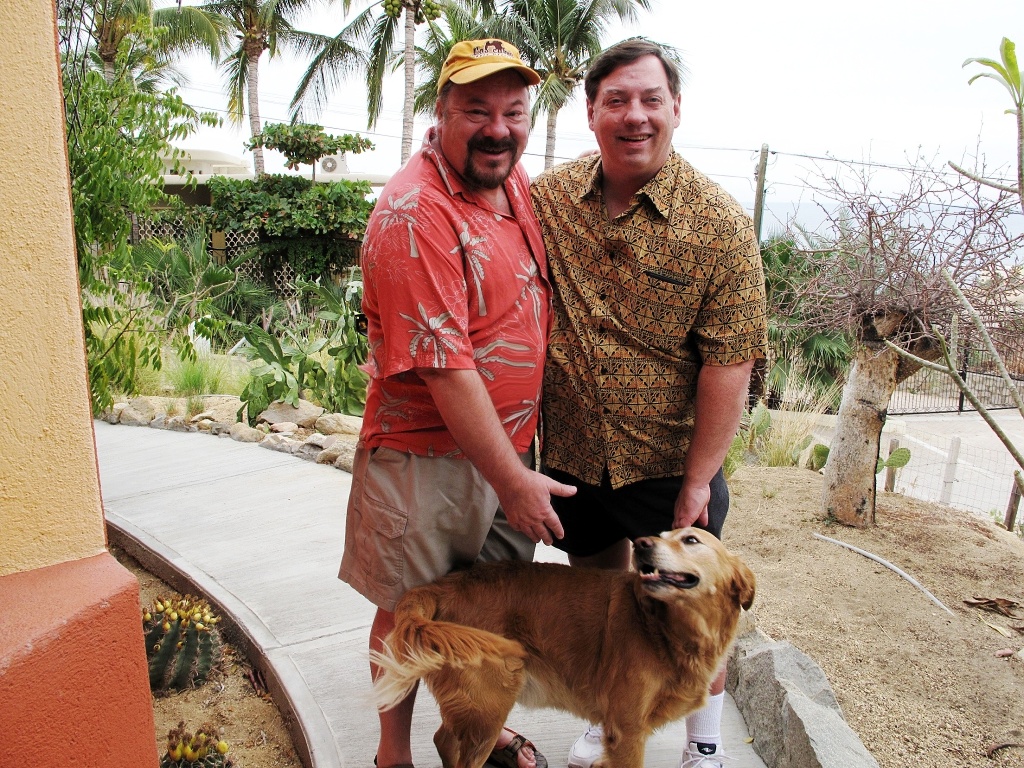
We got dressed and packed and bid Rose Ann farewell. She took a final picture of us with her dog.
We had to fill the Jeep with gas before returning it to the car rental place.
There was a gas station not far from the Posada Chelaba, but it was on the wrong
side of the highway and therefore would involve miles of driving to one
retorno and then another. So we decided to follow the highway until we found
a gas station on our side. I was sure I remembered a couple from our
explorations the night before. But we were on the edge of town before we finally
got to one.
It took about $30 worth of pesos to fill the tank (gas stations don't take
credit cards) and to tip the attendant. We then began to pull out of the
driveway, when I became aware of what was across the street.
In Cabo San Jose and Cabo San Lucas, we'd seen many old stores and shops, but
mostly brand-new and extravagant houses and condominiums. Even on the dirt
streets, the houses were genteel haciendas with wrought-iron gates and
colorful paint jobs. It was very much like being anywhere one might go in
California or Arizona.
But across from this gas station, is where the other half lives.
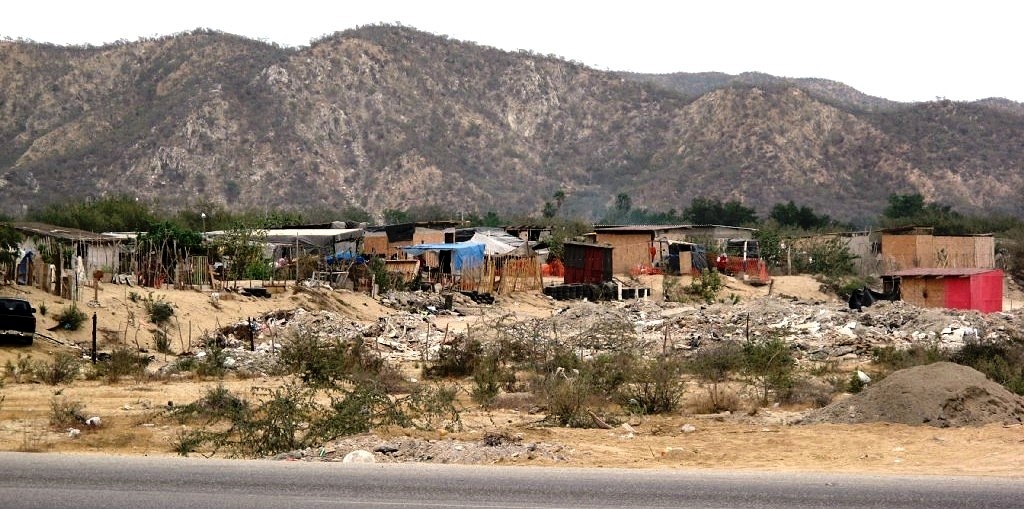
I'd read about this when I was researching Midnight Harvest. These
people live in huts made of cardboard and plywood.
On the plus side, they are allowed to. In America, we'd be too
embarrassed to allow such poverty to exist in plain sight, and would have the
huts bulldozed "for health and safety reasons" and forbid the residents to stay
there. Scattered homeless people are easier to ignore than a village of poor
folks all in one place.
Suddenly I didn't feel nearly as bad about overtipping Tip Guy on Lover's
Beach. This was very possibly where he lived.
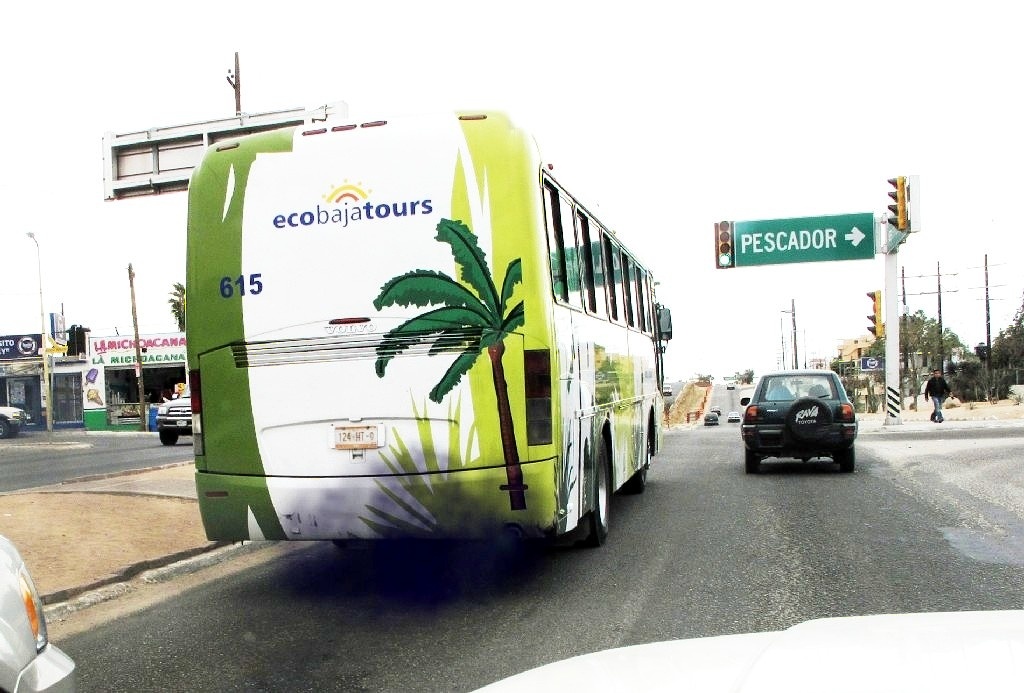
So we pulled back on the highway and found ourselves behind an
"Eco-Baja-Tours" bus, all painted green and obviously going after the
environmentally-conscious tourist crowd. I had to laugh, though, when the bus
started to go again after stopping at a traffic light. It belched enough smoke
to make Rush Limbaugh choke.
Other than that, our trip to the airport was uneventful. We returned the car
to the rental lot, and allowed their shuttle to take us to our respective
terminals. Michael got out first at terminal 1, and I got out at terminal 2,
went through security, and wandered to my gate. I had plenty of time; my flight
wasn't scheduled to leave for a couple more hours.
However, when I arrived at the gate, I was surprised to see they were
boarding now. In fact, they were nearly done! I handed my standby flight
papers to the agent, and asked why they were already boarding. "Oh, we like to
leave early when we can," she replied. Then she added, "There is a $21 fee for
standby passengers."
I was startled, since this had never happened in my previous travels. I was
also dismayed, because I had used the last of my pesos at the gas station. The
woman had me give my credit card to a runner, who took it downstairs to the
United ticket counter and soon returned with a receipt for me to sign. I was
then allowed to board the plane; we took off almost an hour-and-a-half ahead of
schedule.
They've started calling the lead flight attendant (the cabin manager) on
United the "purser". On this flight, the purser was an unusually good-looking
man in his mid-thirties. I had plenty of opportunity to study him because I was
in the front row and his jump seat was directly in front of me. I had a book to
read, but every time I looked up he was looking at me; and when he saw me notice
him he would give me a broad, inviting smile. I was puzzled because my gaydar is
rarely wrong and he seemed straight to me. Maybe I looked like his dad or
favorite uncle or something.
But when I was saying goodbye after we landed in Los Angeles, he shook my
hand in a warm and lingering way, as if he hoped I wouldn't leave.
Maybe that's what they mean by "the friendly skies of United"!
Because we left so early, after I'd gotten through customs I was in time for
an earlier flight home. The agent gladly shifted my reservation and I arrived
within a half hour of Michael (instead of four hours later) and also of my
daughter Karen, who had picked that day to come home for a visit.
So: Trip over, definitely a success, though I don't think I'll return. I
enjoyed visiting Cabo thoroughly, but there are so many places yet to
visit…and so little time!
Flat Stanley
|
By: Paul S Cilwa |
Posted: 1/29/2009 |
|
Page Views: 2,000 |
| Hashtags: #Cailey #FlatStanley #CaboSanLucas |
| My granddaughter's school project goes to Mexico! |
| Estimated reading time: 4 minute(s) (816 words) |
The day before I left for Cabo San Lucas,
I received in the mail a brown envelope from Virginia. Two of my daughters, and
my only granddaughter, live in Virginia; but not at the address on the envelope.
So I almost didn't open it until after my trip. But I did, and it turned out to
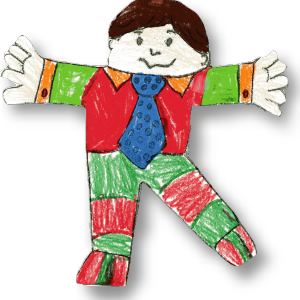
contain Flat Stanley, a cutout
character my granddaughter, Cailey, had made in school. Her teacher had sent
Flat Stanley to me, along with a letter from Cailey asking that I allow Flat
Stanley to accompany me for a week or so and then to respond by telling his
adventures. This blog entry is for that purpose.