|
By: Paul S Cilwa |
Occurred: 12/27/2006 |
|
Page Views: 1,719 |
| Hashtags: #Humor #Movies #Cruise |
| Zach is worried that our upcoming family cruise will be spoiled by a rogue wave. |
| Estimated reading time: 4 minute(s) (929 words) |
My oldest daughter, Dorothy, has informed us she's going to be married. (She
got engaged two or three years ago—I've lost track.) And, she's going to be
married on a cruise ship. Since I haven't yet won the lottery, I can't afford to
load all her friends and our family on board the cruise ship. Not, that is, as
anything but galley slaves. So we're each paying our own way and thanking our
preferred deities that she decided to cruise to the Caribbean, and not around
the world.
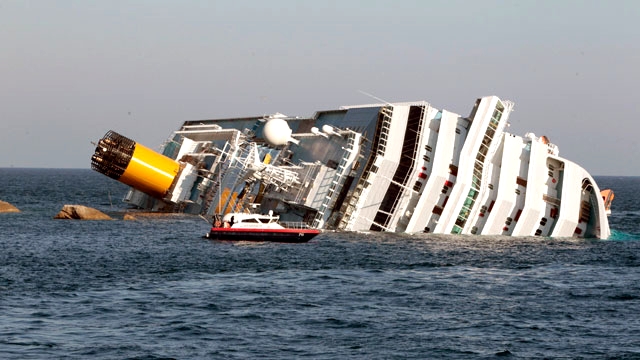
First impulse, which I quickly squashed, was to laugh. Obviously, Zachary had
been paying more attention than we thought when we watched
Poseidon. But it quickly turned out that he'd been paying more attention
to lots of movies than we thought. He'd watched
Titanic and
The Bountyand
Mutiny On The Bounty; and I happen to be reading
Baby Islandto him, a 1937 book about two little girls who are
shipwrecked on a desert island with the four infants they'd been babysitting on
the ship.
Obviously, we'd been feeding the little tyke a lot of anti-cruise-ship
propaganda.
I checked NetFlix for "ocean liners" and
"cruise". Of course, I had to wade past a bunch of Tom Cruise movies—none of
which take place on cruise ships.
Speed 2—Cruise Controlcame up but since that involves an ocean liner
rigged to crash into a supertanker, it didn't seem as if that would reassure
Zachary any.
(Incidentally, Speed 2 takes place on a ship called the Seabourn
Legend, which is not only a real cruise ship—its identical sister ship, the
Seabourn Spirit, has the distinction of being the only cruise ship in
modern times to be attacked by pirates. And, apparently, the Seabourn Legend
didn't find the association with Speed 2, which ends with the ship
crashing into and destroying a port town, as much a passenger draw as they'd
hoped; when the movie was shown on TV, CGI effects were used to change the name
to the "S. S. Legend.")
I looked for it but, to my surprise, Love Boat hasn't yet been
released on DVD.
Love Affair, the remake of An Affair To Remember, won't help;
although the ship doesn't sink, the reason Warren Beatty is on it, is that his
plane was forced down; and we'll be flying to Tampa to get on the ship. Besides,
Zachary thinks kissing is yucky and when it's Warren Beatty being kissed, so do
I.
A possible which I've added to my NetFlix queue is
Dennis The Menace—Cruise Control, in which an animated Dennis annoys Mr.
Wilson on a cruise. The Mitchells bring Dennis' pals Joey and Margaret with
them, which, now that I've priced cruises, seems excessively generous. And I'm
hoping Zachary the Menace doesn't get any ideas from it.
I asked movie critic Dave White
if there were any movies about cruise ships that aren't capsized, sunk
or burnt by mutineers that we could show Zachary so he'd get a positive spin on
all this. I haven't heard from Dave yet, but his partner wrote back and
suggested
Gentlemen Prefer Blondes. I've never seen that film (I know, it's
supposed to be part of the Gay Membership Test, but I snuck through) but I
quickly put it at the top of our list, as kissing doesn't seem to be the main
element of the plot.
The basic problem, of course, is that Zach hasn't yet learned that what he
sees on TV is not representative of the real world. Unfortunately, he is not
alone in that. Studies have shown that the likelihood people believe they have
that they, personally, will be the victims of a violent crime rises with the
amount of TV they watch. That is, a person who watches no TV at all (is
there really such a person?) actually has a fairly accurate notion of the
likelihood he or she will someday be attacked (one
person in 50, according to the US Department of Justice). A person who
watches a lot of TV becomes convinced that a personal attack is inevitable.
(Perhaps that's why they stay home in front of their TVs all day.)
Studies of the human brain show that each distinct thing we see, causes a
unique pattern of neurons to fire—and it doesn't matter if the thing is seen in
reality or on a TV screen (or, for that matter, in the imagination); the same
neurons always fire. So, as far as the brain is concerned, if it sees a ship
overturned by a rogue wave, it's a real ship and a real rogue
wave. It doesn't matter how unlikely such an experience really is; to the brain,
it is now part of your experience.
And it's very difficult to convince someone, especially a seven-year-old,
that what feels like a real experience is, in fact, something he almost
certainly will never encounter in reality.