|
|
Posted: 9/17/2023 |
|
Page Views: 641 |
| Hashtags: #Amsterdam #Netherlands #Holland |
| Most Americans do not understand the difference between the terms used to describe the country of which Amsterdam is a part. |
| Estimated reading time: 5 minute(s) (1117 words) |
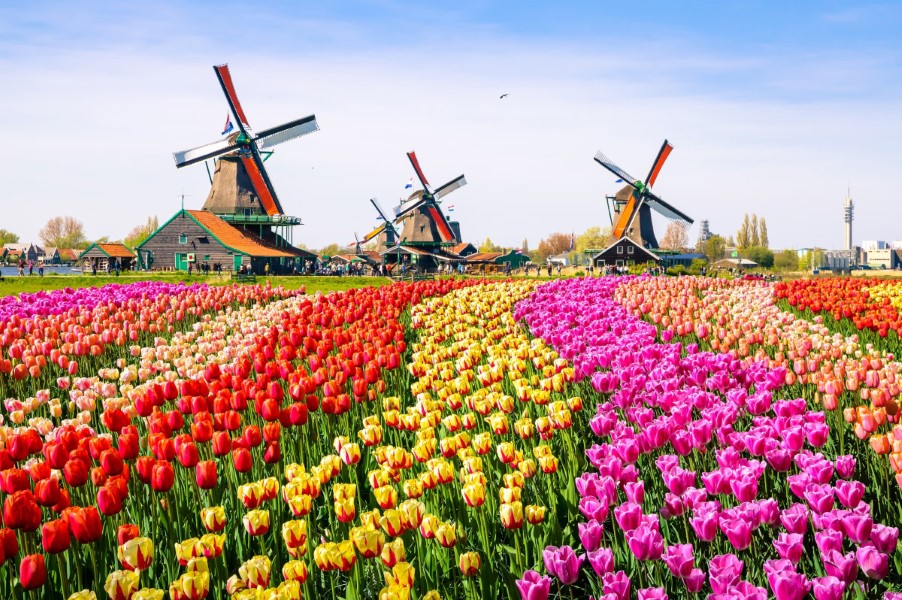
The actual name of the country that contains Amsterdam is the Netherlands.
The name "The Netherlands" means "the low-lying lands" or "the low countries"
in English. It's derived from the country's geography, as a significant portion
of the Netherlands is situated below sea level. The term "nether" means "lower"
or "low" in Old Dutch, and "lands" refers to the country itself.
"Dutch" is an adjective used to describe things or people from the Netherlands.
It's similar to saying "American" for someone from the United States. So,
if you meet someone from the Netherlands, you can refer to them as Dutch.
The confusion with "Dutch" arises because it sounds a bit like "Deutsch," which is
what the Germans call themselves. But make no mistake, "Dutch" refers to the Netherlands,
not Germany.
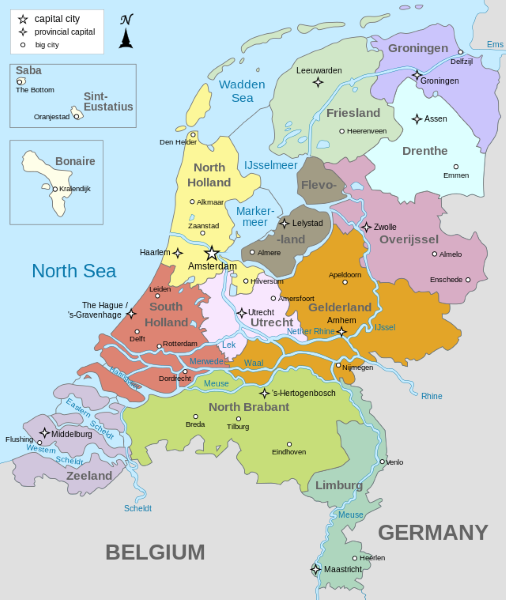
Now, let's talk about "Holland." Holland is not the same as the Netherlands; it's just
a part of it. Holland is divided into two of the Netherlands' twelve provinces:
North Holland (Noord-Holland) and
South Holland (Zuid-Holland). They do not comprise the whole country any more than North and South
Carolina make up the whole of America. These provinces are home to famous Dutch cities such as
Amsterdam, Rotterdam, and The Hague. When people say "Holland," they are properly
referring to these two provinces, not the entire Netherlands.
The confusion between "Holland" and "the Netherlands" arises from historical trade and
economic factors. In the past, the two provinces of Holland were major players in
international trade, making them well-known globally. So, when people conducted
business with the Dutch, they often dealt with folks from Holland. Over time, "Holland"
became synonymous with "the Netherlands" in many people's minds, even though it's only
part of the country.
Ah, now that we've got the distinctions between "Dutch," "Holland," and "the Netherlands"
squared away, let's delve into some of those quirky terms attributed to the Dutch.

Now, remember that we Americans get our words through the English, and the English,
historically, do not have the reputation of being charitable towards their neighbors,
especially regarding cultural artifacts they did not share.
First off, we've got "Dutch treat." Now, when someone suggests a Dutch treat,
they're proposing that each person pays for their own expenses. It's all about splitting
the bill evenly, and it's considered polite and fair. This phrase may have originated
from the Dutch reputation for frugality and fairness in financial matters.
However, it's more likely that the British, who make a big thing over seeming
to be generous, found such a practical and balanced approach to dating, or
indeed simply meeting a business associated for lunch nothing short of scandalous.
Now, if you've ever heard of the phrase "Dutch courage," it refers to the boldness
or bravado that some folks summon when they've had a bit to drink. This, again,
likely originated from a snarky but jealous Englishman who'd just lost out to
the Dutch East India Company in a deal.
Then there's the "Dutch oven." No, we're not talking about a cooking pot from the
Netherlands here. A Dutch oven is a cast-iron cooking pot with thick walls and a
tight-fitting lid, often used for slow-cooking and braising. The device might have
Dutch origins, but it's more likely linked to the fact that these sturdy pots were
manufactured and popularized in the American colonies by Dutch settlers.
So, while these phrases and terms might carry the word "Dutch," they often have more to do
with common social customs and historical contexts than with the Dutch people themselves.
It just goes to show how language has a way of twisting and turning through history,
picking up meanings and nuances along the way.