|
By: Paul S Cilwa |
Posted: 2/27/2006 |
|
Page Views: 5,289 |
| Hashtags: #RepublicanCorruption #Conspiracy #History #AdolfHitler |
| Is there a fundamental difference between the man-in-the-street and the leader of industry? |
| Estimated reading time: 5 minute(s) (1110 words) |
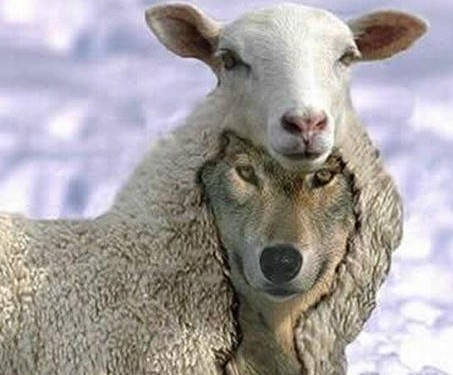
Is there a fundamental difference between the man-in-the-street and the
leader of industry? A difference so basic that one man is impelled to rule
nations while another, who might have attended school alongside the first,
nevertheless finds it impossible to rule even his household? A difference that
makes it inevitable that one man will become a wolf while ten of his brothers
become sheep?
I believe there is, and moreover I think I have identified it. There's a clue
in Adolf Hitler's autobiography, Mein Kampf:
All this was inspired by the principle - which is quite true in
itself - that in the big lie there is always a certain force of
credibility; because the broad masses of a nation are always more easily
corrupted in the deeper strata of their emotional nature than consciously or
voluntarily; and thus in the primitive simplicity of their minds they more
readily fall victims to the big lie than the small lie, since they
themselves often tell small lies in little matters but would be ashamed to
resort to large-scale falsehoods. It would never come into their heads to
fabricate colossal untruths, and they would not believe that others could have
the impudence to distort the truth so infamously. Even though the facts which
prove this to be so may be brought clearly to their minds, they will still
doubt and waver and will continue to think that there may be some other
explanation. For the grossly impudent lie always leaves traces behind it, even
after it has been nailed down, a fact which is known to all expert liars in
this world and to all who conspire together in the art of lying. These people
know only too well how to use falsehood for the basest purposes.
Think about it: You and I might well tell our spouses we worked
late to avoid admitting we went to the races or even that we were
having an affair; but few of us would use working late as an excuse
to hide an additional marriage or a job as a CIA hit man. We would
like to say that a lie, any lie, is a no-no but the reality
is that somewhere between "I really like your hat!" and "I would
never build a paperless voting machine designed to put my crony in
office" is a line that most of us will not cross. Still, some do;
and because the rest of us are forced to look the other way rather
than accept that some people will lie that bodaciously, they not
only get away with it—they prosper.
And, by prosper, I don't mean that they can build a pool for their home. I
mean, they can build their home on a private island.
People who can tell Big Lies without batting an eyelash are called
sociopaths. This condition, which the American Psychiatric Association
labels a mental illness, is characterized by one trait: The lack of a
conscience. Sociopaths are generally smart, often brilliant; they are often
charismatic and would probably do well in any endeavor in any case. But they
simply cannot imagine what it's like to be a victim; so these people are just as
comfortable murdering an opponent as attending a meeting, as long as their
intelligence assures them they will get away with it.
And they usually do, because they'll use the Big Lie—something so outrageous
they couldn't have made it up—to provide their alibi. Again, without
empathy, they cannot imagine what it's like to be someone else—so small lies and
big lies are the same to them. Nothing seems too farfetched. And they
know from experience that big lies usually go unchallenged.
Yet, as Hitler observed, we regular folk, who cannot murder without passion
and can tell only small lies, cannot wrap our minds around the soul so alien to
us that it can murder with cold calculation and lie cleverly to hide it.
What kind of a murder is committed by your average Joe? (That is, when the
average Joe commits murder at all, which isn't that often.) These are generally
crimes of passion. Joe finds out his wife is banging the neighbor and kills them
both, or is fired by his boss at the Post Office and blows away the whole day
staff. The average-Joe murder is marked by little or no planning and a disregard
for the consequences or even whether it is a good idea. It often ends in suicide
as the murderer faces the enormity of what he's done.
What kind of murder is committed by a sociopath? Well, he might allow 3,000
citizens to die in the collapse of an office building in an attack he knew about
but chose not to prevent. He might send soldiers to a country on a false
pretense, allowing both that country's soldiers and his own to be killed by the
thousands. In addition to telling Big Lies, when a sociopath murders, it tends
to be Big Murders.
Murder…corporate wrongdoing…political machinations…to the sociopath,
none of these are obstacles to what he or she wishes to achieve. Rather, they
are tools of the trade.
The biggest difference between a murder committed by a "regular" person and a
sociopath is that the former is always reactive: Something happened, and the
murderer responded by killing someone. A sociopathic murder is always proactive:
The murder is committed to make something happen…a raise in profits or
approval ratings, for example. A sociopathic murder is never committed for its
own sake. The sociopath gets neither pleasure nor satisfaction from a murder.
Problem is, he experiences no guilt from it, either.
And the compulsion the rest of us have to look the other way rather than
stare at the face of those without a conscience, makes us all potential victims
for these wolves in humans' clothing.
To open our eyes to the presence of these predators in our society is to lose
a degree of innocence. But it is necessary if we are to avoid being eaten for
lunch.