|
By: Paul S Cilwa |
Posted: 1/25/2008 |
|
Page Views: 5,299 |
| Hashtags: #MartinLutherKing #Commercialism |
| No level of classlessness is too low to reach when you're trying to sell mattresses. |
| Estimated reading time: 4 minute(s) (867 words) |
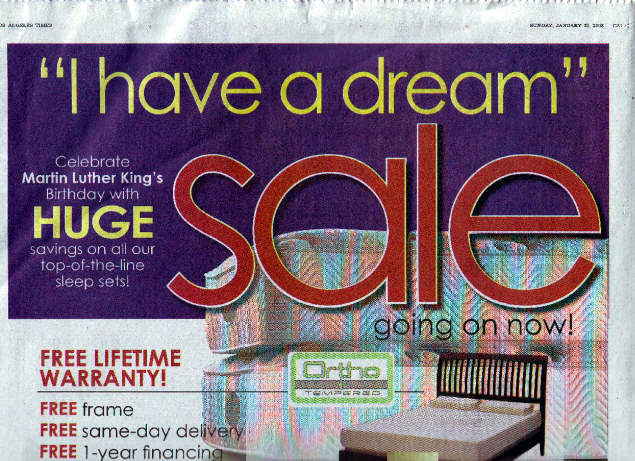
It would be funny if it weren't so sad. George Washington and Abraham Lincoln
(now conflated into a single holiday so as not to negatively impact work
attendance any more than necessary) have become car salesmen; St. Valentine
sells greeting cards and chocolates; as we see above, Dr. Martin Luther King,
Jr. sells sleep sets and Jesus himself hawks every toy, pocketbook, piece of
jewelry, electric shaver and DVD manufactured by the children of China in
between their cigarette breaks at the factory.
When I was a kid, most things purchased were good indefinitely. Vacuum
cleaners lasted forever; Michael and I have had to purchase three in the ten
years we've been together. Automobiles lasted a minimum of twenty years; now
you're lucky if you can drive one for five before it falls apart.
We hear on the news that our economy is falling apart. Interestingly, we
don't hear that it's because the Bush Administration has sent our future
gross national products (and our future and present security) to be blown up in
the Middle East. Indeed, the right-wing pundits are still trying to blame this
disaster on Monica Lewinsky. (We could be in the 90th year of a Bush presidency,
driven to eating what we could find in Bel Aire trash cans, and Rush Limbaugh
and Ann Coulter would still be blaming the failure of the economy on Bill
Clinton. Well, they have to; that's what they're paid to say.)
The message of Jesus was completely lost once it became a commercial for G.
I. Joe Mission Scale Action Figures & Vehicles. George ("Cherry Tree")
Washington and ("Honest") Abe Lincoln's messages of truthfulness disappeared
when associated with the sales of used cars. And now that top-of-the-line sleep
sets have been associated with Dr. King, what do you think that will do to
King's message of equality and brotherhood?

Commercialism is insidious because it seems harmless enough. Why shouldn't I
own a comfortable sleep set? There's nothing wrong with that, of course; in
fact, it would be a good thing. But by disguising itself as a mechanism for
obtaining good things, commercialism disguises its real purpose: To create
want for material goods. Think about it: Is there, in the entire world,
anywhere a mattress that actually delivers a perfect night's sleep, every night?
Of course not. But when you watch that attractive couple snuggle into their
Sleep-a-matic pillow-top, the illusion is created in your mind that all you need
to do to sleep like them (and, by extension, with them), is to buy the
kind of mattress they so obviously enjoy.
Commercials work because they train you to live, not in abundance, but in want.
Have you ever seen an ad extolling the virtues of honesty, or empathy, or
spirituality? Oh, sure, there are ads for churches—but even those treat
the church as a product, filling its pews with pretty, mostly-white parishioners
and suggesting you can find happiness among those folks simply by attending
services.
In fact, in 2004, when the United Church of Christ created an ad showing how
they welcome gay couples into their church,
NBC and
CBS refused to air it. The message in the ad was "Jesus didn't turn
people away, neither do we." Apparently actually featuring Jesus'
teaching was too controversial for TV, though it's acceptable to
associate Jesus with the gas-guzzling Chevy Trailblazer
(via a series of Christian music concerts).
That's why you never see commercials for real spirituality. The spirit of
commercialism can only survive if it goes unchallenged. And the great success of
televangelism is due to its ability to make you doubt your inalienable
relationship to God now and replace it with a fear of what may
happen in the afterlife…a future they cannot prove even exists.
For nearly a million years, most humans lived in simple dwellings made of
mud, or leaves, or branches. Commercials have convinced most of us that these
people couldn't possibly have been happy—they didn't have designer
clothes, or luxury homes, or swimming pools, or Cadillacs, or pillow-top sleep
sets. And if they somehow were happy, it was because they were ignorant
of what they were missing ("They don't know any better").
I am not saying that to be happy, one must live in a mud hut. What I am
saying, is that to be happy, one must learn to live in the moment and
cherish what he or she does have…right now. And a good way to
start is to refuse to watch any commercials. Tune them out, turn them off, turn
the page.
Or better yet, turn off the TV and cherish a sunset.