|
By: Paul S Cilwa |
Posted: 2/2/2006 |
|
Page Views: 4,734 |
| Hashtags: #FreedomOfSpeech #PatriotAct #Sedition |
| Self-Righteous bullies are the worst kind. |
| Estimated reading time: 4 minute(s) (838 words) |
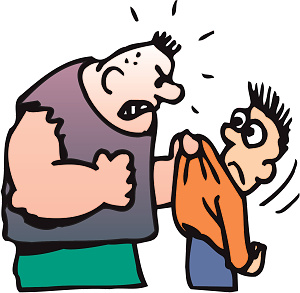
The teacher, whose only goal was to keep things quiet for three more minutes
until the bell rang and these hellions would return to their classrooms and out
of her hair, was neither convinced nor incensed by Danny's argument. But Danny
learned plenty from it. And the next time we gathered for King of the Mountain,
before we could play he made us all promise not to complain if we got pushed too
hard—otherwise, we couldn't play.
We wanted to play, because there was always the chance that this day,
one of us would be able to depose the bully. So we gave in and agreed to play by
his rules.

Two nights ago, Cindy Sheehan, the mother whose son was killed in Iraq and
who has been trying to get President Bush to end the war, was arrested again;
this time for wearing a T-shirt with an anti-war slogan on it to the Capitol
gallery during the president's State of the Union address. At a time when
neither Bush nor his military advisors has been able to prevent increasing
carnage from Iraqi freedom fighters ("insurgents") Ms. Sheehan was taken from
the Capitol building in handcuffs. The news article said she was guilty of
"demonstrating" in the Capitol building, which has long been illegal. However,
she was sitting quietly, simply wearing a T-shirt. I've been to the Capitol
building as a tourist and most tourists wear T-shirts with slogans of one sort
or another. One that says "Leave Iraq Now" is hardly terrorism. But, thanks to
Bush's "Patriot" Act, doing so is called "sedition" and so Sheehan can be
jailed.
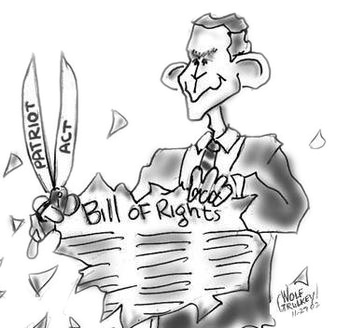
"Sedition" is defined as speaking against "legal authority"—in other words,
criticizing those in power. It is the antithesis of free speech, and should not
be a factor in the United States. However, one of the earliest Presidents, John
Adams, signed into law the Alien and Sedition Acts in 1798. The fourth portion
of this, the Sedition Act, made it a crime to publish "false, scandalous,
and malicious writing" against the government or its officials. Thomas Jefferson
opposed the act as being unconstitutional. It became very unpopular and expired
when Adams' term of office came to an end.
The Supreme Court was never called on to determine the Act's
constitutionality, but several decisions have referenced it. In the Free Speech
case of
New York Times v. Sullivan, the Court declared, "Although the Sedition
Act was never tested in this Court, the attack upon its validity has carried the
day in the court of history."
The Sedition Act of 1918 similarly forbade any American to use "disloyal,
profane, scurrilous, or abusive language" about the United States government,
flag, or armed forces during war. The act also allowed the Postmaster General to
deny mail delivery to dissenters of government policy during wartime! The Act
was repealed in 1921, as the public of the day became aware that it was merely
an attempt by the President to limit criticism when public sentiment was against
him.
And thus it stood until Bush's so-called "Patriot" Act, which once again
makes sedition—criticizing the president—illegal. You can see why it's needed;
his approval rating is in the dumper. What's interesting, however, is that the
"Patriot" Act was passed before his approval rating sank. In fact, he was
so highly thought of in late 2001 that Congress passed the "Patriot" Act without
even reading it. (They were not handed copies until minutes before the vote.)
It's as if, like Danny, he planned to push us around and intended to
quash any criticism in advance. Certainly, the complexity of the "Patriot" Act
shows that it had been written far in advance of the 9/11 attacks, which served
as an excuse for getting it passed.
History shows that every American law against sedition not only is repealed,
but reflects badly on the President who signed it.
Meanwhile, back to Danny—we kids finally wised up. We found another spot of
the playground to enjoy; and our promise not to criticize him became moot,
because we just didn't care any more. We left him alone on his one-foot hill
until he finally gave up and joined us.
It turns out, you can't be a bully if all your potential victims ignore you.