|
By: Paul S Cilwa |
Posted: 3/1/2006 |
|
Page Views: 3,239 |
| Hashtags: #RepublicanCorruption #Diebold #StolenElection |
| Who owns the voting machines, owns the election. |
| Estimated reading time: 7 minute(s) (1643 words) |
We've seen it so often in movies and TV that most of us think we've actually
witnessed such a thing.
But, as ex-Eagle Don Henley pointed out in his song "Gimme
What You Got,"
…there's nowhere you can run
'Cause a man with a briefcase
can steal more money
Than any man with a gun.
To the thieves we really have to worry about, purses are
small change compared to their real goals: Ownership of the
world.
And since, as we've seen, those who would steal a world are
sociopaths who mask their activities with Big Lies, instead of trying to run
them down we must learn to look for evidence of their lies. And the most glaring
evidence? The suppression of that evidence.
Folks, here's a real simple rule and there are no exceptions.
Anyone who says "Pay no attention to the man behind the curtain" is lying—and
the truth probably hides behind that curtain.
If your kid walked into the kitchen and said, "There's no need for you to
check my room," what would you immediately do?
If your spouse came home from shopping and said, "You don't need to look in
the trunk of the car," what would you immediately do?
Well, then—why, when President Bush said, "There's no need to investigate the
World Trade Center attacks," did we, through Congress, agree to a
non-investigatory analysis by his cronies? When he
scolded about the foolishness of pursuing "malicious lies and outrageous
conspiracy theories" after the FBI had already told us the attacks were
performed by a
conspiracy, why did we glare with him at the lack of patriotism of those who
demanded to know the extent of that conspiracy?
Why is it that now, after six years of a
failed presidency, when Bush tells us there's no need to investigate the
selling of our ports to the United Arab Emirates, we finally are
demanding an investigation nonetheless? (I'm not saying we shouldn't, just
why did it take so long?)
If we're finally going to start demanding investigations, why not start with
the odd situation that put Bush in the White House to begin with—the 2004
election?
Now, whenever I bring up this topic, I brace myself for the knee-jerk
response: "Bush won and you lost. Get over it!" The problem is, Bush didn't
win and we lost. Twice! And if we don't identify and solve the problem,
it'll happen again.
The issues regarding the 2000 election are many and legion. Reporter Greg
Palast has exhaustively detailed the way the two key states, Florida and Ohio,
stole the vote from selected residents who were most likely to vote for Gore:
Forget the hanging chads and butterfly ballots. The Presidential
election drama of 2000 is still a mystery to most Americans.
Counting on Democracy
investigates charges of disenfranchisement
and 180,000 uncounted Florida votes cast largely by the working poor and
people of color, uncovering racial exclusion, voting rights violations and the
subverting of a recount in the most contested and controversial election in
U.S. history.
Of course, the "hanging chads" are all people remember of the
2000 election issues. They don't realize that these "chads" were
part of a larger scheme, one which would keep the neocons in
power forever: Voting machines that don't need voters.
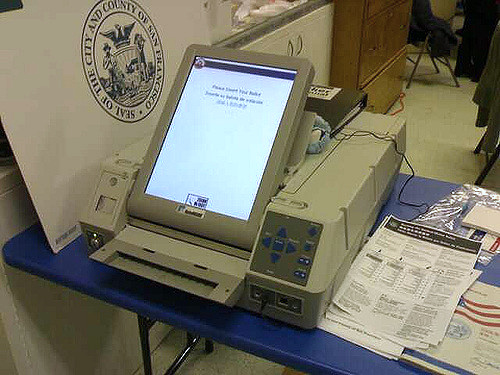
By the time 2004 rolled around a new system was ready and in place in many states:
The "paperless" voting machine, basically a heavy-duty PC with a touch-sensitive
screen. Those of us who were paying attention noted that most of these machines
were manufactured by Diebold, the same company that makes most of the ATMs we
use. So the company had a good reputation. The odd thing was that the CEO of
Diebold, Walden O'Dell,
said in a fund-raising letter to Republicans that he was "committed to
helping Ohio deliver its electoral votes to the president next year."
Now, what could this possibly mean? Just that O'Dell intended to campaign for
Bush? Or did it have anything to do with the fact that Diebold paperless voting
machines were, even then, boxed and ready for shipping to critical swing-state
Ohio?
The first clue that something was amiss was the exit polls. These have been
controversial since the 1950s when TV networks first started polling voters as
they left the polling place. The question was simple: "Who did you vote for?"
And, while a few people were reluctant to share this information, most didn't
mind. The exit polls proved to be astoundingly accurate—so accurate, in
fact, that there were complaints that they actually influenced votes:
People on the West coast, knowing who was ahead on the East coast, might just
vote for the winning ticket.
Nevertheless, exit polls have been so reliable that they are used to detect
election fraud. Jimmy Carter used them, in fact, as an indication that there had
been election fraud in Venezuela—which was subsequently proven.
In the 2004 election, there were only two states in which the exit polls were
markedly different than the voting results. One was Ohio, and the other was
Florida. Getting these two states gave George W. Bush the election.
Thom Hartmann, a TV reporter who covered the 2004 election,
describes the discrepancy:
Election night, I'd been doing live election coverage for WDEV,
one of the radio stations that carries my syndicated show, and, just after
midnight, during the 12:20 a.m. Associated Press Radio News feed, I was
startled to hear the reporter detail how Karen Hughes had earlier sat George
W. Bush down to inform him that he'd lost the election. The exit polls were
clear: Kerry was winning in a landslide. "Bush took the news stoically," noted
the AP report.
Florida didn't use the paperless machines, instead opting for
Diebold Opti-Scan computers to read the ballots filled out by
voters. Since this is the same technology used to buy lottery
tickets, it would seem Florida's largely elderly population wouldn't
have a problem filling them out. But the optical scanners dump their
results into a tabulating computer that is easily hacked, and which
is also running Diebold software. And the results were bizarre:
In Baker County, for example, with 12,887 registered voters,
69.3% of them Democrats and 24.3% of them Republicans, the vote was only 2,180
for Kerry and 7,738 for Bush, the opposite of what is seen everywhere else in
the country where registered Democrats largely voted for Kerry.
Bev Harris, the woman who started www.blackboxvoting.org
from her living room, demonstrated on live TV
how the tabulating computers could be tampered with, throwing an election to the candidate of one's choice
in less than 90 seconds, and leaving no trace!
But things were even more bizarre in Ohio, where the Diebold machines
reported more votes than there were registered voters! According to the
Middletown Journal,
at least 225 votes were registered for the fire levy in precincts with only 148 registered voters.
Many Americans show up at a Presidential election
to vote for a President—but no one else. For example, in Butler County, Ohio,
according to the exit polls and the counts, 40,000 more Republicans voted
for President than voted for the Republican candidate for county judge. This is
pretty typical. However, according to the counts—but not the exit
polls—almost every Democrat voted for both their judge and the Kerry-Edwards
ticket. This might be the kind of factoid that only a statistics major would
appreciate, but take it from me, statistics majors find it very
significant.
In Precinct lB of Gahanna, in Franklin County, the Diebold voting machine
recorded a total of 4,258 votes for Bush and 260 votes for Kerry. In that
precinct, however, there are only 800 registered voters,
of whom 638 showed up.
We've been told by the media that, by and large, only wacko "conspiracy
theorists" believe the 2004 election was rigged. Yet, in real life, there was no
shortage of demonstrations afterwards, as a stunned, pro-Kerry populace began to
realize that no one they asked had voted for Bush—yet Bush had, somehow, won.
And it's not all over. Yesterday, whistleblower Stephen Heller was
charged
in Los Angeles Superior Court with felony access to computer data,
commercial burglary and receiving stolen property. His crime? Giving documents
to the Oakland Tribune that included legal memos from one attorney to another
regarding allegations by activists that Diebold had used uncertified voting
systems in Alameda County elections beginning in 2002. And in
Alaska,
the state Division of Elections has refused to turn over its
electronic voting files to the Democrats, arguing that the data format belongs
to Diebold and can't be made public. (This is a silly statement, since the
format has already been published. And what right would a voting machine company
have to keep their data format secret, anyway?)
There are enough clues apparent to conclude that something was very
squirrelly about the 2004 elections, and that something is connected with
Diebold and its voting machines.
Mayer Amschel Bauer, founder of the Rothschild banking family, once said,
"Give me control of a nation's money and I care not who makes the laws."
Now it looks like a more appropriate sentiment would be, "Give me control of
a nation's voting machines and I'll make my own damn laws."
The only question that remains is, who will tackle the thief before he
escapes with our democracy?