|
By: Paul S Cilwa |
Posted: 9/13/2006 |
|
Page Views: 4,522 |
| Hashtags: #Diebold #Constitution #CivilRights #Arizona #Elections |
| In which I wrestle with Arizona's need for even more proof that I am not a Mexican. |
| Estimated reading time: 5 minute(s) (1082 words) |
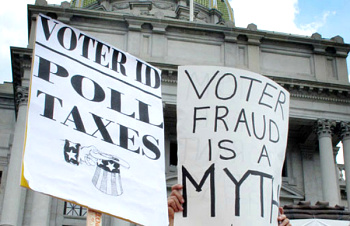
Yesterday, Arizona held its election primary. Arizona holds just one for both
Democrats and Republicans; when we show up, we tell the person at the desk which
we are and they hand us the appropriate ballot.
Not that a driver's license is that different from a universal ID card. But
mine didn't do the trick. See, we moved to Mesa in April from Peoria, on the
other side of the "valley" that is Greater Phoenix, and I haven't had a chance
to update the address on it yet. So my license says "Peoria" but my voter's
registration card says "Mesa". And I was voting around the corner from my home
address, the one on my voter registration card. And on the precinct's rolls, as
well.
Fortunately, I just happened to have an uncashed royalty check in my wallet,
computer printed and with my name and address on it, which they accepted—with
my license (which has my photo on it) and my voter ID.
Now, think about this. At home, I have blank checks and a computer. I could
easily have created a fake check, seemingly to me from my publisher. Of course,
they really wanted me to bring in a bill from the power company or
another utility with my name and address. But I could fake that just as easily.
As could anyone with the least bit of computer savvy and a printer. Which is,
like, everyone.
Well, not quite everyone. It excludes people too poor to own a computer. (And
who tend to vote Democrat, I'm told.)
And what about my husband, Michael? He hasn't changed the address on his
license yet, either. We'll have to make sure one of the utilities is in his
name, and one in mine, if he wants to vote in November. I wonder if I can
convince him to take on the electric bill? It's the most expensive, and I
wouldn't miss it.
But we don't live alone. We also have my daughter, my son, a grandson, and my
ex-wife. I'm not sure we have enough utilities to go around. I may have to make
fake utility bills for everyone, just so we can exercise our legal right to
vote.
Why not simply correct the licenses? Well fine…for us…except one member
of the family, I won't say who, happens to owe on a traffic ticket and the state
Motor Vehicle Division won't correct his address until he's paid the fine,
even though it's from out of state. Now, I'm not saying he shouldn't pay
the fine. But since when did that become a criterion of voting eligibility?
And what about my late Mom, who was 93 and didn't drive? Yes, she could have
gotten a non-driver's ID (and did), but she's not supposed to have to. It
says so in the Constitution.
Anyway, so there I am, in the polling place, with five staffers there—and I'm
the only person there to vote. At 4:30 in the afternoon. We get the
identification thing worked out, and I am handed a Democratic ballot. Well, I
could see why there were so few voters there: Except for one race, in my
precinct there was only one position with more than one person vying for it.
Governor: Janet Napolitano; no other choices (which I'm okay with). Senator: Jim
Pederson (ditto). What was really embarrassing was the number of positions no
one was trying for. As always, I paused for a moment, thinking I should just
write in my name for one of them. If anyone else wrote my name, too, I
might make it onto the ballot in the general election in November! And with the
expected anti-Republican sentiment sweeping the nation, I might even be elected!
On the other hand, I don't really want to be stuck with the job of
dogcatcher, or sanitation department chairman, or whatever. My own, present job
isn't so bad. So I leave those entries blank.
The ballot is printed on a stiff piece of paper—almost cardboard—that gets
fed into a digital reader, a sort of scanner that only reads the marks I've put
on it. The first thing that hits me is: Why isn't this on standard-sized paper?
Even if you wanted to make it cardboard, 8½ x 11" or 14" would have been much
cheaper, from both a printing point of view and a scanning point of view. I
shudder to imagine what the heavy-duty reader must have cost, when as a
programmer I know an off-the-shelf scanner, with appropriate software, would
have been perfectly adequate.
But I am more concerned with the fact that the reader does not give me a
paper receipt. How do I know it's counted my votes correctly? Who tested it? Did
anyone take it home the night before, as happened in California a few months
ago?
Worse, it looks like the device is supposed to print a paper receipt.
There is a strip of cash register-type receipt paper coming out of it, and a new
line appears after it's read my ballot. But what the line says is, "Counting
invalid."
"What about a receipt?" I ask one of the attendants.
"You don't get one," he says. "Have a nice afternoon." And he holds the exit
door open for me.
"But, wait," I protest. "The readout paper says the count is invalid."
"Don't worry about it," he says. The door is still open, a shaft of brilliant
sunlight shining on us.
"But I do worry about it," I say. "Especially after the 2004
elections."
"Take this," the man says, handing me a sticker.
I look at it. It says, I VOTED. "That's it?" I ask. "No receipt? No assurance
my vote counted?"
"It's an 'attaboy'," he explains. "Your vote counted. Don't worry about it.
It's all under control. Now, please. My arm's getting tired."
"From holding the door open?" I say, as I pass through it. "That's nothing.
Wait till you have to salute the Fuhrer."
An empty ballot couldn't have looked more vacant than his face. He truly had
no idea what I was talking about.
Which is, of course, what scares me.