|
By: Paul S Cilwa |
Posted: 2/22/2008 |
|
Page Views: 5,471 |
| Hashtags: #HealthCare #BushCrimeFamily #Conspiracy |
| Not all vaccinations are helpful. |
| Estimated reading time: 8 minute(s) (1680 words) |
It's wise to remember that American Idol is broadcast on Fox, the one
network most consistent in never getting its facts straight. The
current flu season, as severe as it may be (at my daughter's work, a recovery
center, nearly 25% of the residents have contracted it), is nowhere near
the "worst in American history". That honor remains with the 1918 influenza
pandemic, which over the course of three years infected as many as 50% of those
exposed, on average, wiping out entire towns and killing as many as 100,000,000
people around the globe.
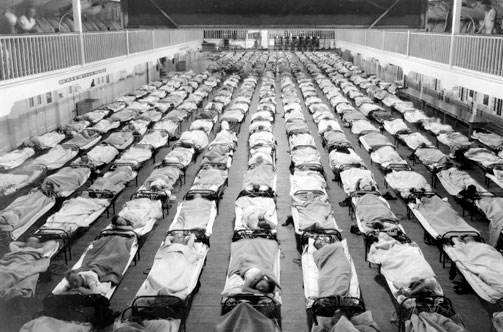
As most of us well know from TV commercials for flu shots, influenza
generally attacks the very young and the very old. But the 1918 flu (called
"Spanish flu" at the time because the Spanish press was the first to publicize
it) behaved just the opposite. It ignored the young, old, and infirm, and
instead attacked the healthiest of people. Since World War I was in full swing
at this time, that meant the disease ravaged military installations around the
globe.
A physician at Camp Devens, near Boston, wrote a friend,
These men start with what appears to be an ordinary attack of la grippe
or influenza; and when brought to the hospital they very rapidly develop the
most vicious type of pneumonia that has ever been seen. Two hours after
admission they have the mahogany spots over the cheekbones, and a few hours
later you can begin to see cyanosis extending from their ears and spreading
all over the face, until it is hard to distinguish the colored men from the
white…It is only a matter of a few hours then until death comes…We have
been averaging 100 deaths per day…It takes special trains to carry away
the dead. For several days there were no coffins and the bodies piled up
something fierce.
The problem, as we now understand, is that this flu (unlike "normal" strains
of influenza) triggered an immune system response called a "cytokine storm".
Normally, when we are infected with some sort of bug, our bodies mount a
multi-pronged defense. As
Wikipedia
explains,
When the immune system is fighting pathogens, cytokines signal immune
cells such as T-cells and macrophages to travel to the site of infection. In
addition, cytokines activate those cells, stimulating them to produce more
cytokines. Normally this feedback loop is kept in check by the body.
However, in some instances, the reaction becomes uncontrolled, and too many
immune cells are activated in a single place.
This is less likely to happen in a person with a weak immune system, such as
an infant or an elderly person. So in 1918 the young and old were spared, and
the soldiers "dropped like flies."
In those with healthy immune systems, the body was overwhelmed by the
attack—rather like holding an exploding nuclear bomb up to a wasps' nest to
destroy it. The flood of white blood cells in the lungs caused them to
hemorrhage and fill with fluid. It was common to bleed from the eyes and ears,
and victims would literally defecate their own intestines (or, as Simon Cowell
might put it, "shit their guts out"). And all this occurred within hours of the
appearance of the first symptoms.
To some extent, Simon can be forgiven his ignorance of the 1918 Spanish Flu
pandemic, because it wasn't highly publicized. America (and the world) was at
war then, and the press happily kept the government's secrets.
Surgeon General Rupert Blue warned that people could be stricken on the
streets or while at work. He advised anyone experiencing symptoms to immediately
go home, get in bed, and call a physician. But so as not to alarm people, he
didn't add that they were likely to drop dead within a day anyway. And he did
not
say that flu was sweeping the country—especially military installations.
In fact, the flu was sweeping the world. Only Spain, which had remained
neutral, allowed its press to reveal the extent of the illness. But people
caught it in isolated South Pacific islands, in the Arctic, and, of course, in
military installations where the bunking of hundreds of healthy young men in
close proximity couldn't have been better designed to spread the disease among
them.
And no matter that the newspapers tried to minimize the scary headlines. In
most communities, their obituary sections took up three times the normal
space. Children quickly latched onto this, as is evident from the 1918 skipping
rhyme:
I had a little bird,
Its name was Enza,
I opened the window,
And in-flew-enza.
Now, some conspiracy theorists believe the "government" (either the United
States government, or the "shadow government", depending on the theorist)
actually created the Spanish Flu virus. I'm inclined to not believe this,
because I don't think any government, shadow or otherwise, had the technical
ability to engineer a virus in 1918. The nature of viruses—that they existed,
are many times smaller than, and different from bacteria—had only been
discovered about 16
years before. However, there is no arguing the fact that the United States
government, hopefully out of ignorance rather than malice, was responsible for
the spread of the disease. It did originate in an army base, Fort Riley in
Kansas. And the wartime movement of men due to the war is certainly what spread
the disease around the world before the first symptoms ever appeared. At
Dartmouth University, even the students' journals noted that the illness was
spreading much faster among the barracked soldiers there (universities were used
for military training) than among the less-densely packed non-military students
and faculty. (About 10 soldiers died, but only one faculty member and four
students.) Dartmouth's president begged the military to change the soldiers'
sleeping arrangements, but to no avail.
It was also a mistake to keep the severity of the illness a secret. When
people believe a doomsday plague is scourging the nation, they tend to hide
themselves away, rather than go to work or school—in other words, to quarantine
themselves. Dr. Cleto DiGiovanni of the Defense Threat Reduction Agency in the
Department of Defense has identified quarantine as the only effective method of
containing a pandemic. Unfortunately, he did so some 90 years too late to stem
the spread of Spanish Flu.
And, conspiracy or not, our government does not have a good track record in
dealing with flu, even since 1918. In 1976, another soldier—this one at Fort
Dix—reported feeling ill. The next day he was dead, and it was announced he'd
died of "Swine Flu". (I
can't answer why these influenza strains keep showing up first at Army bases.
Keep moving; nothing to see here…) President Gerald Ford urged all citizens to
be inoculated against the new disease; about a quarter of the population was.
I was in the Navy in 1976, assigned to the USS Yosemite. All members of the
crew were commanded to receive flu shots. It was a large ship and therefore a
large crew; the line of crewmen awaiting the shot snaked through the ship. I
inadvertently got into the wrong end of the line and was not vaccinated. I was
also the only member of the crew (as far as I know) to not come
down sick.
Not only did many people fall ill who took the flu shot; an
immunopathological reaction to the vaccine in some people caused about 500 cases of
Guillain-Barré syndrome
resulting in death from severe pulmonary complications for 25 people. More people died from the vaccine than died from
the swine flu itself—which was, exactly, one: The original soldier from Fort Dix.
President Bush famously budgeted $7.1 billion dollars in 2005 .to prepare for
"bird flu".
The money was allocated and spent; only a few people were vaccinated (the
recommendation was the very young and the elderly, the ones not affected
in 1918) but not a single case was reported in the United States. By May of 2006, only
100 people had died
world-wide from bird flu. Compared to the 40 million people living with HIV, or the
41,611 Americans
killed in car crashes annually, it seems silly that Bush would have targeted
such an unlikely disease for such a huge outlay of money.
On the other hand, George W. Bush is well-known for his health care
conservatism. That is, he conserves it for his friends and relatives and doesn't
allow any to leak to the poor and needy. On September 11, 2001,
White House
staffers started taking Cipro, a powerful antibiotic used as a treatment
against anthrax, a full three weeks before the first case of anthrax from the
"anthrax letters" was identified. Now, that's good planning! (Too bad an
equal quantity of foresight wasn't used to prevent the 9/11 attacks, or to
evacuate New Orleans, or…)
Year after year, the strains of flu that come along attack primarily those
with weak immune systems. If you get plenty of sleep, take a gram or two of
Vitamin C every day, and take Echinacea and Goldenseal and zinc at the first
sign of a scratchy throat, there's no reason why you should be sick for even
a day. On the other hand, should you hear about a strain of flu that bypasses
the weak and attacks the strong, do just the opposite: Party hearty, don't take
supplements, stay up all night listening to Metallica, wear yourself out.
You don't need flu shots to avoid that "little bird named Enza." All you need
is common sense.