|
By: Paul S Cilwa |
Posted: 6/10/2008 |
|
Page Views: 108 |
| Hashtags: #Bridges |
| People aren't the only ones who make them, you know. |
| Estimated reading time: 5 minute(s) (1031 words) |
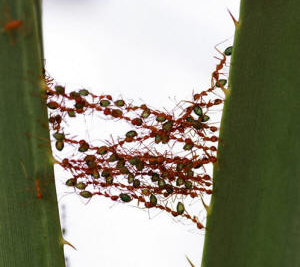
Although we humans like to give ourselves credit for these things,
the fact is we did not invent bridges. There were plenty of examples
in nature to inspire the first would-be engineers. Ants, for
example, create bridges of their own bodies in amazing feats of
cooperative behavior. They have been known to bridge neighboring
leaves, and even streams.
Ant bridges are, of course, temporary, disappearing after the last ant has
crossed. But more permanent bridges can be found in the world of geology, from
the sandstone bridges of Canyonlands National Park and the Agate Bridge of the
Petrified Forest National Park (it's actually a fossilized tree trunk!), to the
less permanent ice bridges one can find on many of our dwindling glaciers.
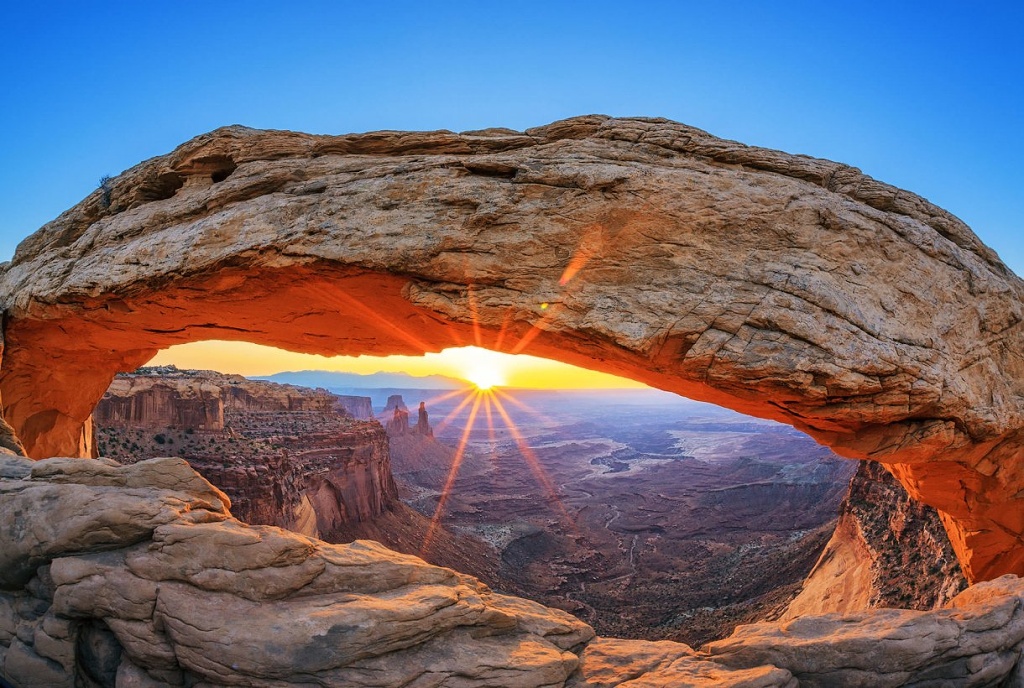
The natural bridges of Canyonlands were sculpted over the course of
millions of years by wind blowing sand against rock walls. Where the
eddies blew more sand against the wall than against the top, hollows
were formed which eventually broke through. We know this because
there are places in Canyonlands where this process is still in
progress, and others where former bridges have collapsed.
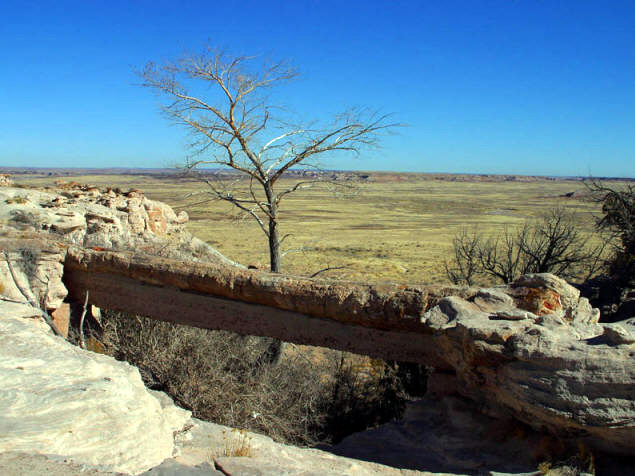
The Petrified Forest's Agate Bridge is a tree trunk that was
fossilized in the Mesozoic era. At that time, this was a plain
traversed by numerous rivers and streams, covered with horsetails,
ferns and coniferous trees. When a tree fell it was covered by
river-borne sediments and sealed off from the air, hindering the
natural process of decay. In wet periods water containing silicon
oxides filtered into the rotten wood, and when it became drier the
water evaporated and the silicon oxides crystallized. The
concentration gradually became so high that quartz crystals
(amethyst, agate, onyx, cornelian, jasper, etc.) were formed,
preserving the internal cell structure and the external appearance
of the trunk. In geologically recent times erosion by wind and
weather freed the petrified plant remains from the overlying
sandstone, because the quartz was harder than the sandstone around
it.
The Agate Bridge crosses a gully, which was dug by wind and water through the
millennia. In 1906, visitors worked to preserve Agate Bridge by establishing the
Petrified Forest National Monument, which eventually became a National Park.
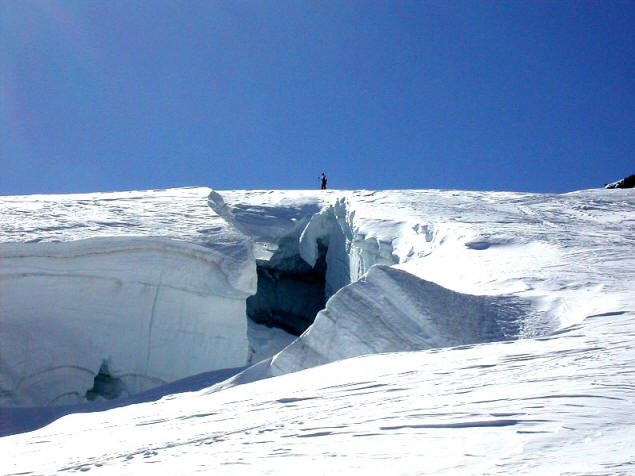
The very same mechanism causes the formation of ice bridges in glaciers, but
it happens much more quickly because ice is far more malleable than stone, even
sandstone. By seeing the exact same intermediate forms in ice over the course of
years, that we see in sandstone over the course of millennia, and knowing the
relative hardness of ice compared to stone, it's easy for geologists to
calculate how old a sandstone bridge is.
No doubt the very first bridges were simply logs placed conveniently over
creeks, mimicking logs that had naturally fallen that way. But such bridges
don't last; the next good storm will demolish them. And so the search was on for
ever more permanent and reliable bridges.
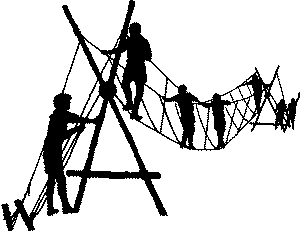
A "monkey bridge", so simple that Cub Scouts build them now during events, may not
be for the faint of heart to cross but can be quite reliable. Modern day monkey
bridges are constructed of rope; indigenous peoples make them of vines. Either
way, they may be brought down during a serious storm; and of course since both
hands are occupied during traversal they aren't ideal for carrying things across
a river or gorge. Still, if you have a backpack they can come in handy.
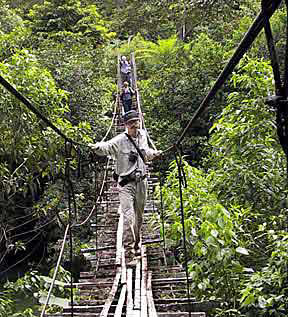
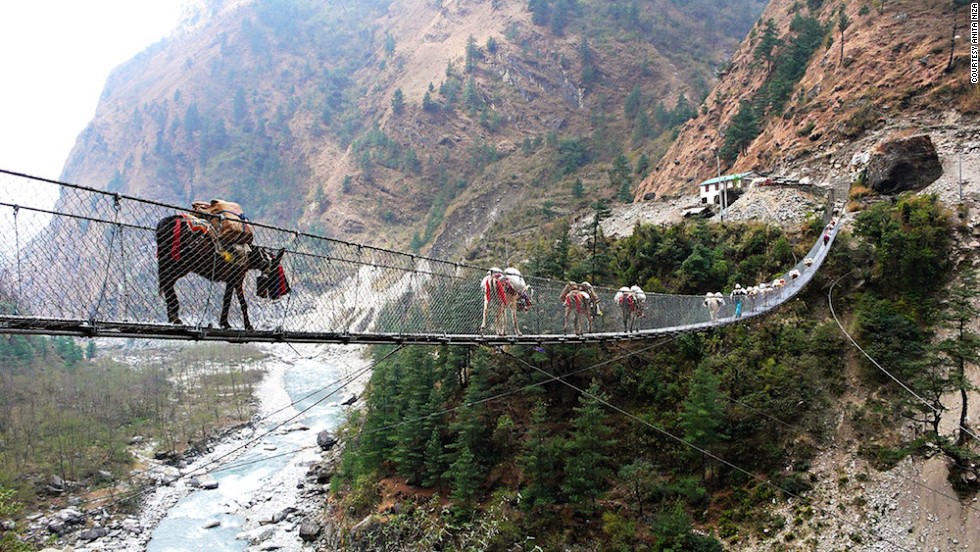
It isn't a big jump to rope bridges with a "floor" made of planks. Such bridges are
also relatively flimsy; on the other hand they are inexpensive to make and
repair and, despite most urban dwellers' fears, they almost never collapse while
in use (because only a crazy person would try to cross one during a severe storm).
Technically, this type of bridge is called a "suspension bridge", not because
people walking on it hold their breath the whole way, but because it is
suspended by the ropes that are anchored at either end. This basic
engineering form is still used in our largest automobile bridges.
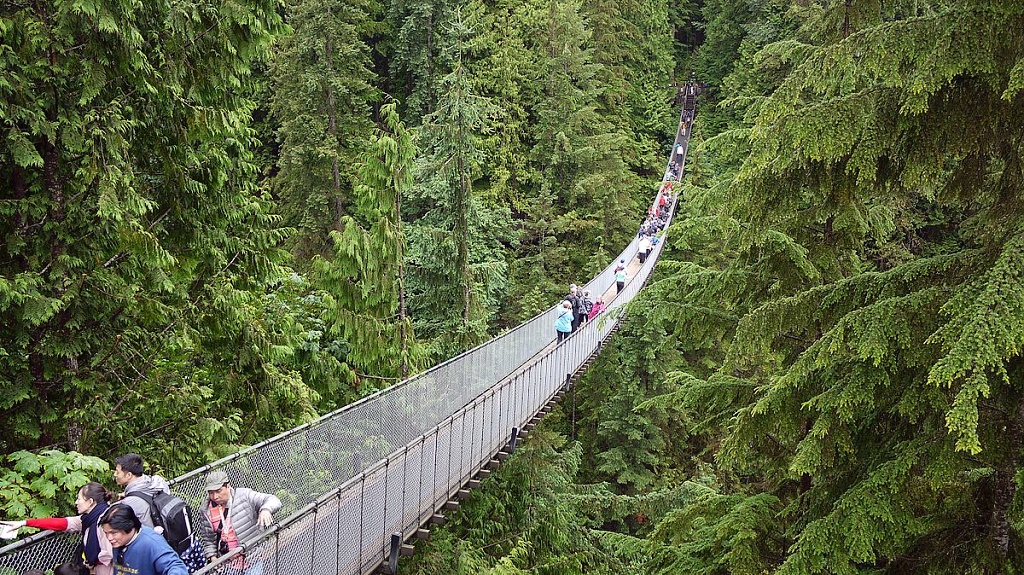
And if you think pedestrian bridges are a thing of the past, you're
wrong. The world's longest pedestrian bridge is in Vancouver,
British Columbia; it's called the Capilano Bridge and, while made of
modern materials such as steel, it still is built using the same
basic technology used by the ancient Incas.
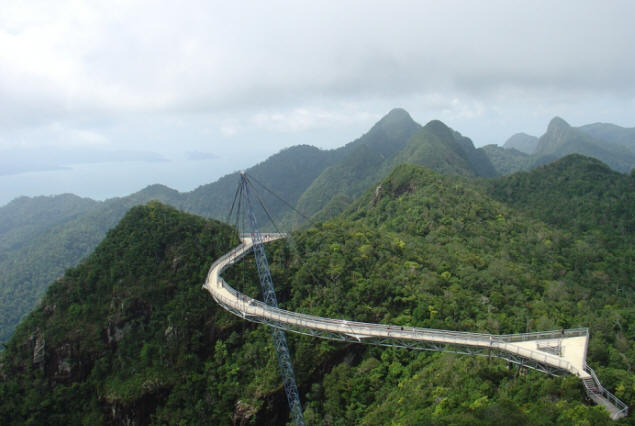
A more terrifying pedestrian suspension bridge is absolutely
state-of-the-art. In Malaysia, the bridge curves around its central
support, dangling (it seems) from a 290-foot high pillar.
While we're on the subject of pedestrian bridges, we wouldn't want
to miss the Bridge To Nowhere, also known as the Grand Canyon
Skywalk.
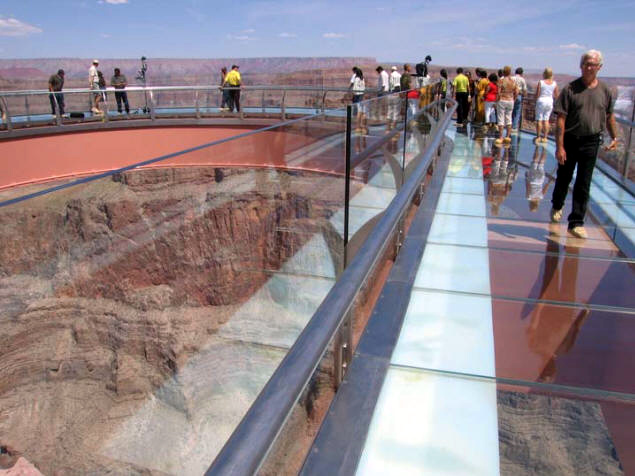
Built by the Hualapai Indians (or, rather contracted out by them)
partnered with businessman David Jin, and at a cost of about $31
million, the steel-and-glass horseshoe-shaped walkway extends 65
feet beyond the edge of and 4000 feet over Granite Gorge, one of
Grand Canyon's innumerable side canyons. The thing does not look
safe but is; it was designed to hold 800 people at once but no more
than 125 are allowed on at a time.
If you want to visit the Grand Canyon Skywalk you may either drive there (it
costs $20 to park and the road is not well-marked) or take a Hualapai tour bus
($29.95 per person). Admission to the Skywalk itself is also $29.95 per person.
Photographs are not permitted; gripers say it is to encourage visitors to
purchase postcards.
Suggesting that perhaps another type of bridge has been crossed: From
indigenous people to Disney-type amusement park tycoons in just four centuries.