|
By: Paul S Cilwa |
Posted: 10/14/2014 |
|
Page Views: 111 |
| Hashtags: #Science #UFOs #Transistors #Diodes #VacuumTubes |
| I uncover the mystery of who invented the transistor? |
| Estimated reading time: 8 minute(s) (1789 words) |
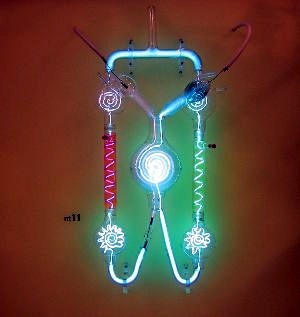
The story begins with a
device called (in North America) a vacuum tube. (The Brits call it a "valve"
instead of a "tube".) The first partially evacuated tube was invented in 1857 by
German physicist and glassblower Heinrich Geissler. He experimented with
different rare gases in the tubes; when an electric current was applied; the
gases glowed in pretty colors. One of the gases used was neon; our neon signs
evolved from Geissler's tubes.
Thomas Edison's signature electric light bulb, patented October 14,
1878—happy birthday, light bulb!—was one of the offshoots of Geissler's
evacuated tubes.
Despite these experiments, the early 20th century was the tail end of the
mechanical age. Player pianos, cameras, phonographs, sound recording and even
the transmission of radio waves, were all accomplished by mechanical means. Even
early telephones, while electrical devices, caught and recreated sound using
mechanical methods and are considered electrical, not electronic, devices.
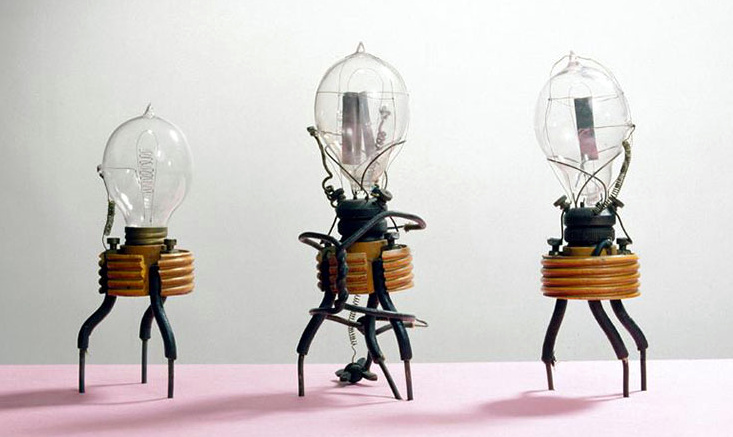
But experiments involving vacuum tubes continued, and in 1904
English physicist John Ambrose Fleming
invented what he called an "oscillation valve", but which we today call a diode.
Electricity can be transmitted either as direct current, or
alternating current. Direct current is what comes out of batteries and
generators. Electrons are made to move from the battery's negative terminal to
its positive terminal, usually passing through a device like a light bulb or
motor on their way.
Alternating current moves back-and-forth, rather than in one direction only
(and is created by an alternator). Some electrical devices, such as the
light bulb, work equally well with either direct or alternating current.
However, others firmly require one or the other. Clearly, then, a device that
could convert one to the other, would be of great value. The diode only allows
electricity to pass in one direction, thus converting alternating current into
direct current.
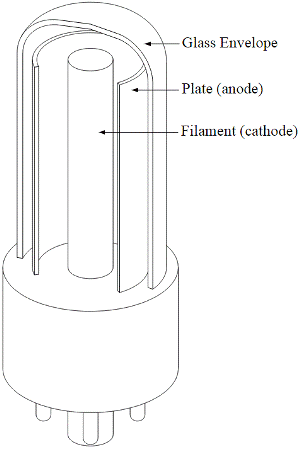
The way a diode works is quite simple—it was much harder to invent than it is to understand!
Inside the evacuated glass tube are just two components, called a
cathode and and anode. The cathode is heated, causing
electrons to boil off it when the current is on its positive swing. (The vacuum
is required because if there were air in the tube, it would burn or explode from
the heat. This was one of the reasons Edison's light bulb became a commercial
success, whereas the 22 previous light bulb inventions from around the world, did not.) The anode
sucks up the loose electrons. But when the alternating current changes
directions, in other words the cathode becomes positive, its attraction for the
electrons is too strong so they don't go anywhere. Thus, for the half time that
the current is moving forward, the electrons go from the cathode to the anode;
the other half of the time, nothing happens. The output, therefore, is a sort of
"vibrating direct current" even though the input is alternating.
Within a few years, the diode had led to a truly amazing advancement: the triode.
This device has three components in the tube: a cathode, an anode, and a grid. The anode and
cathode work the same as in a diode, except the grid is provided with an
additional input, which is generally a current of quickly-varying voltage (for
example, the signal from a phonograph needle or a microphone). The grid
therefore flips from positive to negative. Electrons pass from the cathode to
the anode in direct proportion to the voltage on the grid. This allows the
output current of the triode to be many, many times greater than the input.
In other words, triodes amplify a signal
and originally made possible all our modern electronic devices: radio, stereos,
television, radar, computers, and so on.
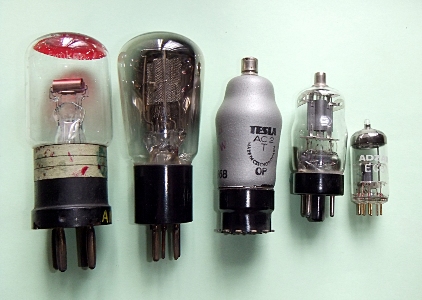
However: Vacuum tubes are big, and most
devices required several of them, plus a lot of assorted wiring. The tubes got very
hot, and died regularly. In the fifties, most families I knew kept a box of
spare tubes to facilitate a quick replacement in case the radio or TV died in
the middle of a show. If you didn't have such a box, you would have to run to
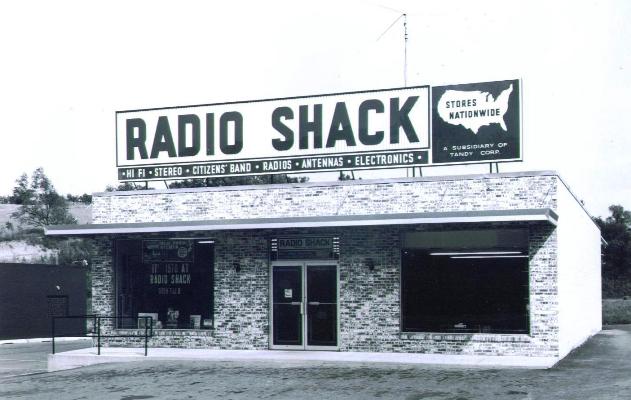
Radio Shack for a replacement. (They also had tube testers, so you could figure
out which tube had gone bad and was keeping the device from working.)
In the centuries since the English
scientist William Gilbert
made a careful study of electricity and magnetism, we
have identified two distinct types of materials with regard to the
way they conduct electricity. First, there are conductors, such as
gold and copper, that allow the (nearly) free passage of electrons
along their length and width. Second, there are insulators, such as
glass and air, that provide (nearly) total blockage of free
electrons.
In the 19th century, scientists began to catalog the properties
of various materials, and found that some materials possessed some
of the traits of conductors, combined with some traits of
insulators. That is, they allowed the passage of some
electricity, but less efficiently than pure conductors. On the other
hand, when these "semiconductors" were heated, their electrical
resistance decreased, the opposite of what happens when
pure conductors are heated. Which seemed to be an interesting
effect, but no one could find a use for it.
And that was the state of the art…until 1947.
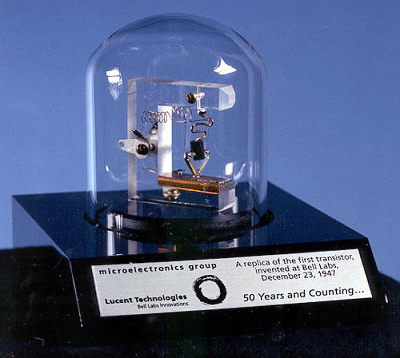
As I learned in my Navy 'A' School, in November and December of 1947, AT&T
experimenters found that if two gold-point contacts were applied to a germanium
crystal, the output signal was stronger than the input, making this a miniature
triode, yet one that was far more efficient (not to mention, much smaller and
cooler) than a vacuum tube.
At the time, AT&T was the
telephone company, a government-sanctioned monopoly that, as part of its public
charter, performed a great deal of cutting-edge scientific research.
Like triodes, transistors have three connections, each leading to
the chip of semiconductor material—usually silicon "doped" with
germanium. Like triodes, one lead is connected to an electric
current, another to a varying voltage, and the output is a
high-current flow of electrons that varies according to the voltage
applied to the second lead, amplifying just as a triode does.
Once AT&T had patented a semiconductor diode as well, vacuum
tubes became obsolete for most commercial purposes. (Vacuum tubes
are still preferred for very high-frequency operations, such as
television and radio broadcasting.) And transistors continued to
shrink, finally being built right into slices of silicon by the
billions, giving us pocket-sized cell phones, flash drives, and
computers that fit in your pocket instead of taking up an entire
building.
But, wait…why did AT&T even consider such experiments?
Semiconductors were not, in 1947, readily available. There was no theory to
explain how they worked, or of what use they might be. They were simply
something that existed in the natural world, like air or water. In any case, no
one in the previous century had thought they were worth looking at.
And yet, AT&T's own records and history show that John Bardeen, Walter
Brattain, and William Shockley of Bell Labs sat down in November, 1947 with
nothing, apparently, to start with; yet had a working transistor triode a month
or so later.
So I, in studying all this in the Navy, found myself wondering—what in the
world could possibly have given Bardeen and Brattain the idea to work
with germanium in the first place? There was simply no work on record to
have provided them with a lead into this realm of study.
And I didn't have an explanation for years.
But then I learned about something else that happened earlier in 1947.
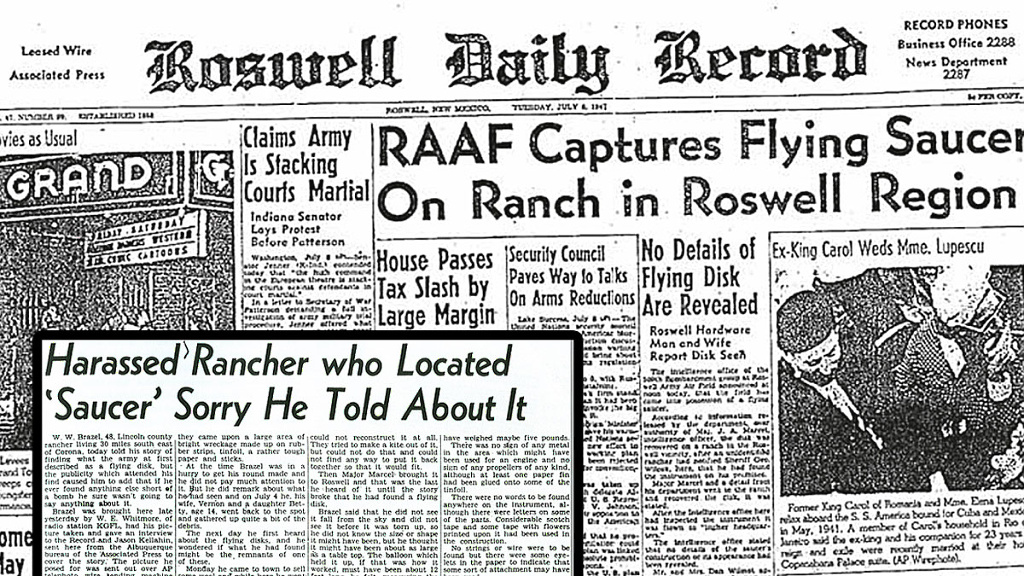
Outside the little town of Roswell, New Mexico, on July 2, 1947, a "flying
saucer" crashed. It was recovered by what, at the time, was the US Army Air
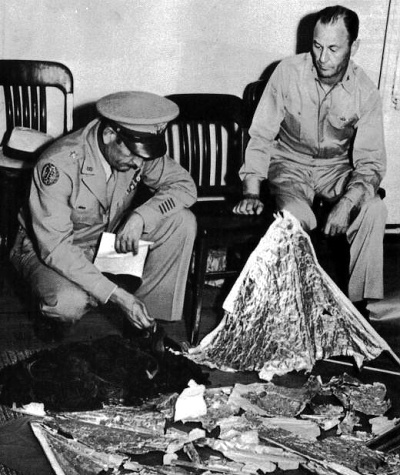
Force, which, after announcing they had recovered a UFO, backpedaled and said it
was just a weather balloon. They even published a photo of the balloon parts
they had supposedly recovered, which experienced airmen pointed out were
not from the type of balloon the Army Air Force had claimed, thus
providing early proof that this was a cover-up.
And who could better reverse engineer alien technology, than America's
foremost scientists, who, in those days mostly worked for AT&T?
Well, it turns out my notion was dead on.
The Day After Roswell,
a book written by United States Army Colonel Philip J. Corso,
described how Corso was given the job of distributing the recovered
technology to American corporations for reverse engineering. Without
telling them where it came from, of course.
As you might expect, the naysayers were quick to claim fraud or a hoax.
Senator Strom Thurmond, who knew Corso personally and had written the foreword to
the book, was pressured into demanding his forward be removed from subsequent
printings of the book.
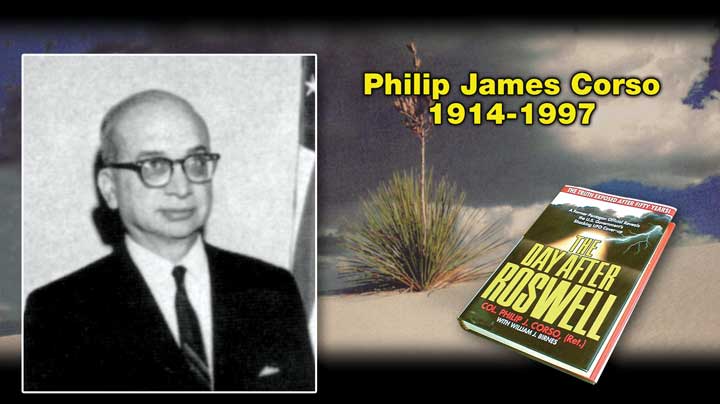
And yet Corso's stellar military career is a matter of public record. Every
aspect of his story that should be a matter of public record, is. And the
aspects one might expect to be hidden, nevertheless make sense in the grander
scheme of things. Corso was not a scientist, and didn't really know what he was
passing out. It was, perhaps, a matter of luck that AT&T wound up with the
germanium-doped silicon so plentifully distributed in the walls of the downed
craft.
Although Corso claimed to have distributed saucer components to only US
corporations, Roswell was not the only crash site in 1947. Other UFOs have been
reported downed here and there. And so we have
Velcro, which was supposedly
invented by a Swiss guy named George de Mestral. He claimed to have invented it
in 1948 but did not patent it until 1955. Of course, even a child can examine
some Velcro and figure how it works; it doesn't have the same "where did that
come from?!" cachet that I find with transistors.
However…Mestral was an electrical engineer, and Velcro has nothing
whatsoever to do with electrical engineering. So…I find myself wondering: What
else that we think we invented, have we merely reverse engineered?