|
|
Posted: 12/10/2019 |
|
Page Views: 116 |
| Hashtags: #Science #Humor |
| Those Romans were mighty clever. |
| Estimated reading time: 2 minute(s) (352 words) |
Most Americans have heard, by now, of the terms "digital" and
"analog", and know they have something to do with computers.
The difference between analog and digital technologies is that in analog technology, information is
translated into electric pulses of infinitely varying amplitude. In digital
technology, translation of information is into a binary format (zeroes and ones) where
each bit is representative of two distinct amplitudes. Since analog signals allow for an infinite degree
of gradation between values, and digital data can only represent specific, fixed-point values,
digital signals lose data compared to analog; but a good digital-to-analog converter is able to
approximate the original analog signal by allowing the digital values to "slide" one from
the other, thus recreating the infinite variety between discrete values.
One would think that such a device would be a new invention. But it occurred to me that, since
"digits" are also fingers, the ancient Romans had the potential to invent an analog-to-digital
converter of their own.
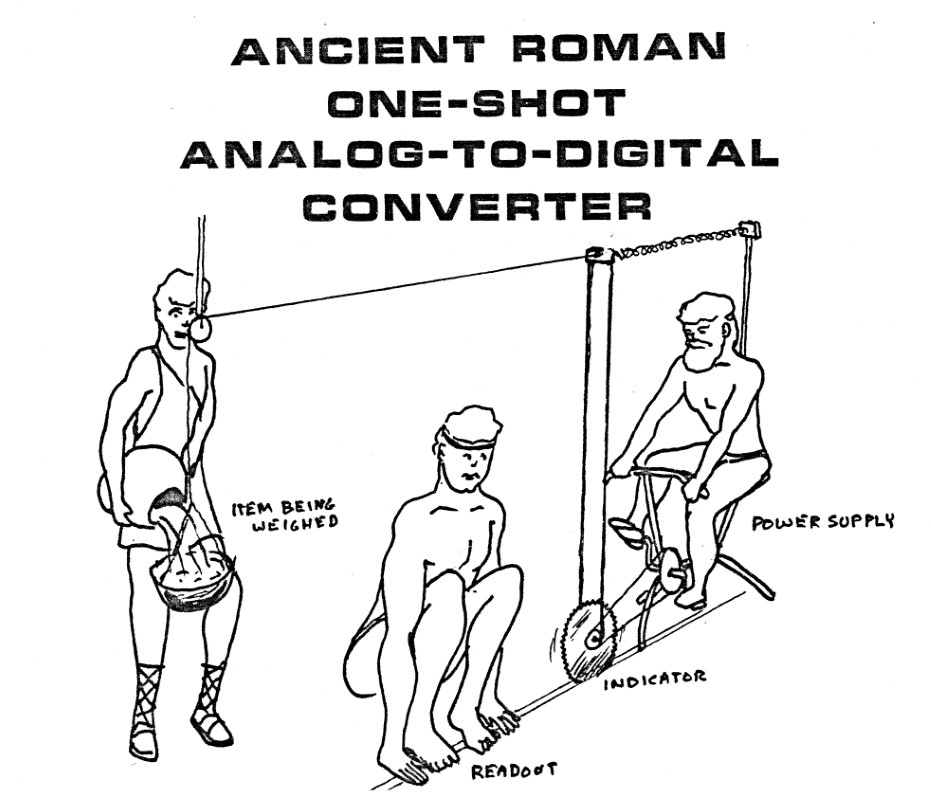
The line from which this blade is suspended is attached to a
spring, mounted on the power supply, and to a wire pulley at the
end of which is suspended a weighing basket.
When the item to be weighed is placed in the basket, its weight
causes the spinning blade to move toward the first Greek slave,
severing a varying number of digits depending on the weight
involved.
The major disadvantage of this system is the fact that the
readout must be re-loaded after each use. This, coupled to the
rising costs due to decreasing availability of Greek slaves
undoubtedly contributed to this device's falling into disuse,
not to be rediscovered for over nineteen centuries.