|
By: Paul S Cilwa |
Posted: 9/24/2026 |
|
Page Views: 325 |
| Hashtags: #Astronomy #BootesVoid #CosmicWeb #VoidGalaxies #EdwinHubble #WarpFactor #StarTrek #AlphaCentauri #ProximaCentauri #AdamStrange #GalacticCenter |
| Where could you go to really get away from everyone? A tour of the Great Void, the loneliest galaxy, Star Trek's warp factors, our neighbors at Alpha Centauri, and the crowds downtown at the galactic core. |
| Estimated reading time: 13 minute(s) (2990 words) |

If you live in a city, the traditional answer is to go camping. I've done
a lot of camping, and a fair amount of whitewater rafting, and I can tell
you the flaw in the plan: there are people there, too. The campsite next
to yours has a generator, a radio, and three children who love to play
hide-and-seek with strangers.
So where could you go to really get away from everyone? The answer
turns out to be a lot farther away than the nearest national forest.
When the Galaxy Was Everything

A hundred years ago, the question would have had a simpler answer. Until
the 1920s, most astronomers believed the Milky Way was the
universe. Every star, every glowing cloud, everything that existed
belonged to one enormous swarm of stars, and beyond its edge there was
nothing at all.
There were those fuzzy spirals in the telescopes, of course. Astronomers
called them "spiral nebulae", and argued about what they might be. In April of
1920, Harlow Shapley and Heber Curtis debated the question before the
National Academy of Sciences in Washington. Shapley said the spirals were
clouds of gas inside our own galaxy. Curtis said they were "island
universes", whole galaxies in their own right, unimaginably far away. The
debate ended in a draw, the way debates usually do when nobody has the
data.
The Letter That Destroyed a Universe
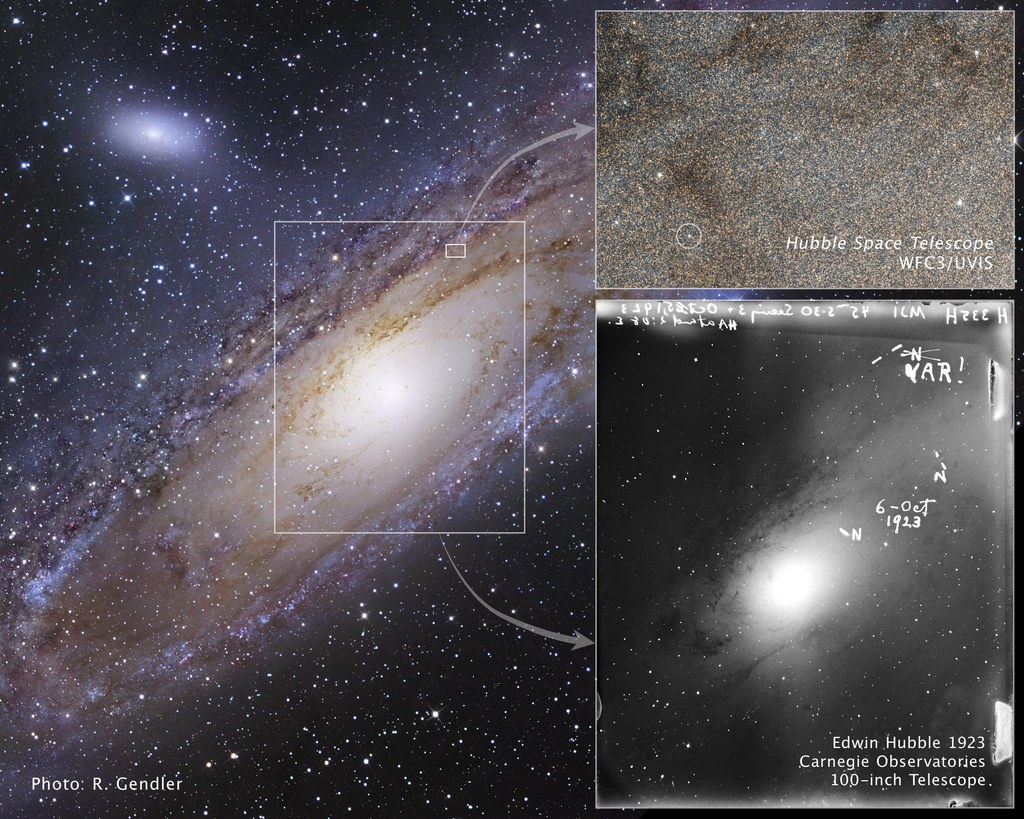
The data came from Edwin Hubble. In October of 1923, working with the new
100-inch telescope on Mount Wilson, Hubble photographed the Andromeda
"nebula" and found a star that brightened and dimmed on a regular
schedule. He crossed out the "N" he'd written beside it, for "nova", and
wrote "VAR!" instead. It was a Cepheid variable, and a decade earlier
Henrietta Swan Leavitt had worked out that a Cepheid's rhythm reveals its
true brightness. Compare that to how bright it looks, and you know
how far away it is. (I explained how that works in
Dating
The Universe.)
Hubble's answer was nearly a million light-years: far beyond the edge
of our Milky Way galaxy. He was off by a factor of almost three, as it happens;
Andromeda is about 2.5 million light-years away. But the point stood. When
Shapley read Hubble's letter, he reportedly said, Here is the letter
that has destroyed my universe.
Andromeda was a galaxy, and so were all
those other spirals. The universe was suddenly full of them.
The Unfashionable End
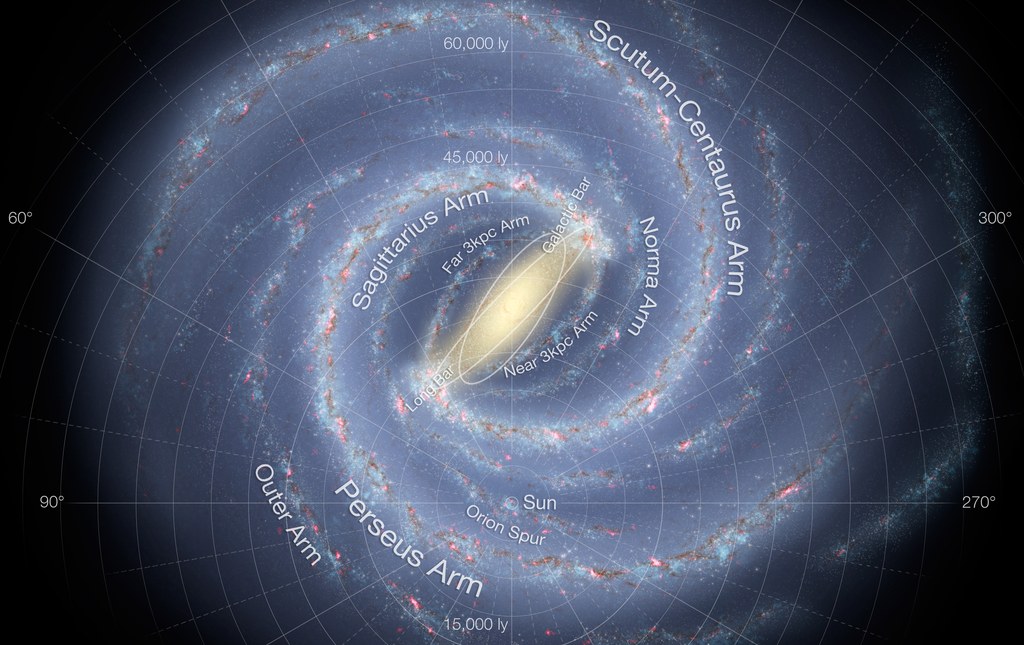
Even inside the Milky Way, we don't live in the big city. Douglas Adams,
in The Hitchhiker's Guide to the Galaxy, described our Sun as being in the
unfashionable end of the western spiral arm of the Galaxy
, and he
wasn't far wrong. We live in the Orion Spur, a minor branch between two of
the galaxy's great arms, about 26,000 light-years from the center. Out
here, the stars average about five light-years apart. It's the galactic
equivalent of a farmhouse at the end of a long dirt road.
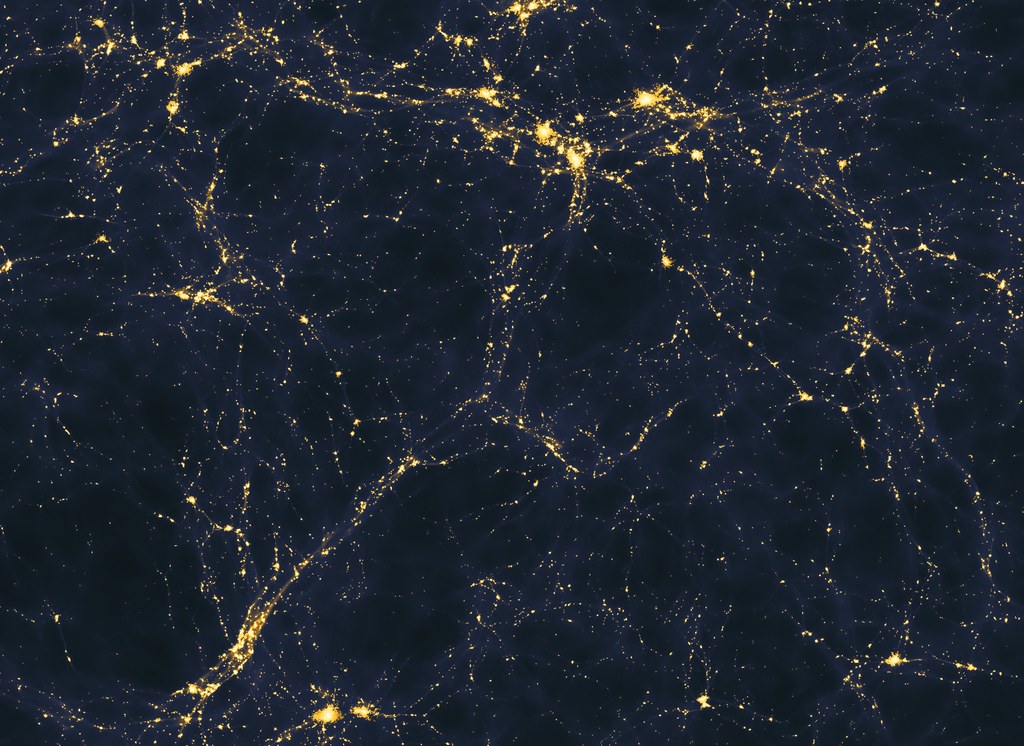
For a few decades after Hubble, astronomers pictured the galaxies
scattered more or less evenly through space, like raisins in a pudding.
Then, in the late 1970s—practically yesterday, as astronomy
goes—the pudding turned out to be something else entirely. As they
measured the distances to thousands of galaxies, Jaan Einasto and his
colleagues in Estonia, and separately Stephen Gregory and Laird Thompson
in the United States, noticed that galaxies seemed to gather in long chains and
sheets, with enormous empty regions between them.
In 1986, Valérie de Lapparent, Margaret Geller, and John Huchra of
the Harvard-Smithsonian Center for Astrophysics published a map of one
slice of the sky that settled the matter. The galaxies traced out the
walls of giant bubbles. (A cluster in the middle happened to look like a
stick figure, and the map became famous as "the stick man".)
Today we call the whole arrangement the "cosmic web". Galaxies gather
along filaments hundreds of millions of light-years long, the filaments
meet at knots where the great galactic clusters sit, and between them lie
the voids. It looks less like a pudding than a sponge, or the foam on a
glass of beer.
The Great Void
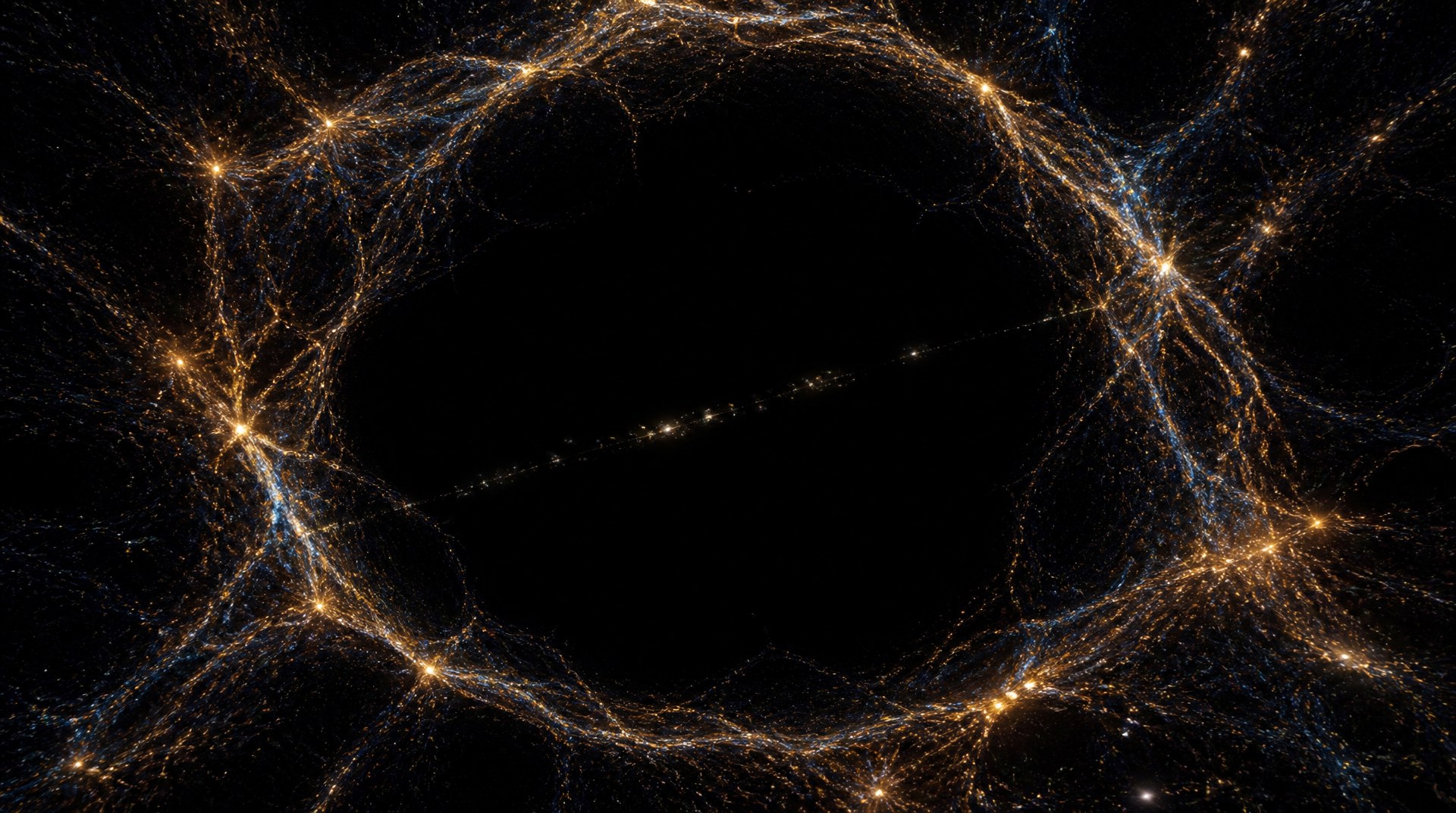
The most famous of the voids lies in the direction of the constellation
Boötes. In 1981, Robert Kirshner, Augustus Oemler, Paul Schechter,
and Stephen Shectman found that a huge region of space there, centered
some 700 million light-years away, held almost no galaxies. Estimates of
its size vary with where you draw the edge, but a common figure is 330
million light-years across. Our entire Milky Way is about 100,000
light-years across; you could line up more than three thousand of them
inside the Boötes void.
A region that big should hold something like two thousand galaxies. It
holds about sixty. It's been nicknamed the Great Void, and if you want to
get away from it all, this is the place.
A Star of One's Own
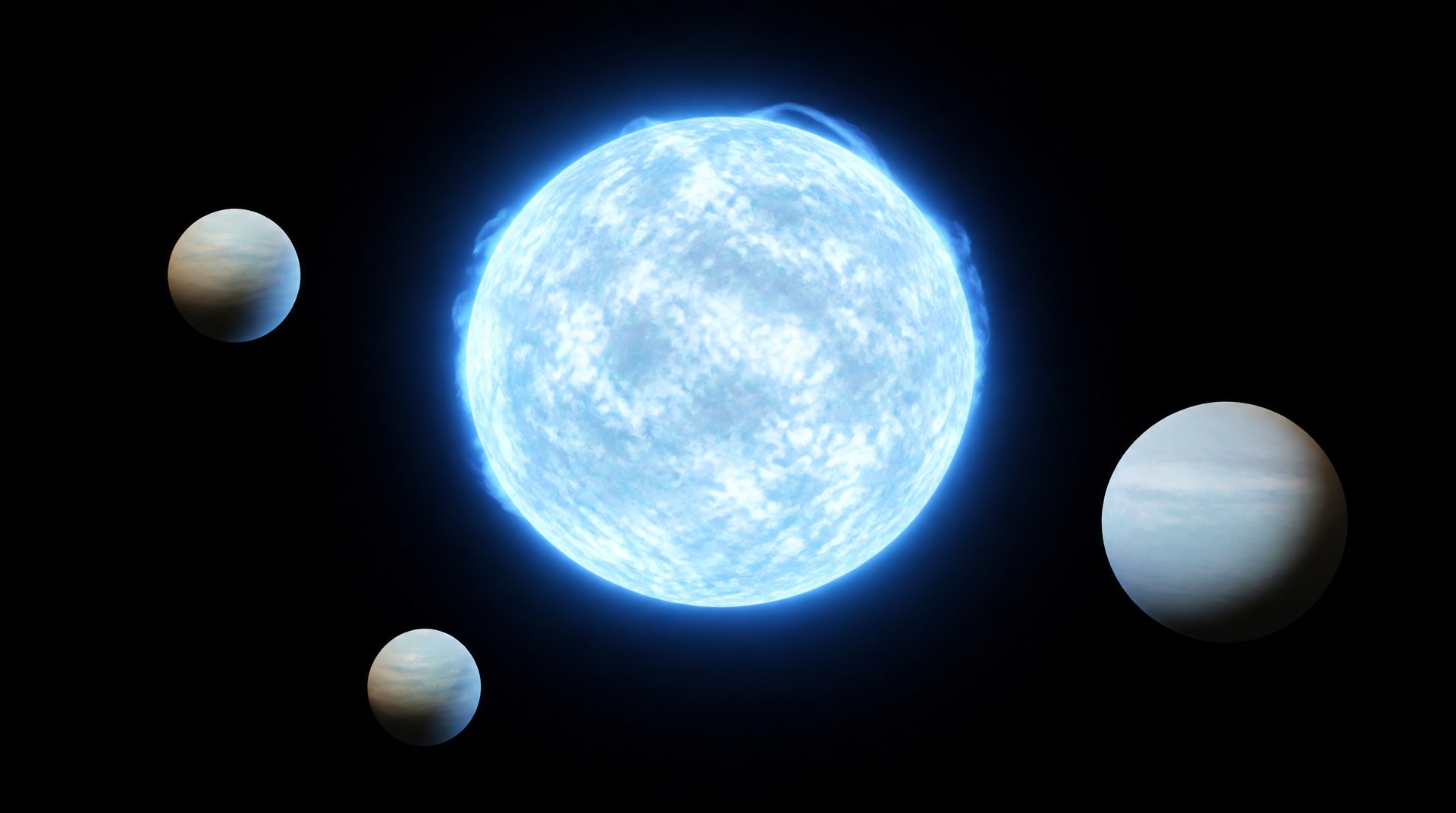
So imagine a star out there, all by itself in the middle of the Great
Void, with a planet, and on the planet, life. Talk about privacy. Its
night sky would be completely black. Its philosophers would grow up
believing, the way ours did before Hubble, that their little system was
the whole universe.
However, that can't happen. A star that formed out there, far from
any galaxy, would have to be made of the same stuff the universe started
with: hydrogen, helium, and a pinch of lithium. Everything
heavier—the carbon in our bodies, the oxygen we breathe, the silicon
and iron of the ground under our feet—was cooked inside earlier
generations of stars and scattered when they exploded. A lone star in a
void would be a first-generation star, with no earlier generation to
borrow from. Its planets, if it had any, would be balls of hydrogen and
helium, with no rock, no water, and no chemistry worth mentioning.
Any "life" it had would be gaseous, and probably not very interesting,
which would make their building a telescope difficult.
Nor could a star from a proper galaxy wander out there later. Some stars
do get flung out of their galaxies; the fastest one known is moving at
more than a thousand miles a second. Even at that speed, coasting a
hundred million light-years into a void would take longer than the
universe has existed.
The Loneliest Galaxy
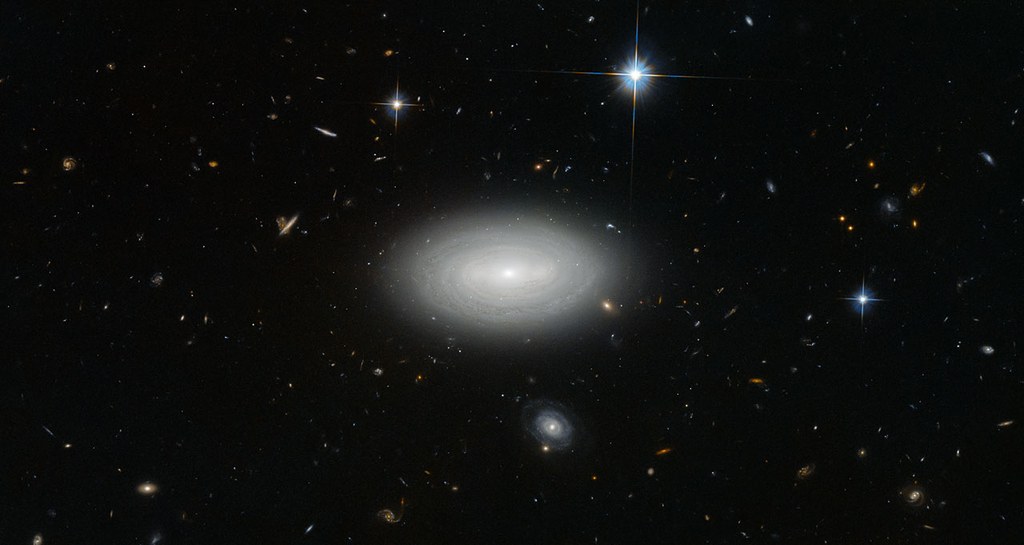
So if not a star, then a whole galaxy. And those do exist. The Great Void's
sixty or so galaxies aren't scattered at random. Many of them lie along a
thin tube running through the void, probably the leftover wall between
smaller voids that merged into one, the way soap bubbles pop into a
bigger bubble.
The loneliest galaxy we know of is in a different void. It's a barred
spiral called MCG+01-02-015, about 290 million light-years away in the
constellation Pisces, and it sits near the center of its void with no
known neighbors for about 100 million light-years in any direction.
According to the European Space Agency, if the Milky Way were that
isolated, we wouldn't have known other galaxies existed until the
1960s.
Did it vacuum up everything around it? No. The voids began as places that
were just slightly thinner than average in the early universe. Gravity
pulled their matter outward, toward the denser regions around them, and
the thin places got thinner, the way a stadium parking lot empties toward
the exits. The galaxies left in the voids are the stragglers: mostly
small, rich in gas, still forming stars, and growing slowly, because
there's nothing nearby to feed on or collide with.
Are We There Yet?
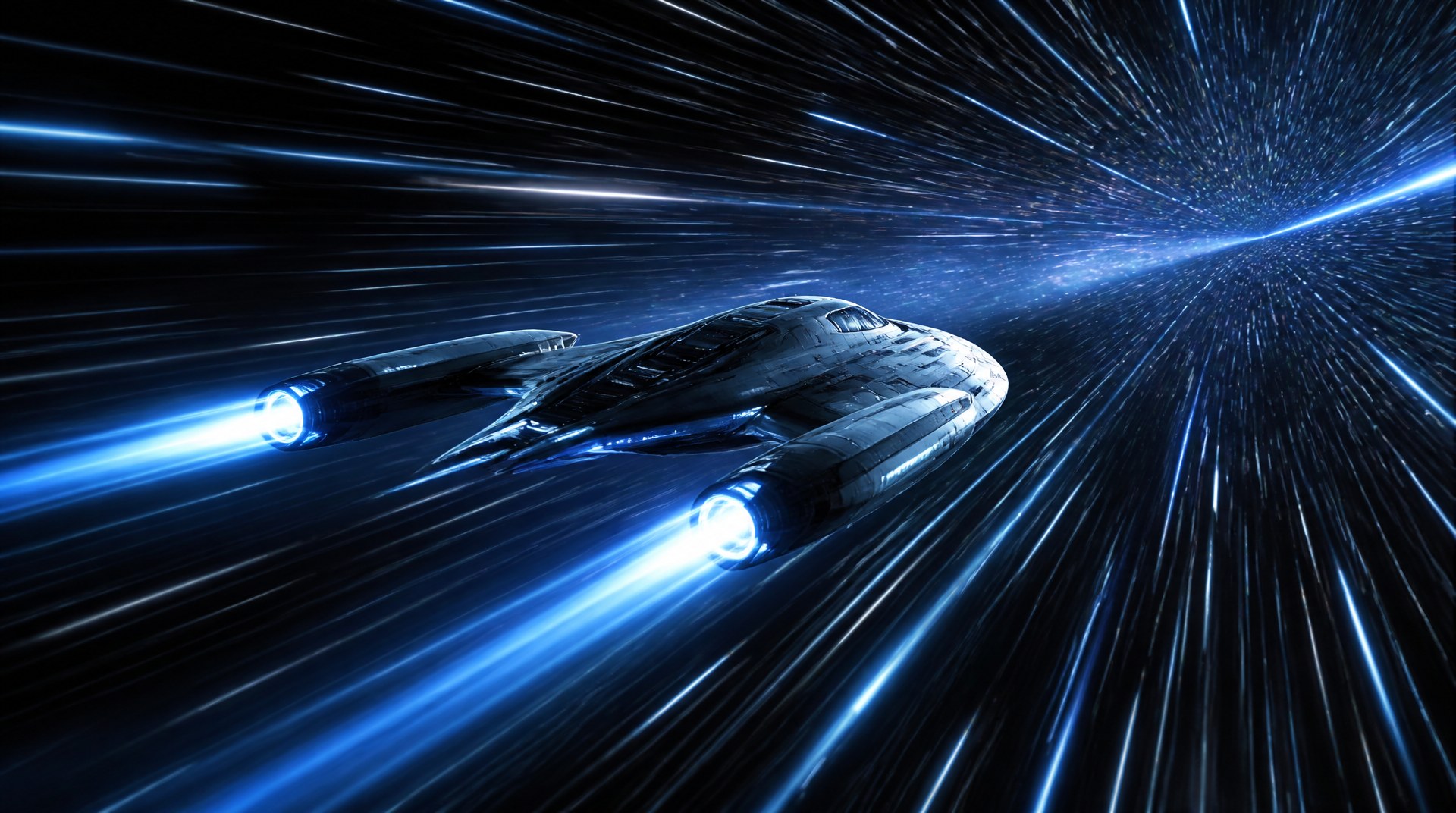
Suppose you wanted to go there. You'd need a faster ride than anything
NASA has on the drawing board, so let's borrow from Star Trek.
In the Star Trek universe, starships travel faster than light by "warping" the space
around them, and their speed is given as a "warp factor". In the original
1960s series, the formula was simple: cube the warp factor (2 × 2
× 2, for instance) and that's how many times the speed of light
you're going. Warp 1 is the speed of light. Warp 2 is 8 times the speed of
light; warp 3, 27 times; warp 6, 216 times.
When The Next Generation came along in 1987, the writers redrew the
scale so that warp 10 became infinite speed; a ship at warp 10 would be
everywhere in the universe at once. Below 10, the numbers crowd together
as they approach the limit. Warp 9 is about 1,500 times light speed, warp
9.9 about 3,000, and warp 9.99 nearly 8,000. That's why the later captains
fuss over decimal points.
Here's how long the trip would take, both across the Great Void and just
from the loneliest galaxy's nearest neighbor to the galaxy itself:
Travel Times at Warp
| Warp factor |
Times the speed of light |
Across the Great Void (330 million light-years) |
Nearest neighbor to the loneliest galaxy (100 million light-years) |
| Warp 1 (both scales) | 1 | 330 million years | 100 million years |
| Warp 6 (original) | 216 | 1.5 million years | 463,000 years |
| Warp 8 (original) | 512 | 645,000 years | 195,000 years |
| Warp 9 (Next Generation) | 1,516 | 218,000 years | 66,000 years |
| Warp 9.9 | 3,053 | 108,000 years | 32,800 years |
| Warp 9.99 | 7,912 | 41,700 years | 12,600 years |
| Warp 9.9999 | 199,516 | 1,650 years | 500 years |
Even at warp 9.99, crossing the Great Void takes about 42,000 years, eight
times the length of recorded history. Push it to warp 9.9999 and you could
make the crossing in about 1,650 years: leave while Rome still had an
emperor, and you'd be pulling in about now. Pack a lunch.
For the Extroverts
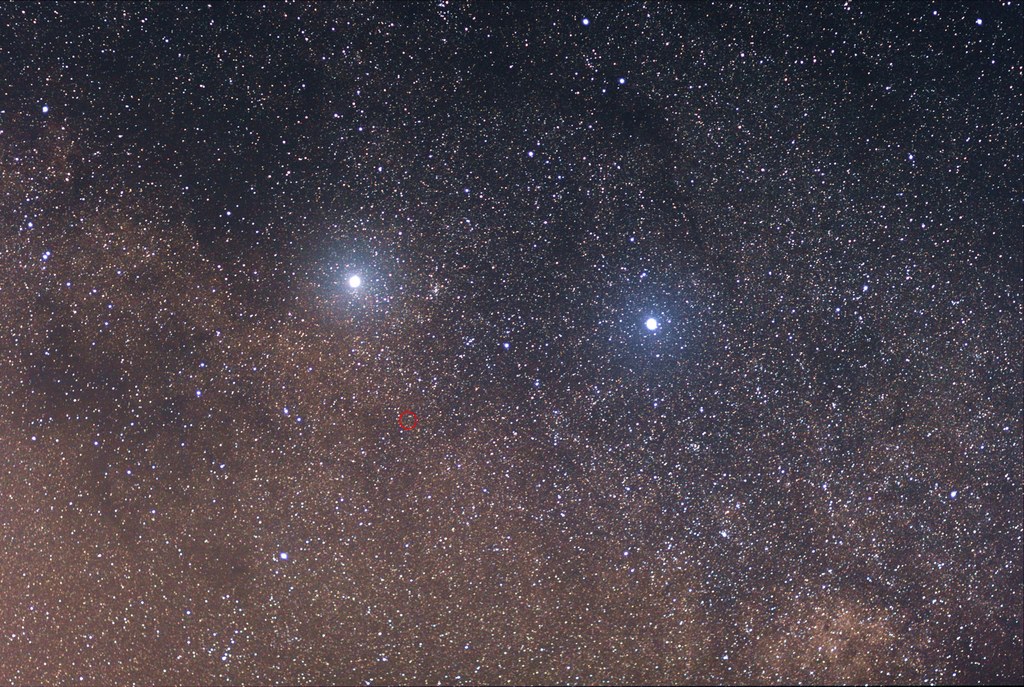
On the other hand, maybe you're one of those extroverts who actually
want to be around people. (I'm told they exist.) Good news: the
Sun's neighborhood may be quiet, but it isn't empty. The nearest house on
the block is the Alpha Centauri system.
Alpha Centauri is the brightest star in the southern constellation
Centaurus, and the third-brightest star in our night sky. Its light takes
4.3 years to get here. That sounds close until you do the arithmetic: 4.3
light-years is about 25 trillion miles. Voyager 1, the fastest spacecraft
now leaving the solar system, would need about 75,000 years to get there,
if it were headed that way, which it isn't. At warp speed it's another
story. Kirk, at warp 5, would get there in under two weeks. Picard, at
warp 9, would make it in about a day, roughly the time it takes to drive
from Phoenix to Seattle.
Right next to Alpha Centauri in the sky is Beta Centauri. Together
they're called the Pointers, because they point the way to the Southern
Cross. For years it was believed they were partners, the two suns of a double
star. But they aren't. Beta Centauri is about
360 light-years away, and is not one, but a trio of hot blue stars, the
brightest of which is tens
of thousands of times as luminous as our Sun. That's how it manages to
look like Alpha's twin from so far away.
Adam Strange Was Right, Sort Of
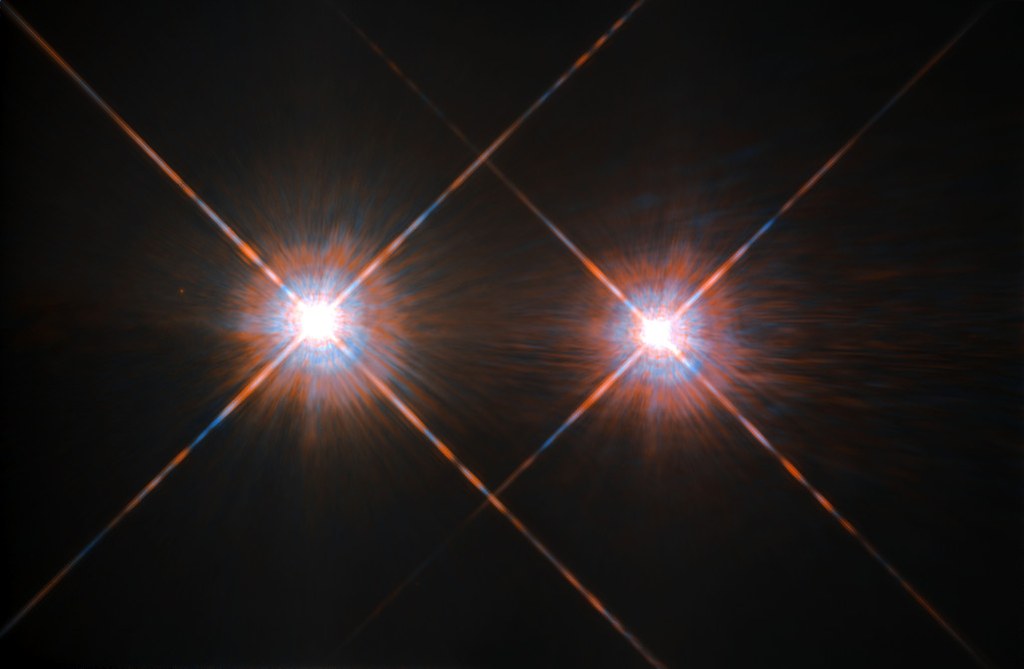

When I was a kid, most of what I knew about Alpha Centauri came from DC
Comics. Starting in 1958, an archaeologist named Adam Strange was
regularly snatched off the Earth by a "zeta beam" and deposited on Rann, a
planet of the Alpha Centauri system, where he'd save the day before the
beam wore off and dropped him back home. (I loved those stories enough to
write one of my own in 1975.) The
comics made a point of telling us that Alpha Centauri was a triple star
system, and Rann had three suns.
The comics were right. Alpha Centauri is a triple. But the three
aren't Alpha, Beta, and Proxima. The two bright ones are Alpha Centauri A
and Alpha Centauri B—a yellow star a little bigger than our Sun and
an orange one a little smaller—circling each other every eighty
years. They're too close together to separate without a telescope, so
they look like a single star. The third member is Proxima Centauri, a dim
red dwarf that is actually the nearest star to us, at 4.25
light-years.
Here's the "wrong reason" part. In 1958, nobody could prove Proxima
belonged to the family. It travels across the sky in step with A and B,
so astronomers assumed it was a member, but it's so far from the other
two—about 13,000 times the Earth's distance from the Sun—that
it could have been a stranger passing through. Proof that it's actually
in orbit around them, on a path that takes more than half a million years
to complete, didn't arrive until 2017. And from a planet circling A or B,
Proxima wouldn't be a sun at all, just a faint red star, barely visible
to the naked eye. Rann would have seen two suns. Right for the wrong
reason, but in science fiction, that still counts.
Downtown
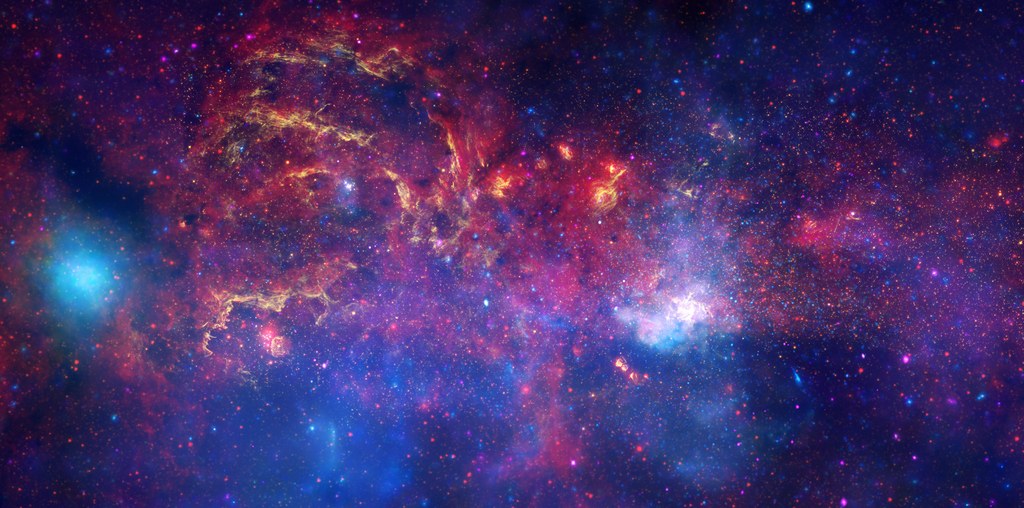
If Alpha Centauri still sounds too quiet, there's always downtown. The
center of the Milky Way, 26,000 light-years from here, is where the crowds
are. At the very middle sits Sagittarius A*, a black hole four million
times as massive as the Sun, and packed around it is a swarm of stars
millions of times more crowded than our neighborhood. Instead of four
light-years, your nearest neighbor might be a light-week or two away.
Night would never really fall. The combined light of all those close
neighbors would outshine our full moon many times over; you could read a
newspaper at midnight, if anybody still printed newspapers. Isaac Asimov
put Trantor, capital of his Galactic Empire, near the center of the
galaxy, and it makes sense. That's where the trade routes are short. It
would be a merchant's paradise.
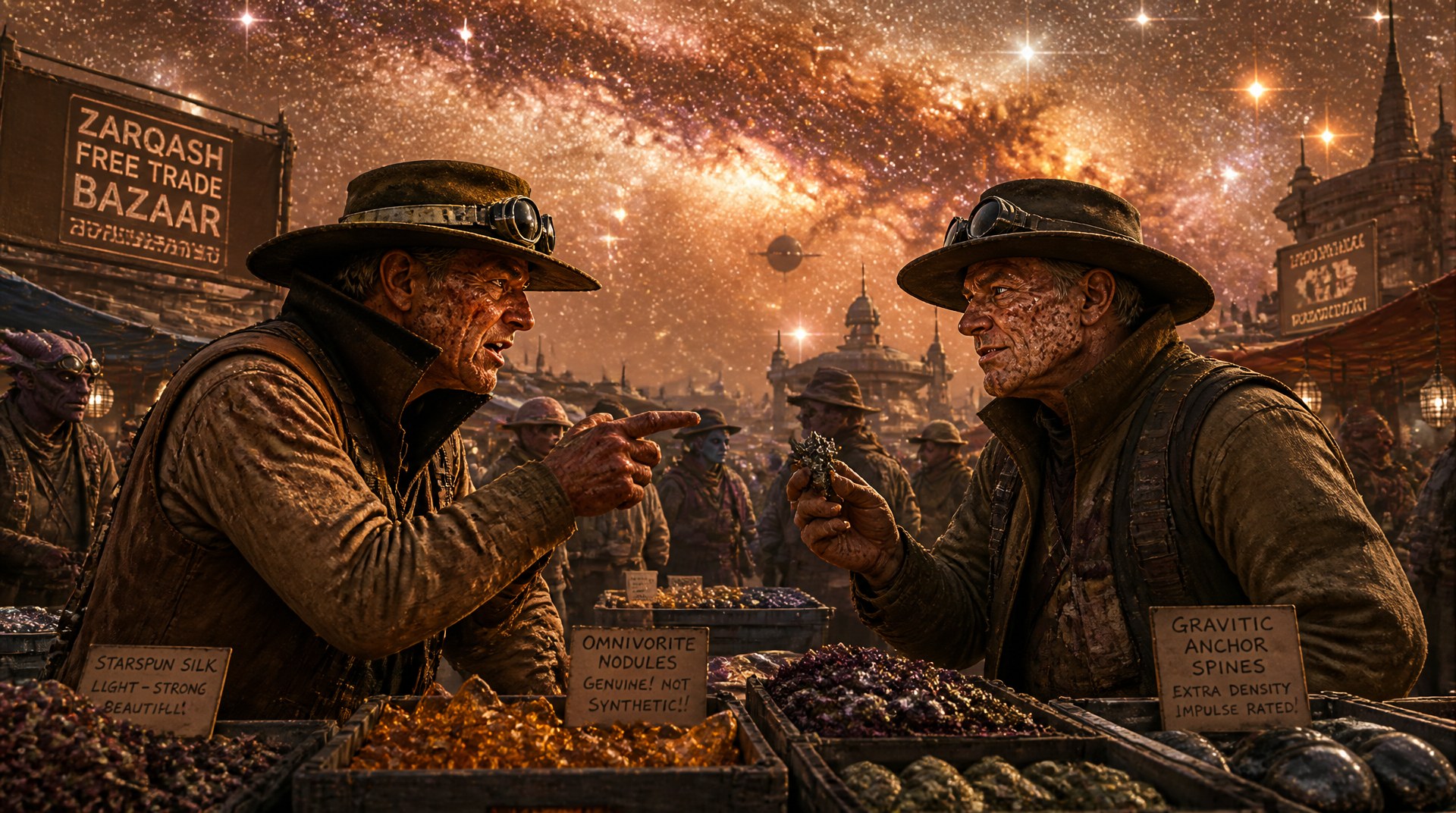
It would also be hard on the skin. The black hole at the center flares in
X-rays about once a day. The region is crowded with young, massive stars
pouring out ultraviolet light, and massive stars don't live long; they die
as supernovae, spraying radiation for light-years around. I picture Core
merchants as a leathery, blotchy lot, squinting out from under
wide-brimmed hats, who gave up worrying about their complexions a long
time ago.
Back to the Drawing Board
Me, I'm glad I like being alone, because I have work to do. My novel
The Abode
of Angels takes place on the home world of the M'nar, the
third planet of what I thought was Beta Centauri, Alpha's "twin sun". You
see the problem.
My first thought was to move the M'nar into a Tatooine-style orbit around
both A and B. Planets like that are real; the Kepler space telescope found
several circling two suns at once. But those suns are practically
touching. In the Kepler-16 system, the two stars are less than a quarter
of the Earth-Sun distance apart. Alpha Centauri A and B swing between 11
and 36 times that distance from each other, from about Saturn's distance
from our Sun to beyond Neptune's. A planet circling both would need to
stay about twice as far out as Pluto just to have a stable orbit, and out
there it would be colder than Pluto.
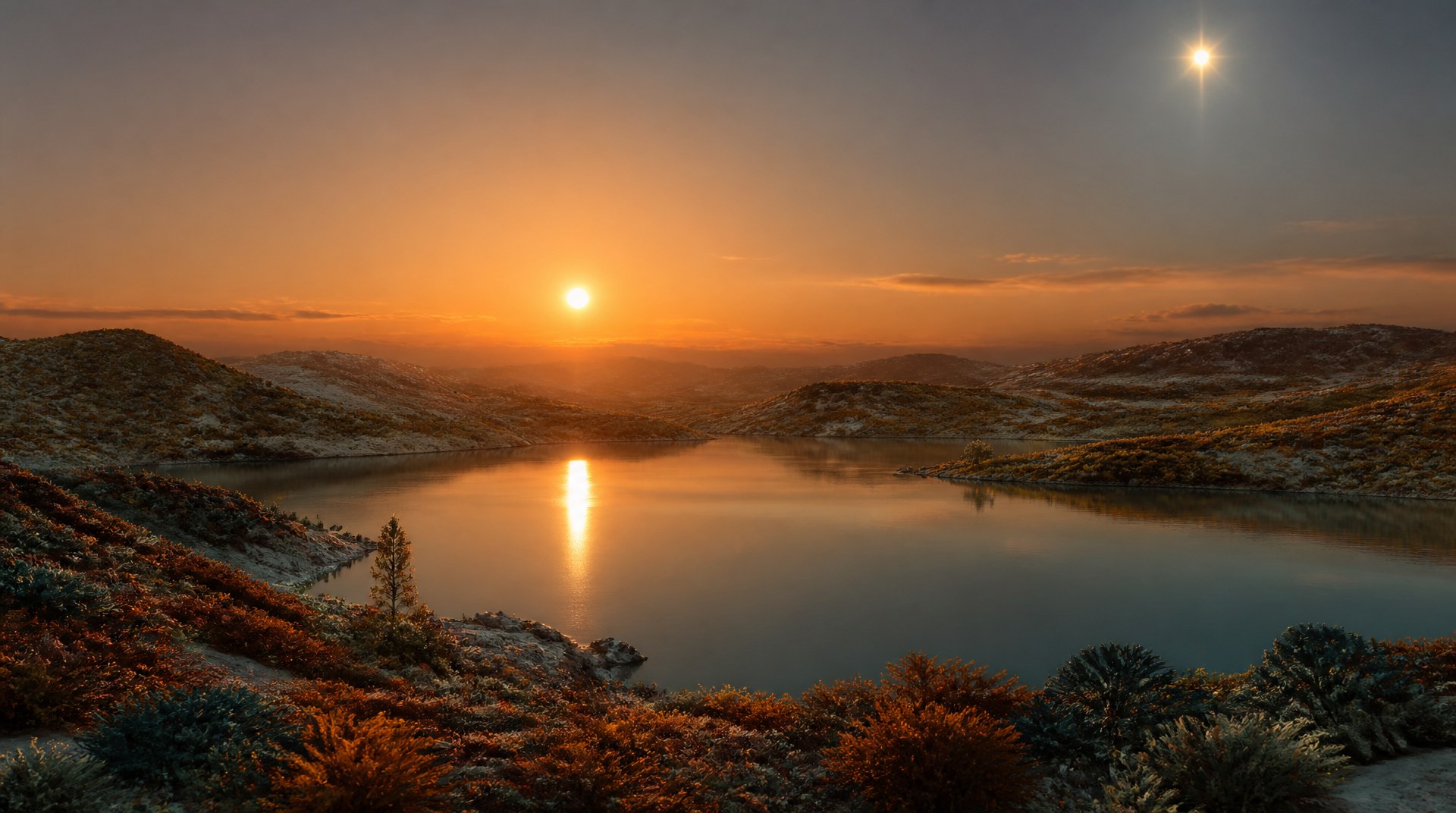
So the M'nar will circle Alpha Centauri B alone, close in, where the
orange sun keeps things comfortable. Orbits like that are stable, and they
come with a bonus: Alpha Centauri A. From the M'nar's world, A would be a
second sun, a dazzling point of light somewhere between 500 and 5,000
times as bright as our full moon, depending on where the two stars are in
their eighty-year dance. For part of each M'nar year, A would ride the
night sky, and the nights would be more like twilight.
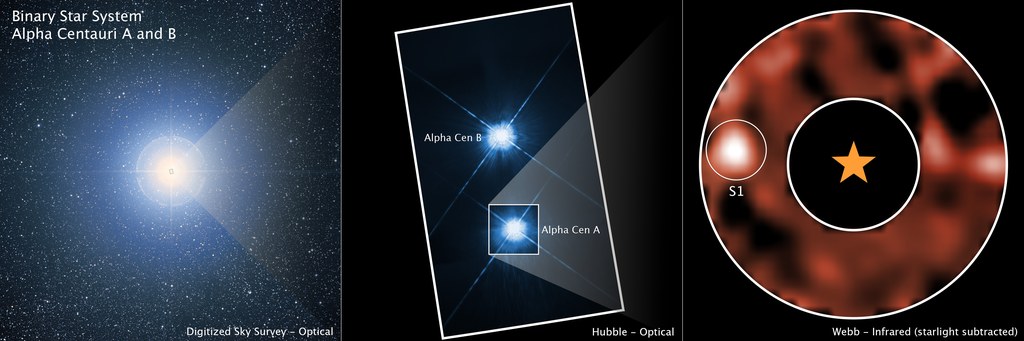
Real astronomy keeps nudging the novel, too. In 2025, astronomers
announced that the James Webb Space Telescope may have photographed a gas
giant about the mass of Saturn orbiting Alpha Centauri A, in that star's
habitable zone. As I write this, it's still only a candidate. A gas giant
is no place for life even remotely like ours to live; but gas giants can
have moons, and moons can have air…

So that's the job: a new orbit, a second sun, and every scene that
mentions either one to rewrite. I'll be at my desk for a while, with
Finley and Lilly for company and occasional visits from grandkids who also
live here, and nobody else, which suits me fine.
A science fiction writer's work is never done.
Because science is never done.