|
By: Paul S Cilwa |
Occurred: 2/24/2003 |
|
Page Views: 1,850 |
| Hashtags: #18Wheeler #TruckDriving #BigRigs #Schneider #TruckDriver |
| It's possible to recover from a jackknife-in-progress, but few truckers know how. |
| Estimated reading time: 14 minute(s) (3121 words) |
Monday, February 24, 2003
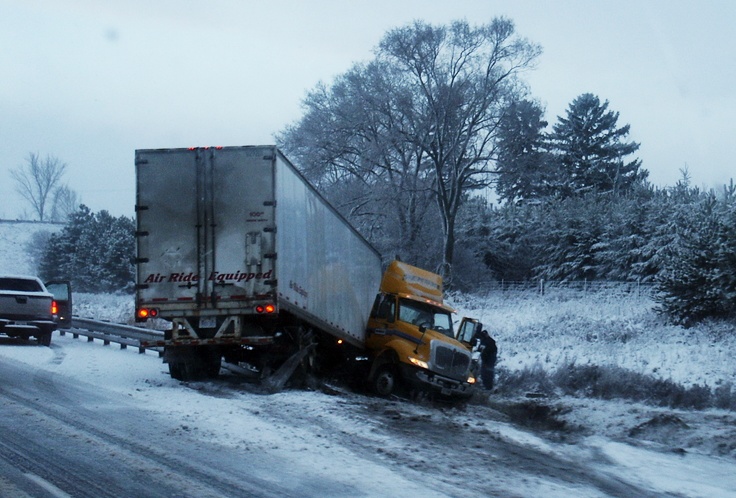
"I know how to recover from a jackknife," the grizzled old truck driver said.
And now, while waiting at
a grocery store, another driver, having found out I've been driving
less than six months, informed me that recovery was possible.
Whenever you hit your brakes,
he went on, always watch in the side mirror
where the trailer would go if there was a jackknife.
Which side is that?
I asked.
It's gonna be the side that's lowest,
he said. If you're in the right hand
lane, that's usually to the right unless you're on a curve. If you're in the
left-hand lane, it's usually to the left.
Okay.
He was talking about the fact that the center of the pavement is
built up higher so rain water will flow off the road.
So you step on your brake. If you see the trailer start to swing, all you
have to do is let go of the brake. The back of the trailer will get right back
in line.
Of course, he neglected to mention that jackknives are far more likely to
happen if you've jammed on the brakes hard, and that's more likely to happen if
there's something in front of you that you don't want to hit. Still, hitting one
thing is not as bad as jackknifing and having a whole lot of things hit
you. So I made a mental note to check my mirrors more, especially when
braking; but I still hoped I would never be involved in a jackknife.
As happens more often than I like, today started yesterday. That is, I
started my shift
in the evening, with a delivery of detergent to a Reno,
Nevada, grocery store. It was a two-stop load; afterwards, I was supposed to
deliver to the other side of the Sierra Nevada mountains, to a grocery store in
Stockton, California.
I was already on my way up toward Donner Pass when I received a message on
the Qualcomm. Paul, we need your help,
the message read (I've taken the
liberty of expanding the cryptic abbreviations of which Qualcomm messages are
typically composed). Can you save a Sears load? It has to be picked up in Reno
and taken to Delano, California.
They included a delivery date and time.
I can,
I responded, assuming I don't also have to deliver the next load
I'm assigned to.
I promptly received another message telling me that I was off that other
load. It then instructed me to drop the trailer I was pulling for relaying by
another driver…in Reno.
But I had already left Reno! In fact, by now, it was past midnight,
officially the 24th, and I had already gone further along Donner Pass than most
of the Donners
had. I pulled over, sent a message to this effect, and continued
on. I had to continue; it now made sense to drop the trailer in Sacramento for
relay rather than Reno; but I had to do it as soon as possible in order to get
back in time to make that Sears load.
Feeling that I couldn't be adequately expressive in the few lines of text to
which the Qualcomm messages are limited, I sent my cell phone number and a
request they either call me, or give me their extension so I could call them.
After a few minutes, I got another message: Just so we're clear,
the message
said, you are to drop your trailer in Reno for relay.
This was stupid, I thought. But, what the hell. I turned off at the
next exit, got on the eastbound ramp and headed back toward Reno. But I wasn't
going to be able to make Reno, and then to the Sears distribution center in
Delano by 6 PM this evening, its requested delivery time. I sent another message
saying so. In fact, I waited at the side of the road for fifteen minutes, hoping
to receive another message—but, no such luck. So, I continued on toward Reno.
I had just passed Donner summit when a response did arrive. Makes
sense,
the anonymous sender typed. Okay, drop in Sacramento and then go back to Reno.
Well, now it didn't make sense. But, with an hour turn-around between
messages, and Support Shift's unwillingness to have a phone conversation with
me, by the time I straightened it out it would be too late for anything
to get where it was supposed to be on time. Better to go along with the latest
instructions, now, even though the Sears load would deliver late, all because
the Support Shift people have been instructed to conduct all their
business by Qualcomm rather than phone. If I had called them, it wouldn't have
cost Schneider anything and would have saved the fuel for 80 miles of driving,
plus I might have gotten the Sears load delivered on time. It was just another
example of corporate penny-wise, pound-foolish silliness and I decided I
wouldn't waste another moment worrying about it.
Though it was annoying, knowing I had just driven 80 miles I would not get paid for.
I then spent the rest of my time on the mountain calculating exactly
how much pay I wouldn't receive for my west-east-west-east do-si-do.
But, eventually, I was able to drop the trailer in the Sacramento drop yard
and turned around to cross Donner Summit again.
To think how excited I was the first time I did this.
But I wasn't sleepy then. This time, though I had begun my shift in the
evening, I had been unable to go to sleep during the day—not always a problem
for me, but this time it was—and I was tired. I began to catch myself
starting to nod. This is never a good idea while driving; but it's especially
dangerous on a steep, winding road like I-80 across Donner Pass.
I took deep breaths. I munched on Chee-toes. I shifted position in my seat so
often I would have looked like I was chair dancing if it had been light enough
for anyone else to see. Finally, at 5 AM in the morning of February 24th, I got
to Sherwin Williams (the paint people) and coupled to a pre-loaded trailer.
Destination: Sears, at 6 in the evening.
Thank Hermes, I didn't have to make the trip instantly. I had finally run out of
hours. I was required, now, to take an eight-hour break, which I did gratefully.
When I awoke, it was after one in the afternoon and the weather had changed
while I slept…and not for the better. The sky was leaden and the air, even
here below the mountain, had become chill and smelt like snow. I crossed my
fingers that I would not be required to put on chains.
I never put on chains,
practically every driver I talked to on the subject,
said. We are required by law to carry them. But, by the time you put them on,
the consensus went, they've already cleared the road and you don't need 'em any
longer. So, why bother?
Which made sense to me. I had been to a class in how to put chains on, in
which we all stood and watched the instructor do it…once. There was no
opportunity to try it for ourselves. And that was a warm day in Fontana, in
southern California. I sure didn't want to have to teach myself now, at better
than 7,000 feet altitude, in a blizzard. So, crossing my fingers, I took off.
Heading west on I-80, you cross the California state line well before you get
into mountains. Shortly after that, you come to the California agricultural
check point. Being a farming state, and having been burned once already by the
Mediterranean Fruit Fly menace of the 1970s, California is justifiably nervous
about letting any more agricultural pests into the state. So, they have these
checkpoints along the border; and anyone entering California is asked whether
they happen to have any fruit trees or other potential agricultural dangers with
them.
Later, you come to the California weigh station, which are also posted along
the border and also here and there on major highways in the state. These don't
affect four-wheelers (that's regular cars, boys and girls) but eighteen wheelers
have to pull in (if the weigh station is open; sometimes they're closed) and get
weighed. Also, at random, they ask drivers to pull around to the back and get
their trucks inspected.
I'd only had that happen once before, and it was when I was in a hurry,
trying to deliver a load on schedule. I was in a hurry now, trying to deliver a
load on schedule; so, of course, they decided to inspect me now. The scary part
was, because it was so late and I was so tired, I hadn't properly inspected the
trailer I was pulling. What if one or more of the tire valve caps was missing?
That's a $20 fine for each one. Or the license tag light, which has been missing
from so many trailers? I'd never even looked at the back of this one. I didn't
even know, from personal observation, if the DOT bar was there (though it was
extremely likely to be).
I rolled the rig inside the inspection station and
the inspector, a confident-looking woman with blonde-streaked hair
and a neutral expression, closed the door behind me. She asked for
my license, health card, and log book; all three of which I gave
her. She inspected my log book closely, actually entering my daily
hours into her computer to see if I'd driven too much or missed a
DOT break. Thank God, every page in the last eight was done legally
and even accurately.
After almost an hour, the only problem she
found was with one of the trailer's tires. The tread is less than
3/32 of an inch,
she reported. She gave me a fixit ticket
, which
carries no fine or points and doesn't go on my record, as long as I
repair the problem within thirty days. Since I intended to get the
tire replaced in Sacramento, that wouldn't be a problem.
She lifted the garage doors and, as I was passing through them, pointed
at my rainbow sticker on the window. Nice sticker,
she said,
smiling in a conspiratorial way.
Thanks,
I said, nodding in
understanding that she was telling me she was also family
. I'd
have had no clue otherwise. Male gaydar doesn't usually include the
ability to identify lesbians.
While I'd been snug inside the inspection facility, the weather outside had
been moving in. The clouds were thick and heavy and close enough to touch, as
they roiled and rolled just overhead. Spatters of rain smacked against the
windshield, and then began larger and stickier—snow. I slowed a little, knowing
the road surface would become more slippery. If the road were straight, I
wouldn't worry so much. A big truck is going to tend to keep going in the same
direction whether the road is slick or not—Newton's first law of motion. But the
same law makes travel on a winding, mountain road dangerous. Several times I
had to touch the brakes, and did remember to watch in my passenger-side mirror,
but luckily the trailer slowed appropriately.
I passed a chain-up
area and saw that a police car had stopped and the
officer seemed about to put up a barricade. My heart sank; I was sure I would be
required to put on chains. But he let me through. Trucks behind me, though, I
saw were made to stop. Mine was the last one through unchained.
Eventually, on the western side of the mountain, I descended below 5,000 feet
and the snow became rain again. It was still potentially slippery, but not as
bad as snow and ice.
It was still pouring when I reached the 49er Truck Stop in Sacramento. I
showered while the mechanics changed my bad tire for a good one, then continued
my trip. I was definitely going to be late for my delivery; I sent a message
with a new estimated time of arrival.
Then, on state road 99 I saw a sign warning that the road was closed 120
miles ahead. Great, I thought. That would give me a little over two hours
to worry about it. How else would I go? I could only hope that there would be
detour signs.
The rain continued as I made my way south. Every time I had to touch the
brake, I checked the side mirror to make sure the trailer wasn't trying to
jackknife. This is easy, I thought. An easy habit to develop, as it
turned out. When the traffic was clear, I would try to start a jackknife
by hitting the brake too hard. However, I couldn't do it. Either the road wasn't
slick enough, the load was too heavy, or I couldn't quite bring myself to hit
the brake hard enough.
I stopped at the Pilot truck stop in Madera for fuel, and asked the driver
fueling the rig next to mine if he'd heard about the road being closed south of
here. Apparently I touched a nerve, because he exploded. Damned CalTrans!
he
swore, referring to the California Transportation authority. You know why I'm
not worried about a terrorist attack? Because there's nothing
terrorists could do to screw things up more than CalTrans does every day!
Okay, no details from him. I would have to take my chances.
CA-99 was, indeed, closed; but there were, indeed, detour signs and they weren't
hard to follow. I made my delivery before midnight, only six hours late, which
wasn't bad considering what I'd had to contend with.
Wednesday, February 26, 2003
A postscript to this story came two days later. I had picked up a
load at Sears, after dropping the previous one there. The new load
was to be delivered to two separate places in Utah. The appointment
for the first stop, in St. George, came without incident at eight in
the morning. To reach the second, in Richfield, I had to drive
through the mountains where, apparently, snow had recently fallen.
The roads were good, overall, though, and I was making pretty good
time—partly because I was one of only two rigs using our part of the
highway. The other driver and I started chatting on the CB. He was
an independent operator and could have driven 'way faster than me
(Schneider trucks are governed at 63.5 mph) but he remained behind
me as we talked.
We were both overwhelmed by the great beauty of the place. Utah is a
beautiful state, anyway; no doubt about it. And, here, the snow had turned the
entire landscape into a giant Christmas card. I wish I had my camera!
the
other driver remarked.
I have mine,
I said. I've already stopped two or three times to take
pictures. If it wasn't so much effort, I would be taking one every three or four
hundred feet.
We came to a stretch where snow-covered fields rose gracefully, becoming
snow-covered hills, rising further to become snow-covered mountain slopes and
then snow-kissed, rocky crags, all in one expanse. Oh, man,
the driver cried
over the CB, there's a stop ahead. You should get a picture of that.
Yeah, you're right,
I said, seeing the pullout to the right of the road
ahead. I gently touched the brakes, looking, thanks to my new habit, through the
passenger side window. Instantly, I saw that something didn't look right. My
trailer was lined up behind me, as it should be; but—I suddenly realized what I
was seeing. I was still holding the CB mike, and shouted into it, Let go the
brakes! You're jackknifing!
I released my own brakes so he wouldn't hit me.
His trailer meekly returned to its place behind him. We passed the pullout but
didn't have an incident
, which for me was well worth the loss of a photo
opportunity.
There was a silence, and finally I heard the other driver's voice on the CB.
Man,
he said shakily, how'd you know letting go of the brakes would stop a
jackknife?
I explained about the old driver at the Reno supermarket, and his advice on
avoiding jackknives. I never heard of such a thing,
the driver said, and I
been driving almost four years.
Well, now we both know that it works,
I said.
I wished I'd known last year,
he said. Or the year before that. Or six
months before that.
I whistled. You've been in three jackknives?
I asked. He admitted to
it. If you don't mind my asking, how do you keep your license?
They was never my fault,
he explained. But my insurance is through the
fucking roof.
Well, no higher for today, at least.
I didn't stop for any more photos that day, and eventually he passed me. I
gave him as wide a berth as possible as he did so—I wasn't completely convinced
he was the safest driver on the road. He'd been a nice guy, but I didn't breathe
easier until he was out of sight ahead of me—and then, I suddenly realized, I
could come upon him any time, sprawled across the highway, blocking all
lanes of traffic with a jackknifed 53 foot trailer.
But, maybe that bit of information from the old driver in Reno was all this
owner-operator needed. Maybe now his career would take a turn—and not a 90°
turn—for the better.
I could only hope.