|
By: Paul S. Cilwa |
Posted: 5/3/2026 |
|
Page Views: 116 |
| Hashtags: #HistoricalFiction #LucianOfSamosata #Miletus #Christianity #EarlyChurch |
| Lucian encounters a Christian woman and follows her to a service. |
| Estimated reading time: 12 minute(s) (2728 words) |
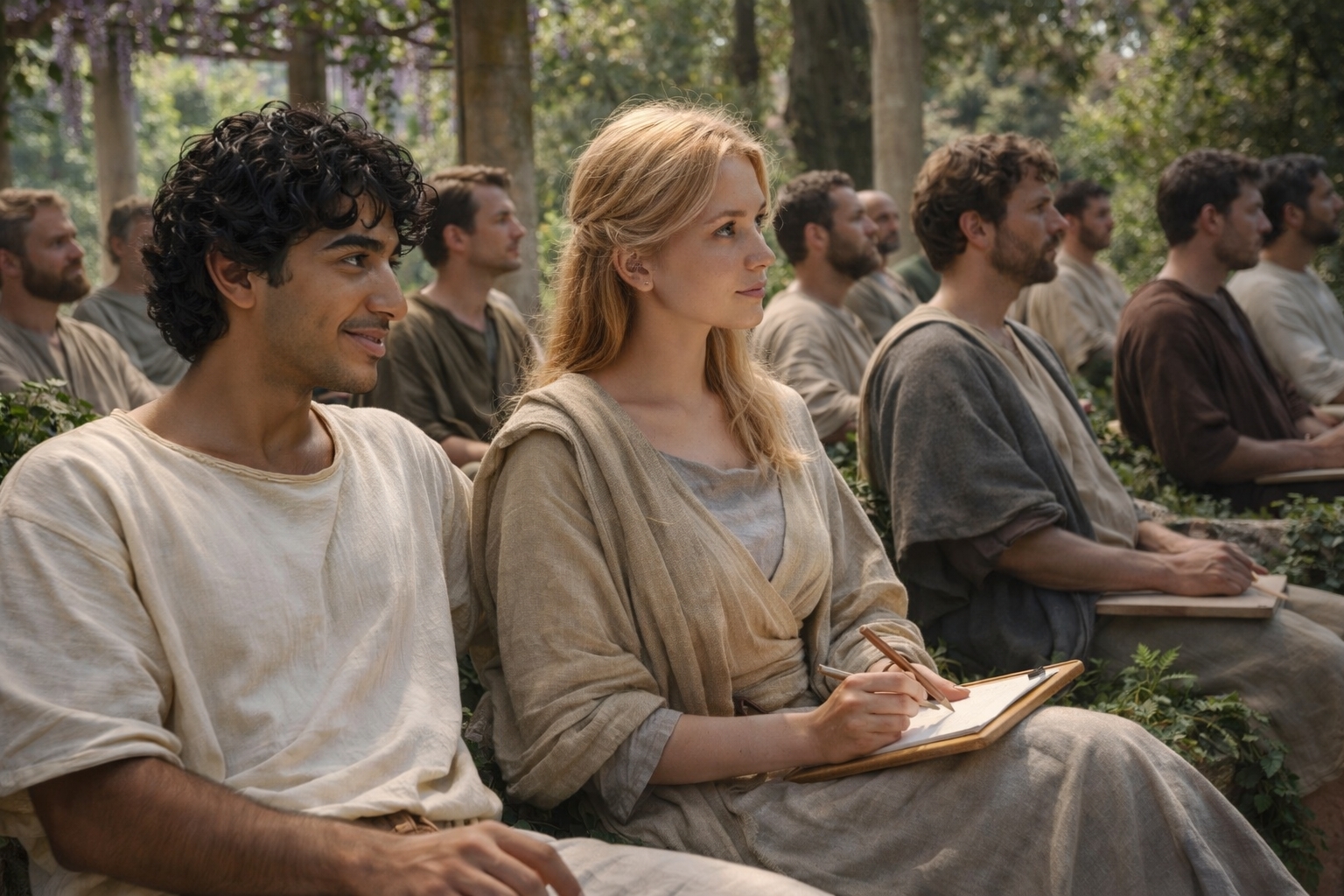
Lucian returned to the Epicurean lecture the next day on his own, claiming he was more drawn
to the school than either Philostratos or Demetrios. Arriving early, he secured a seat
near where she had sat before—and sure enough, she appeared again.
As they waited for Kallimachos to begin the lecture, Lucian realized he had caught her
eye and smiled and nodded, as if greeting a woman at a philosophical lecture was
the most normal thing in the world. She smiled back, and Kallimachos appeared,
and the lecture began.
Later, Lucian realized he had no idea what the lecture had been about.
When the lecture ended
and people began drifting away, he found himself gravitating toward her, driven by something
between curiosity and desire, and not entirely sure which was which.
"You were here yesterday," he said, which was obvious and stupid, but it was what came out.
She turned to look at him, and he saw amusement in her expression. "So were you," she said,
smiling.
She was perhaps two or three years older than him, with the kind of self-possession that
suggested she had spent time thinking about who she was and what she believed. Her tunic was
plain, her hair covered with a simple cloth, her hands marked with the calluses of work.
"I'm Lucian," he said. "And you are?"
"Hermione," she said. "And before you ask: no, I'm not here because a man dragged me,
and no, I don't understand philosophy only because someone explained it to me slowly. We women
do occasionally have thoughts of our own."
The Lunch
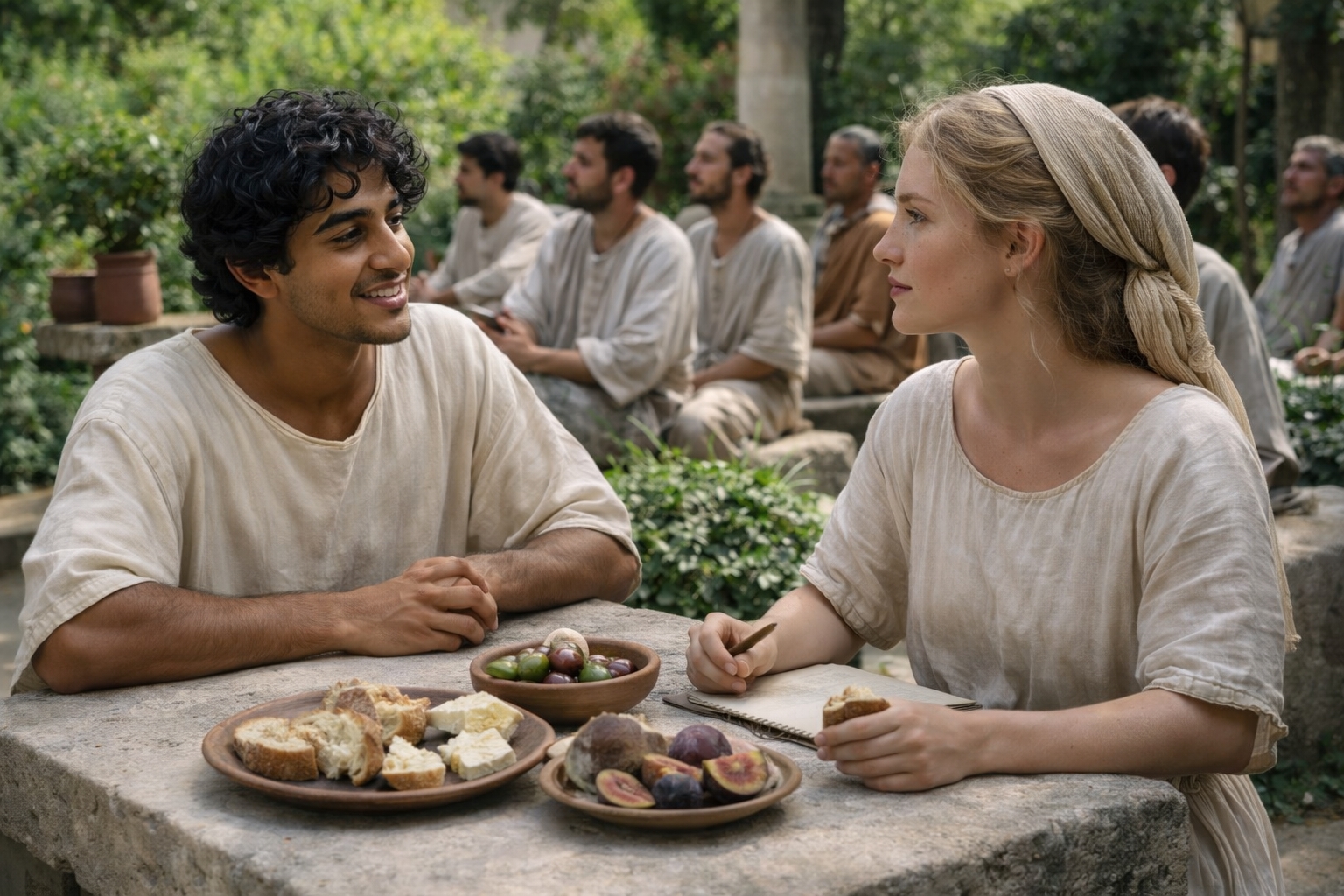
Kallimachos had arranged for a light meal to be served at midday, a break from the morning
lecture before the afternoon discussion began. It was simple—bread, olives, cheese, figs.
And Lucian found himself sitting across from Hermione, trying to think of something intelligent
to say.
"So what brings you to Epicurean lectures?" he asked finally.
"What brings you?" she countered.
"I travel with Philostratos. I'm learning philosophy."
"And I wanted to understand what people think true pleasure is," she said. "I have my own
beliefs about that, but it's useful to know what others think."
"What do you believe?" Lucian asked before he could stop himself.
She studied him for a long moment, as if trying to decide whether he was genuinely interested
or merely performing interest to flirt with her. Lucian, aware of being assessed, tried to keep
his face open and honest.
"I believe," she said slowly, "that true pleasure comes from knowing you are loved. Not
by the gods, who don't exist. But by people. Real people. And by a God who does exist, though
not the way the temples teach."
Lucian blinked. "You don't worship the gods?"
"Not the gods your philosophers argue about," she said. "There is, actually, only one God. And he
loves humanity so much that he sent his Son to die for us."
For a moment, Lucian was not sure if she was joking. "A god's son died?"
"He was crucified," Hermione said matter-of-factly. "By the Romans. And he rose again
three days later, because death could not hold him. He is called Jesus. And he is the savior of
the world."
Lucian's mind reeled. This was not philosophy. This was mythology, but mythology that had
happened, supposedly, within living memory, if the Romans were involved. "You believe this, literally?"
"Yes," Hermione said. "And I know it sounds insane. I thought so too, at first. But when
you understand what it means—that someone loved us so much he was willing to suffer for
us—it changes everything."
Before Lucian could ask another question, Hermione continued. "There's a gathering tonight.
Not a lecture. A synaxis—a coming together of those who believe. If you want to
understand, you should come. See it for yourself. Judge it yourself." She pressed a small
token into his hand, a simple fish carved from olive wood. "Show this when you arrive. They
will know you are a guest."
The House Church
The gathering took place in a house not far from the harbor, in a modest neighborhood where
artisans and laborers lived. There was no outward sign that anything unusual was happening. A
servant answered Lucian's knock and, when he showed the fish, wordlessly led him through a
courtyard to a room where perhaps thirty people had gathered.
They were a mixture—a few merchants, several slaves, a freedwoman, craftspeople, young
and old. There was none of the hierarchy Lucian was accustomed to in the temples. No priests
in elaborate dress, no sacrificial animals, no sense of performance or theater.
Instead, there was a simplicity that was almost touching. An older man stood and began to speak
about Jesus, about his teachings, about his crucifixion and resurrection. The words were
repetitive—Lucian kept hearing the same phrases, the same promises—but there was a
sincerity in them that was almost painful to witness. This man believed every word. So did
everyone around him.
Then they prayed. Not the formal, bargaining prayers of his religion, where you
offered something to the gods in exchange for a favor. This prayer was intimate, direct,
conversational. "Father," the old man said, and everyone repeated the word as a kind of
affirmation. They asked for forgiveness for their sins, for strength to live as Jesus taught,
for the coming of God's kingdom.
This was an utterly new concept to Lucian, that of "sin". In Greco-Roman religion, one could offend
a god, but there were specific rituals to ameliorate the offense. Apparently an offense against
Hermione's god was more of a moral stain on the soul that would accompany one into the
afterlife. So, while Lucian was used to the idea of a god annoying a man for his lifetime,
apparently Herminone's Jesus had added eternity to that annoyance.
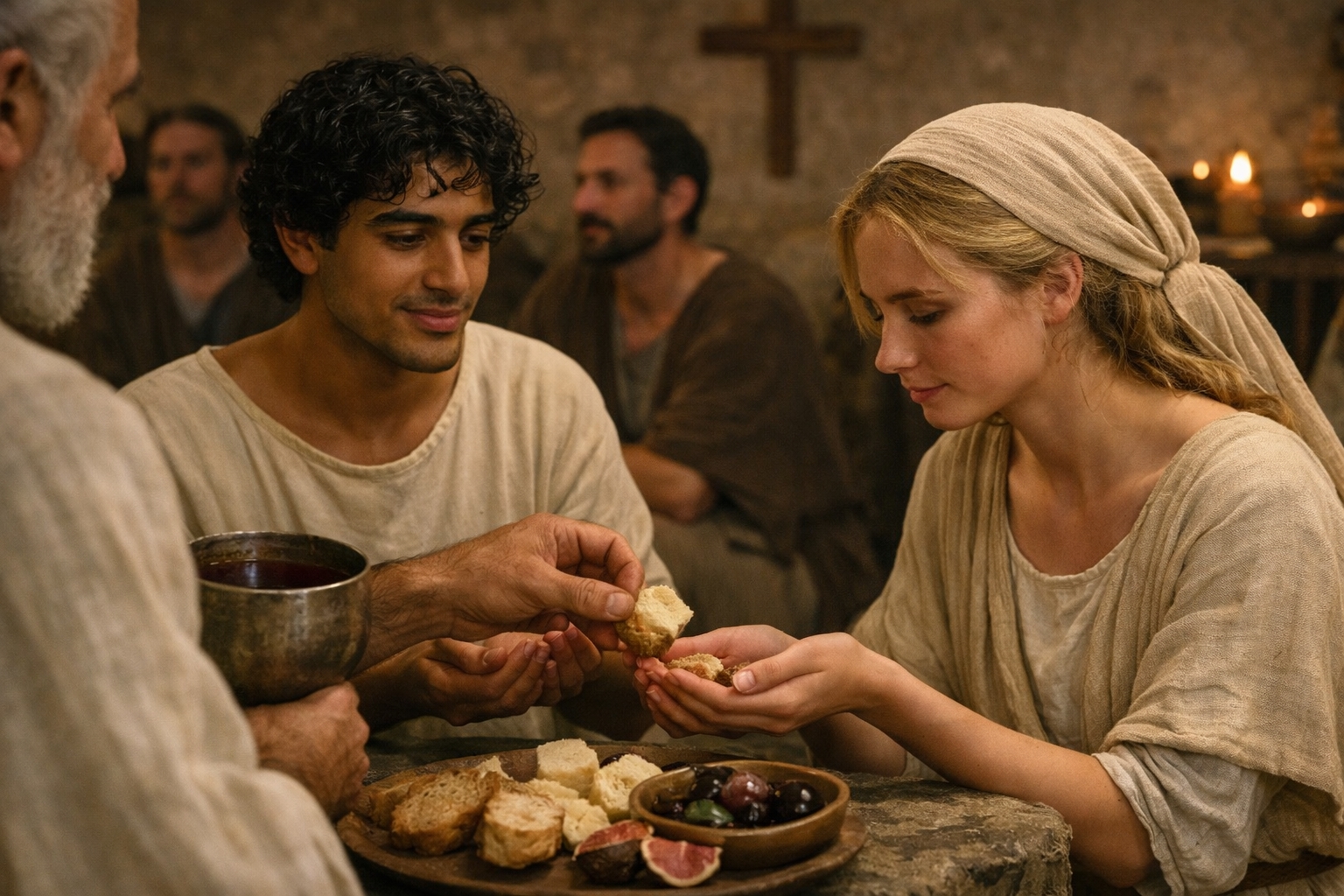
And then they ate. A simple meal of bread and wine, but it was clearly a sacred act. The old
man broke the bread and spoke words over it—words about Jesus's body, given for them.
They passed the cup, and each person drank and spoke the name of Jesus. It was the most
intimate and the most strange thing Lucian had ever witnessed in a religious context.
When he'd awakened that morning, he certainly never expected to participate in
ritual cannibalism.
After the meal, people began sharing. A woman spoke about how her master had tried to force her
into prostitution, and she had refused, and now she had found this community where she was
treated as a person, as a sister in Christ (meaning Anointed, another term for this
god-son). A young man spoke about his family cutting him off
when he converted, and how the church had become his family. An older man spoke about his fear
of death, and how the promise of resurrection had given him peace.
Hermione stood and spoke briefly. "I came to Jesus because I was lonely," she said simply.
"The world did not have a place for me. My family was poor, I had no husband, no dowry, I had no
security. And then I learned about Jesus, about a man who loved the poor and the outcast and
the women that everyone else ignored. And I understood that I was loved. That I mattered. That
my life had purpose."
When she sat down, she caught Lucian's eye and gave him a small shy smile. And he realized, with
sudden clarity, that his attraction to her had shifted. It was no longer just about her beauty
or her wit. It was about her conviction. She believed something absolutely, and that
belief had transformed her from someone uncertain into someone who was very
certain. He recognized it, because that was what he wanted—to find something he believed
in so deeply that it could remake him.
After the gathering, as people filed out into the darkness, Hermione introduced Lucian to the
old man who had led the prayer. His name was Alexios, and he had been a follower of Jesus for
more than thirty years. He studied Lucian with intelligent eyes.
"You have questions," Alexios said.
"Many," Lucian admitted. "If this Jesus is God, why did he die? Why not simply strike
down his enemies with lightning or a flood or something?"
"Because he came not to rule by force," Alexios said, "but to show us how to love. A
God who needs power to enforce obedience is not much of a God. A God who is willing to suffer
and die rather than abandon us—that is a God worth worshipping."
Lucian's head tilted. "But the gods—I mean, the other gods—they ask
only that they be honored, not obeyed. What kind of commands does your god issue?"
"Mostly moral commands, how to treat people ethically."
"Like philosophy has been doing for, what, a thousand years?"
"Ah!" Alexios chortled. "But nothing compels the non-Christian to do
that. If we fail to follow His teachings, God will make us spend eternity
in Gehenna, where our greatest punishment will be knowing we can never be with Him
in Paradise."
"That seems harsh." Lucian observed. "No decent human parent would turn their back on their
child for eternity like that."
Alexios held out his hands. "But all we have to do to escape that fate is beg forgiveness,
as we did here, tonight."
Lucian shook his head. "But this is all based on the idea that your Jesus is a son of God.
Lots of Greek heroes are sons of the gods."
"Yes, but we know Jesus is the Son of God, because his mother was a virgin,
making his birth miraculous."
Alexios seemed so sincere, that Lucian felt it would be rude to ask the obvious question:
How do you know? But he kept quiet.
The Reflection
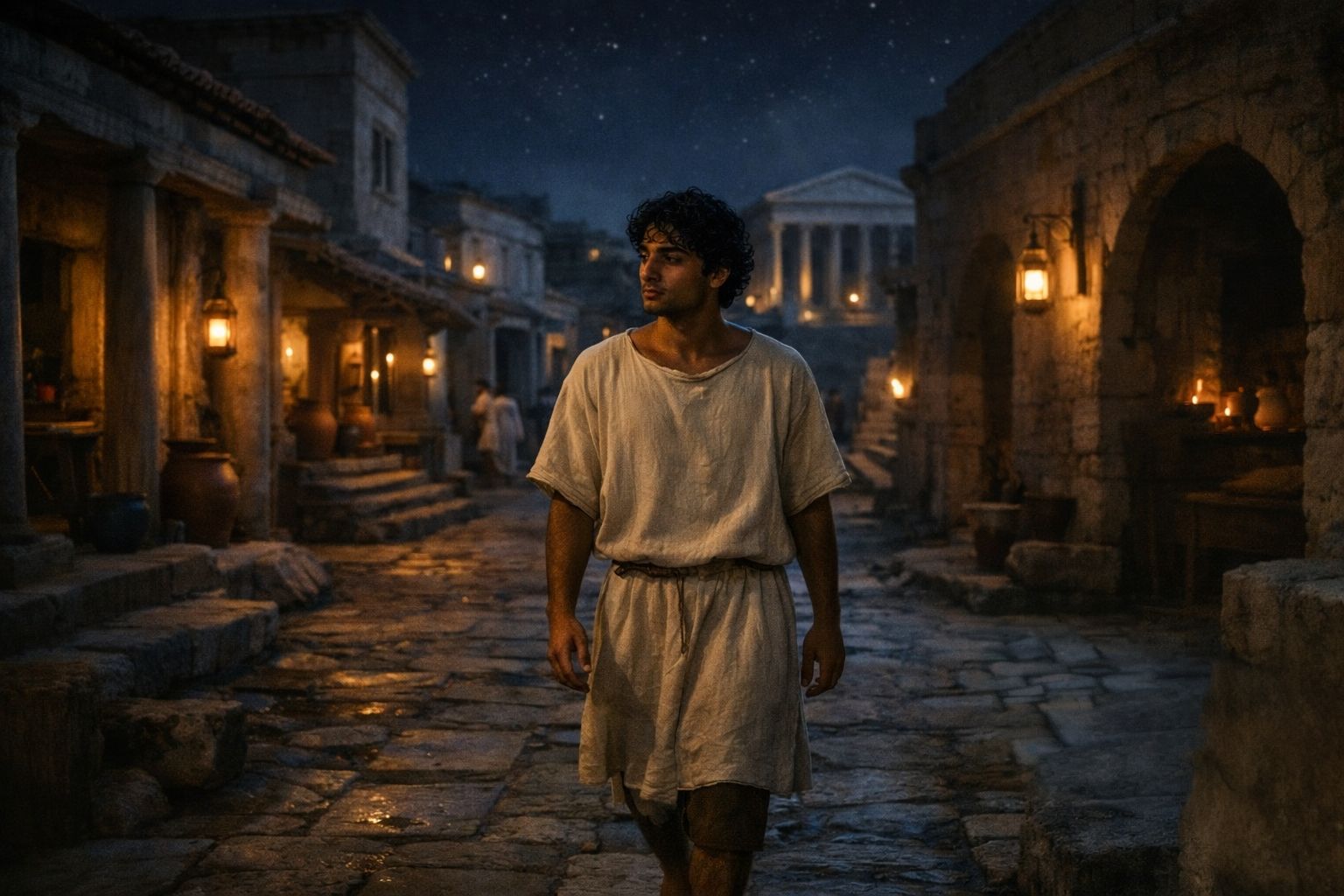
When Lucian left the house, his mind was churning. He had encountered many things on his journey
—Platonism, Stoicism, Epicureanism—but none of them asked him to believe in
something that had no rational support whatsoever. Philosophy argued from reason. Christianity argued from
rumor and revelation, from faith, from something that could not be proven.
And yet, there was something compelling about it. The way these people cared for each other, the
way they seemed to have found a kind of belonging that the pagan world did not offer—that
was real. The woman with no family, the man rejected by his parents, the slave woman denied
basic dignity by society—they had found a place here. That was not imaginary. That was
real power.
It also spoke to the inequalities of the world: That the complaints these people had were
genuine. But he also saw that, rather than doing something to change their circumstances,
they had instead banded together with others like themselves to simply tolerate them, hoping
their situation would improve after their deaths.
And this was potentially dangerous, not only to the Christians but to the Empire.
Lucian could see that clearly. A religion that promised salvation
to the poor and the outcast, that said all were equal in God's sight, that declared other
gods false—this was a religion that would eventually come into conflict with Rome. The
authorities would not tolerate a faith that claimed exclusive access to Truth.
He also feared that, if this religion did become popular enough to pose a genuine threat,
it was flexible enough to warp it to support the government. Currently, the common religion
was favored by the Emperor because it helped maintain the status quo. But any religion,
aimed as they are to entertain the masses, can be made to do the same. And Lucian had yet
to learn of any unambiguous method of communication between gods and men, which meant,
when all is said and done, Hermione wasn't doing Jesus' bidding, but Alexios'.
When Lucian returned to Kallimachos's house, Philostratos and Demetrios were in the courtyard,
discussing some point of Platonic philosophy. Lucian sat down, and after a moment, Philostratos
looked at him.
"You have been somewhere," he said. "You have the look of someone who has encountered
something unexpected."
So Lucian told them about the Christian gathering. He described the prayer, the meal, the
testimonies, the absolute conviction that death could be conquered through faith in a man who
had died and risen.
Demetrios laughed. "They believe in a literal resurrection? Bodies coming out of the ground?"
"Yes," Lucian said. "But not just any bodies. Perfected bodies. Immortal bodies. It's
actually rather brilliant, in a way. They've taken the fear of death and turned it into a
source of hope."
Philostratos was quiet for a long moment. "What do you think of it?" he asked finally.
"I think," Lucian said carefully, "that it is false. There is no evidence for any of it.
The man Jesus died two generations ago. We have only the claims of his followers that he rose
again. This was supposed to have happened in Jerusalem, a real place. But no one else
reported it? That's hard to believe. And their whole faith hinges on that one event.
Well, and one other—they believe his mother was a virgin, that their Jesus' father
was their god."
Philostratos burst out laughing. "If I had a drachma for every young girl who insisted
her pregnancy was due to a god, I could afford to be an Epicurean!"
"And yet…they are sincere. And they have built something real. A community. A kind of
love that transcends the normal boundaries."
"But?" Philostratos prompted.
"It troubles me," Lucian said. "Because it works through belief rather than
reason. And because it claims exclusive access to Truth. It says: all other gods are
false, all other philosophies are mistaken, there is only one way. That is not how philosophy
works. Philosophy argues, questions, acknowledges other perspectives. But Christianity is not
interested in that. It wants conviction. Certainty. Faith."
"Is that necessarily bad?" Demetrios asked.
"No," Lucian said. "I envied them, in a way. The certainty. The sense that they belonged
to something larger than the Empire. But I also saw something else. In their absolute conviction
that they alone possess the Truth, there is the seed of something dangerous. Eventually, that
conviction will be tested by the state. And then we will see whether love and faith can survive
persecution, or co-opting by the State."
Philostratos nodded slowly. "You see deeply, Lucian. Most people would either dismiss them as
fools or accept their claims uncritically. But you see both the power and the danger."
"There's a woman there," Lucian said, blushing slightly. "She was actually the reason I
went. She's intelligent, convinced, living a life completely dedicated to her faith. And she
terrifies me."
"Why?" Demetrios asked.
"Because conviction like that…it makes one capable of terrible things," Lucian said.
"Or beautiful things. But rarely anything in between. You either embrace it completely or
reject it completely." he shook his head ruefully. "There's no room for the kind of
questioning I do. But that's not the scariest part."
"Which is…?" Demetrios prompted.
"That there are that many people in the world who so easily let go of reason for blind
faith, and think of it as a good thing." He paused, and then added something that
he would remember years later, when he was writing his
satirical dialogues: "They are simple people," he said. "But simplicity in service of
conviction is powerful. More powerful, perhaps, than all the arguments of philosophy."
He paused. "Not more correct, mind you. Just more powerful. And it's the idea of
large amounts of people devoted to faith over reason that I find terrifying."