|
By: Paul S. Cilwa |
Posted: 5/15/2026 |
|
Page Views: 66 |
| Hashtags: #HistoricalFiction #LucianOfSamosata #Hispania #Tarraco #Venatio #Mari #Basque #Vascon |
| Lucian gets an unexpected offer from a mysterious woman. |
| Estimated reading time: 13 minute(s) (2917 words) |
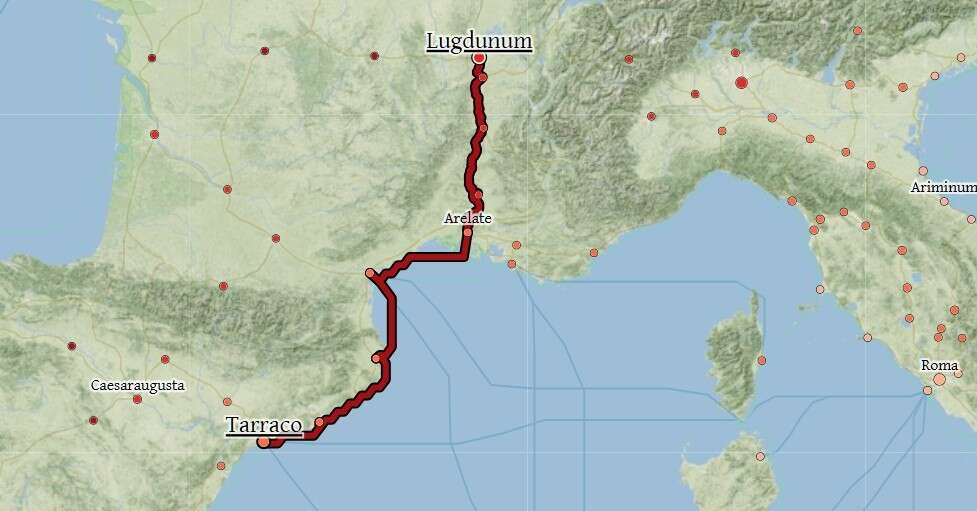
That evening, Lucian sat with Demetrios in their inn, watching the sun set
over Lugdunum. He felt the peculiar lightness of a man who has completed an
unexpected task. The gods had wanted Tanno and Brigid reunited, he thought.
They had simply used him as their instrument.
"We've done what we came to do," Lucian said to Demetrios. "Lectured.
Performed. Made our money. But I want to see the Pillars of Heracles before we
return home. I want to see what lies at the edge of the world."
Demetrios nodded. He had been with Lucian long enough to understand when the
rhetor needed a new horizon. "Hispania, then," he said. He opened the
worn papyrus on which had been inscribed a map of the known world. "We'll take the
Rhône down to the sea. There are river boats that travel daily—faster
than the roads and far more comfortable. We'll go down to Arles, or all the way
to the coast if we must. From there, we board a merchant ship heading to
Tarraco. It's the capital of Tarraconensis, a proper Roman city with theaters
and audiences who will want to hear you speak."
"And then from Tarraco?" Lucian asked.
"From Tarraco, we follow the coast south toward Baetica. The Pillars of
Heracles are in the south, where the Middle Sea meets the Outer Sea. It
will take time, but we'll get there. And along the way, there will be cities
that want to hear a famous rhetor speak."
Lucian smiled. Yes. That was what he wanted. Not the performances themselves
anymore, but the journey. The listening. The learning.
"When can we leave?" he asked.
"Let's say three days," Demetrios suggested. "It will take that long to arrange passage,
book our route, and prepare supplies. By the end of the week, we'll be on the
road south."
"I've been talking with the captain's mate," Demetrios said. "There are games
scheduled here. A
venatio,
starting in three days. The procurator has planned for a
Greek rhetor to open the ceremony—someone to dignify the spectacle with philosophy,
as they do. But they haven't yet chosen one."
"You're suggesting we present ourselves for the position?" Lucian asked, uneasily.
"I know it's my Syrian upbringing, but I really don't like those things.
Syrians do not approve of cruelty to animals, especially pointless cruelty."
Lucian grinned self-consciously. "I guess you can take the boy out of Syria, but…"
"Greeks don't approve, either. It's hardly a test of athleticism to defeat an
animal with weapons the animal cannot possess. But, Lucian—it's not something
we can stop. The Romans love these spectacles. But, perhaps by being there, speaking,
you might be able to reach some of the people who attend. Seeds, my boy. An oak tree
lives longer than a man, but when it finally matures, it pushes everything else out
of its way. —Have you ever actually been to a venatio?"
Lucian admitted he had not.
"Well, I know what you'd say if someone else complained about something they'd never
themselves experienced."
Lucian laughed.
"And if you're going to go and find out what all the swordplay is about, why
not get paid for it? The mate said the organizers have been looking for someone suitable," Demetrios
said. "Word travels along the river. Your reputation as a Second Sophistic speaker
would be ideal for what they want. And it's profitable work—as you know, cities pay well for the
opening rhetoric. We could establish ourselves here, make connections, and move on to
Hispania proper with both coin and credibility."
Lucian nodded. This was familiar ground. He had performed at dozens of amphitheatres
across the empire. The role was always the same: a dignified opening speech to set the
mood, to frame whatever was to follow within the philosophical and moral context that
Rome preferred to believe justified them.
"And you—we—can always duck out after your speech if you want."
"You've talked me into it," Lucian said, a hint of resignation in his voice.
The Spectacle
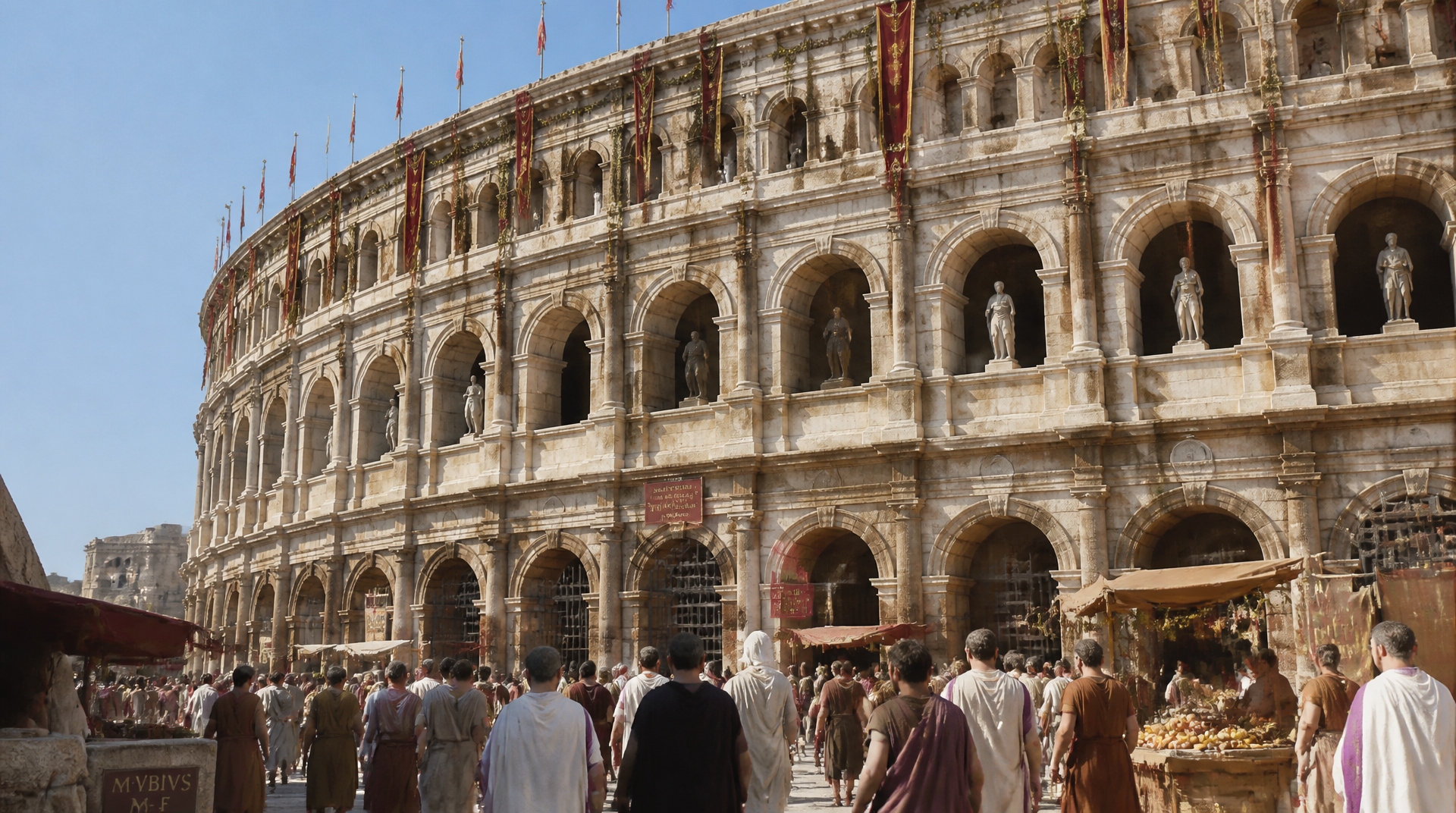
The amphitheatre at Tarraco was smaller than those at Rome or Lugdunum, but it was
nonetheless impressive. The crowd was already substantial on the morning of the games,
and Lucian's role was to begin before the main events—to soften the crowd with
words, to prepare them for what they had come to see.
He stepped to the center of the arena floor and waited for the crowd to settle. When silence came,
he began to speak—not with bombast, but with the measured cadence of a man revealing deep
truths.
"I invite you," he said, his voice carrying to the highest seats, "to imagine something
with me. Imagine a young tiger. Born in distant lands, in the forests of the East, where your
fathers have never ventured. It has a mother who loves it, and siblings who play with it.
It grows to be an adult, learning its world and how that world works.
It hunts, and kills, but it does so cleanly. It does not kill for sport, but for survival.
And it doesn't torture its prey. It kills quickly, and then it eats."
"And then—nets. Ropes. Cages. A journey across oceans to a place it cannot understand."
He paused, letting the image settle into their minds.
"This tiger does not know why it has been brought here. It does not comprehend the glory of Rome,
the majesty of Augustus, the civilized virtues that we gather to celebrate. It knows only terror. And
hunger. And when it is released into this arena, it does what a tiger has always done: it hunts.
It kills. It struggles for survival."
Lucian began to walk the arena floor, his gestures precise and eloquent.
"And we, in our wisdom, in our supreme understanding of order and civilization, we applaud this.
We celebrate it. Because the tiger cannot comprehend that it dies not for itself, but for us.
For our pleasure. For the glory of Rome!" Lucian grinned in mock enthusiasm, his voice
cheerful, the sarcasm beneath barely masked. "What a magnificent thing—to bring a creature across
the world, to strip it of all that it knows, to place it in a space where death is certain,
for our entertainment." He shook his head in mock wonder. "What a perfect
expression of our supremacy, that we can command even death itself to serve our amusement!"
The crowd stirred, most in agreement. But a loud, female guffaw broke through the murmurs.
Heads turned. She caught herself immediately, covering the sound with a cough, but Lucian heard it.
At least someone understands! he thought, and continued.
"And when the tiger falls—when its strength finally fails, when the spears find their mark—we
do not mourn. We do not question why a creature that has not harmed us, that threatens nothing but our
own desire for dominance, must die to prove that we are great. We simply enjoy the spectacle. We
simply accept that this is what civilization demands. This is the price of our order."
Lucian's voice shifted then, becoming almost tender, almost mournful.
"Perhaps the tiger understands something we do not. Perhaps, in its final moment, as it lies bleeding
on this sand, it understands more about the true nature of Rome than any of us ever will."
He bowed then, and silence held for a long moment. Then the applause came—genuine, enthusiastic,
but with an odd quality to it. As if the crowd had been given permission to feel something complicated,
something they had not expected to feel at a venatio.
Some in the upper seats were nodding, as if Lucian had confirmed their deepest convictions about Roman
superiority. Others lower in the amphitheatre looked troubled, uncertain whether they had been praised
or indicted. And in the section reserved for the foreign merchants and visiting notables, the woman
who laughed sat very still, her dark eyes fixed on Lucian, biting her lip, fighting to keep her
composure.
He had done it. He had mocked an entire amphitheatre full of people, and the crowd had loved him for it.
But there was at least one person in that crowd who had understood what he was really saying. And as he took his
bow, he caught her gaze one final time. The slight nod she gave him was unmistakable.
He marched to the exit to the seating area, where Demetrios was waiting for him.
Demetrios was grinning from ear to ear. "I can't believe you got away with that!" he exclaimed.
"You are truly amazing!"
And then the barred gates opened, and the spectacles began.
The first events were not the main attraction. A few gladiators, matched for skill rather
than death. The crowd was restless, waiting. But it was the events with animals that made
Lucian realize, with each passing moment, that he could no longer pretend to understand
the purpose of what he was seeing.
They brought out panthers first. Then a rhinoceros, brought at enormous expense from Africa.
Condemned criminals were sent into the arena with them, armed only with spears. Some fought.
Some fled. All of them died. And they weren't quick deaths; the men writhed in agony, bleeding.
One man's head was trampled.
Lucian felt his last meal rising in his gut. He jumped up and ran to the nearest exit. Demetrios
ran after him. He barely made it to the grassy area beyond the amphitheatre before puking
his guts out. Demetrios stood there, watching him, concern painting his face. When there
was nothing left to vomit, Lucian wiped his mouth and looked up at Demetrios. "I'm sorry,"
he said. "I guess that was appealing."
Demetrios shook his head. "Not to worry, dear friend. I guess it's hard to keep room for
food with such a big heart."
The outside of the amphitheatre was deserted, with everyone still inside. But then he saw her—the
woman from the audience, the one who had laughed. She was standing at the exit, looking around.
When she spotted Lucian, she approached.
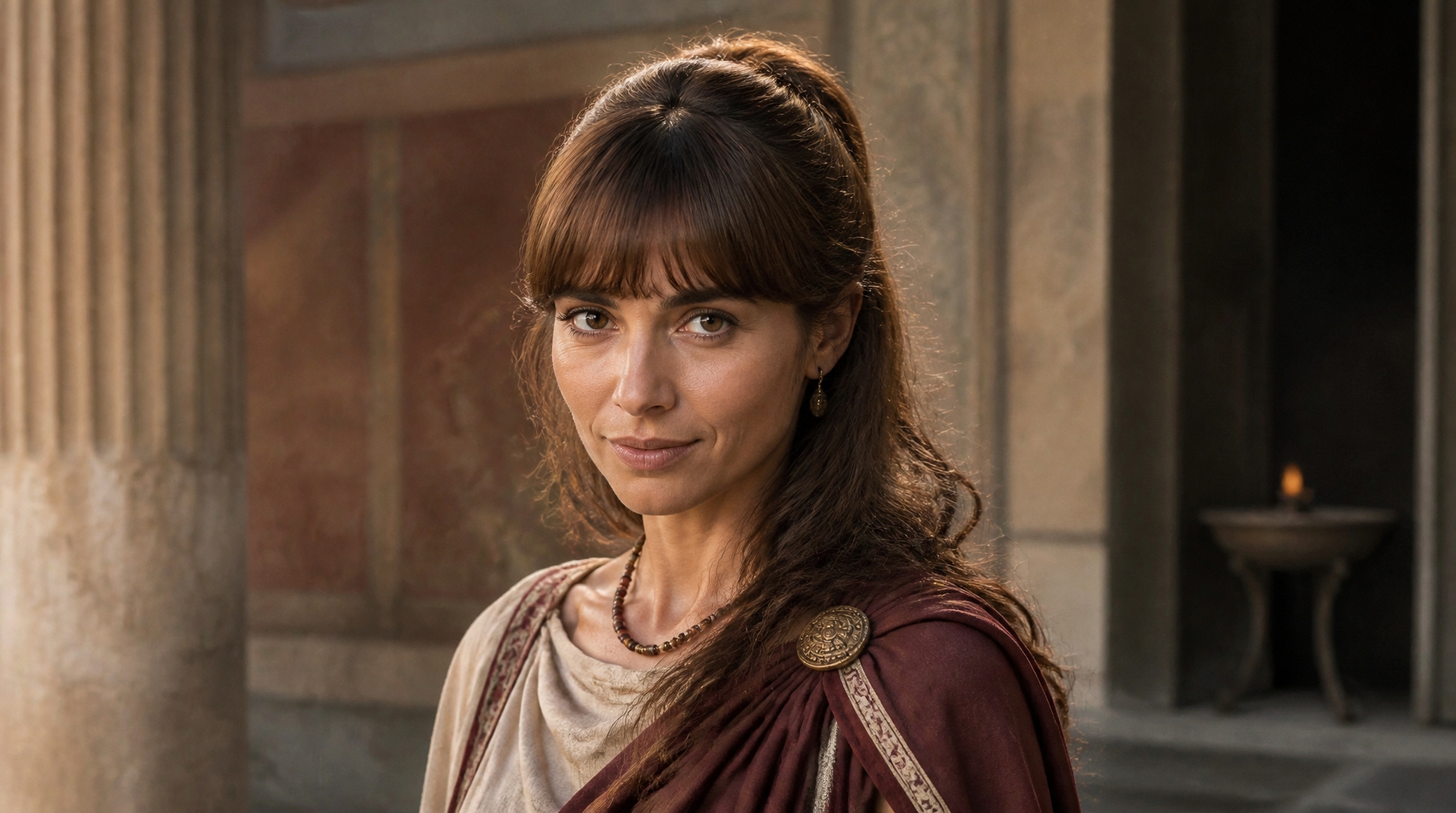
Up close, he could see her more clearly: she was mountain-born,
unmistakably. Her hair was a deep reddish-brown, pulled back from a face with sharp, angular features
and a prominent nose. Her skin was fair, weathered from sun and wind, her eyes brown with a greenish tinge.
She wore practical traveling clothes that wouldn't have drawn a second glance in any Roman city—a
simple tunic, a light cloak, the kind of thing a merchant or soldier's companion might wear. But there
was something in the way she carried herself that suggested she might be far more than she appeared.
At her side was a sword, and she wore it the way a scout wears a tool.
The Meeting
"That was a dangerous speech," she said, without preamble. Her accent was distinct, rolling the
consonants in a way that marked her as someone for whom Latin was not a native language. "Most people
will applaud without understanding. But you knew that. You were counting on it."
Lucian studied her. "And you understood?"
"Yes," she said simply. "I am Mari. I am Vascon. I came to Tarraco looking for someone like you."
"Looking for a blasphemer?" Lucian asked, with a slight smile.
"Looking for someone who speaks truth wrapped in a way that Romans can hear," Mari
said. "My people—the Vascones—we have a problem." She lowered her voice.
"We have no more love for Rome than I suspect you do. But we are not warriors.
We are not soldiers. We are farmers, shepherds, hunters. We have no army, no navy, no fortifications.
We have nothing to fight with against the Romans. And yet, Rome is coming. They will come for
our land, our resources, our people. They will come to take what they want, and we will
have no choice but to give it to them."
"I agree, that sounds like a serious problem," Lucian said. "But what can I do about it?
I'm just a speaker. I can give speeches, but I can't fight. I don't have any influence with the
Roman authorities." He chuckled ruefully. "I wish I did!"
Mari shook her head. "We don't expect you, or anyone, to fight for us. But I believe
you possess something that neither the Vascones nor the Romans have: A unique perspective.
A man who can see things from the point of view of a tiger, may be able to see things
from the point of view of a Roman, and yet not be a Roman. I have, well, a feeling
that you will be able to help us see what we must do. Not tell us, but help us see it for
ourselves."
Lucian laughed gently. "I think you give me more credit than I deserve. But in any case,
I have to work for a living. Speaking at these things," and he gestured back toward the amphitheatre
with distaste, "is how I make my living. I can't really afford to go on missions of mercy,
especially to places that require long journeys."
She reached into a leather pouch at her side and withdrew some coins. "I have gold," she said.
Demetrios stepped forward. "We'll do it!" he accepted.
"This is payment. Half now, half when you have given your speech to my people. The journey is three
days into the mountains. But we must leave immediately."
Lucian thought of the speech he had just given. The applause. The complicity of the crowd. The rightness
that came from shaping people's minds with words.
Perhaps a mountain village would be different. Perhaps their needs would be simpler, more honest.
"Very well," he said. "I accept. But we will need time to gather what we need for the journey."
"We leave at sunrise," Mari said. "Be ready." She turned to go, then paused. "And bring
warm clothes. The mountains will be cold, even in this season."
Then she walked away, disappearing back into the crowds near the amphitheatre, leaving Lucian and
Demetrios standing in the grassy area with a handful of gold coins and the weight of a decision that
suddenly seemed far more important than it had moments before.
Preparations
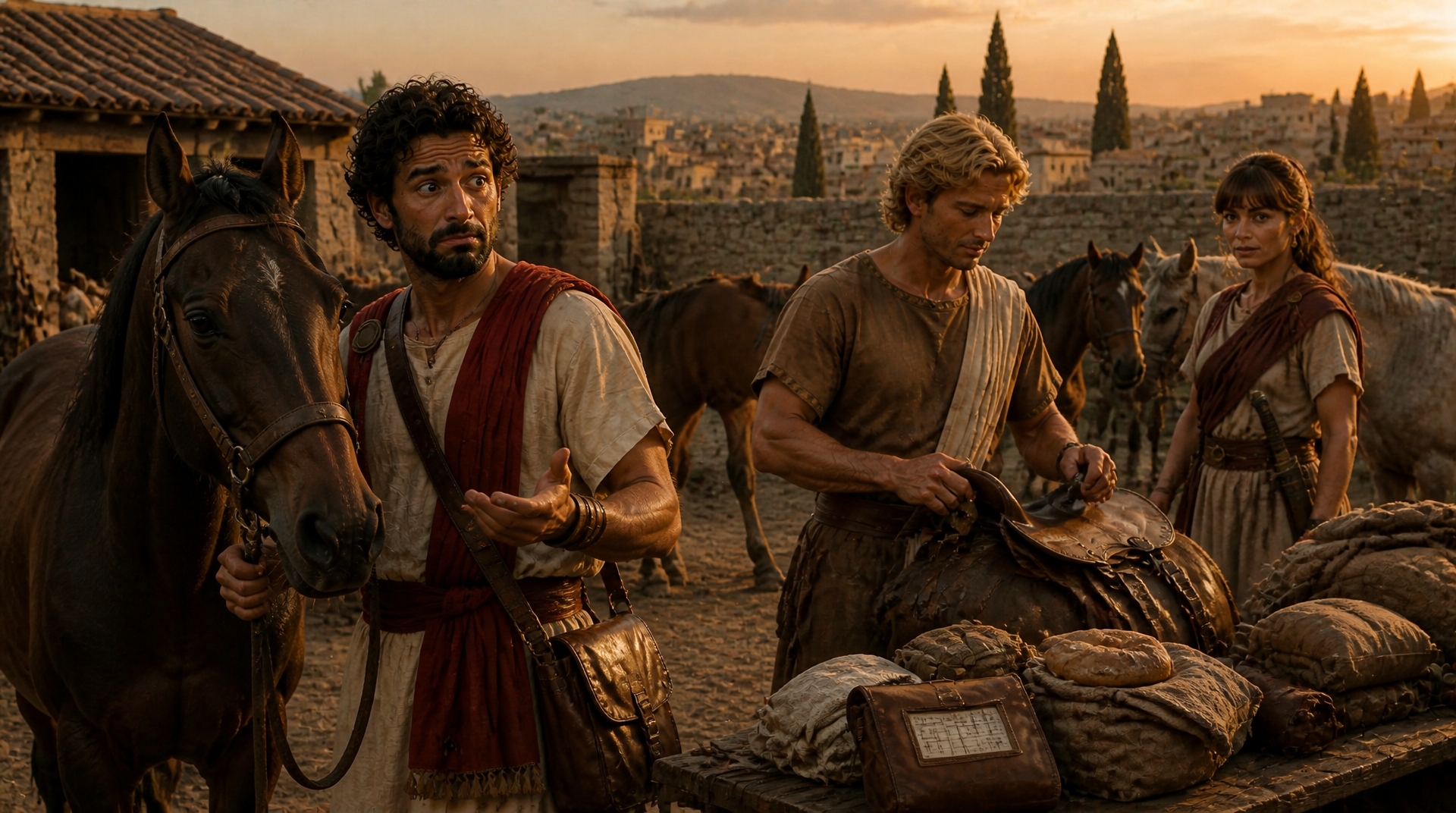
The sun was just rising as they stood in the yard of a stable on the outskirts of Tarraco. Demetrios had been
practical about Mari's offer from the start, exchanging her gold for supplies while Mari selected horses
with the efficiency of someone accustomed to mountain journeys. "Three days to the mountains," he'd
said during their walk from the amphitheatre. "Gold in hand. Whatever this woman's people want, you're
skilled enough to provide it."
"You have ridden before?" she asked, addressing both of them but looking at neither.
"I rode as a boy," Demetrios said carefully. "In Athens. Not recently."
"Not at all," Lucian admitted. "I've traveled by ship, by litter, by foot. But not on
horseback."
Mari grunted. She selected a steady mare for Lucian, something with a calm temperament.
"You'll learn," she said. "The mountains require it. And you will hurt tomorrow.
Everywhere. But the pain will fade by the third day, if you don't think too much about it."
From a leather bag slung across her shoulder, she produced a list written on wax. The supplies
were already arranged: two servants of the stable were loading dried meat, hard cheese, bread,
waterskins, and blankets onto pack animals. Mari moved through the preparations with ease,
checking each item, adjusting the balance of the loads.
"What about weapons?" Demetrios asked quietly.
Mari paused. "I see you have swords. Do you know how to use them?"
Demetrios responded, "I'm no swordsman, but I know which end cuts."
Mari said. "I hope we won't need them. But there are those who travel the roads
to Hispania who will not hesitate to kill for the gold we carry, the clothes we wear, or simply
because they think we look Roman."
She turned to Lucian then. "You know how to handle a blade?"
"No," Lucian said. "I've never had reason to. I'm good with a chisel,"
he added helpfully.
"Then you will stay in the middle of our group," Mari said matter-of-factly. "And you will
not wander. And you will ride when I say to ride, and dismount when I say to dismount. Your safety
depends on following my commands without question. Can you do that?"
"Yes," Lucian said.
"Good," Mari said. "Then we will survive this journey."
By noon, they were ready to depart. The horses stood saddled and patient, loaded with supplies chosen
for necessity rather than comfort. The city of Tarraco lay behind them, fading into the cloud of dust
left behind by their horses' hooves as they moved down the dusty
road that led inland toward the mountains. Lucian looked back once at the port city, at the
amphitheatre still visible on the hillside, and thought of the speech he had given—the
speech that had drawn a warrior woman from the mountains to find him.
Every day, Lucian thought, a new adventure!