|
By: Paul S. Cilwa |
Posted: 5/23/2026 |
|
Page Views: 92 |
| Hashtags: #HistoricalFiction #LucianOfSamosata #Mariana #Sisapo #Hispania |
| Demetrios is arrested for the murder of the Overseer of Mines. |
| Estimated reading time: 12 minute(s) (2724 words) |
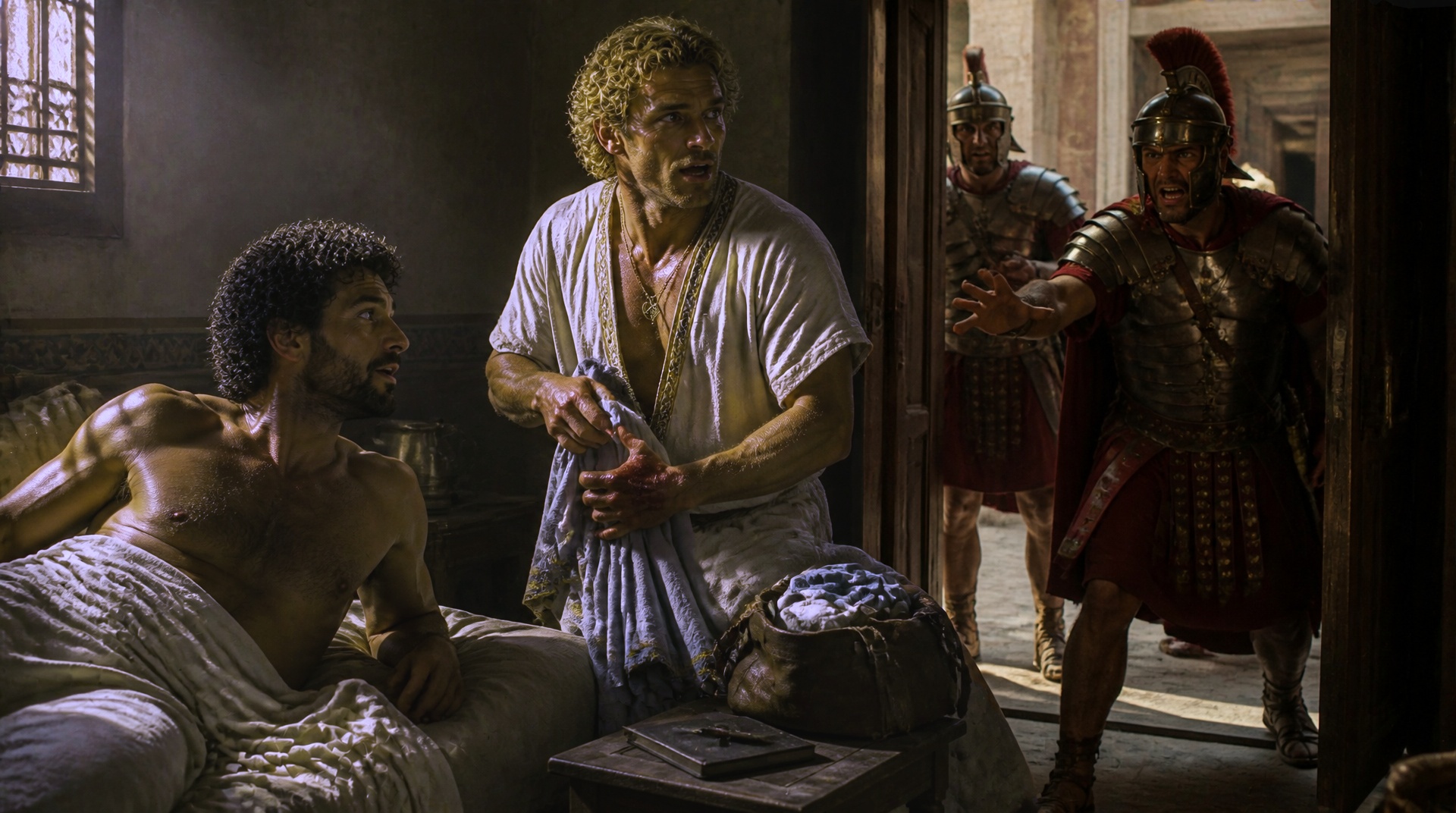
Lucian was just dozing off when he was startled awake by a scream in the night.
Moments later, Demetrios burst through the door of their bedchamber
as if the door had wronged him personally. He crossed the room in three long strides,
and began stuffing his second tunic into a satchel.
"Get up. Pack," he said. "We are leaving. Now!"
Lucian tried to blink away sleep. "What's wrong?"
Demetrios was shaking, furious in the way he was when something
had struck him as truly wrong. The knuckles of his right hand were split,
and a bead of blood had dried at the base of the smallest finger.
"What happened, Demetrios?" Lucian's eyes narrowed.
"What did that man do to you?"
"What every man like that does. He offered me a position. When I declined, he grabbed me.
When I asked him to remove his hand, he reached with the other. When I asked him to remove that
one too, with rather more emphasis, he took offense. So I broke his piggy little nose.
I only wish he'd had two noses so I could have broken the other one, too."
"Oh my gods."
"I do not propose to spend another minute in this house, and I do not propose to find out
what a Roman procurator of mines can arrange for a Greek who has hit him. Sandals. Cloak. Your
satchel. We will take the south road and we will not stop until we are out of the district. Move,
Lucian, I am not kidding."
He stopped.
Another scream, this one thinner, higher pitched. A woman's voice answered it. A man's
voice answered the woman, sharper. The household, which had been quiet a minute before, was
abruptly not quiet at all.
Demetrios's face changed.
"That," Lucian said worriedly, "was not for a broken nose.
Perhaps we'd best be off like a toga at Aphrodite's Temple."
In a moment he was up, sandals on; satchel at hand.
They nearly finished packing when the banging on the outer door of the house began, and the banging on the
outer door was not the polite knocking of a household slave.
The voice of the steward, raised: "—at this hour, the master is not—"
A second voice over his: "Stand aside, freedman, and direct us to the Greek."
Demetrios had gone very still. He looked at Lucian. Lucian looked back. Neither of them moved.
Boots in the corridor.
A square-shouldered Italian centurion came through the bedchamber door with two soldiers behind him.
He had the look of a man pulled from his sleep and not happy about it. His eyes
went straight to Demetrios's right hand.
"The Overseer of Mines is dead. You will come with us."
Demetrios said it flat: "Dead. I left him alive."
"You left him alive a quarter of an hour ago. The slave who served his wine has just found his
body. The slave saw you leaving the chamber bruised at the knuckles and red in the face. We have
your knuckles. We have a broken nose on the dead man's face. We have a witness who will swear no
one else entered the chamber in the time between. The case is plain enough for a soldier. The
magistrate will hear the rest of it tomorrow."
Lucian rose. "Centurion. He hit him once. He has been in this room with me since he—"
"He has been in this room with you for less time than it takes to die of a broken skull. Bind
him."
The soldiers bound him. Demetrios did not resist. He looked once at Lucian as they took him out,
and the look was the look men get when they suddenly realize that everything they knew, was wrong.
The boots went down the corridor. The outer door opened, and closed.
Lucian stood in the bedchamber alone. The wax tablet was where he had set it. The lamp had not
even guttered.
He picked up Demetrios's satchel from where it had fallen, folded the second tunic back into the
chest, and went out into the colonnade.
The household was coming quietly awake around him now. Doors opening. Whispers. A woman, somewhere,
beginning to weep—or to perform the weeping that custom required. He stood for a long time
and listened. Then he began to think.
The Deputy
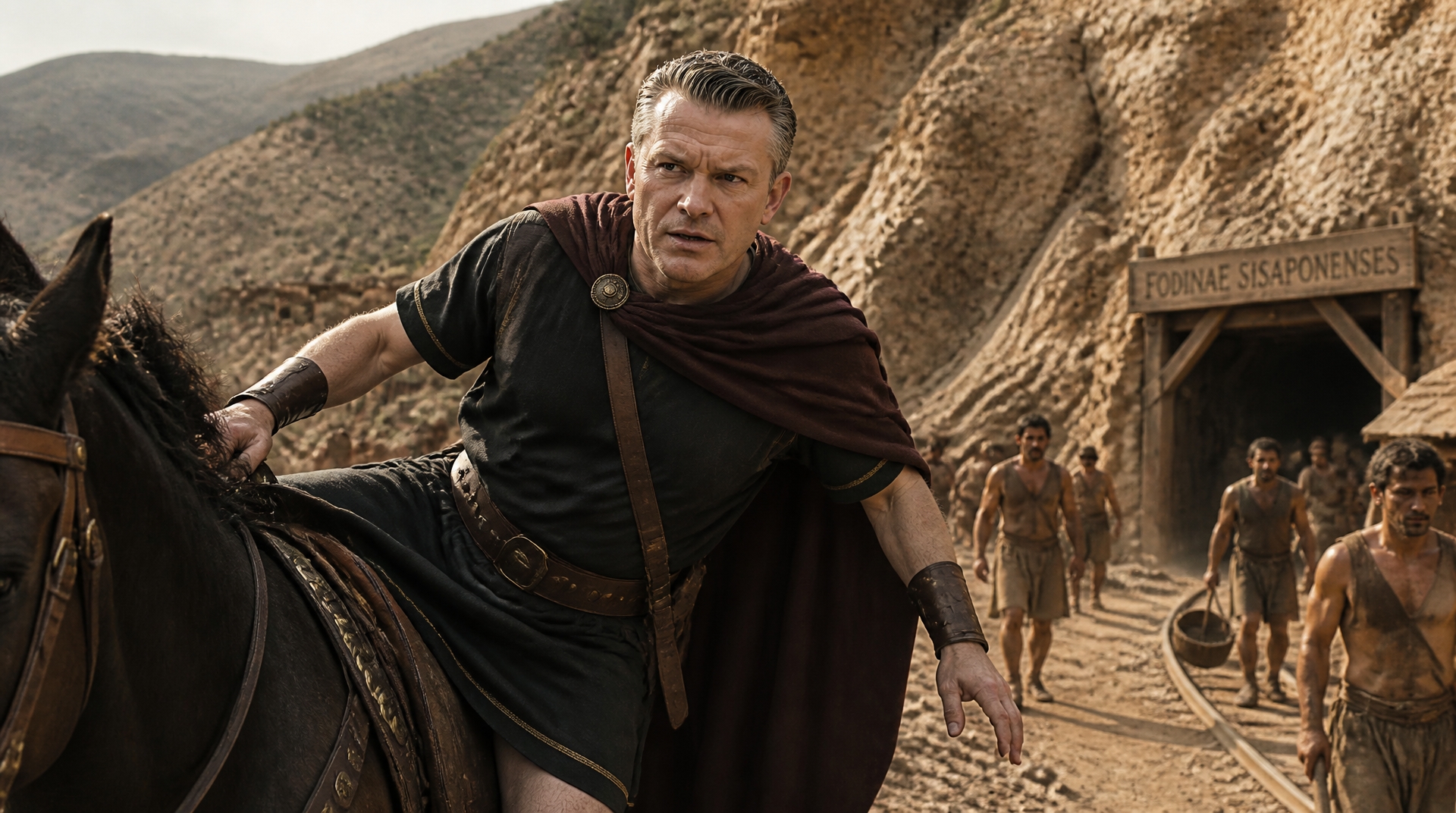
A horse arrived in the atrium an hour after sunrise, on the heels of its rider. It was foaming. So
was its rider.
He was perhaps forty-five, lean as a wire, with the burned face of a man who spent the better part
of his life out of doors. His tunic bore the cinnabar dust of the pits and the sweat of a hard
ride. He had not stopped to wash.
Onesimus murmured at Lucian's elbow, very low: "Lucius
Vibius Sabinus. Master's deputy at the pits. Freedman of the
same gens. He has run the mines in everything but name for nine years."
The deputy did not see Lucian. He saw the centurion.
"The Greek," he said. "Where is the Greek?"
"In the cells. The magistrate is sending for the prosecutor."
"The magistrate." The deputy laughed, once, short. "The magistrate? An imperial procurator
has been murdered by a foreign hireling, and you are sending for the magistrate?!"
"It is the law."
"The law is what Rome says the law is. Rome is three hundred miles away. I am here. The mines are
here. Tomorrow morning the gangs will go down into those pits, and they will know, every one of
them, that the man who held them in their place is dead, and they will know whether his killer is
dead also. If he is not, I cannot answer for what happens at the pit head. Cinnabar runs slowly
when no one is afraid. Do you understand me, Centurion?"
The centurion understood. The centurion, Lucian saw, would have done it. The centurion was a soldier;
he preferred his cases simple and quick.
"The magistrate," said another voice, "will hear the prosecutor and the defense, and the
magistrate will pronounce sentence, and the prosecutor will then carry it out. That is how it is
done in this province. It is how it was done under your patron,
Sabinus, and how it will be done now."
Lucian turned.
The speaker was perhaps fifty-five, in the white toga with a narrow purple stripe that marked the
equestrian magistrate. He had the lined face and slightly stooped shoulders of a man who read too
many petitions by too few lamps. His eyes were brown and very steady. He had come in through the
side door without ceremony.
"Tiberius Aelius Priscus," he said to Lucian, with the small
inclination of one professional to another. "I am the Judicial Magistrate for Mariana
and the surrounding district. I have heard you are a rhetor."
"I am."
"Then you will know what is coming, and you will save us both some time."
"I will defend him."
"I expected nothing else. The accuser will be Quintus Porcius Carbo
of Corduba. The household have sent for him at the deputy's insistence. He will be here by sundown.
The trial will sit tomorrow at the second hour."
"Tomorrow."
The magistrate's eyes flicked briefly to Sabinus. "The town
is restive. The mine is restive. The accused is a foreigner in a household full of grieving Romans.
If I sit longer than tomorrow I will be sitting on a riot. But the
procedure will be followed quickly. Use your day, rhetor. You will not have a second one.
The procedure will be followed."
He turned to Sabinus.
"And you will not interfere."
The deputy did not answer. He inclined his head perhaps half a degree, which was not assent, and
walked from the atrium without looking back.
The magistrate watched him go.
"The deputy will hang the Greek by sundown if I give him an hour's opening," he said, quietly,
to Lucian. "I will not give him one. But I cannot give you a week, either. Be ready."
"I will be ready."
"Begin with the body."
By Lamplight
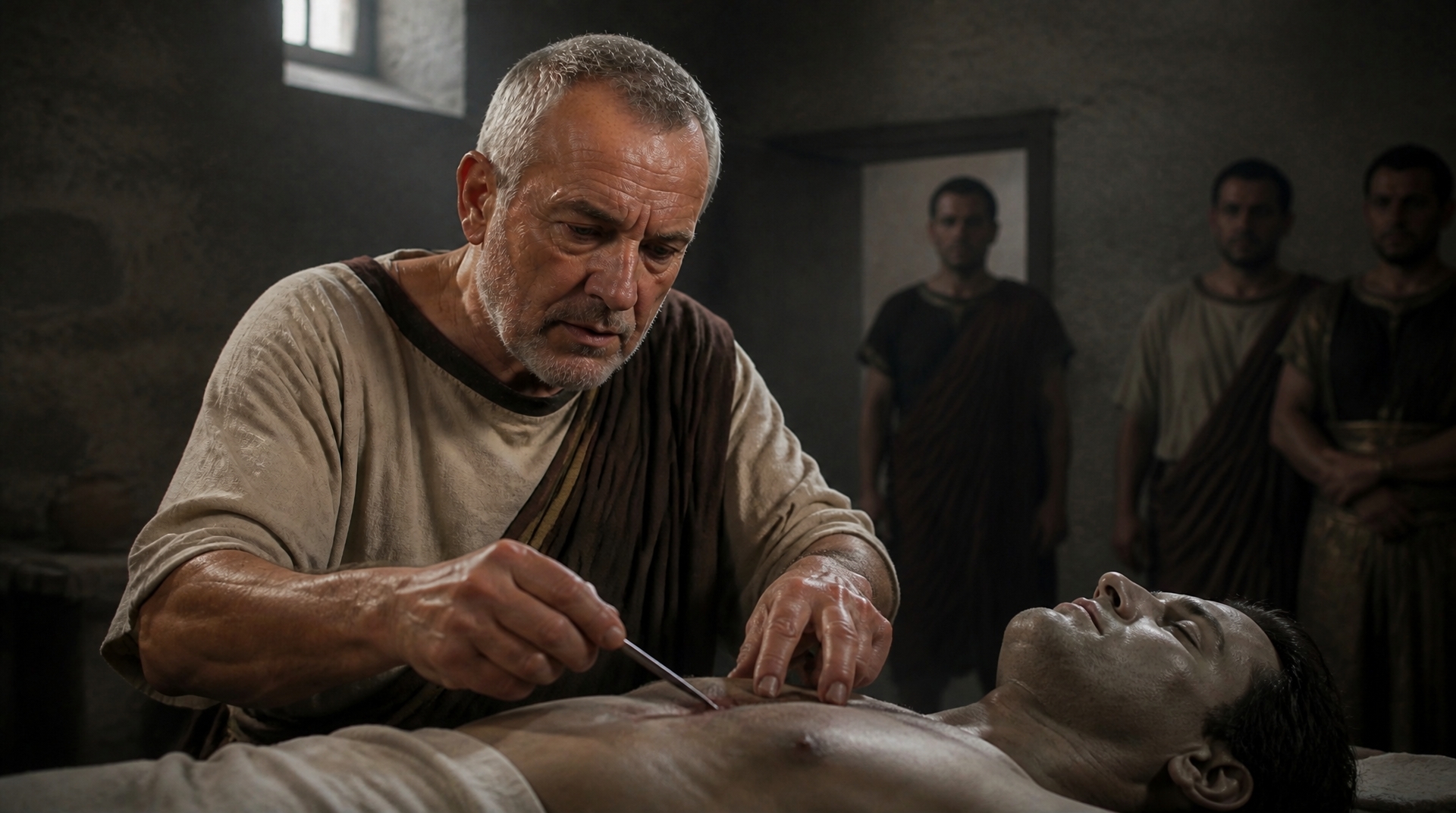
Hermogenes had laid the body out in the small room beside
the kitchen that served, in this household, as the place where the dead were prepared. The
Overseer's tunic had been cut away. The flesh was washed. The physician was working by the light
of three lamps in late morning because the room had no window.
"You came at the right hour," Hermogenes said when
Lucian entered. "Look here."
He turned the dead man's head, gently, to expose the left side. The hair above the ear was matted
dark.
"The nose," the physician said, "is broken. The bruise is consistent with a fist. A right
fist, by the angle, with the striker facing him. That is the blow your Greek dealt. It would not
have killed him. It would have hurt him, and it would have humiliated him, but he would have washed
his face and called for wine."
He moved Lucian's hand to the matted place above the ear.
"Feel that."
The skull gave, very slightly, beneath Lucian's fingers.
"That," said Hermogenes, "is what killed him. A
single blow with a heavy object. Smooth, rounded. Not an edge. The wound is on the left side; the
angle of the blow is descending, but only barely. The striker was the same height as the Overseer
or shorter. Demetrios is a hand taller. The arithmetic does not work."
"What kind of object?"
"Bronze, I should think. There is a small green discoloration at the rim of the wound; bronze
leaves it. Something with weight. Smooth on the striking face. A measuring weight, perhaps; the
household keeps several. A heavy lamp. Something of that order."
The chamber where the Overseer had died had been left untouched. A soldier stood at the door.
Lucian was admitted on the magistrate's authority.
The body was gone, but the floor remembered it. The blood on the marble had dried to the color of
rust, in the shape of a man who had lain there for some time. The wine cup was where it had been.
The scrolls were in their cubicles. The lamps had been extinguished. The shelves along the wall
held, in tidy rows, the equipment of a procurator of mines: tally tablets, lengths of cord, a
brass balance, and a row of bronze ore-weights of graduated size, from half an ounce up to a
pound.
He examined one shelf. The dust was even along the row. Cinnabar dust, the same red dust that hung over the whole town,
lay on every weight. —On every weight but one! The pound weight—the heaviest, a smooth bronze
cylinder the size of a clenched fist—sat in its place with no dust on it at all. It had been
wiped.
He lifted it. The base was clean. The rim, turned to the lamp, showed a single thread of dark matter
caught in the seam where the casting had been finished. He did not remove it. He set the weight
back exactly where he had found it, summoned the soldier, and instructed him that nothing in the
room was to be moved, by anyone, on the magistrate's authority, until the trial sat the next
morning.
Then he went to the jail.
The Cell
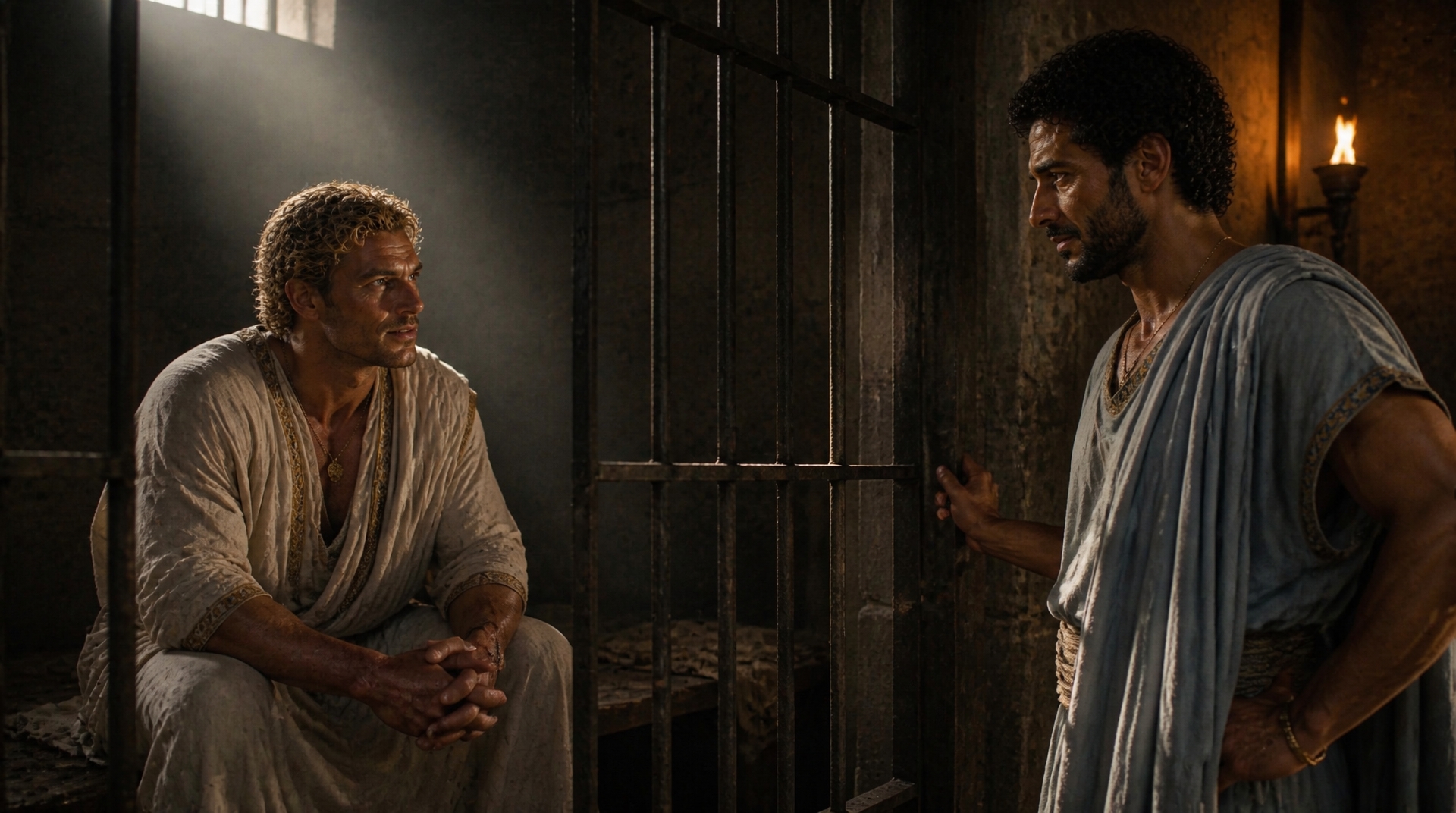
Demetrios stood when Lucian entered. The cords had left dark rings on his wrists that had not
yet faded. He looked less afraid than he had any right to look. That was Demetrios. The fear would
come at night, alone. In daylight he held himself like a man at a dinner he had not enjoyed.
"If they find me guilty," Demetrios said before Lucian had quite sat down, "I assume it is
crucifixion."
The question was not asked as a question. It was offered as a thing they would both be carrying
through the next day's work, and might as well put down on the table now.
"For striking a Roman procurator and being credited with his death? Yes."
"In private?"
"In public, my friend. They will want it seen. They will want it remembered. They will want the
gangs at the pit to walk past it on their way to the cinnabar."
Demetrios accepted this with the small motion of a man who had been told the price of a thing he
was always going to buy.
"Okay. So what next?"
Lucian sat beside him on the stone bench.
"You are in cognitio, not formula. You know the difference."
"In broad strokes. Refresh me on the parts that matter today."
"No formula constrains the magistrate. No jury. He hears the accuser, he hears the defense, he
examines the witnesses himself or permits them to be examined, and at the end he renders judgment
by his own authority. He has discretion he would not have in a civil case. He can dispense with
rules of evidence he might otherwise be bound by. Discretion will work for us or against us,
depending on the man."
"Will this one work for us?"
"This one is Tiberius Aelius Priscus. He is sixty if he is a
day. He is the kind of Roman who reads Greek in his cubiculum because he prefers it to Latin and
will not say so. He has, I think, no use for the deputy at the mines, and he has, I think, some
use for me. He will not bend the law, but he will not let the deputy bend it either. That is the
most we can hope for."
"Who is the accuser?"
"Quintus Porcius Carbo of Corduba. The household sent for
him at the deputy's insistence. He will be here by sundown."
"Is he good?"
"He is loud. Whether he is good we will see. Loud is enough, in most cases, to convict. The crowd
likes loud. Priscus does not, but
Priscus is one man."
"And me?"
"You will sit through it. You will not speak unless I or the magistrate tells you to. If
Carbo asks you a question, you answer it as briefly as you can.
Yes. No. I do not remember. Do not explain. Do not argue. Do not, under any circumstances, be
witty. He is hoping for witty. He will hang you with witty."
Demetrios almost smiled.
"I will be the dullest man in Hispania."
"Be duller than that. Now. The slave who found the body. She is fourteen."
The color went from Demetrios's face. "And under the rule, her word is no word
at all without quaestio. I can't believe they would torture a child for this."
"They will not. Priscus has discretion under
cognitio; he can dispense with the requirement when the slave's testimony is offered for
examination by both parties without dispute. I will so offer. Carbo
will object, because Carbo will object to anything, but
Priscus will rule. He will rule because if he does not, he will
spend the next twenty years being known as the magistrate who tortured a child in front of a Greek
philosopher."
"That is… an unusual lever."
"I'll take it."
Demetrios laughed, then, for the first time that day, and in the laugh was the friend Lucian had
walked with for a thousand miles.
"One more thing," Lucian said. "Hermogenes has
examined the body. It was not your punch that killed
Crispinus. It was a second blow, with a
bronze object, struck by someone no taller than the Overseer and probably shorter. I have found the
object. I have not removed it. It is on the shelf where it belongs, with no dust on it, while
every other weight on that shelf wears the cinnabar of the town. Someone wiped it clean,
presumably to get the blood off of it."
"Who?"
The cell door, which the jailer had closed but not bolted. He lowered his voice.
"I have suspicions. I need a little more information that I hope to get by tomorrow."
Demetrios studied him a long time. "You are sure of yourself."
"I am sure of what I do not yet know. That is the most a rhetor is ever sure of, on the eve of a
trial. It is enough."
The jailer's footsteps came in the passage.
"Be the dullest man in Hispania," Lucian said again, rising. "Let me do the rest."
Lucian wished he was as confident as he appeared.