|
By: Paul S. Cilwa |
Posted: 5/27/2026 |
|
Page Views: 82 |
| Hashtags: #HistoricalFiction #LucianOfSamosata #Gades #Hispania #Spain |
| Lucian trades tall tales with a tavern full of sailors. |
| Estimated reading time: 17 minute(s) (3989 words) |
Demetrios, who knew when a man needed quiet, gave him quiet. He sat beside him under the small
leather awning, occasionally producing food (bread, dried figs, a piece of hard cheese) and
pointing at something on the bank: an egret, a tile-kiln with smoke pouring from its
chimney, a man washing a mule. Lucian would look and nod and then return to
watching the water.
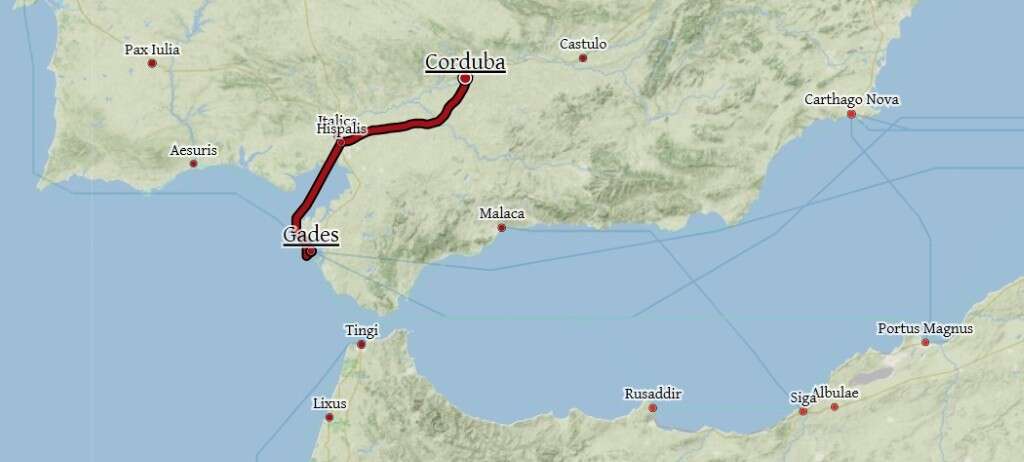
The Baetis was navigable, the bargeman told them, all the way from Corduba to the sea, though only
barges of this shallow draft could manage the upper reaches. Below Hispalis the river broadened
into something almost like a sea itself, a wide brown estuary lined with marsh, where the tides
came up twice a day and met the river's downward push, and where a ship could ride either way
depending on the hour. Their barge would take them to Hispalis. From Hispalis they would change to
a coaster.
Hispalis to Gadir
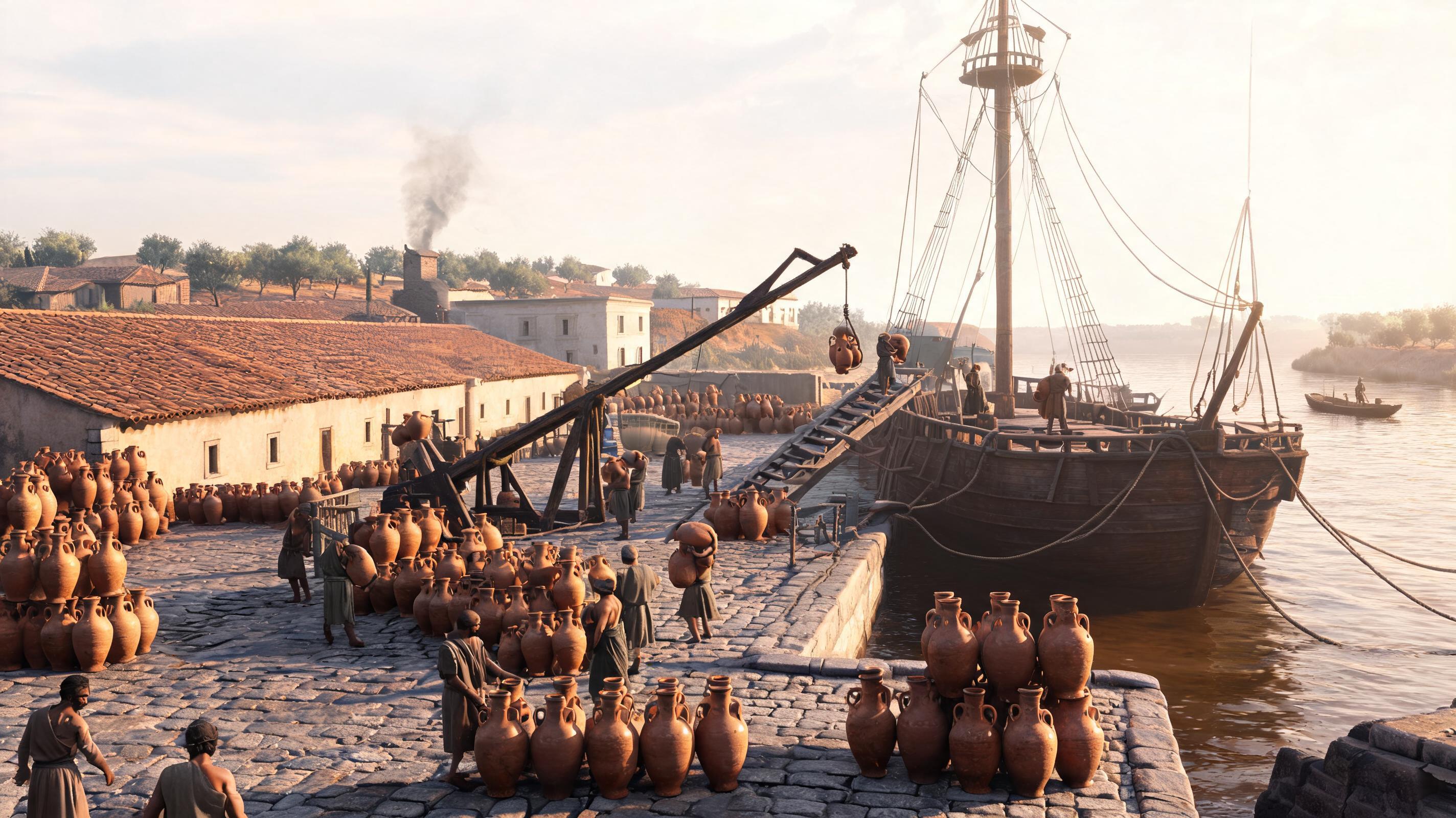
Hispalis was a working city. It did not perform for its visitors. It loaded ships and unloaded
them, it processed the olive oil of half Baetica into the long, fat amphorae that would feed Rome,
and it had no patience for travelers who wished to be impressed by it. They were in Hispalis less
than a day. Demetrios found them a place on a coaster bound for Gades the next morning, and that
was as much of Hispalis as they saw.
The coaster carried them out of the estuary and along the low Baetican coast, past the salt-pans
glittering in the winter sun, past the fishing villages where men hauled nets full of tuna twice
the length of a man. By the afternoon of the second day the captain pointed ahead.
"Gadir," he said. He used the Phoenician name without thinking, the way the men of this coast
always had.
Lucian roused himself. He had been promising himself, for the better part of a month now, that when
Gades appeared he would feel something. He looked.
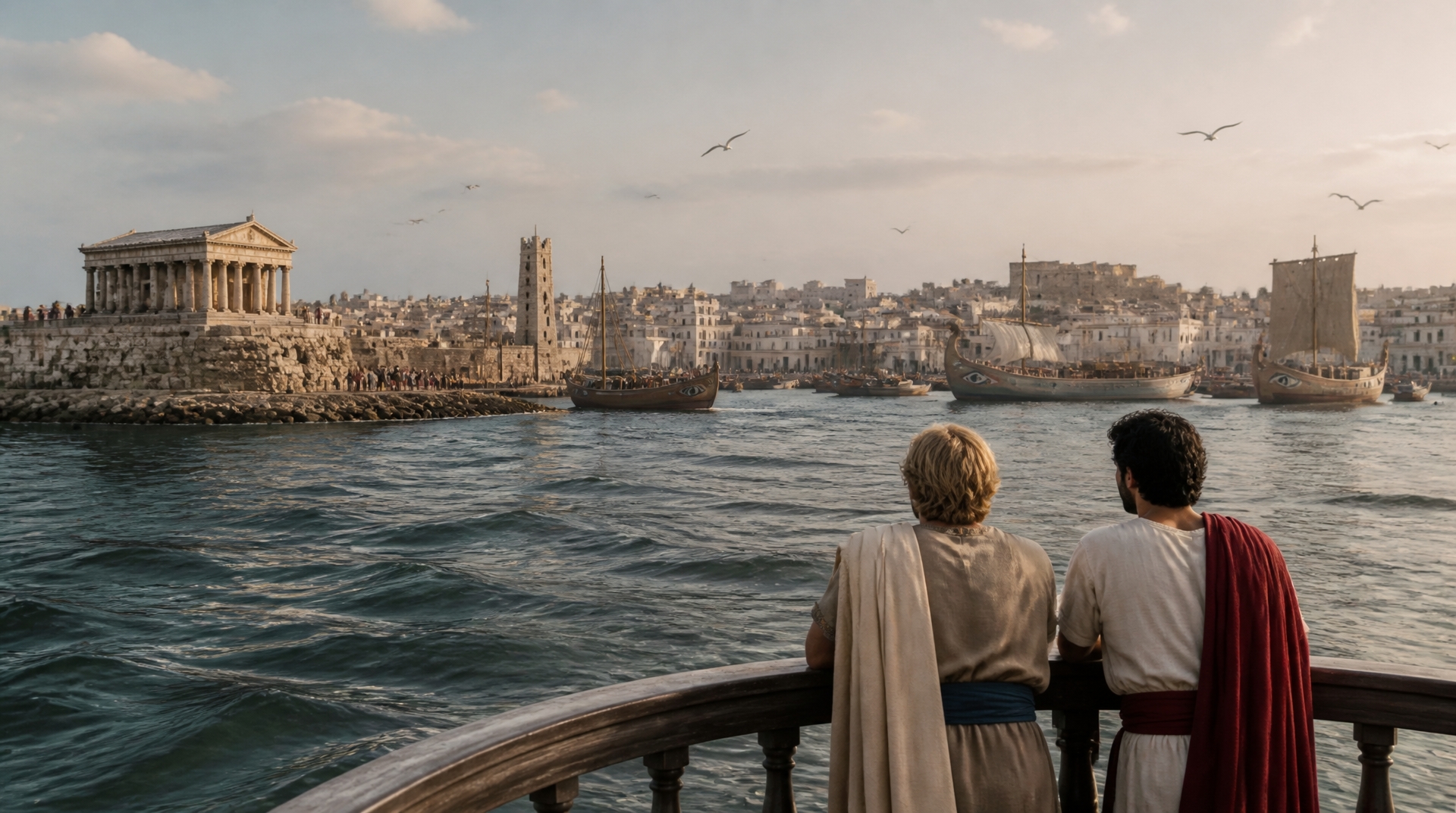
What he saw was a low island lying long against the water like the back of a sleeping animal, with
a city upon it, and at the city's southern tip a smaller island still, joined to the main by a
causeway, on which stood a temple that even from a distance could be seen to be very old. The walls
of the city were not Roman. They had been built before Rome was a village. The harbor was full of
ships of every nation that touched the western sea—Gaulish, Mauretanian, Punic-rigged vessels from
Carthage and her daughters, the great round-bellied Roman grain ships, and out beyond them at
anchor, two ships of a build Lucian did not recognize, with prows curved like the necks of swans
and sides painted with eyes.
"Tin ships," the captain said, following his look. "From the Cassiterides. Up beyond Gaul,
in the Outer Sea. They come once a year, sell their tin, drink themselves blind, and sail home."
So this was the edge of the world. Or the edge of this world. Beyond it, everyone knew,
lay only the Outer Sea, in which there were islands men spoke of and more they did not, and
beyond the islands, nothing—or everything, depending on which sailor you asked, and how much wine
he had swallowed before you asked him.
Gadir of the Phoenicians
Gades was old. That was the thing one had to understand about Gades, and it was the thing the
Gaditani themselves would tell you within five minutes of meeting them. The Phoenicians of Tyre had
founded the city perhaps eleven hundred years before Lucian set foot in it—before Rome, before
Athens in any form Plato would recognize, before Homer was born—and the city had been continuously
inhabited ever since. The Carthaginians had ruled it. Then the Romans had taken it. But the bones
of the place were Phoenician, the harbor was Phoenician, the gods at the temple were Phoenician
under their Roman names, and the men who fished the tunny in the strait still sang in Punic when no
one of authority was listening.
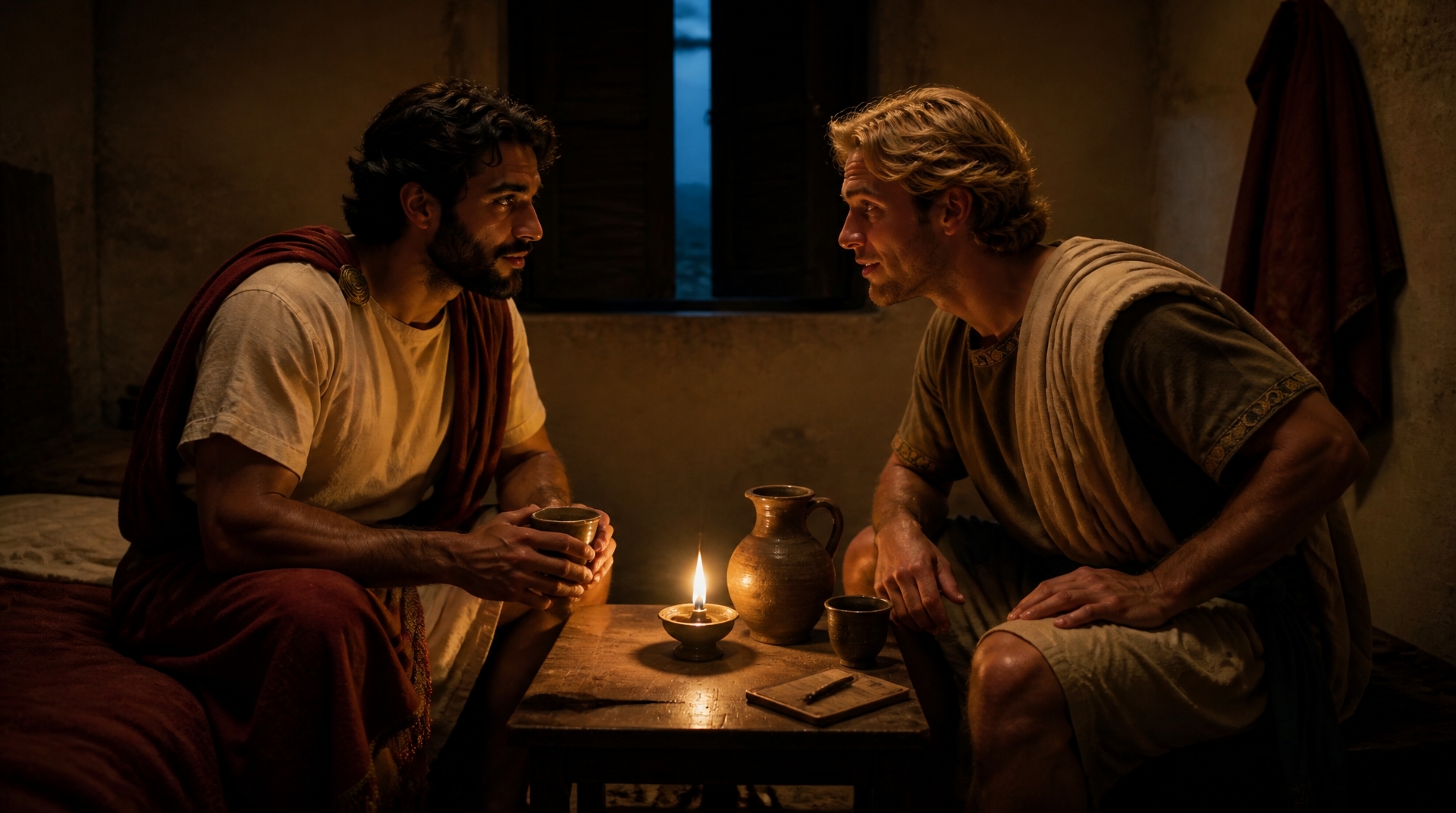
Lucian and Demetrios took rooms at a Greek-run inn near the forum. There was a small Greek quarter,
as there was in every port of the western sea; and the men spent the next two days simply walking. Lucian
walked because Demetrios had insisted, gently, that walking was better than sitting in a dimly-lit room.
Demetrios walked because that was the only way to get Lucian walking. They went to the harbor in the morning and watched the
boats come in. They went to the forum at midday and watched the magistrates conduct the small
business of an imperial city at the imperial periphery. They went to the bathhouse in the afternoon
and let the heated water work its magic.
And on the third morning they went, as one had to, to the Temple of Melqart.
The Temple of Melqart
It stood, as Lucian had seen from the boat, on a smaller island at the southern tip of the larger,
joined by a causeway that the sea covered at high tide and uncovered at low. They went at low tide.
The temple itself was not large—smaller than the great temples at Ephesus or even Smyrna—but it
was old in a way that Lucian had never quite felt a building be old before. The Phoenicians had
built it. The Carthaginians had repaired it. The Romans had added a portico and renamed Heracles
"Hercules" (because it felt more comfortable rolling off a Latin tongue)
and otherwise left it alone, because in Gades you did not change the temple.
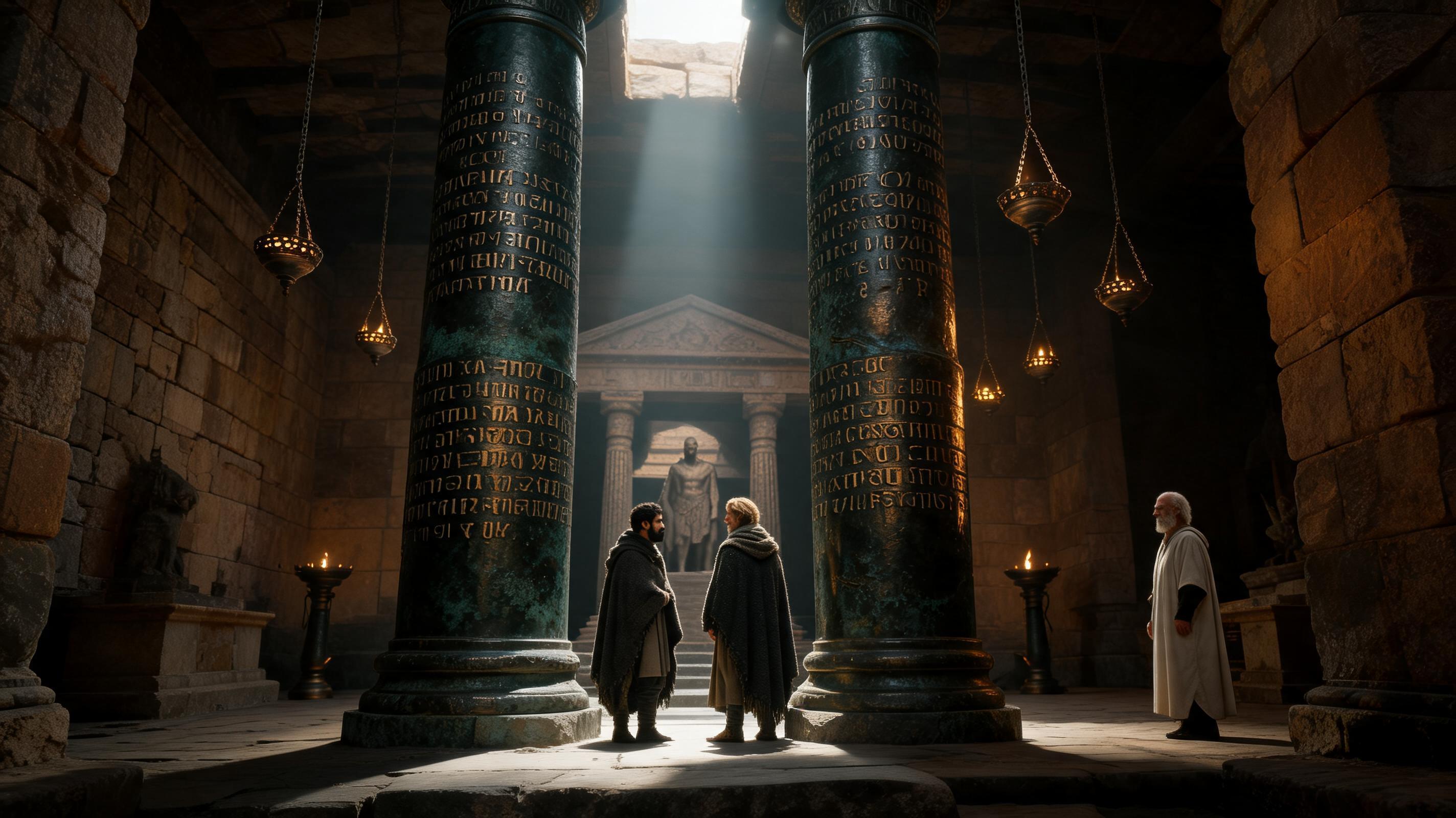
Inside, in the dim, there were the two bronze pillars. They stood perhaps eight feet high, smooth
and dark with the patina of a thousand years of being touched by pilgrims, and they bore an
inscription in Phoenician letters that the priest who guided them said no living man could now read
with certainty. Tradition held that they recorded the cost of the temple's construction. Tradition
also held, depending on whom you asked, that Solomon of the Jews had copied his temple's pillars
from these, or these from his—the Phoenicians and the Jews having been thick as thieves in those
centuries, and Hiram of Tyre having provided the craftsmen for both projects.
Hannibal had sacrificed in this temple before crossing into Italy. Caesar had come here as a young
quaestor and, the priest said, had wept before the statue of Alexander, because Alexander at his
age had already conquered half the world and Caesar had not yet conquered so much as his acne. Lucian stood
between the two bronze pillars and thought about the pillars of Heracles, who had labored, and died, and ascended to
godhood. Melqart, the Phoenicians called him. The Romans called him
Hercules. His Twelve Labors changed in the telling, but the shape of the story did not: a man, a hard
life, a death, an apotheosis. People needed that story. They had needed it for as long as Gades had
stood, and Gades had stood for a thousand years.
Lucian came out of the temple into the winter sun and stood on the causeway and looked south. The
sea was open. Somewhere over the southern horizon was Africa. Somewhere east, along the African
shore, was the southern Pillar of Heracles. The northern one was at his back, the smooth limestone hump of Mons Calpe
rising out of the strait southeast of Gades. The pillars of the man-god, marking the edge of the inner sea.
He did not say anything. But Demetrios, watching him, saw the small change. Lucian's eyes had begun to
look outward again.
A Prescription for Grief
That evening, back at the inn, Demetrios poured them each a cup of wine, sat down across
from Lucian, and looked at him squarely.
"I am about to be unkind to you," he said. "I would like you to know in advance that I am
being unkind because I love you and not for any other reason."
Lucian raised an eyebrow. "That's an alarming preamble!"
"You've been carrying your grief for days now, and I haven't said anything, because it is
understandable. But you can't grieve forever, Lucian. Especially since you hadn't seen or heard
from your family in over a decade, and, in all these years, I never once heard you express
a wish to return to Samosata. You loved them, of course you did. The news was a blow.
Grant yourself the days you have
already given. But tonight," Demetrios said, "you need to get out, amongst merry people. It is
time to go tavern-hopping."
Lucian started to protest, and then closed his mouth, because Demetrios was, in his slightly
bullying way, right. He had been turning the same three thoughts over and over for a fortnight. The
thoughts had not lightened on examination. They had, if anything, gotten heavier.
"One tavern," Lucian said. "I will agree to one."
"One tavern is how it begins," Demetrios said cheerfully. "Three or four taverns is how it
ends. Drink your wine. Put on your better cloak. Larissa downstairs has told me where the sailors
drink, and where the sailors drink is where one hears the things that travelers like us came all
this way to hear."
Lucian drained his cup. He set it down. He looked at Demetrios for a moment, then said,
"I'll go on one condition. I want to climb the Pillar."
Demetrios paused with his own cup halfway to his lips. "The Pillar?! You mean
Heracles' Pillar? Why, for gods' sakes?"
"Mons Calpe. The rock. I have been seeing it in my mind since we left Lugdunum,
even though I'd never seen it before. Then today I
stood on the causeway at the temple and looked east, and when I saw it, I knew. I want to climb it."
"You still haven't given a reason. Climbing a mountain is hard work. So I've heard.
And there's nothing on the top but a small shrine to Heracles. No amphitheatre for you
to declaim in."
Lucian considered. "There's a view. And maybe
I would like, for one afternoon, to stand on a stone that Heracles is supposed
to have set there with his own hand, and look at the sea from a place the sea cannot reach."
Demetrios set his cup down. "You're the master, master. The summit of Heracles'
North Pillar will be ours. Tomorrow morning, we will climb it.
But tonight? We will drink!"
The Anchor
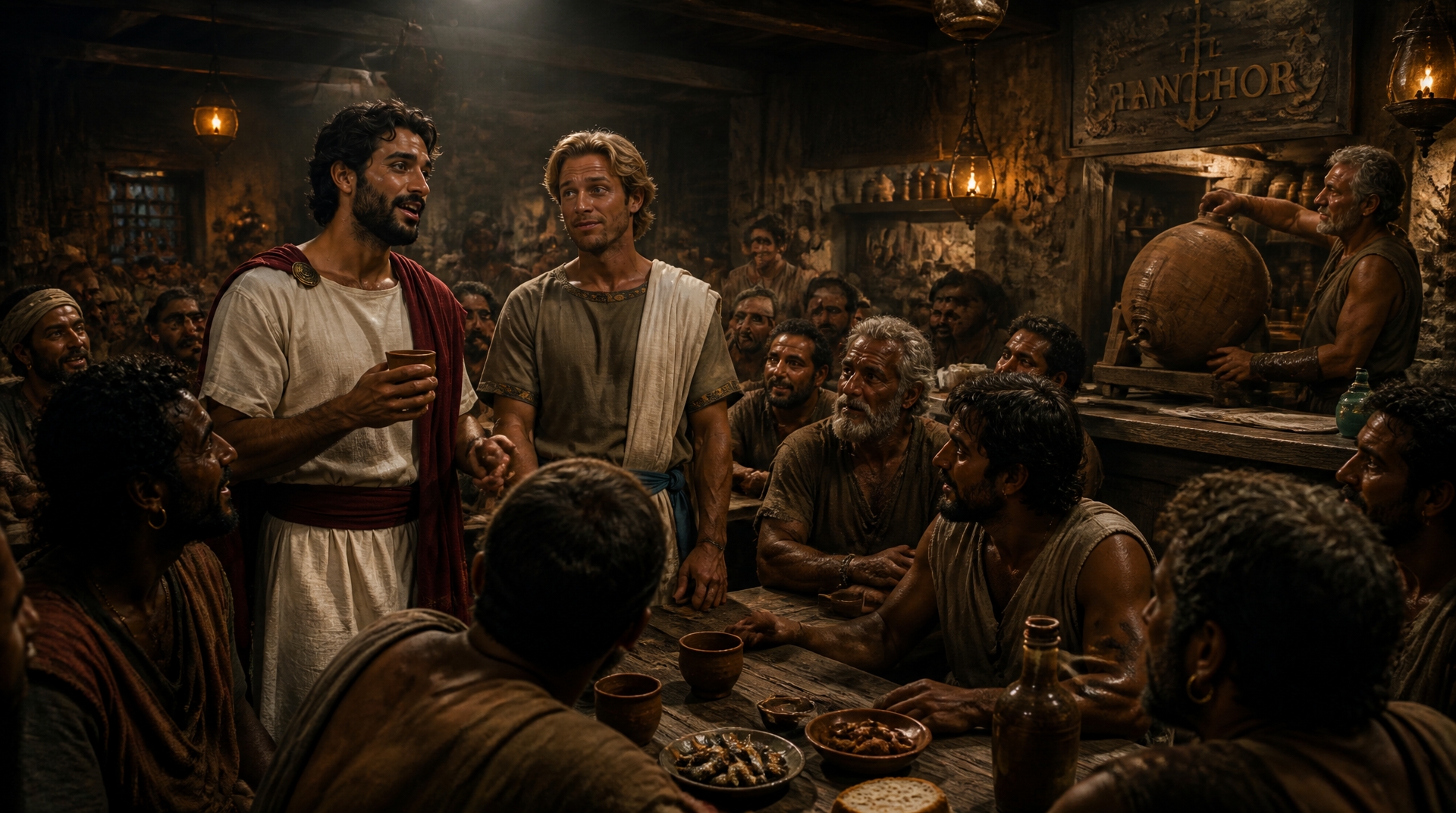
The tavern was called The Anchor, because there was a tavern in every port of the empire called The
Anchor, or some equivalent. This one stood two streets back from the
harbor, in a low building whose roof had been patched so many times the original tile was
not much more than an afterthought. The door was open despite the chill of the December evening, because the inside was so
full of smoke and bodies and breath that no door could have contained it.
They were noticed at once. Two well-dressed strangers, one of them clearly Greek and the other
a bit more exotic, walked into the regular drinking-place of the Gaditan tunny fleet and the
long-haul Atlantic captains, and the room paused for that brief, evaluating second a working room
always pauses for, and then resumed.
The proprietor, a one-armed Gaul who had once, Lucian assumed, made his living doing something
more dangerous than serving wine, set them up at the end of a long bench beside a tableful of
Mauretanian sailors. The wine was, as expected, terrible; but the bread was good. There were small
fried fish in a clay dish, and a jar of the local garum so pungent that Lucian, who had grown to
appreciate at least milder varieties of garum on his travels, dipped a single piece of bread and
decided that this jar was more of a weapon than a condiment.
The introductions began, as they always did, with someone asking where they were from.
"Samosata," Lucian said, "by way of Athens, Rome, Massilia, Lugdunum, and Tarraco."
The whole bench turned to look at him.
"That," said the largest of the Mauretanians, in a heavily accented but serviceable Latin,
"is a great deal of by way of."
"I have been traveling, more or less, since I was seventeen."
"Well, by Melqart," the Mauretanian said, raising his cup, "welcome to the actual edge of
the world! Anything east of here, you have been. Anything west of here, you have not. But we have!
Drink with us."
They drank. The Mauretanian's name was Bocchus. He captained one of the small swift coasters that
ran cargoes down the African shore to Lixus and beyond, and he had once, he said, been twenty days
out of sight of land in the Outer Sea with a wind that would not let him turn, and when he had
finally seen land again it had been an island he could not place on any chart, where the people
wore feathers instead of clothes and worshipped a stone that had fallen from the sky. He told this
story with a self-effacing shrug, as if it were the sort of thing that happened to anyone who went
to sea in the wrong month.
The man beside him—a small, wiry Gaditano named Balbus, who had clearly told all his stories
before in this very room—said: "That is nothing. Bocchus only got blown off course. I
sailed deliberately past the Fortunate Isles, four days west. It was in the year my uncle died. We landed
on an island where the dogs were as large as ponies and would let any stranger pet them, and where
the fruit on the trees, if you ate it, made you forget the name of your own mother for half a day.
I forgot mine until sundown. I remember thinking, very clearly, that I would like to live there
forever, and only the fact that the wind shifted prevented it."
A third sailor, older, with the sun-blasted face of a man who had spent forty years on the deck of
something, leaned forward and said: "The Fortunate Isles are not where Balbus thinks they are.
The Fortunate Isles are south. I have been there. The fruit is real. The dogs are not. The people
on those islands are Greeks, originally—descended, they say, from a ship blown out of the Pillars
in the time of Odysseus—and they live to be a hundred and twenty if they live a day, because the
air on those islands does not allow the body to decay. I knew an old woman there who said she
remembered Hannibal as a boy. I didn't believe her, but she did say it."
The men at the bench laughed, and toasted themselves, and refilled.
Lucian set his cup down. As Demetrios had predicted, the wine had warmed him and he
found himself longing to enjoy the rapport he could build with an audience.
He looked at the faces of the men at the bench, who, sensing he
was about to speak, looked toward him. He let the silence build for the length of one slow
breath, which was the precise length a silence needed to be built in order to silently gather an
audience without overdoing it. Then he said:
"You assume because I am from the East, that I have never been anywhere else. But that
assumption, my friends, would be premature."
Rivers of Wine
He had nothing prepared. He had drunk three cups of bad wine on top of two cups of good wine at the
inn. He was, in the artistic sense, making it up as he went along. But he had been making things up as
he went since he was ten.
"I first sailed," he said, "through the Pillars of Heracles in the year I was twenty-three. I did
so on a Phoenician ship out of Gadir—perhaps from this very harbor, gentlemen; perhaps the ship is
still down there at her mooring; I have not gone to check. We were eighty days out before we saw
land again, and the land we saw was an island that does not appear on any chart any of you would
recognize."
He let that settle. He had their full attention.
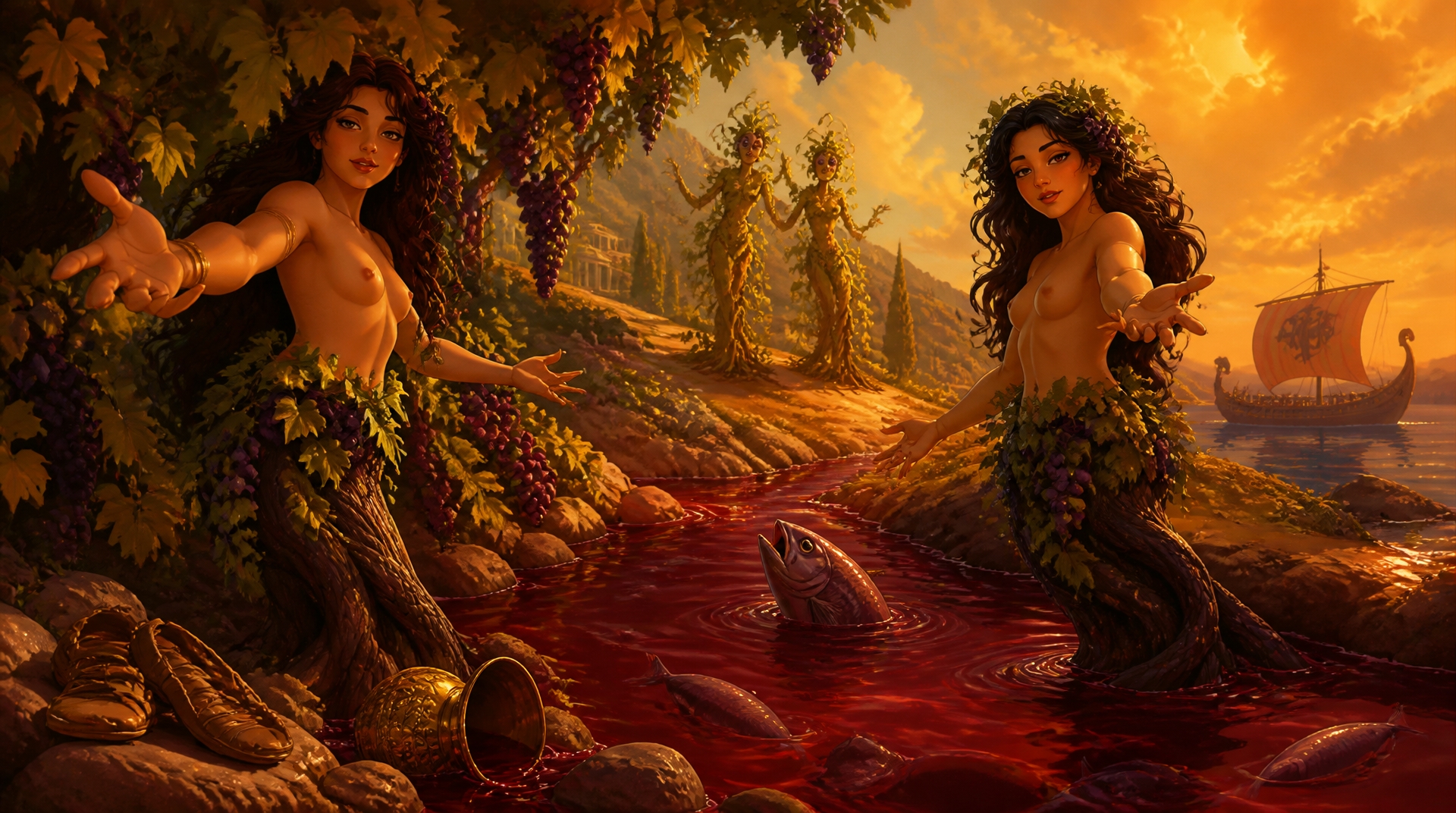
"On that island," Lucian continued, "the rivers ran with wine. I do not mean that the water
tasted of wine. I mean that the rivers were wine. We dipped our cups in them and drank. The
wine was a good Chian on the day we landed. It was a serviceable Falernian three days later, when
we crossed the island to the southern coast. On the fourth day, by the western shore, it was a poor
Spanish red of the kind The Anchor here serves on a slow Tuesday. The wine, you see, varied by region.
Bacchus himself, who had made the island and given the rivers their nature, had not seen fit to standardize
the vintage. I respected him for that."
The men at the bench were rapt, grinning at Lucian's audacity; and the rest of the tavern had fallen silent.
Balbus had set down his cup. Even the proprietor had leaned forward on his elbow.
"In the wine rivers," Lucian said, "there were fish. They looked like ordinary fish, but they
were not. The fish, having lived their entire lives in wine, were themselves drunk, and being
drunk, were astonishingly easy to catch. We pulled them out by the dozen. We grilled them on the
beach. And every man who ate one of those fish became drunk himself—not from any wine he had drunk
that evening, but from the wine in the fish! We slept for sixteen hours. We woke with the worst
hangovers of our lives! So of course we ate more fish for breakfast.
We were drunk again by mid-morning. After
three days of this, the captain ordered us all back aboard the ship, because, he said, if we stayed
any longer none of us would ever leave the island, and he had no desire to die a drunkard on a
Bacchic beach when he could die honestly at sea like a respectable Phoenician."
The Mauretanian was openly laughing. The old sailor was wiping his eyes.
"But the wine fish," Lucian said, "were not the strangest thing about that island. The
strangest thing about that island was the trees."
He paused.
"The trees," he said, "were actual women. From the waist up they were as fair as any woman you have
ever seen—more so, in some cases; one of them looked uncannily like the wife of an overseer I
knew in Mariana who happened to be a murderess, so of course I was apprehensive.
But that was from the waist up. From the waist down,
they were grapevines! If you doubt me, you are in good company because I doubted
my own eyes. But it was true! They were rooted in the earth like ordinary trees, but they could move
their upper bodies, and they could speak, and they could—" he paused for the room,
and smiled a self-effacing smile. "Let's just say they
could be very friendly to a sailor newly off a long ship."
The room howled.
"Two of the crew," Lucian continued gravely, shaking his head in sadness, "were too friendly back. They embraced the
tree-women. The tree-women embraced them. And in the morning, when we went to look for our missing
crewmates, we found two new young vines growing where the men had stood, and on each vine, where
the face should have been—and I swear this by Bacchus himself, gentlemen—a single small grape,
perfectly ripe, with the exact features of the man who had been there the night before."
A long, delighted silence.
"What did you do?" said Bocchus.
Lucian looked at his cup. He looked at Bocchus.
"What could we do?" he said. "We made wine."
The room, briefly, lost its mind. Cups were banged on the table. The one-armed Gaul brought a fresh
jar without being asked. Balbus declared that he would never tell a sea story again as long as he
lived, because he had been outdone by a Syrian, and a Syrian who had not even been to sea—here
Lucian raised his eyebrows in mock offense, and the bench laughed harder—and Bocchus insisted on
toasting Lucian, and then Demetrios, and then, having run out of dignitaries at the table, the
tablecloth.
Acrophilia
It was past the middle of the night when they finally walked back to the inn. The streets of Gades
were dark and quiet, and the air was clean off the water, and Lucian, who had been drunk and was
now in the gentle interval between drunkenness and the hangover, felt almost like himself for the
first time since Corduba.
Demetrios walked beside him with the easy patience of a man who had spent the evening drinking
deliberately less than his companion. After a while, he said:
"I asked around, while you were listening to sea stories. It can be done.
I spoke to Bocchus, and to the old sailor, and to a third man who has lived in
Carteia—that's the Roman town in the lee of the rock—for twenty years. There is a trail. It runs
up the northwest face, the side away from the strait. A goatherd's path, mostly, but well enough
used that you cannot lose it. Half a day up if you stop to rest; less if you don't. There is a
small shrine to Heracles near the summit, with a priest who lives in a hut beside it and will sell
you a libation for a copper. From the top, on a clear day, the other Pillar is plainly visible
across the strait. The Africans call it Abila. It is a mountain in Mauretania. Bocchus has seen it
from both sides."
Lucian was quiet for several paces.
"And to get to the rock itself?"
"Carteia is a half day's sail east of here. Any of the coasters going that way will take us.
Bocchus offered, in fact, but he is not going for another week, and I told him we
would probably prefer to not wait that long."
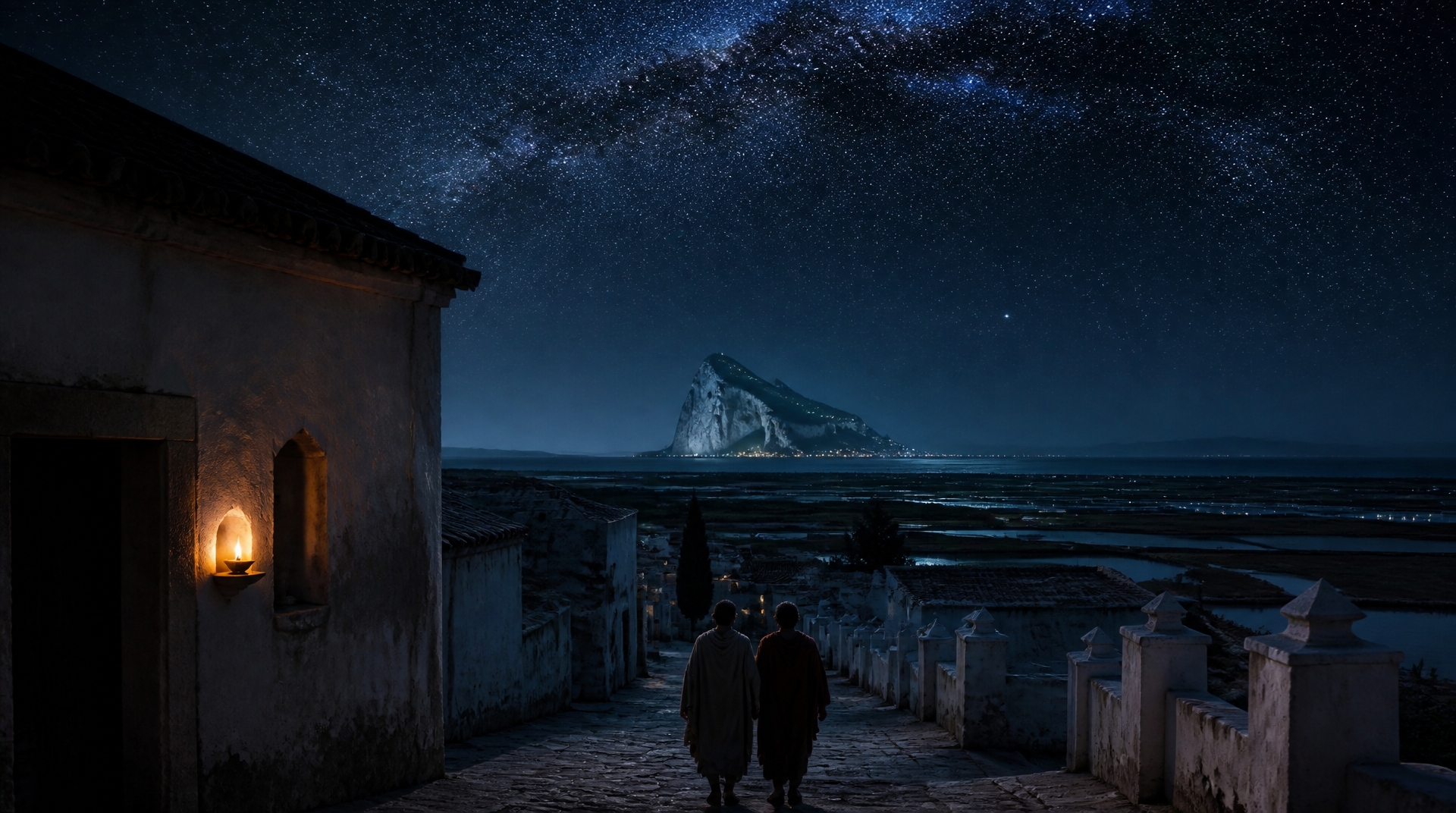
They walked another block. The stars hung thick and winter-bright over the harbor.
"I have an urge," Lucian said at last, "to be somewhere high. I'm not sure why.
But it is a longing inside that I cannot resist."
Demetrios shrugged. "Well, the top of the Pillar is pretty high. If that doesn't work,
you may have to sail to the Moon."
They walked the last block to the inn. Above them, over the dark roofs of Gades, the sky had
cleared, and the stars hung in their winter brightness, and somewhere east of the city, beyond the
marshes and the salt-pans and the low coast of Baetica, Mons Calpe stood waiting—the handiwork of a
man who, after his death, was made a god by Zeus himself and taken to Olympus.
Perhaps that was his longing: For Olympus. But, for now, the northern Pillar of Heracles
would have to do.