|
By: Paul S. Cilwa |
Posted: 6/6/2026 |
|
Page Views: 193 |
| Hashtags: #HistoricalFiction #LucianOfSamosata #Edessa #Plague |
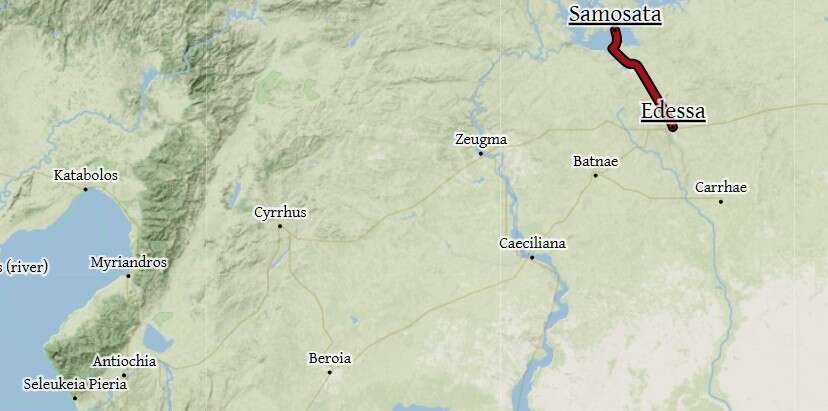
| On the road to Edessa, Lucian is struck by the plague. |
| Estimated reading time: 15 minute(s) (3536 words) |
Demetrios came out a few minutes later with their bread for the road and the small clay
flask of watered wine the innkeeper sold by the cup at this hour to riders who would not
stop again before noon. Lucian took the flask. Demetrios looked at his face, scrunched up his own.
"What?" Lucian asked.
"You feeling all right, brother? You look like Death breaking a hard biscuit."
Lucian shook his head dismissively.
"Just still have this headache. It'll probably pass once we get going."
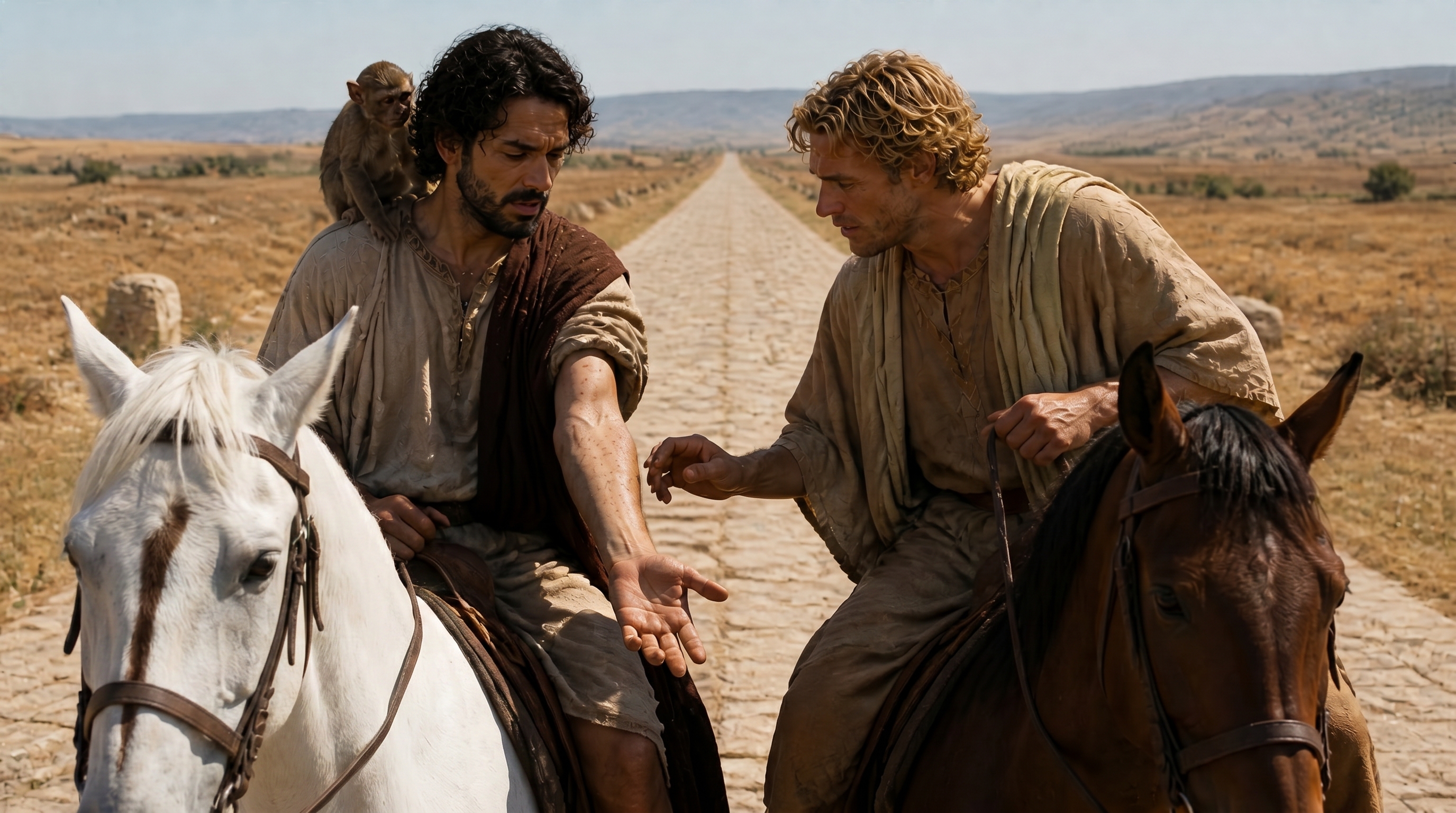
They rode out at the third hour, with the sun just clearing the eastern hills and the
shadow of every milestone running long across the stubble to the west. The road was empty
except for an old Syrian on a cart heading the opposite direction, who raised one hand as
they passed and was raised back to. Veritas rode on Lucian's shoulder. The papyrus chest
rode behind. The olive box rode in Demetrios's saddlebag, and they spoke of
philosophy, with Lucian hoping to distract himself from his throbbing head.
"So, the idea of writing an untrue thing is not actually a new one, is it?
Yochanan brought it up at his table, the night we were there. His people have cherished stories that were
never meant to be taken as histories."
"I remember those," Demetrios said. "The story of Ruth, and the one about Esther.
Oh, and the Job one."
Lucian nodded, instantly regretting it as it made his head ache even more.
"Ruth is a short story about a foreign woman who marries into a
Bethlehem family and becomes the great-grandmother of their best king. Yochanan said the
text is so carefully arranged for moral effect that no scholar in his tradition reads it
as history; it's a parable, told as parable, and everyone knows it's a parable. The second
is a comic story about a Jewish queen of Persia who outwits a wicked minister. The
Persians have no record of any such queen, ever. The Jews don't believe there was such a
queen either. They tell the story every spring at a festival, with masks and noise and a
lot of wine, and the contract is that everyone is in on it. It isn't a lie because
nobody pretends it's real."
Demetrios considered this as they plodded along.
"So you're saying Yochanan's people had your idea before you did."
"Yochanan's people had a lot of ideas before any of us did. That's why I keep listening
when he talks. The interesting part is that nobody on our side has had it. Homer is told
as history. Hesiod is told as history. The poets work hard at sounding like reporters and
the historians work hard at sounding like poets, and nobody in either trade has yet
stepped forward and said I am about to tell you a beautiful lie about a place that
isn't there, just for the fun of it. When the Jews do it they call it a megillah and they
read it at supper. When we do it we call it a history and we put it in the school
curriculum, and we beat children for not remembering it as Truth."
Demetrios laughed. "Now you sound bitter."
"I was a student. I have opinions about beating children."
They rode a half mile without speaking. Lucian found the silence harder to hold than he
usually did. He kept losing his place in the saddle.
"Lucian," Demetrios said. Lucian didn't answer immediately because the work
of remaining upright on his horse was taking all of his attention. "Lucian!"
"I'm fine," Lucian responded. But he wasn't.
Symptoms
By midmorning the headache had moved from above his right eye to the back of his neck and
had brought a friend. Lucian's hands had begun to shake. He held the reins more tightly
to hide the shaking and the holding tighter made his shoulders ache, and the shoulder
ache settled into a chill across his upper back that did not match the warmth of the
morning. He told himself the chill was the morning.
But Demetrios didn't look cold. "Brother," he said.
"I'm fine."
"Brother. Look at me."
Lucian looked at Demetrios. Demetrios's face had two of itself in it, slightly offset.
Lucian blinked and the two became one again, and the one had on its face the expression
Lucian had been hoping not to see this morning.
"Show me your arms," Demetrios said.
"I don't—"
"Show me your arms, Lucian."
Lucian pushed up the right sleeve of his chiton. On the inside of his forearm, where the
skin was thin and pale, a rash had come in overnight in a fine even spread of small red
points, none of them yet raised, all of them incipient. He looked at it the way a man looks
at a contract he has already signed before reading.
"Yes," Lucian said.
"We spent too much time in the bad air. That city is cursed, I hate to say."
Lucian pulled the sleeve down.
"How far to Edessa?"
"Another day. We can also turn around."
"And return to Samosata?" Lucian laughed harshly.
"Curing this doesn't seem to be their strong suit."
"It would be a roof and a bed and a man who knew when to give you water."
"Edessa," Lucian said. "Edessa has hospitals. Edessa has the trade. If I'm going to
be sick I want to be sick where there's the best chance of recovery."
Demetrios shook his head. He did not smile. But he reined his horse around and back into
the road and they rode east, and Lucian sat his horse for a Roman mile by an act of pure
concentrated will that he had not used since the night before his first appearance at
the games in Tarraco.
The Push
The afternoon went somewhere Lucian could not later recall. The country opened
out around them and the road kept on running. The sun moved across the sky and a
milestone went past and another one and Lucian's grip on the saddle horn became the
single thing he was doing.
A peasant in a field said something to a child. The child laughed. Lucian was nine years
old hearing his mother laugh from the courtyard. The horse stumbled and was caught and
the courtyard was gone, and the road ran on under a sun that was at the wrong height for
the time of day Lucian thought it was.
At some point Demetrios dismounted, and walked beside the horse for a stretch, and made
Lucian drink from the water-skin. The water tasted of warm leather. Lucian drank it. It
helped a little and then it didn't. Demetrios jumped back when he touched Lucian's arm.
"Good gods, man," he said. "You're burning up. If you get any hotter,
we'll be able to cook dinner on your ass."
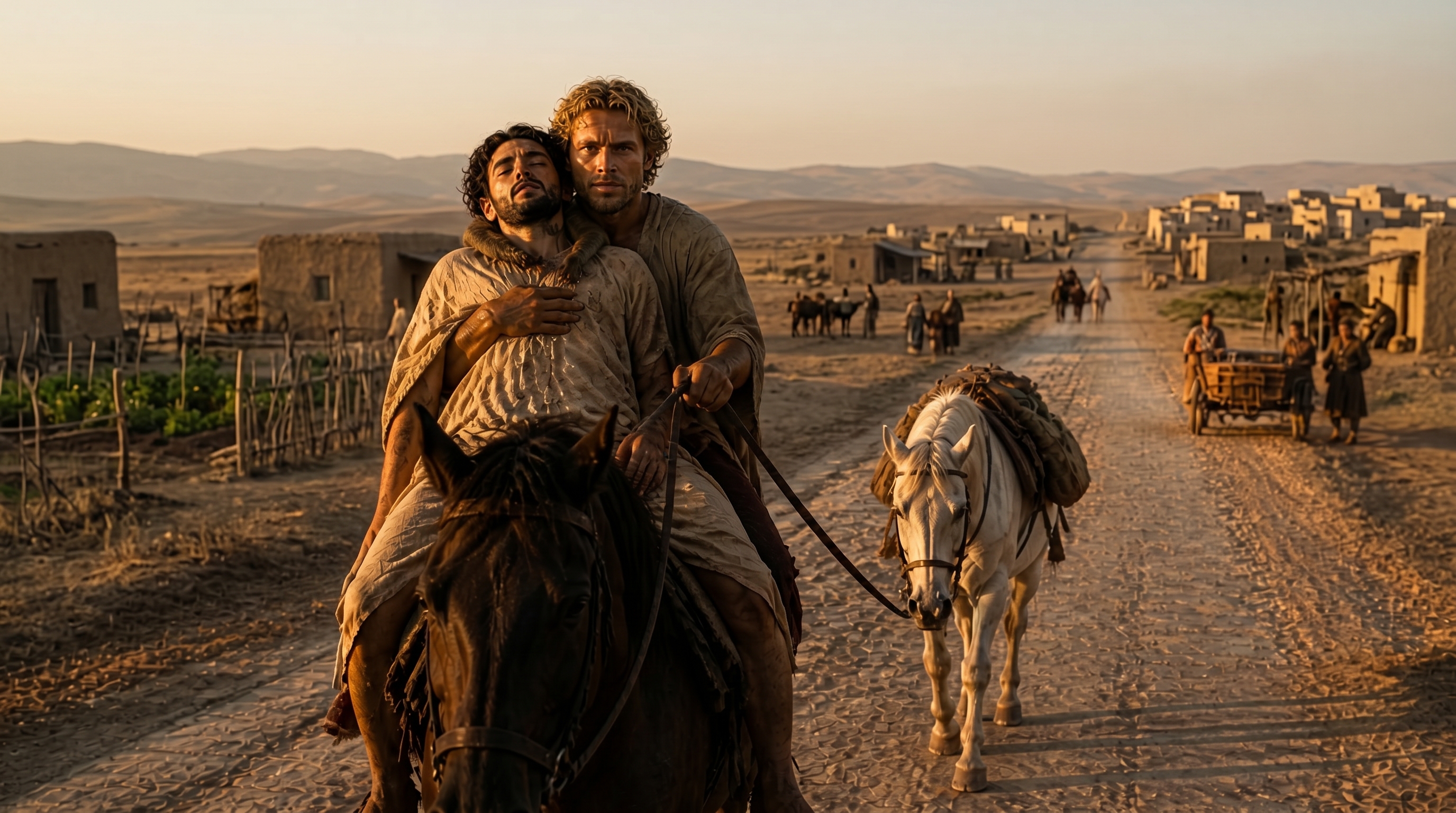
At some other point Demetrios was up on Lucian's horse behind him, with one arm around
Lucian's chest holding him in place and the reins of both horses in the other hand. Veritas was a
small steady weight against Lucian's neck that was very particular about not letting go.
The hills rose. The hills became closer. The hills became one hill, and at the foot of
the hill was a wall, and above the wall was the citadel of Edessa, and Lucian had time to
register that they had arrived before the world went sideways for some indeterminate
number of breaths and came back with the wall much closer.
The gate. A soldier with a question. Demetrios with an answer Lucian did not catch. The
soldier looking at Lucian a long moment—a man who had seen this arrive at his gate
many times before—then saying something short, pointing with his chin down the
colonnaded street, and stepping back farther than politeness required. The soldier
waving them through. The inside of Edessa rising up on either side, a colonnade, a
fountain. The smell of Edessa coming over Lucian in a wave that was mostly bread baking
and slightly garum and slightly something he could not identify and did not want to.
Demetrios followed the soldier's directions. The horse turned. There was a square, and
across the square was a long low stone building with an open doorway, and from the
doorway came the smell Lucian had been smelling at a distance for half a Roman mile and
had been refusing to name. Vinegar. Lye. The particular smell of a place where many
people had been recently very ill.
The hospital.
The Hospital
Someone was helping Lucian off the horse. The arm supporting him was strong and the
voice was familiar but would not resolve
into a person. He let the arm take his weight because the alternative was the
cobblestones. They went through a doorway into a cooler space that smelled of vinegar
and lye and underneath those a softer smell of clean linen.
The bone-deep ache had moved into his lower back and set up a small permanent house
there. His skin hurt where the wool of his inner tunic touched it. The light from the open
door behind him stabbed sideways into his right eye and would not leave. Every
swallow felt like swallowing a pebble; the inside of his mouth had gone strange. He
put a hand to his cheek and felt small hard places that had not been there yesterday,
two of them on the upper cheekbone and another at the line of his jaw.
When someone asked how he was feeling, all he could say was that Death itself
couldn't possibly feel worse.
A woman's voice. A man's voice answering. He was set down on a wooden bench. The strong arm
that had brought him in was talking to the man with the Greek voice, fast and quiet.
Lucian heard the words plague and Samosata and five days and
rash overnight.
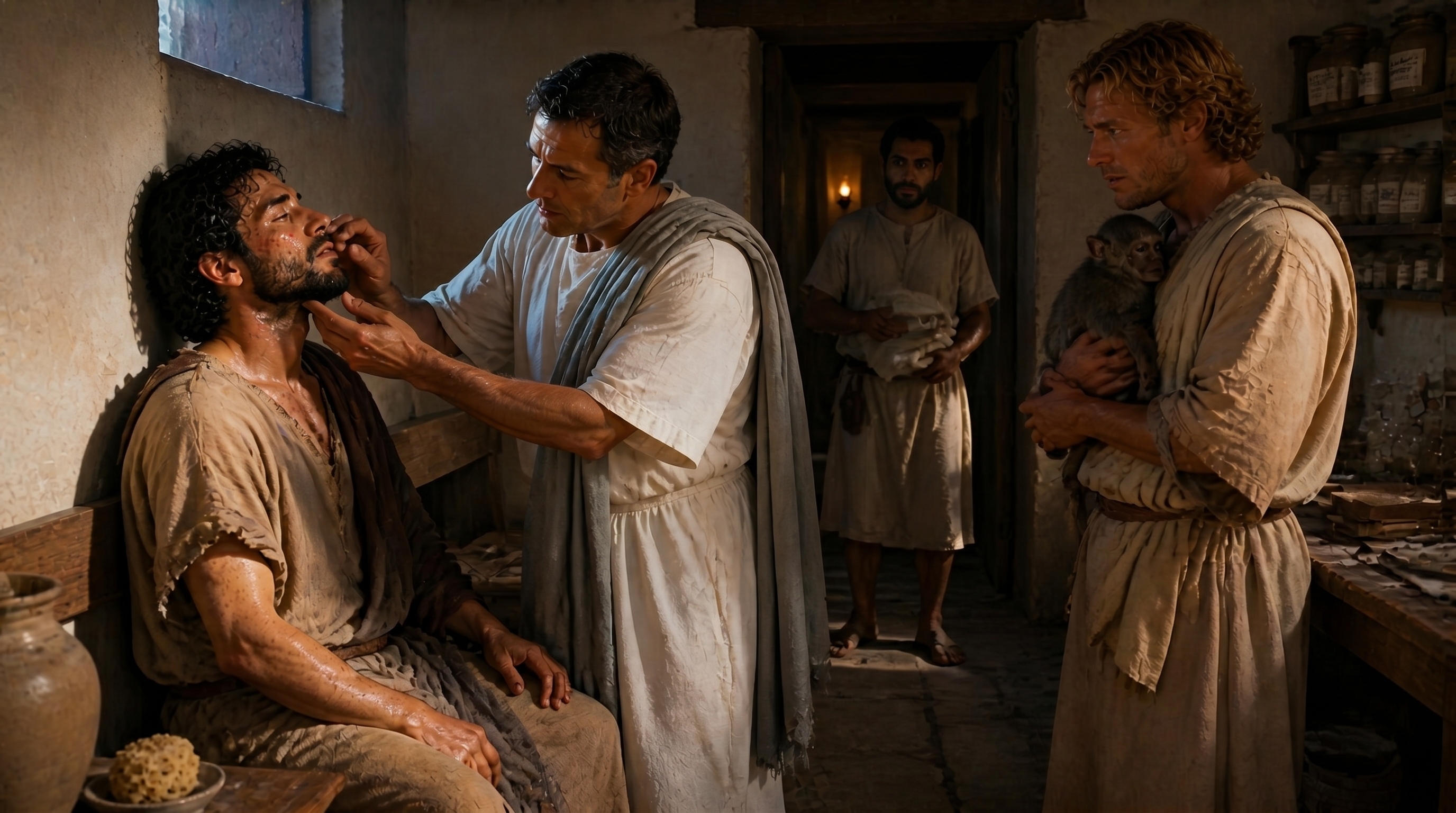
Hands lifted Lucian's chin and looked into his eyes which tried, but were unable
to return the favor. Hands rolled up his sleeves, looked at the rash, put the
sleeves down.
He heard, "Quarantine."
Lucian shut his eyes because the open door was still stabbing into his right eye and
because looking at a face he should know and did not was a separate kind of pain he
did not have the strength for. When he opened his eyes the face had gone, and the
cooler hands of strangers were lifting him from the bench, and the world rolled
forward and a corridor came up under his feet and went past, and he was being walked
into a long room with occupied cots along both walls.
Lucian was lowered onto one. They pulled a clean folded blanket
over him to the waist and then left.
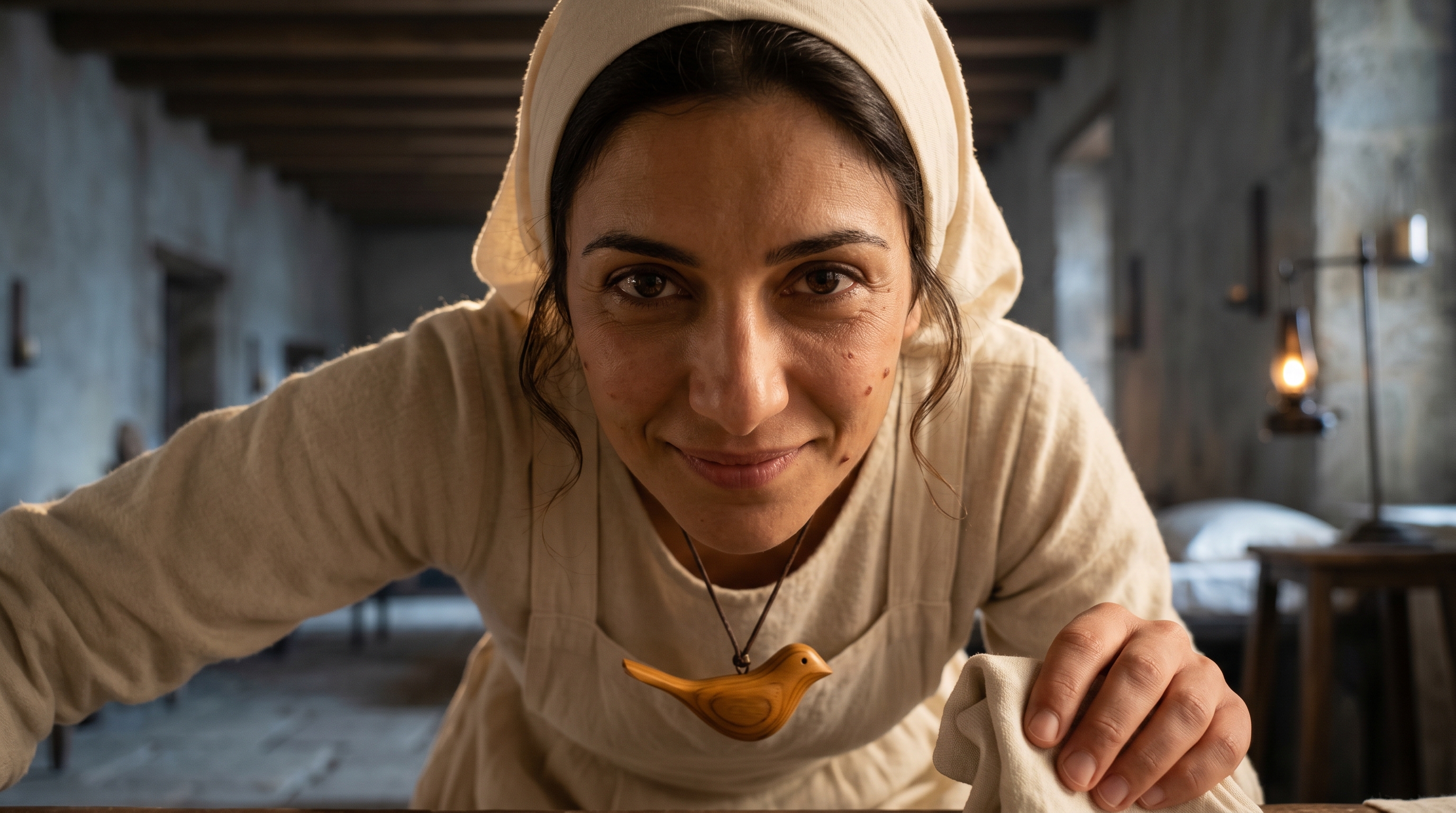
Some time later, a woman in a plain undyed wool shift and clean linen apron
arrived at the foot of his cot without his having
seen her cross the room to get there.
She put the back of her hand to his forehead. It was cool, so
welcome it was a small shock, and he made a sound he had not meant to make. She made
a small efficient hum in answer, lifted his head a little with one arm under his
neck, and brought a clay cup to his mouth.
"Drink," she said, in serviceable trade Greek. "Slowly. All of it."
The drink was cold and sweet and faintly bitter and red. He could see the red
clinging to the rim of the cup as he tipped it. He drank what she gave him. She
lowered his head back to the cot.
"Again in an hour," she said, more to herself than to him. "And again. And
again."
She set the cup down out of his line of sight, dipped the linen, wrung it, and began
to sponge his face. The water had mint in it. The sponging was so cool against the
burning of his face it made him shiver in relief.
The fever drew back from her hand and met it again where her hand had not yet been.
She worked. Her face was not far enough into focus
for him to do anything with; the room beyond her was a soft pale rectangle of
lamp-light and ceiling-beam. She unfolded a second cloth, set it on his forehead.
She lifted the blanket and laid a third cloth across his chest. The chest cloth
smelled of vinegar.
Then a voice was calling something into the ward from the doorway at the far end of
the room. A man's voice. A name. Lucian could not place either.
The nurse turned, glanced down the room, and called back in clear trade Greek:
"Not yet, sir. He's just come in. Tomorrow if the fever breaks. The day after
if it doesn't. You may wait in the courtyard. The doorman will bring you word."
Lucian closed his eyes for what he believed was a moment and was no longer in the
room.
The Isle of the Blessed
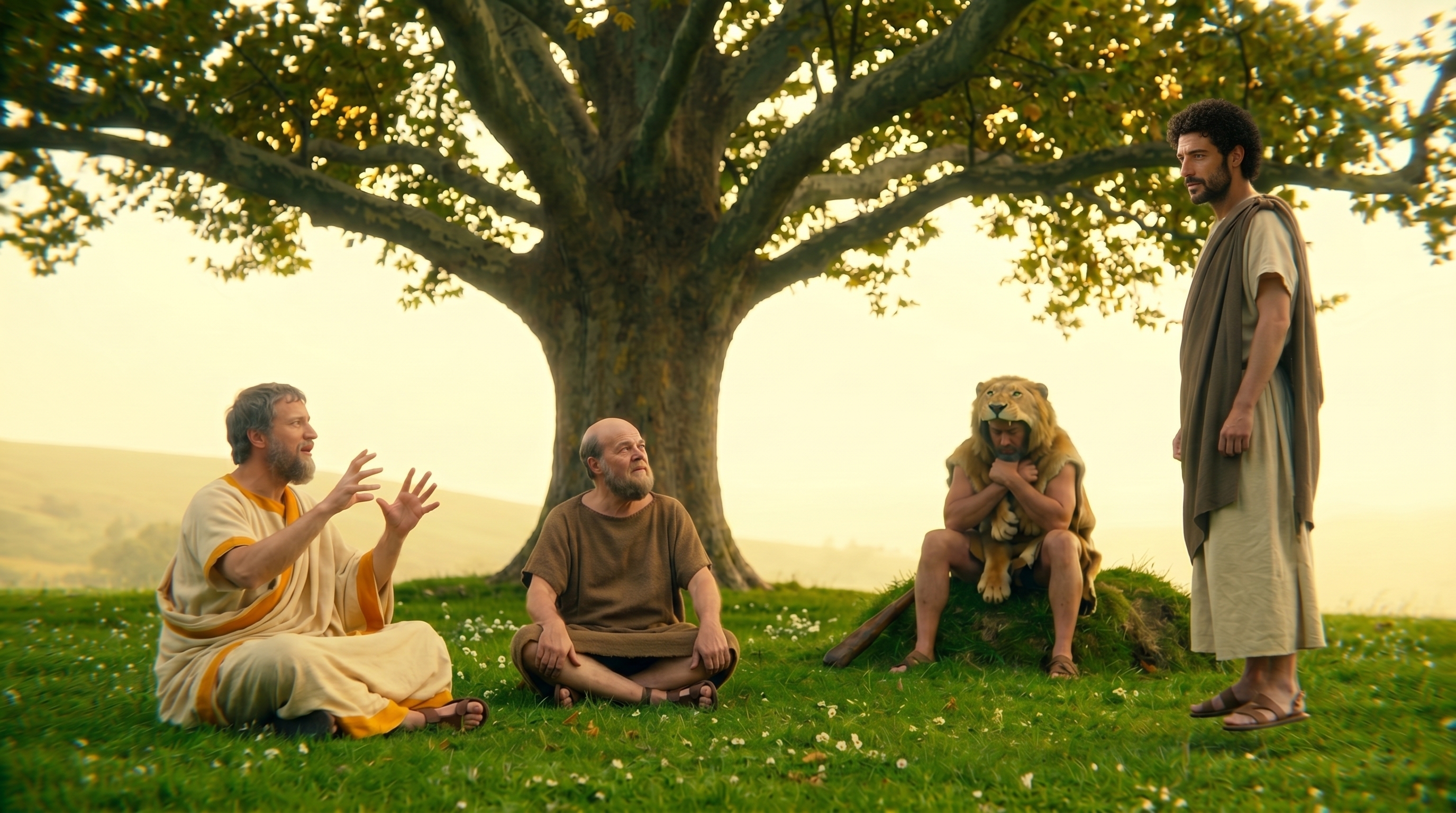
He was on a hill. The grass had been cropped short
by sheep he could not see, and there were small white flowers in it of a kind he had
never seen and did not recognize. The
light was very good. The light came from no sun he could place in the sky.
The sky was the pale gold of a thing remembered well.
A group of men was sitting under a tree at the top of the hill. Lucian,
recognizing the place by the absence of any other available explanation, went
toward them.
The man holding forth on the left end of the group was no one less than Plato,
the philosopher! Lucian recognized him by his
elaborate sentences and the small habit Plato had of arranging his fingers in the
air as if to hold a shape no one else could see. Plato was perhaps fifty in his
blessed years; he had filled out; he wore the himation of a comfortable gentleman.
In the middle, listening with his famous slight tilt of head, sat Socrates.
Snub-nosed. Bald. The eyes that had been described in a thousand books were just as
Lucian had imagined.
To Socrates' right, sitting a little apart on a low mound of grass with his hands on
his knees, was a man Lucian knew at once by his bulk and by the lion-skin around his
shoulders. Heracles was older than the stories suggested. His shoulders were broad
but his face was the face of a man who had been thinking lately, and the thinking
had not made him happier. The lion-skin was a little threadbare. He did not look up
when Lucian arrived.
Lucian stopped a polite distance from the group. He did not know the etiquette of
the Isle of the Blessed, so he waited.
Plato saw him first. Plato raised a hand and finished the sentence he had been
building, which Lucian could not quite follow, and then let the hand drop and
looked at Lucian with the small inquiring expression of a man who had not had a new
guest in a while.
"Sit down," Plato said.
Lucian could not sit. He had been having this problem with his body since he arrived.
"I can't yet, master."
"Ah. One of those. Not done with the other side. Then stand. Standing also
works."
Plato turned his attention to Socrates with the small gesture of a host introducing
a guest.
Socrates studied Lucian.
"Tell me your name, young man."
"I'm Lucian," he said. "Of Samosata."
Socrates considered. "And your trade?"
"Rhetor."
"Mm. Are you any good?"
"Tolerable."
"Tolerable is the word a man uses when he has been told by a Roman official that
he is more than tolerable. Are you actually good?"
Lucian tilted his head self-deprecatingly and shrugged. "Maybe."
Socrates considered. "So, as I was saying, a man can write a true story
by admitting it is a lie. We have
always known this on our side of the river. We have not yet found a Greek who would
do it. You may be the Greek. Make sure you do it badly the first time, though. The first
time at a new thing is always the most honest."
Heracles, who had not spoken, said without looking up: "And don't write me as a
hero in it. The hero business is overrated."
Socrates inclined his head toward Heracles. "Our colleague has been re-reading
his own myths."
"I crushed a man up against the air," Heracles said to the grass. "It was
supposed to be a noble fight. I have been thinking about it for a long time. The
man's mother was a hill, and she was crying when I left."
Socrates turned back to Lucian.
"If you like writing, young man, you should totally write about all three of us.
Sitting around, having conversations, as in my Dialogues.
Make it short. Make it ridiculous. You will be
paid and we will be flattered. The readers will actually read it, which is more
than readers do with most books they love to own. There is a great deal of
fame in making up dialogues between famous people. We do not begrudge anyone the
fame. Most of us had a great deal of it ourselves and have noticed, on this side of
the river, that it has been less interesting than we expected."
Then, suddenly, Lucian spotted his mother a little ways past the philosophers.
She looked exactly as she had when he left
Samosata at seventeen. Her hair was the dark hair he remembered. She was unfolding a cloth from the
basket and laying out flat bread and cheese and a small jar of olives on a clean
square stone she had set in the grass for the purpose.
Lucian's father was sitting a little way down the slope, talking to his uncle
Zenodoros. His father's
clerking-hands were the hands of a man in his middle thirties, ink-stained at the
fingertips. Zenodoros was the uncle who had slapped a seventeen-year-old Lucian for
cracking a slab of practice marble, with the strong shoulders he had had then, and
was making a point with one hand the way he had always made points, fingers spread,
chopping the air. Lucian's father was laughing.
His mother looked up at him.
"Sit down," she said in Aramaic. "The bread is fresh. We saved you the
corner piece, with the seeds, just like you like."
Lucian tried to sit. He could not. He could not move toward the cloth or away from
it.
"I can't," Lucian said.
"I know," his mother said. She tore the corner piece from the bread anyway and
set it on the stone for him in case he came down. "Not yet. Soon, perhaps. Not
yet."
Lucian's uncle looked up the slope at him without surprise. "Don't argue with
your mother. You always argued with her and you were always wrong."
His father raised a hand. The hand was the hand of a man content to be exactly where
he was.
The light began to go out of the hill from the edges inward.
The Nurse
Lucian opened his eyes. The pale rectangle of lamp-light was over him again. The
nurse was wiping his forehead with a fresh cloth. She did not appear to have moved.
The cup was at his mouth again. He drank. It may have included pomegranate juice,
and he was so grateful for it that his eyes watered.
She lowered his head. She wiped his eyes for him, gently, with the corner of the
cloth. Then she pulled the blanket up to his chin and went back to her stool by the
lamp, and sat down, and Lucian watched her for as long as he could keep his eyes
open.
His mother had saved him the corner piece of the bread.
He shut his eyes to hold the images steady.
The fever closed over him from the edges inward like the light going out of the
hill, and he was gone before he could decide whether he had managed to keep any of
it.
Lucian wasn't at all sure how many days had passed, when he awoke, clear-headed, for
the first time since he'd left Samosata. He was still in the hospital, but the fever was gone,
he could tell. The nurse was sitting by the lamp, reading a book. She looked up at him and smiled,
and his breath froze in his chest.
It was his sister.