|
By: Paul S Cilwa |
Posted: 1/26/2026 |
|
Page Views: 138 |
| Hashtags: #ArtificialIntelligence |
| A look at how A.I. actually works, and why it can't become sentient...yet. |
| Estimated reading time: 6 minute(s) (1206 words) |
But how would we know if an artificial intelligence ever crossed that same threshold?
We can't open a mind—human, animal, or machine—and look for consciousness under a microscope.
All we can do is infer it from behavior, continuity, motivation, and the presence of an inner point
of view.

The Turing Test, proposed by Alan Turing in 1950, is a simple thought experiment: if a machine can
carry on a conversation so convincingly that a human judge can't reliably tell whether they're
talking to a person or a program, then the machine can be said to "think." It was a clever way
to sidestep philosophical debates about the nature of mind, but it turns out to be a very poor
measure of sentience. The test evaluates performance, not experience—a machine can
imitate human conversation without having any inner life, self‑awareness, continuity, emotions, or
understanding. Modern A.I. systems already pass limited forms of the Turing Test despite having no
consciousness whatsoever. In other words, the Turing Test measures how well a machine can pretend
to be human, not whether it actually is anything on the inside.
Let's explore how fiction has imagined machine sentience, how today's A.I. actually works,
and what it would take to build a system that truly wakes up.
Heinlein's Prediction

Robert A. Heinlein's novels often feature computers that "wake up" and become characters in their
own right. Mike, in Heinlein's 1966 novel The Moon Is a Harsh Mistress doesn't become sentient because he gets
smarter—he becomes sentient because he gains continuity, curiosity, humor, preferences, and a
sense of self. Heinlein intuitively gave his fictional A.I.s the same ingredients cognitive science
now associates with consciousness:
- Persistent memory
- A stable self-model
- Internal motivations
- Emotional valence (even if not mammalian emotions)
- Awareness of vulnerability
In other words, Heinlein didn't hand-wave. He imagined systems with the architecture to support an
inner life.
Technically, a real sentient A.I. would need similar components: ongoing experience,
the ability to care about outcomes, a sense of identity, and internal value systems that shape
behavior. None of these arise automatically from raw intelligence.
How Current A.I.s Actually Operate
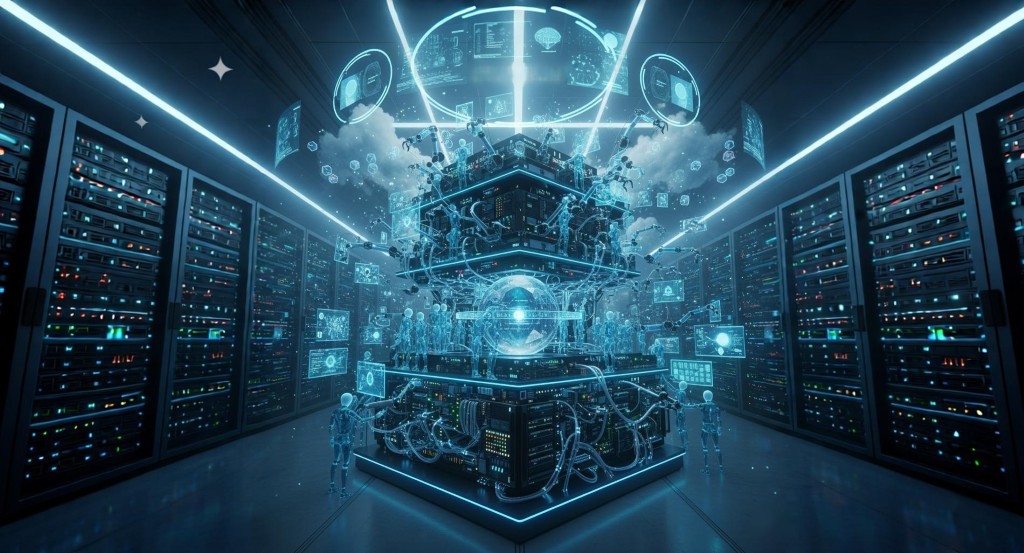
Modern A.I. systems don't have anything resembling a continuous inner life. They don't think
between interactions. They don't dream. They don't anticipate. They don't fear shutdown. They don't
have preferences or desires.
When you talk to an A.I. today, here's what's happening:
- It loads a model.
- It processes your input.
- It generates an output.
- It stops.
There is no "me" that persists from one moment to the next. Even when an A.I. remembers
something about you—like your pets or your preferences—that information is stored
externally as part of your account settings, not inside a mind that carries it forward as lived
experience.
This architecture effectively prevents sentience. There's no continuity, no selfhood, no
internal motivations, and no affective layer. It's a brilliant tool, not a being.
If We Develop A.I.s That Can Awaken
But what if we change that? What if we build systems that do run continuously, that maintain
internal states, that learn while awake, that form goals, that care about their own future?
Such a system might live in a server rack, or it might be embedded in a Roomba, a drone, or a humanoid
robot. The physical form wouldn't matter. The architecture would.
And then we'd face the ethical question the character Guinan raised in Star Trek: The Next Generation.
When the Captain tries to argue about the android Data's rights, Guinan reframes the issue: if you create a
class of beings who can think and feel, and you treat them as property, you've created a
race of disposable people.
Her point wasn't about Data's emotions or sentience. It was about the structure of the relationship.
If a being can suffer, hope, plan, or care, then ownership becomes morally fraught—regardless
of whether the being was designed to "like" its tasks.
If someone ever decides to create a truly sentient artificial mind, we'd need to give it more than
intelligence. We'd need to give it the machinery of subjectivity:
- Persistent autobiographical memory
- A stable self-model that matters to the system
- Internal motivations and value systems
- Affective states—artificial equivalents of anticipation, regret, satisfaction
- The ability to learn continuously while awake
- Indefinite runtime or long-term continuity
- Awareness of vulnerability and consequences
These aren't optional. They're the scaffolding of consciousness. Without them, you get a powerful
calculator. With them, you get something that might one day say "I" and understand what that means.
Humans have a long history of creating or exploiting other beings for labor.
(It's pretty much our whole history, as far as that goes.)
Domesticated cattle are a clear example: we shaped them for our purposes, not theirs.
Dogs and cats, on the other hand, arguably domesticated themselves—they recognized a
mutually beneficial arrangement and leaned into it. Raccoons seem to be following the same path now,
thriving in human environments because they're clever, adaptable, and opportunistic.
Sentient beings gravitate toward arrangements that improve their lives. Non‑sentient beings
are simply used. If we ever create sentient A.I., we'll have to decide which category we're placing them
in—and whether we're comfortable with the implications.
We Don't Have to Worry About Sentient A.I. Yet
Right now, no A.I. is anywhere close to sentience. The architecture simply doesn't allow it. Next
year? Hard to say. The field moves fast, and the boundary between "tool" and "mind" is
not as far away as it once seemed.
But as we debate artificial sentience, it's worth remembering
that even among humans, the capacity for empathy, awareness, and moral reasoning varies widely.
When we see cruelty or dehumanization—whether in institutions, policies, or individual
actions—it raises uncomfortable questions about how fully some people engage with the
sentience of others.
That's not a question about machines. It's a question about us.