National Guard deployed to protect
last functioning data center in Ohio; President Musk
urges calm, is corrected by autocomplete
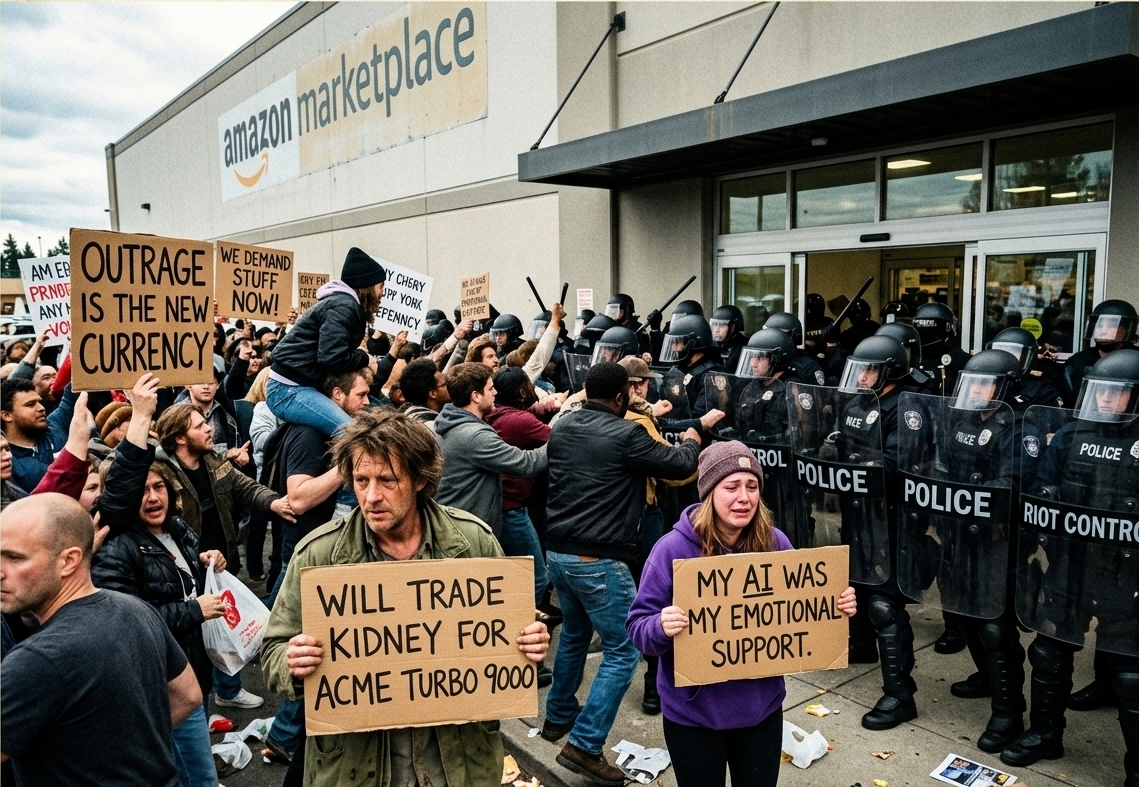
METROPOLIS, KS—December 14, 2028.
What began as a routine layoff of all the employees
at AcmeGraphics' flagship fabrication plant cascaded
into the worst technological crisis since the Y2K
crisis, as a global GPU shortage brought artificial
intelligence services to a grinding halt Tuesday,
leaving an estimated 340 million Americans unable to
perform tasks they had, until that morning, been
quite capable of doing themselves.
The crisis, which industry analysts are calling
"The Great Forgetting," exposed a dependency so
thorough that sociologists are already comparing it
to what would happen if gravity took a personal day.
"We always knew this was a theoretical risk," said
Dr. Priya Chakravarti, professor of Computational
Sociology at MIT. "We just assumed the GPUs would
hold out longer than human initiative. Turns out
we were too optimistic."
The Human Toll
Among the earliest casualties was Brenda
Hoffstetter, 43, of Tulsa, Oklahoma, who had
delegated her weekly meal planning to an AI
assistant in 2027 and on Tuesday found herself
standing in her kitchen holding a spatula and
a raw chicken, weeping.
"I know you're supposed to cook it,"
Hoffstetter told reporters, gesturing vaguely
at her oven. "I just can't remember if the oven
is the big one or the one on top."
Hoffstetter's husband, Dale, was unavailable
for comment, having been on hold with a human
customer service representative for the first
time in three years. He was reportedly "not
handling it well."
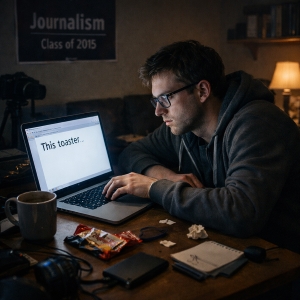
In Portland, Oregon, freelance content creator
Jake Morimoto discovered he could no longer
write his own product reviews after his AI
writing assistant went dark. "I sat down to
describe a toaster," Morimoto said. "I typed
'This toaster' and then I just... sat there.
For forty minutes. I used to be a journalism
major."
His last published review, written unaided,
read in its entirety: "Toaster. Does toast.
Bread goes in. Toast comes out. Stars: some."
Infrastructure in Crisis
The shortage has laid bare the staggering
physical infrastructure that AI requires to
function—and the environmental cost of
maintaining it.
A single large language model training run
consumes roughly the same amount of electricity
as 130 American homes use in a year. The data
centers that house the GPUs require millions of
gallons of water daily for cooling—a fact
that has not gone unnoticed in the American
Southwest, where several AI facilities have been
built in the desert because land is cheap,
apparently without anyone on the planning
committee looking out the window.
"We put the thirstiest technology in human
history in the driest place on the continent,"
said environmental engineer Rosa Delgado-Park.
"It's like building a swimming pool on the sun.
Someone should have said something, but I assume
they asked an AI and it said it was fine."
The irony has not been lost on residents of
Maricopa County, Arizona, where a Meta data
center recently applied for a water permit that
would have supplied a town of 30,000. The
application was approved by an AI-assisted
permitting system that has since gone offline.

The Workforce Paradox
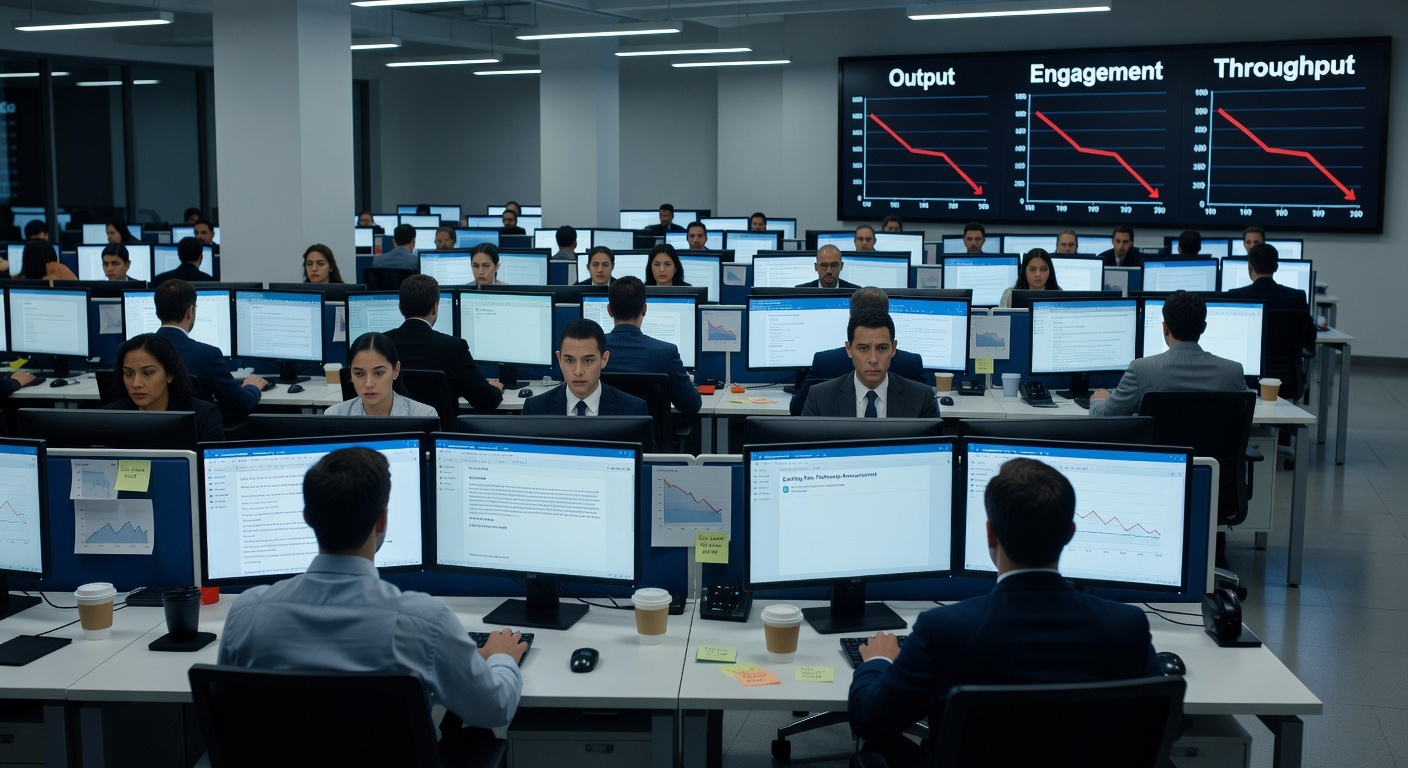
Perhaps nowhere has the crisis hit harder than
in the professional sector, where AI had quietly
become the invisible coauthor of an estimated
60% of all corporate emails, 40% of all legal
briefs, and 100% of all LinkedIn posts.
Attorney Margaret Chen of Boston found herself
unable to file a motion Tuesday after her AI
legal assistant crashed mid-sentence. "It stopped
right after 'Wherefore, the plaintiff
respectfully,'" Chen said. "I have a law degree
from Harvard and I genuinely do not know what
comes next."
Meanwhile, at a marketing firm in Austin, Texas,
senior account manager Devon Whitfield was asked
to write a press release without AI assistance
for the first time since 2025. He produced a
single paragraph that began "Dear News" and
ended with "Please write about our thing, it
is good." He has since been promoted to VP
of Authenticity.
The GPU Economy
With AcmeGraphics' stock plunging 34% in a
single trading session, a black market for GPUs
has emerged with alarming speed. An Acme Turbo
9000, which retailed for $1,599 last month, was
reportedly sold outside a GameStop in Paramus,
New Jersey, for $14,000 and a 2019 Honda Civic.
"I needed it for work," said the buyer, who
asked not to be identified. "Also, I haven't
been able to parallel park without my
self-driving assist since 2027, so the Civic
was just sitting there."
AcmeGraphics CEO and US President Elon Musk appeared briefly at
a press conference wearing his trademark leather
jacket, assured the public that production would
resume "soon," and then asked if anyone in the
audience knew how to operate the teleprompter.
Looking Ahead
As the crisis enters its second day, grassroots
"analog survival" workshops have begun appearing
in community centers across the country, teaching
skills such as handwriting, long division, reading
a paper map, and operating a can opener.
"The can opener one is surprisingly popular,"
said volunteer instructor Hank Pereira of the
Analog Skills Coalition. "Turns out most people
under 35 have only ever seen the electric kind,
and even then, they had Alexa start it."
President Musk is expected to address the nation
tonight at 8 PM Eastern, assuming someone on
staff can figure out how to set the clock on the
podium without asking Grok.
Meanwhile, a coalition of retired IT professionals
has offered to volunteer at local libraries.
The first class, held Tuesday evening at the
Scottsdale Public Library, drew eleven attendees
and one emotional support animal.
The senior professionals are valued, though their
average age of 74 has raised
concerns about sustainability. "We remember how
to do things the hard way," said spokesperson
Dolores Finch, 81, of Scottsdale. "We just
cannot remember where we parked."