|
By: Paul S Cilwa |
Posted: 4/3/2026 |
|
Page Views: 399 |
| Hashtags: #GPU #GraphicsProcessingUnit #AI #MachineLearning #ArtificialIntelligence #Compute #DataCenter |
| How GPUs power AI, why we need farms of them, and when that might change. |
| Estimated reading time: 7 minute(s) (1591 words) |

That vision isn't science fiction anymore—it's a matter of timing. Today's AI lives in massive
server farms, the digital equivalent of power plants. But the same technological forces that have
shrunk computers from room-sized mainframes to pocket-sized devices might be about to do the same
for artificial intelligence.
How GPUs Make AI Possible
To understand why AI needs GPUs in the first place, you need to understand what AI actually does.
An AI language model like Claude doesn't "think" the way humans do. Instead, it performs trillions
of mathematical operations on patterns in data. When you ask it a question, it runs through those
operations billions of times in sequence, each one predicting the next word that should appear in
its response.
A traditional computer processor—the kind in your laptop—excels at doing one thing very quickly.
But the math that AI does is different. It's embarrassingly parallel, meaning the same mathematical
operation needs to be performed on many different pieces of data simultaneously. A Graphics
Processing Unit (GPU) was originally designed for video games, where it performs the same
pixel-shading calculation on thousands of pixels at the same time.
It turns out that the math for shading pixels is structurally similar to the math for training and
running AI models. This happy accident of engineering means GPUs are roughly 10 to 50 times faster
at AI work than regular CPUs—not because they're "smarter," but because they're better at doing
many things in parallel.
Just How Many GPUs Are We Talking About?
For the most capable AI models today, companies use thousands of GPUs working together. Anthropic,
which created Claude, uses entire data centers filled with them. Training a state-of-the-art model like
Claude requires tens of thousands of GPU-hours, sometimes hundreds of thousands, each GPU running
continuously for weeks. A single powerful GPU might cost $10,000 to $40,000, and you need dozens or
hundreds of them just to meaningfully speed up the training process.
But here's the interesting part: running an already-trained AI model is much less demanding than
training it. You might need only a handful of modern GPUs—or even a single one—to have
conversations with Claude or use it for most practical tasks. This is why some smaller companies
can afford to offer AI services without owning their own data center.
A GPU Farm
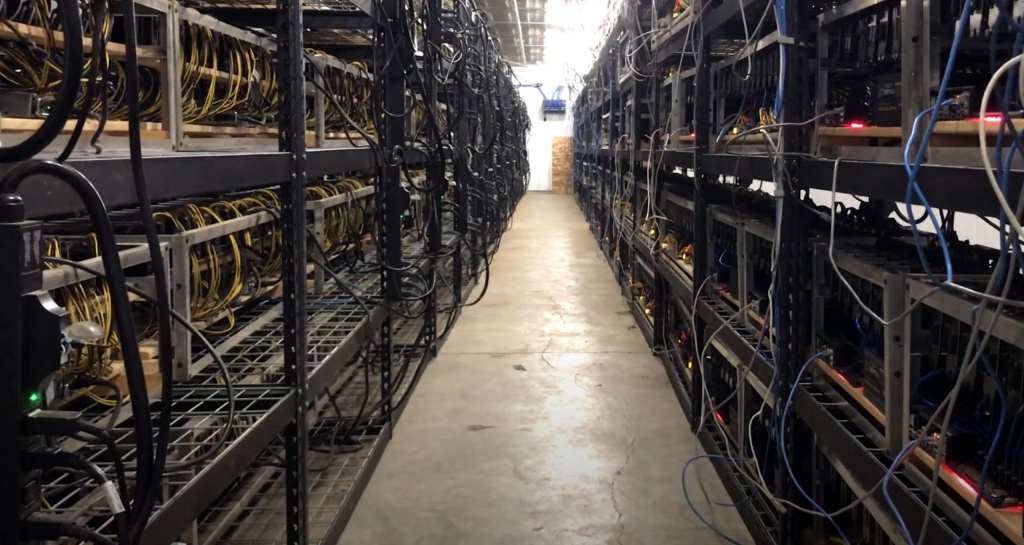
A GPU farm is exactly what it sounds like: a facility dedicated to housing thousands of GPUs,
usually organized in specialized servers. Think of it as a warehouse where every computer is
optimized solely to perform AI calculations. These facilities require enormous amounts of
electricity, sophisticated cooling systems (GPUs generate tremendous heat), and specialized
networking to keep all those processors communicating with each other.
Companies like OpenAI, Google, and Amazon operate GPU farms at massive scale. These farms train the
models that power services like ChatGPT, Bard, and countless enterprise AI applications. The
economic model is simple: build the farm, train models in it, rent access to users, and hope the
revenue from rentals exceeds the staggering electricity and infrastructure costs.
There are several serious objections to the current GPU farm model, and most of them boil down to
scale and sustainability.
- Energy consumption:
Training a large AI model can consume as much electricity as a small city. Inference (running a
trained model) is cheaper, but at the scale of millions of users, it still adds up. Data centers are
responsible for an increasing portion of global electricity consumption, and most of that
electricity still comes from fossil fuels in many regions. If everyone starts running AI queries
through cloud providers, the energy impact could be enormous.
- Centralized power:
When all AI runs on a handful of corporate servers, those companies gain unprecedented control over
which questions can be answered and how. A corporation or government could censor or bias AI
responses. A data breach could expose private conversations that were sent to the cloud. A service
outage affects millions of people simultaneously.
- Cost and access:
Today, advanced AI capabilities are expensive. Not everyone can afford a subscription to Claude or
ChatGPT. If powerful AI remains locked in corporate cloud services, it widens the gap between those
who can afford intelligence and those who cannot.
- Environmental unfairness:
The electricity that powers data centers in wealthy countries doesn't go unnoticed by those in
developing nations facing their own energy crises. There's an uncomfortable conversation to be had
about whether the global benefit of AI training justifies the electricity consumption, especially
when it's concentrated in rich, well-powered nations.
The Historical Trends: Moore's Law Meets Energy Efficiency
To understand where this is heading, it helps to look at where computing has been. For the past 50
years, the semiconductor industry has followed a pattern called Moore's Law: the number of
transistors you can fit on a chip doubles roughly every two years. This means processors have
become exponentially more powerful while also becoming exponentially more efficient.
The speed curve shows the familiar exponential growth of processor power. Today's chips are
millions of times faster than the processors of the 1970s. But the size curve—the physical
footprint of the chip—has gone in the opposite direction. Transistors have shrunk from being
visible to the naked eye to being measured in nanometers, each chip now containing tens of billions
of transistors in a space smaller than your fingernail.
GPUs have followed the same curve. The first graphics cards were massive boards. Today's high-end
GPUs are small enough to fit on a motherboard alongside a CPU, and yet they're exponentially more
powerful.
The Energy Efficiency Transformation
Parallel to processor improvements, energy efficiency in computing has improved dramatically. The
best example is lighting. For a century, electric lighting was dominated by incandescent bulbs,
which were terribly inefficient—95% of the energy was wasted as heat, only 5% turned into light.
When compact fluorescent (CFL) bulbs arrived in the 1990s, they were 4 times more efficient. LED
bulbs, which became mainstream in the 2010s, are 8 to 10 times more efficient than incandescent
bulbs.
Semiconductors have followed a similar pattern. The chips in your phone use a tiny fraction of the
power that computer processors used 20 years ago, despite being millions of times more capable.
This is because transistors themselves have become more efficient, and the system designs have
become more sophisticated at avoiding wasted power.
The Convergence: Personal AI Is Coming
Now here's where it gets interesting. Look at those two trends and imagine them continuing.
Processor speed is plateauing—we're hitting the limits of how fast semiconductors can operate
before they burn up. But processor efficiency continues to improve. Meanwhile, GPUs are following
the same path as CPUs did thirty years ago: they're becoming smaller, more specialized, and far
more efficient.
The acceleration of AI model compression techniques means that you can now run a reasonably capable
AI model on a smartphone. Not the largest, most capable models—Claude at full size still needs
real hardware—but smaller, focused models that can handle specific tasks. With each year that
passes, the gap between "full-sized" models and "shrunken" models shrinks.
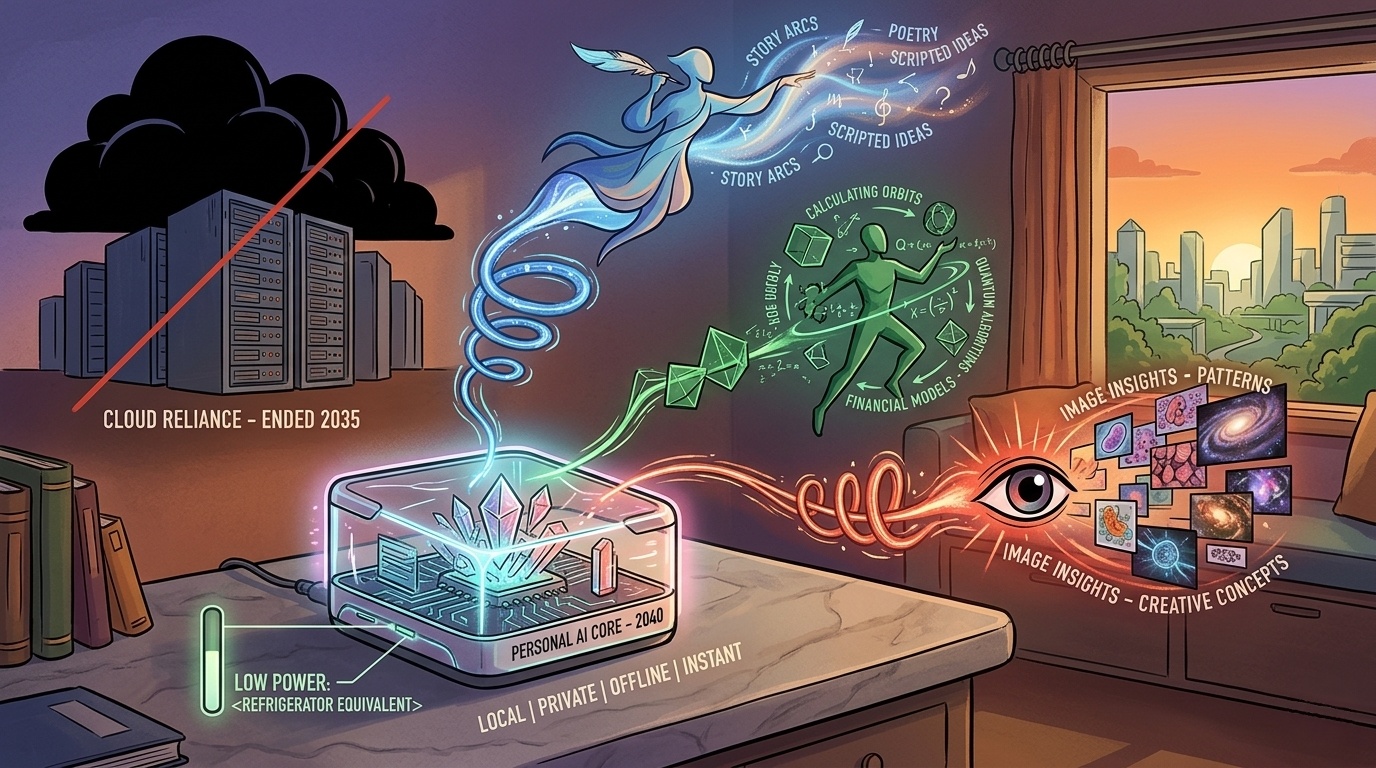
By 2035 or 2040, a reasonable projection is that a home computer (or appliance, or phone, or
smartwatch) will contain GPUs powerful enough to run a capable AI model locally, using less power
than a traditional refrigerator. You could run multiple AI agents simultaneously—one tuned for
writing, another for math, another for analyzing images—all offline, all private, all instant.
If this happens, the economics of AI change dramatically. There's no need for billions of dollars to be spent in data
center infrastructure. The energy footprint drops by orders of magnitude. Privacy is restored
because your AI never leaves your house. And the barrier to entry for AI capabilities plummets,
because the hardware costs become marginal.
We won't know for certain until we get there. Moore's Law has held for over 50 years, but it can't
hold forever. Transistors can't get smaller than atoms. But we've seen this story before: computers
that filled buildings now fit in your pocket. Video processing that once required a room full of
equipment now happens in real-time on a phone.
The GPU farm era might turn out to be a brief chapter in a much longer story—a necessary step
while we figured out how to build AI, but ultimately, a transitional phase. The future that opened
this essay, the one where your home has its own personal AI, might not be science fiction at all.
It might just be waiting for the hardware to catch up to the idea.