|
By: Paul S Cilwa |
Occurred: 11/1/1979
Posted: 7/26/2025 |
|
Page Views: 358 |
| Hashtags: #GTETelenet #Telemail #email #Tandem #Prime #TAL #ComputerProgramming |
| Telephone, telegraph, tele...mail? |
| Estimated reading time: 10 minute(s) (2256 words) |

But I couldn't take Calculus by examination, and I couldn't imagine ever needing it.
I said as much to the professor who was trying to talk me into taking his class.
Rather than providing a rational explanation as to why I should, he had a temper tantrum.
I mean that literally: he turned livid, and spittle came out as he yelled, "You need
Calculus! You use it every day! Every time you cross a bridge, or ride an elevator or airplane,
it's Calculus that made it possible!"
"Right", I responded. "Because they didn't have computers then, and needed a mathematical
shortcut to get those jobs done. But…now we do."
He threw me out of his office. But I never took Calculus (or Accounting, or Statistics; the courses
I lack for getting my degree in Systems Science).
I understood his frustration, though. He'd spent a whole lifetime mastering an arcane but
essential art that had suddenly become irrelevant. Lashing out was his only response.
I see the same thing happening now as A.I. has suddenly made a lot of jobs irrelevant.
But, in 1979, there was no A.I.; there were only very rudimentary computers that ranged in
size from that of washing machines, to something that occupied multiple floors of very
large office buildings.
And email, a concept that had been suggested by Ray Tomlinson, a computer engineer working at
BBN Technologies, had not yet reached the general public, or even the white-collared public.
In 1971, Tomlinson implemented the first networked email system on ARPANET,
a precursor to the modern internet. It was Ray who chose the "@" symbol to separate the user
name from the host computer name. Nevertheless, eight years passed before email became a "thing".
That was because ARPANET wasn't accessible to everyone, or even most everyone. It would take
a company called GTE Telenet to change that. And I was on that team.
My contract with Professional Micro Systems, which had been to complete a specific task,
was complete; and my buddy who owned PMS recommended I go a recruiter for my next contract.
However, the recruiter I saw wanted to steer me towards a "permanent" job with a new
startup, GTE Telenet. With five mouths to feed besides my own, I didn't put up much of a fuss.
Plus, as my friend had promised, "Once you make $20,000 a year, no one will ever offer
you less." So I took the job.
As if any job could be "permanent"! (Did I say that out loud? Perhaps, because the
recruiter mentioned that they don't get paid until I'd been at that job for six months.)
GTE (General Telephone & Electronics Corporation) was the largest independent telephone
company in the United States, providing local and long-distance voice services and
manufacturing telecommunications equipment from its founding in 1934 until its merger into
Verizon in 2000. Telenet, launched in 1975, was the first FCC-licensed public packet-switched
network in the U.S., connecting computers nationwide via virtual circuits. After acquiring Telenet
in 1979, GTE began work on an electronic mail feature to leverage its new packet-switching
infrastructure, enable two-way links with Telex and overseas systems, and capture a share
of the burgeoning global electronic messaging market by providing value-added business
messaging services atop its network.
When I first started there, they were in a small building in MacLean, VA. But we soon moved to
a large, custom built headquarters in nearby Tyson's Corner.
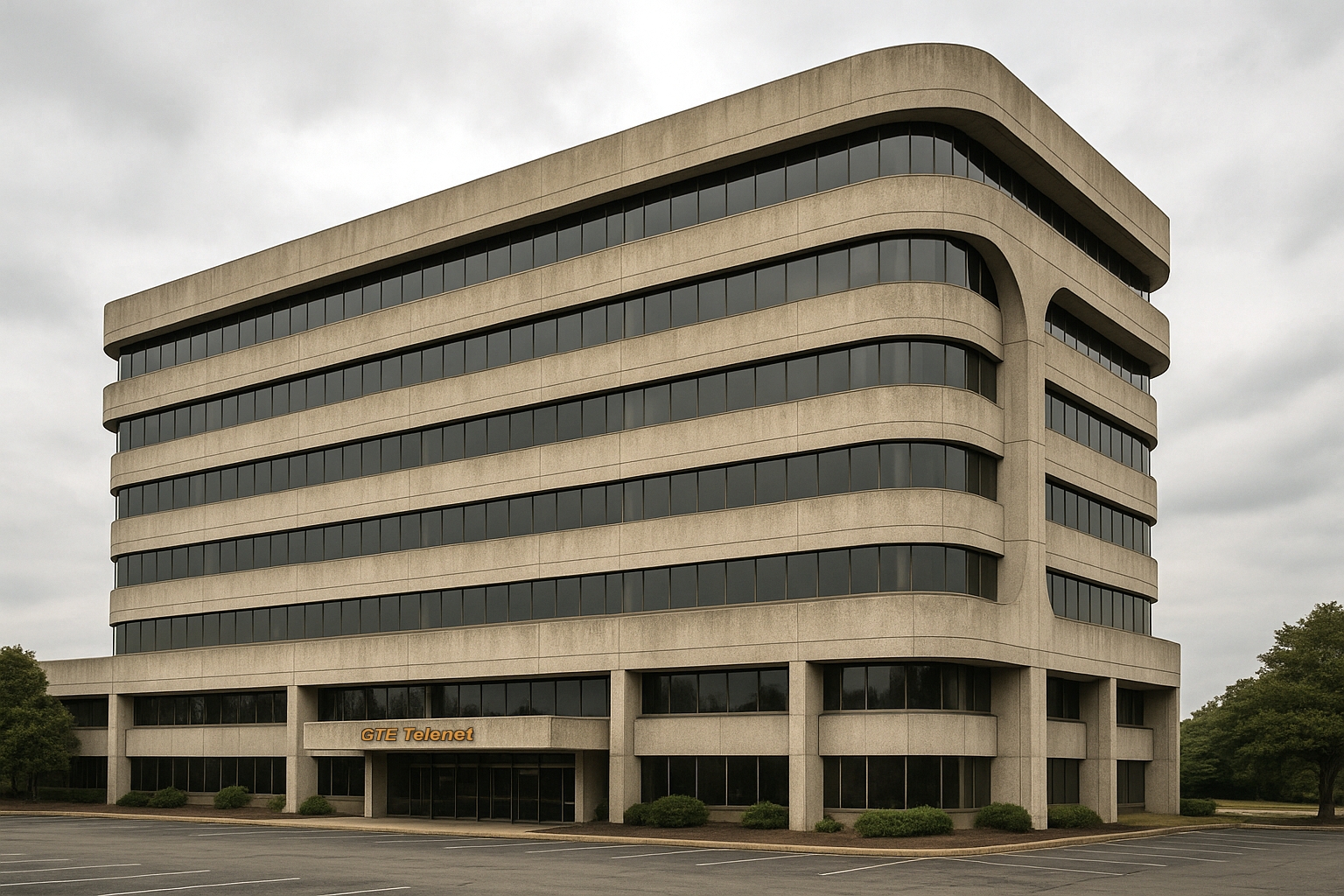
It was a small team; there were only six of us. To protect the privacy of my teammates (and to
allow me to reveal some less-than-flattering aspects), I will change their names in this document.
But they know who they are!
I was next to the last hired. Clark was the boss, a small man with prematurely-thinning black hair
and pasty skin. He shared an office (in the first building) with Ben, a former Air Force guy.
Two women, Lou and Connie, shared an office. And myself, and the last guy, Mitch, shared a third.
When we got to the new building, Clark, Ben, Lou and Connie each got offices of their own;
but Mitch and I were still packed into the same room. In the remainder of my time there,
Mitch and I were always the left-outs: "Forgotten" to be invited to group lunches; not invited
to the team photo shoot. I have no idea why this was so, but I have a suspicion which turned out to
be likely true.
The fact was, Mitch and I were doing most of the work. Ben worked on the database aspects
of the system, and he did earn his keep. I never did understand what Connie was working on.
But Lou, Mitch and I were supposed to be writing computer routines and Lou didn't have a clue
what she was doing.
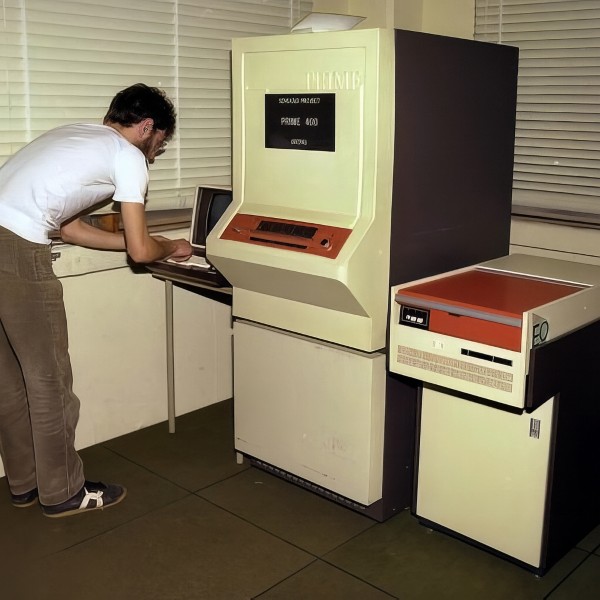
In 1979, most computers were mainframes, like IBM's System/360 family. These were designed for
massive centralized batch and transaction workloads but typically relied on planned downtime
for maintenance and offered only basic database services. This was what I had learned during my
time with the EPA. But Telemail didn't use any mainframes at all. Instead, we relied on two
kinds of "minicomputers", Prime and Tandem.
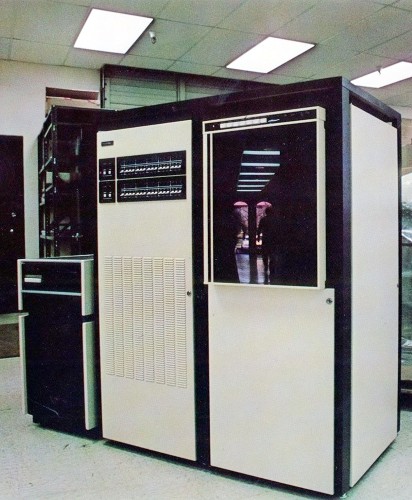
Tandem's NonStop line used a "shared-nothing" cluster of lock-stepped processors, redundant
controllers and automatic failover to guarantee continuous, sub-second recovery—making
it the go-to platform for real-time, fault-tolerant applications (ATMs, telephony switches,
emergency-response systems, etc.). Prime's PRIMOS-powered minicomputers, by contrast, carved
out their own niche with an integrated high-level database environment
that let developers build and modify interactive applications far more quickly than on a mainframe.
In short, Tandem outclassed mainframes on nonstop real-time reliability, while Prime outshone
them on ease of high-level database development, each machine eclipsing general-purpose big
iron in its specialty.
I worked on the Tandem, learning TAL (Transaction Application Language), which was not unlike the
language ALGOL. I didn't know that, either, but learning the language wasn't hard. (In programming,
the language syntax is the easiest part.) TAL is a block-structured, procedural language introduced
in the mid-1970s as the original system-programming language for Tandem's NonStop machines,
blending Pascal-style readability with C-like semantics and generating optimized microcode for
its register-stack architecture.
These days, a programming environment like Visual Studio actually error-checks and translates
computer code into machine code (the numbers that actually make the computer work) as you type.
But, in 1979, it didn't work that way. First, the programmer had to write the program, using
memory and a manual to get the syntax right. Compiling a program means feeding this source
through a pipeline of preprocessing, converting to assembly code, assembling into object files,
and linking, with each phase checking syntax and semantics and emitting machine instructions or
error reports. Since a compiler's parser depends on correct punctuation and matching keywords
to understand structure, a single missing semicolon or unmatched block delimiter can derail
its state machine, leading it to misinterpret the rest of the code and generate cascading
errors that can fill dozens or hundreds of pages of output before recovery succeeds or the
process terminates.
Actual TAL Hello World program:
PROC MAIN;
BEGIN
STRING message;
message := "Hello, World!";
WRITETEXT(message);
END;
Lou tried to write a short program of the "Hello World" variety. ("Hello World" is the
simplest possible program, which runs just to emit the words "Hello World" before terminating.
Such a program is used to test the development environment before working on anything more
substantial.) The printer ran through an entire box of paper before we realized this was
all due to one syntax error Lou had managed to type.
I can't imagine what that error was. I couldn't think of anything I could type that would
be that confusing to the compiler. (To compare, my first compile of a routine
would typically emit 5 or 6 pages of error messages.)
She never tried to write another program. But for some reason, Clark, instead of firing her,
made her…my boss!
Each week we would have a staff meeting, both to make design decisions, and to announce what we'd
completed that week. (Many times programmers will write small, helpful routines that can be
referenced from more places than the ones for which they were originally written. By announcing
them, we let others on the team know they exist, so they can become part of the team library.)
The first few meetings we had, everyone sat wherever and, when I was asked what I'd accomplished
that week, I would have something to report.
But Clark always went clockwise around the conference table. Always. And
soon Lou learned to sit to his left, so he would always ask her about her accomplishments first.
And she would take credit for mine, which she knew about because, as my boss,
she had passed on the assignment. But the way she phrased it, made it sound like she'd personally
done the work! And then, when it was my turn, I had nothing additional to add. So it seemed
like I'd done nothing!
When, in fact, I'd done things like creating the basic algorithm for converting the date and time
from any human readable format to the internal one computers require. My algorithm has
since been incorporated into every library that performs the same task. My developing specialty
became working with text, getting the computer to try to understand it: a function required today
as an essential aspect to Artificial Intelligence.
But despite my doing good work for the project, as acknowledged by Ben, Mitch and Connie, Clark
seemed to be losing patience. With me, with everything. One time he charged into my office,
screaming at me. I honestly couldn't tell about what. But I rose, saying, "I'll come
back when you've calmed down." And I left my own office.
Later, when he'd composed himself, he told me why he was so upset: I had left out of a
project something that needed to be in it. I reached for the folder for that project and
showed him the instructions I'd been given…by Lou, who he'd made my
supervisor. And there was no hint in her instructions of the missing feature.
I shrugged. "Too bad you didn't just tell me what you wanted, yourself."
And then, one day before my six month's probation was up, Clark fired me.
They fired Mitch, too. And a week later, Telemail was released to the public.
It now became clear why Mitch and I had consistently been left out of things:
Clark had always intended to let us go before they had to pay the recruiter
for hiring us, and the others knew!
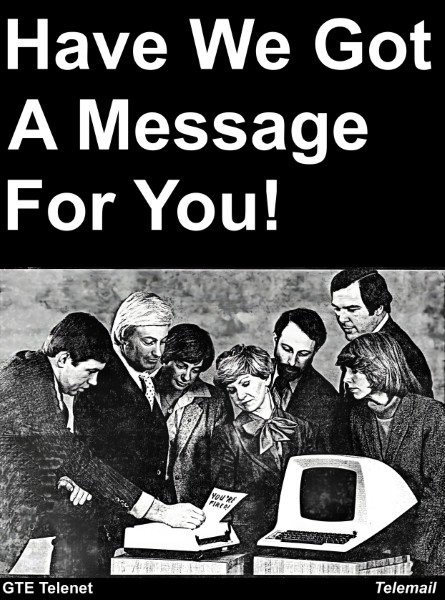
In its August 1981 issue, Business Week crowned GTE Telemail "the easiest?to?use
electronic mail system" on the market, applauding its clean, menu?driven interface
and context-sensitive help that let new users mail their first message in minutes.
Around the same time, InfoWorld's hands-on tests found that Telemail's clear prompts
and minimal command set slashed training time to under a day, while Computerworld noted
that its centralized mailbox model and simple error reporting made troubleshooting
virtually painless for in-house support teams. Byte magazine went so far as to contrast
Telemail's intuitive design with the more arcane interfaces of MCI Mail and CompuServe,
observing that Telemail's seamless Telex gateway integration and overnight facsimile-style
print-outs gave it a decisive edge in commercial environments.
But I was back looking for a job. However, this wasn't the last I ever heard of Lou.
A few years later, when I was working for the National Association of Securities Dealers
(NASD), a guy from a neighboring department came to me and said, "Do you know anyone named
Lou Llewelyn? She says she used to work for Telemail, and I remembered you did, too."
"Oh my god!" I cried. "I never expected to hear her name again!"
"Is she any good?" my friend asked. "She's applying to work in my department."
"Oh, she's very good," I enthused, "…at office politics. She'll figure
out a way to take credit for other people's work, which she has to do, because she
can't actually do the work, herself.—Is she here? I'd love to say hello!"
My friend told me later that, when he told her I worked there, she snuck out and
left the building when he stepped away for a moment.

Don't mess with me, bitch! It may take some time, but Hell hath no fury like that of
a programmer scorned.