|
By: Paul S Cilwa |
Occurred: 11/1/1981
Posted: 11/1/2025 |
|
Page Views: 323 |
| Hashtags: #Blair #Nebraska #Shopping #VideotoDigitalConversion |
| What was shopping for groceries (with four kids!) like in the early 1980s? |
| Estimated reading time: 4 minute(s) (814 words) |
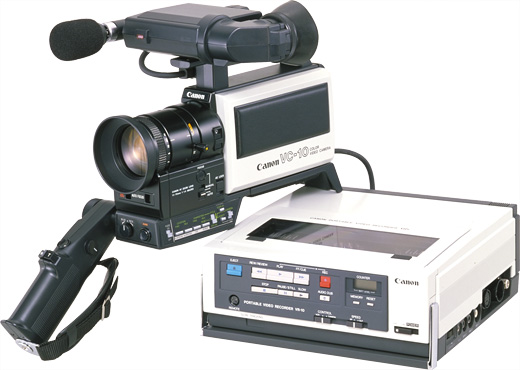
The machine still had
some heft, with its shoulder strap and separate VHS deck, but it was light
enough to follow my wife and kids down the aisles of the grocery store
in Blair, Nebraska. I remember the fluorescent lights glinting off the
chrome of the shopping carts, the kids sneaking glances at the camera as
if they were suddenly stars in their own show, and the quiet thrill of
knowing that this everyday errand—so ordinary and fleeting—was
being captured in living color and high fidelity sound, ready to be replayed
at home on our own television set.
That taping took place over forty years ago. Now, back then, most people
who took home videos simply watched the whole videos afterwards. But
I knew that watching unedited home movies is worse than boring; it contravenes
the anti-torture laws set in place by the United Nations.
But editing places existed with bays I could work in! Each bay had two decks,
a monitor, and a controller. I loaded my original, source tape, cued it,
and inched forward frame by frame. A pause, a shuttle, a decision—this
shot stays, that one is cut short. The process was slow but exact,
each splice a choice made in real time.
I had also brought a few albums with me, records I knew by heart. Their
tracks became the score. I would cue the music, then roll the tape, laying
one against the other. The hum of the machines mixed with the sound from
the speakers, and the ordinary scenes of family life gained a rhythm, a
pulse. The editing bay turned errands and laughter into something shaped,
something meant to last.
That's not what I presented above. The original "Cilwa Family Album" in VHS,
was as good as you could get in 1981—but not now. Then, VHS was
the approximate equivalent of 480i resolution (that would be an image about
640x480 pixels). Also, analog copies of originals suffered from a lot of
detail loss.
So, fortunately, I retained the originals!
About twenty years ago I got the then-new company,
Memories Renewed, to digitize
the VHS and BetaMax tapes I had saved, before they could deteriorate any
further. That gave me a bunch of digital .mp4 files
that, while they could be lost, would never decay as long as they existed.
(And I'm excessive in my creation of backups!)
Today, editing from digital files is done in software like
OpenShot and
Microsoft Clipchamp (included for free with Windows 11),
where the process is visual, non-destructive, and far more flexible
than tape-based editing.
Instead of shuttling reels frame by frame, I drag video clips into a timeline.
Each file sits as a block I can trim, split, or move with a click. Selecting
edit points is no longer a matter of committing to a cut on a master tape—it's
a reversible choice. I can shorten a shot, extend it again, or rearrange the
order without losing the original footage. The timeline shows both picture and
sound, so I can see exactly where a laugh or a glance falls, and line up the cut
to the frame.
Music is just as easy to add. I bring in an album track as an audio file,
drop it beneath the video, and slide it until the rhythm matches the images.
In OpenShot, I can fade the music in or out with simple handles on the track.
In Clipchamp, I can use built-in stock audio or my own files, adjusting levels
so dialogue and background sound balance cleanly. The hum of machines is gone,
replaced by the quiet precision of dragging, snapping, and layering.
Both programs make the process approachable. OpenShot is open-source,
cross-platform, and free, with a straightforward interface that lets me cut,
fade, and add titles without distraction. Clipchamp, built into
Windows and available online, emphasizes templates and quick exports,
with AI-assisted tools for trimming or resizing. Together they represent
the shift from editing as a mechanical ritual to editing as a fluid, iterative
craft—where the ordinary moments of life can be shaped, rearranged,
and scored with ease.