|
By: Paul S Cilwa |
Posted: 2/5/2013 |
|
Page Views: 6,112 |
| Hashtags: #SocialSecurity #disability #necrotizingfasciitis |
| I try to explain to the judge at my hearing why I deserve to be on Social Security Disability. |
| Estimated reading time: 6 minute(s) (1376 words) |
Your honor,
In January, 2011, I was bit by something—probably a spider—in
bed. I thought nothing of it at the time. Two days later, I came
down sick with what I thought was the flu. The next day I was in the
hospital, and the next day, I was in a coma. When I came out of it a
day later, I woke to find all the skin and half the fascia (the
layer between the skin and muscle) gone from my lower left leg, and
a gaping wound from the knee to my groin. I was told I had beat a
mere 20% chance of survival.
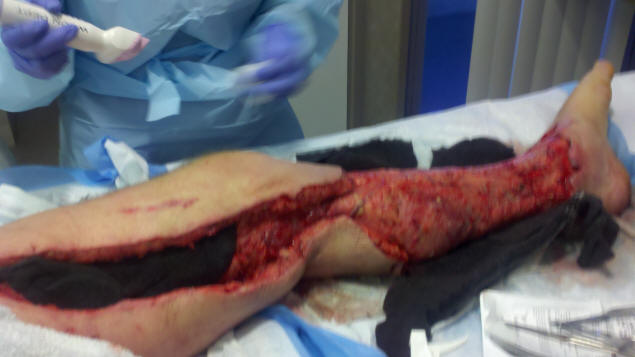
The diagnosis was necrotizing fasciitis, popularly known as
"flesh-eating bacteria."
I underwent a series of painful operations to graft healthy skin
from my upper legs to the skinless lower left leg. Every day was
agony, made slightly less unbearable with heavy doses of the
painkiller dilaudid, and the anti-anxiety medicine, ativan.
I was in the hospital for months—you have the exact dates in the
paperwork from the hospital—and when I was released, I still had a
PICC line for a daily antibiotic drip, and I was attached to a
device called a wound vac. I was instructed to keep my leg higher
than my heart for as much of the day as possible. I was able to
perform simple chores such as laundry and running the dishwasher,
but no more than that.
I have worked steadily since I was 14 years old, and it never
occurred to me I couldn't, or shouldn't, go back to work as a
computer programmer. So, in April of 2011, I attempted to return to
my job. At first, my supervisors were encouraging. But when it
turned out that painful swelling made it impossible for me to work
full time, and lapses in memory (a documented side effect of the
ativan I never expected to linger after I stopped taking it)
affected the quality of work I could do, they let me go. (I was a
contractor, and they could fire me for any reason or no reason at
all.)
The frequent and inexplicable bursts of tears probably didn't
help, either. (I learned later that NF often produces symptoms of
PTSD in its victims.)
Friends recommended I apply for Social Security Disability "just
in case" and I did so, not really expecting that I wouldn't have
another job before it ever came through. After all, sick and wounded
as I was, I still didn't have the mindset that I was "disabled." I
felt like it was a temporary setback that I would soon overcome.
Consequently I kept trying to do "normal" things, starting with
getting another job. The problem was, even more than crying during
phone interviews and forgetting what we were talking about, that I
could not remain upright more than a couple hours without my left
ankle swelling and becoming excruciatingly painful. The swelling and
pain could only be alleviated by putting my leg up higher than my
heart, a position no employer could envision accommodating in the
workplace.
I also tried doing the things I love, like hiking and swimming.
Both attempts were disastrous. The grafted skin on my leg has never
grown to be as supple as "normal" skin; and my immune system hasn't
recovered. My lower left leg has no sense of feeling, so that I can
brush against a normally innocuous object, such as a rock, bush, or
chair, not realize it, and find myself with an open cut that quickly
gets infected. It took four more hospital stays, complete with more
antibiotics, dilaudid and ativan, before I finally realized I really
couldn't do those things ever again…at least, not without risking
my life.
Now it's 22 months later, and the situation hasn't changed. My
ankle still starts swelling after I've gotten up, and I have to lie
down with my leg higher than my heart for an amount of time equal to
how long I was up, for the swelling and pain to subside. The pain
isn't just annoying, it's mind-numbing and prevents me from thinking
clearly, even beyond the lingering effects of the ativan. If I take
strong drugs (such as Percocet), the pain eases somewhat but then I
can't think at all. So the only real solution, which I've
employed for the past year, is to carefully time my activities so I
get up, do what I have to do, then lie back down—leg higher than my
heart—for the same amount of time.
The most I can stay up without severe pain is just under four
hours.
And it doesn't matter whether I am standing or sitting, or, for
that matter, riding a bike or watching TV. It's up for four hours,
then down for four hours…and by then, the pain is severe enough
that I can't even read. I just breathe and try to meditate until it
passes.
Of the four issues I have that make me unable to work, only the
memory loss/mood swings are invisible. Several years ago I tore my
right bicep tendon, which you can see. This has weakened my right
arm to about 30% of its former strength. This never interfered with
computer programming, but eliminates truck driving, factory work,
and similar physical jobs. (After 9/11, I spent a year driving truck
since there were no programming jobs available.) The thin skin on my
leg is easy to see and feel, and a basic understanding of the
mechanism of infections will make it obvious why I must maintain
constant wariness to make up for having no feeling to warn me of
impending danger. And, finally, while the pain in my ankle
can't be seen, the swelling can be seen and measured.
I have worked all my life. My first paying job came when I was
14; the summer I was 18 I had three part time jobs at once. I have
often worked two or even three jobs at the same time. In the
seventies, I had a full-time job, two part-time jobs, and
carried 19 credit hours at my local community college (and was on
the Dean's List). When people used to ask me what my retirement
plans were, I would joke that I intended to go camping in Canada and
annoy a grizzly. See, I never intended to retire at all. I have
always loved my job, and being with the friends I made at my work. I
loved being good at what I did.
And through all that, I paid my Social Security taxes knowing
that, if I ever couldn't work, I would have that to fall back
on. It is, after all, supposed to be an insurance policy.
According to the rules, if my condition persists for 12
months, I am eligible for disability. Well, it's been 22
months and my improvement has long since plateaued. Meanwhile, while
waiting for the disability to come through, I've lost my house, my
car, and am now living with friends whose patience is surely wearing
thin. I feel certain, your honor, that if your auto insurance
resisted paying you with the dedication Social Security has resisted
paying me, that you would be at least as frustrated as I am.
All I am asking is what I have paid for during 45 years of being
a contributing member of society. All I am asking is that you
acknowledge what is materially visible to you, your honor, should
you simply look at my leg and ankle. I am only asking for what
I've paid for and am entitled to. With disability payments, I can
stop being a burden on my friends and society and maybe even get a
little more enjoyment out of my life and grandchildren in the time I
have left to me.
Thank you for your consideration.
Regards,