|
By: Paul S Cilwa |
Occurred: 10/3/2022 |
|
Page Views: 1,197 |
| Hashtags: #Health #LumbarSpinalStenosis #MedialBranchBlock #Arthritis |
| Hey, who needs those nerves anyway? |
| Estimated reading time: 4 minute(s) (799 words) |

I turned down the option of sedation, partly because I'm guessing it would cost more; and
also because it would require my having a driver to take me home. Besides, at this point I'm one
tough sunavabitch and it takes a lot of pain to even get my attention.
Medial branch blocks are a minimally-invasive, non-surgical injection for
neck and back pain.
First understanding the anatomy of your back can help you learn how these
blocks work. To start, your spine consists of vertebrae cushioned by
intervertebral discs that are further stabilized by facet joints. These
joints allow your spine to twist and flex safely. Running through and
innervating each facet joint is the medial branch of the dorsal ramus
nerve—the first branching nerve root in the spine.
Over time, and sometimes because of injury or a chronic pain condition,
facet joints can become irritated and inflamed. This sends pain signals from
the medial nerve to your brain.
A medial branch block reduces inflammation and irritation in the facet
joints of the spine, blocking these pain signals. A medial branch block
placed directly next to the medial nerve may provide relief when other facet
joint injections (into the joint itself) have been unsuccessful.
Medial branch blocks may also be used as a diagnostic tool. For example,
patients who find relief from a medial branch block can opt for
radiofrequency
ablation, a more long-term pain treatment.
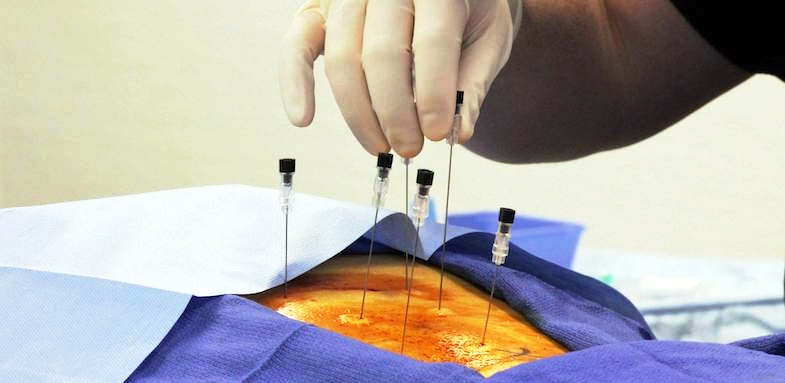
Since I wasn't sedated, the whole procedure was brief. The doc gave me six numbing
shots, so I wouldn't feel the deeper application of numbing agent on each side of my spine.
The numbing shots definitely got my attention.
And then I got up. The problem is, I was so sick with my migraine that I could barely
feel my back at all. It was all about that band of tightness at the back of my neck (where I
normally get my headaches.
If this procedure works, I am expected to have no back pain at all for a period of
four to six hours. Thus, I was requested to fill out a pain diary, and here it is:
| Time | Pain Level | Notes |
|---|
| 11:30 AM | Back: 5
Head: 7 | Drove to Winco, went
shopping (in a cart). Back is still very stiff. Doesn't hurt, exactly;
but hard to flex it. Still have migraine. |
|---|
| 12:30 PM | 4 | Carried groceries upstairs to apartment.
Migraine still hurts. Back is still stiff. But I have to lie down b/c
headache. |
|---|
| 1:30 PM | 5 | Made a lunch omelet. Back is still very
stiff. Again, not exactly pain but discomfort. (Note: My back was
unusually bad when I woke at 4AM with the migraine, especially at the
top of my left hip.) |
|---|
| 2:30 PM | 5 | Rose from nap. Back so stiff I can hardly
walk. |
|---|
| 3:30 PM | 3 | Back less stiff. Headache gone. |
|---|
| 4:30 PM | Spine: 0
Hip:5 | Spine pain gone entirely
but hip pain takes over when I walk. And while my spine doesn't "hurt",
it is as stiff as concrete. |
|---|
| 5:30 PM | Spine: 0
Hip:4
Stiffness: 5 | Walked
dogs. Spine not hurting but walking is difficult, Spine very stiff. |
|---|
| 6:30 PM | | I'm now at the part of the post-migraine
thing where the headache is gone and I'm just exhausted and only want to
sleep. Still stiff. |
|---|
Next day,
8:30 AM | 6 | This is later than I was
instructed to journal, but it was remarkable enough to note. When
walking the dogs, I have to walk them separately because I can't manage
them both at the same time. Each dog is a walk downstairs, and around the outside
of the pool enclosure; then back up the stairs. In my current shape, this
is an effort every time—and by now you'd think I'd just be used to doing
it so it shouldn't be an effort. But because of the back pain, it is.
And the thing is, now that my spinal pain had returned, I could realize
that it had really been absent yesterday. The stiffness and my headache
were unpleasant but may not have been related to the procedure—certainly
the headache wasn't. So a second test, one done without a concurrent migraine,
is probably called for. |
|---|