|
By: Paul S Cilwa |
Posted: 8/21/2026 |
|
Page Views: 208 |
| Hashtags: #Tolerance #Intolerance #KarlPopper #Logic #Mathematics #Philosophy |
| Tolerance and intolerance do not cancel out like plus and minus. Intolerance is zero, and everything you multiply by it becomes zero. |
| Estimated reading time: 7 minute(s) (1515 words) |

Popper Buried It In A Footnote

The idea is not mine and it is not new. Karl Popper laid it out in
The Open Society and Its Enemies, published in 1945, which he
wrote from New Zealand while the war he was really writing about was
still being fought. The most quoted sentence in that entire two-volume
work is not in the text. It is in a footnote to chapter seven, where he
observes that "unlimited tolerance must lead to the disappearance of
tolerance."
That line has been doing heavy lifting on the internet for years,
deployed mostly by people who stopped reading at the end of it. Popper
kept going. In the same footnote he says he does not mean that
intolerant philosophies should be suppressed as a matter of course. So
long as we can answer them with argument and hold them in check with
public opinion, suppressing them would be a mistake. He drew his line
somewhere much more specific: at people who will not meet you on the
level of argument at all, who answer reasoning with fists.
So Popper's version arrives with a condition attached, which is
precisely the sort of thing that evaporates when a paragraph becomes a
meme. But he was making a philosophical case, and philosophical cases
can be argued with forever. What interests me is that you can reach the
same conclusion without appealing to philosophy at all.
Plus And Minus Is The Wrong Picture
Here is where these arguments usually go off the rails. Everybody
pictures a scale. Tolerance on one side, intolerance on the other, and
if you pile up enough of the first you can afford to carry a little of
the second. Plus one and minus one make zero. Enough plus ones and a few
minus ones do not matter.
That picture is comforting and completely wrong, and you can show why
on a napkin.
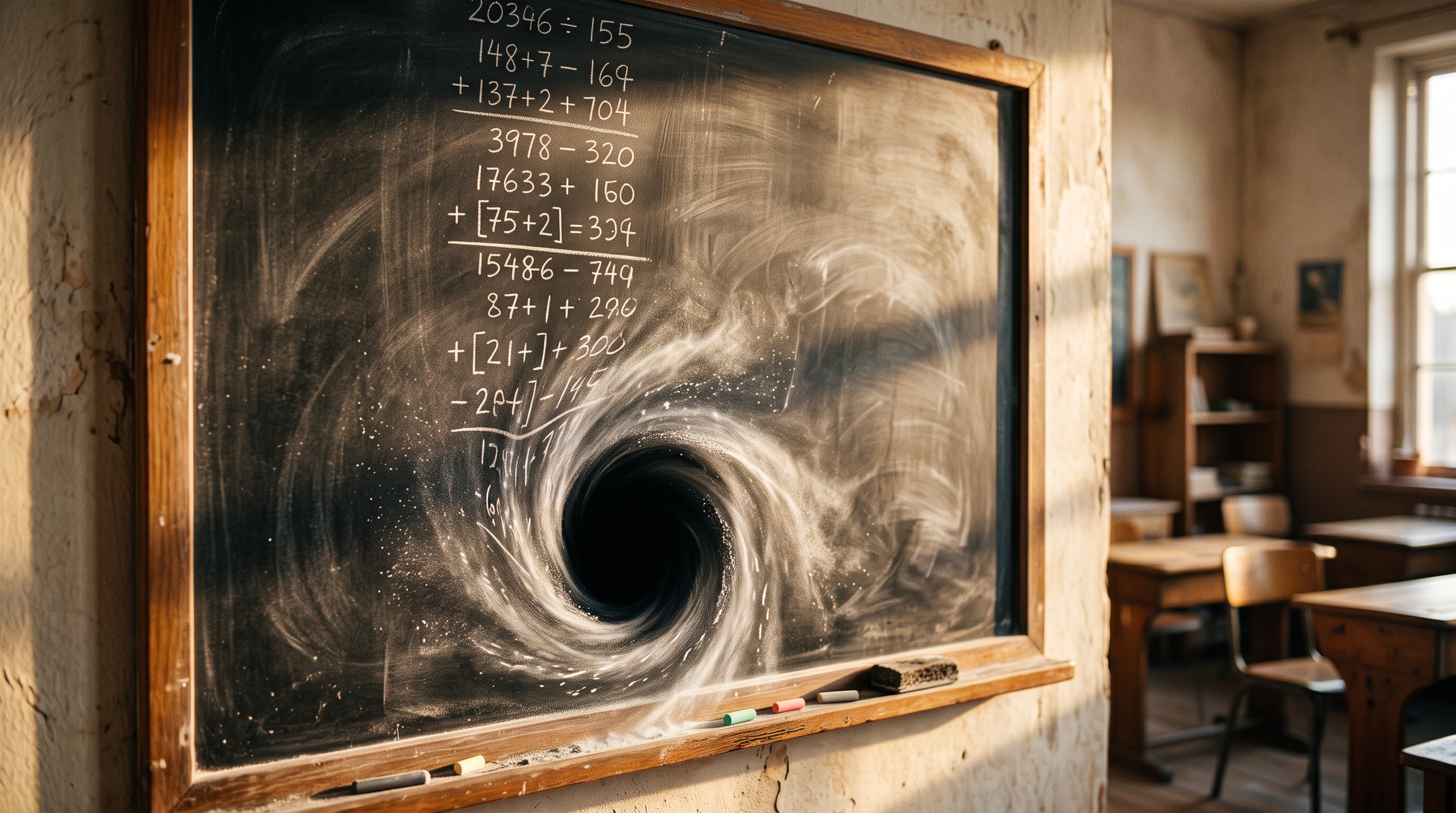
Start with multiplication instead of addition. Take any number you
like—a million, say. Multiply it by one. You still have a million.
Multiply by one again, and again, forty times in a row. Still a million.
Multiplying by one is the mathematical equivalent of leaving the room
exactly as you found it.
Now multiply your million by zero.
It does not matter how big the million was. It does not matter how many
times you multiplied by one beforehand. You have zero. And here is the
part that actually matters: there is no number you can multiply zero by
to get your million back. Not a million. Not a trillion. Zero does not
cancel anything out. Zero absorbs. Mathematicians call it an
absorbing element, and it is the most accurate description of
intolerance I have ever run across.
The Room

You can skip the notation entirely and just picture a room.
Tolerance is a rule about who gets to be in the room, and the rule is:
everybody. Intolerance is also a rule about who gets to be in the room,
and the rule is: everybody except them.
Now run those in sequence. Let intolerance work on the room first, then
apply tolerance to whatever is left. Tolerance announces that every
person in this room is welcome here. Which is true! It is also
useless—the people intolerance removed are not in the room to be
welcomed, and tolerance has no way to go out and get them.
That is the whole paradox, right there, and it needed no equations at
all. Tolerance has no restoring force. It cannot un-remove anybody. It
was never that kind of rule. All it can do is decline to remove anyone
itself. Intolerance subtracts; tolerance does not add. It merely
refrains from subtracting.
Which means the two are not opposites. They are not even the same kind
of thing. One is a rule about how to behave inside the room. The other
is a rule about who the room is for. You can no more balance those
against each other than you can balance a pound against an hour.
Order Matters, And Then It Stops Mattering
Ordinary addition does not care about order. Three plus five is five
plus three, and nobody has ever lost sleep over it. Plenty of real
operations are not so accommodating. Socks and then shoes is a fine
morning. Shoes and then socks is a bad one.
Tolerance and intolerance do care about order, but in a peculiar way:
whichever order you run them in, you get the same answer. Tolerate an
intolerant society and you have an intolerant society. Introduce
intolerance into a tolerant one and you have an intolerant society. Two
different roads, one destination, and no road out.
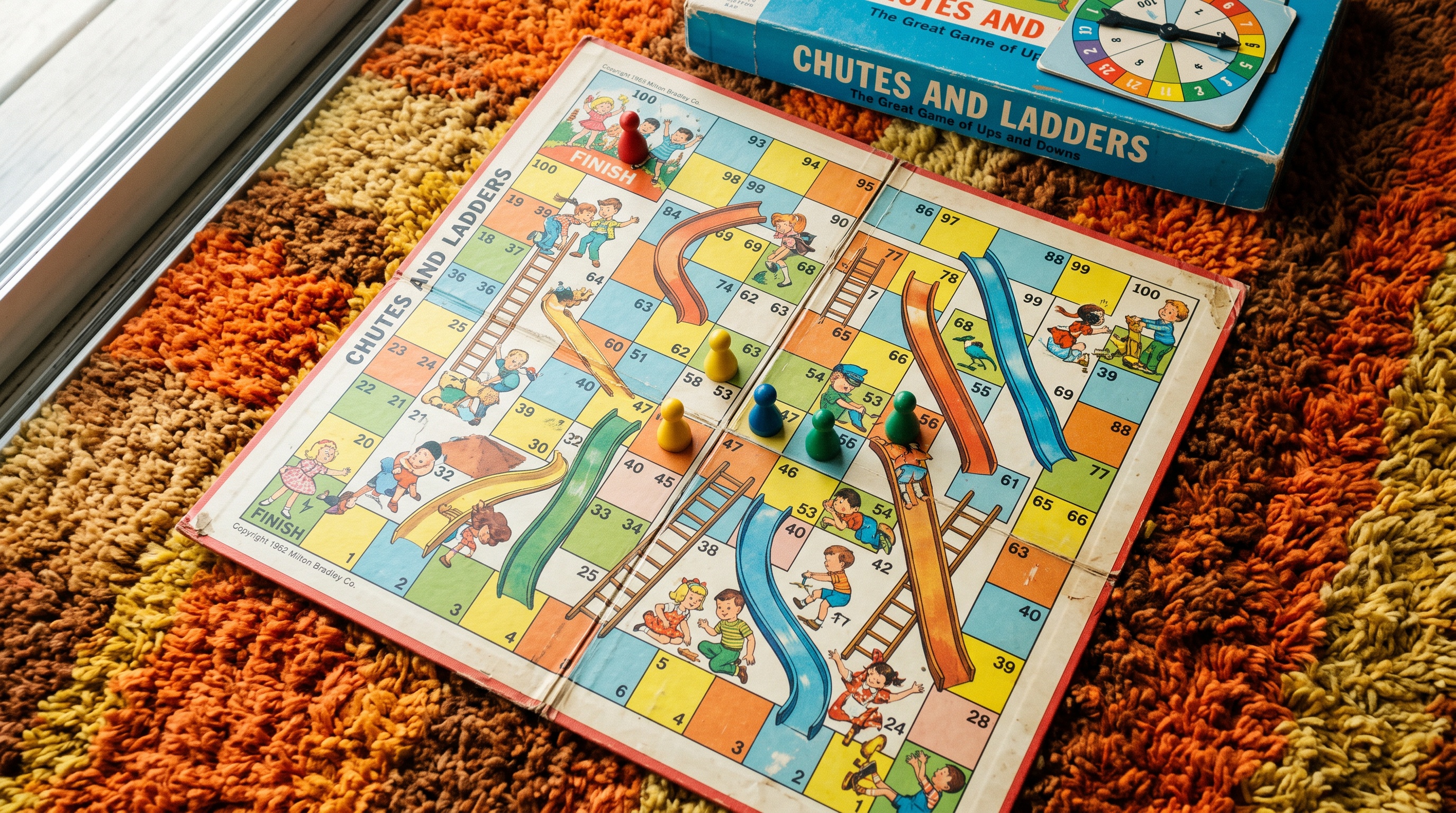
Mathematicians have a name for a state that every path leads to and no
path leads away from, and anybody who has played Chutes and Ladders has
met one. It's the last square. You can reach it from anywhere on the
board. Once you are on it the game is over, and nothing you roll changes
a thing.
The mathematics of systems that wander from state to
state—weather models, board games, a gambler working through a
fixed bankroll—treats those squares as a special case, because
they determine the ending regardless of everything that happened
earlier. Intolerance is that square. It does not have to win the
argument. It only has to be reachable.
Welcome to Bikini Bottom: Please Follow the Rules

I was a lifeguard during most of my teen years, which is the closest I have ever come to
running a small society. The beach had rules that I had to enforce regardless of
my own opinions. No swimming in the riptide. No nudity.
No playing with the jellyfish. And no holding anybody underwater.
(And I'm serious about having to enforce the no-nudity rule! It didn't happen
often, but once I had a European tourist who just couldn't understand
why I wouldn't let the sun shine on her boobies.)
Nobody ever accused that beach of hypocrisy. Nobody stood dripping on
the sand demanding to know how a facility that welcomed the entire
town could presume to stop them from holding somebody's kid brother
under. The question would have been ridiculous, and everyone knew
exactly why. The rule against holding people under was not in tension
with everybody's welcome. It was the mechanism by which everybody's
welcome survived contact with actual people.
Fire codes work the same way. A building code permits an enormous range
of human activity and prohibits arson, and nobody has ever called that a
philosophical inconsistency. The prohibition is not an exception to the
openness. It is the maintenance requirement for the openness.
Tolerance is that same kind of arrangement, and always has been. It is
not a personal virtue you accumulate points in. It is a condition a
system is in, and it stays in that condition only as long as nothing
absorbing gets into the water.
None Of This Is About Being Good
That is the part I like about the structural version, and the reason I
wanted to write it down. Zero is not evil. Zero has no character, no
intentions, no unhappy childhood. It has a property—it
absorbs—and you can prove that property without knowing the first
thing about zero's inner life.
I spent a lot of years treating tolerance as a moral question, and moral
questions are the ones where everybody arrives already wearing armor.
Nobody in the history of the world has changed their mind because you
informed them their values were defective. Structure is different.
Structure fits on a napkin. Structure does not require anyone to concede
that they are the villain of the story; it only requires them to accept
that a million times zero is zero, and most people will grant you that
much before breakfast.
So when somebody smiles and delivers the gotcha—if you're so
tolerant, tolerate me—I have stopped answering with a
speech about values. The honest answer is smaller and much harder to
argue with. I would if I could. It doesn't work that way. Not because
of my morals. Because of the arithmetic.