|
By: Paul S Cilwa |
Posted: 9/12/2026 |
|
Page Views: 322 |
| Hashtags: #Retirement #Programming #OperatingSystems #Singularity #DesktopMinder #FileExplorer #Projects |
| In 1995 I started building a document-oriented operating system. I should be done any day now! |
| Estimated reading time: 8 minute(s) (1846 words) |
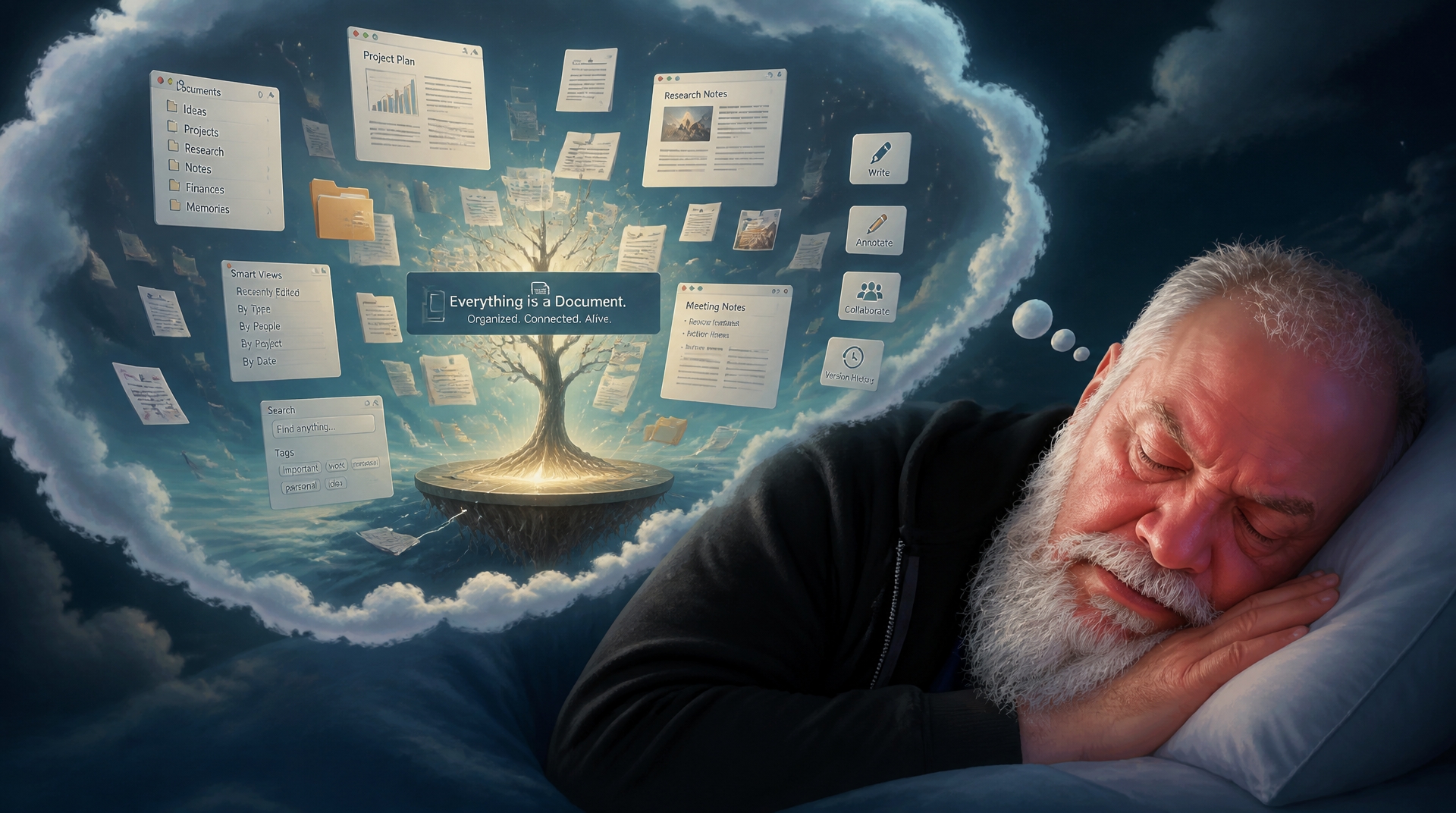
Suppose a letter arrives in the mail and you want to read it. You pick up
the letter. That is the whole procedure. Nobody has ever opened a
letter by first going to the closet, getting out the letter-reading
machine, plugging it in, waiting for it to warm up, and then asking the
machine to go find the letter.
On a computer, that is exactly what we do, and we have done it so long
that we no longer notice. You do not open the letter. You open Word, and
then you ask Word to go and fetch the letter. The document is the thing
you actually want, and in every system I have ever used, the document is
the passenger.
This has bothered me since 1995. I have a folder to prove it.
The Operating System of Your Nightmares
The folder is called The Operating System of Your Dreams, and
it contains two chapters of a book by that title, saved in Microsoft Word
6.0 format, written on a machine whose hard drive went up to F:. I had
published three books by then and was working on a fourth, so proposing a
fifth felt reasonable in a way I would like to recapture.
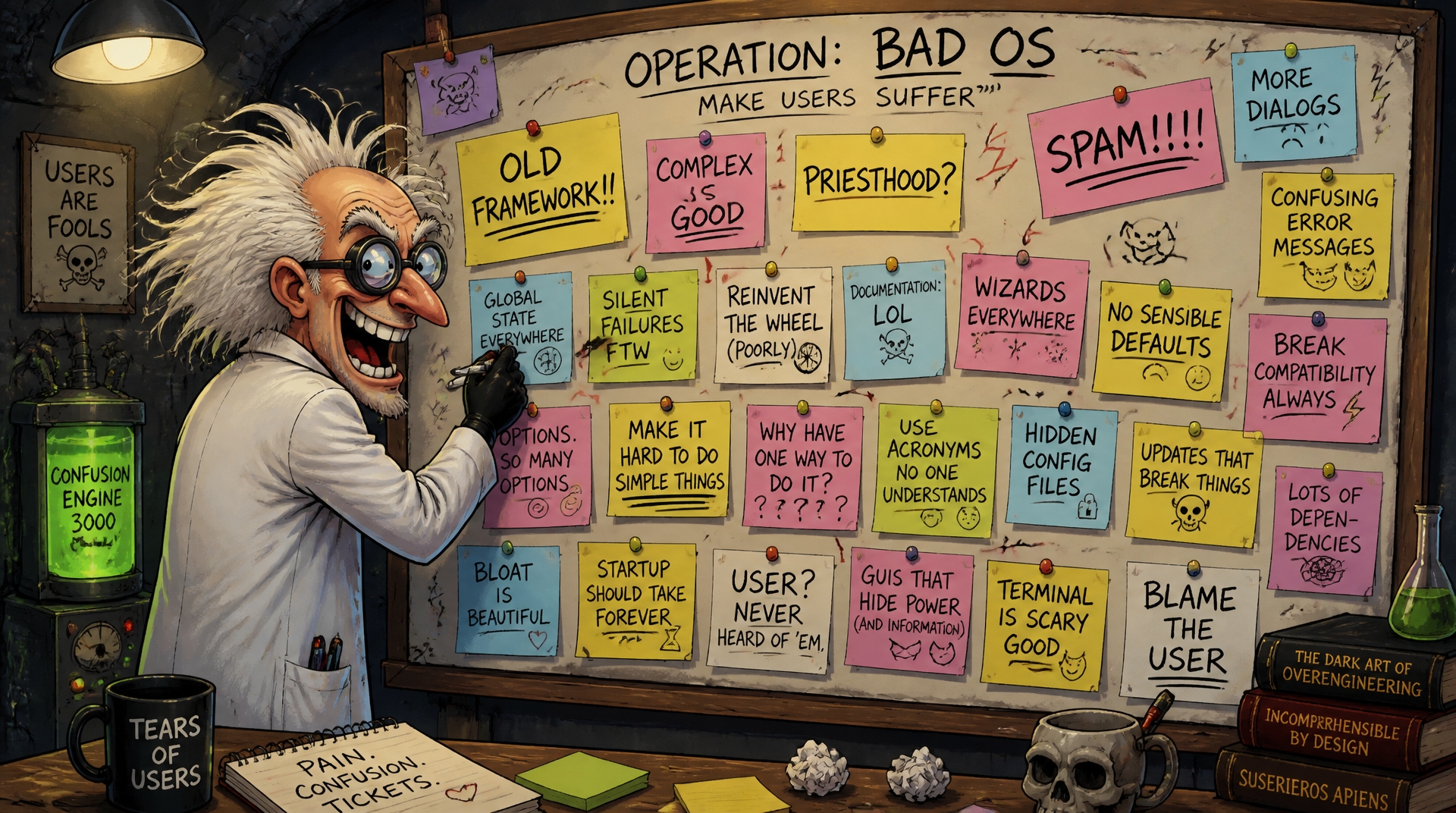
Chapter One did not open with the good idea. It opened with a list of how
you would design a truly bad operating system, if that were your
goal. Base it on something written twenty-five years earlier. Carry
forward compatibility with every obsolete program anyone has ever
written. Keep a file system that has not changed in its essentials since
the Ford administration. Bolt an object-oriented user interface onto a
foundation that is not object-oriented at all. Then bury the whole
arrangement under an object model so complicated that the man who wrote
the book explaining it admits in print that he does not understand
it.
The joke in 1995 was that I had just described DOS, Windows, and OS/2.
The joke in 2026 is that I could republish that list without editing a
word of it. Two of those three operating systems are gone and the list
survived them both. We are still dragging the file system, still bolting
objects onto something that is not one, and the folder on my desktop
still has a little picture of a manila folder on it because in 1974
somebody needed a metaphor a filing clerk would recognize.
Singularity
The replacement was going to be called Singularity, and the book was going
to build it a chapter at a time, in public, starting from nothing. Boot
sector first. Then protected mode. Then a task switcher, a keyboard
driver, a video driver. The reader would type it in and end up holding an
operating system, which is a thing I genuinely believed a person could
do, because in 1995 it very nearly was.
Chapter Two got as far as the floppy disk. It is a good chapter. It
explains why the FAT file system wastes space, what the BIOS parameter
block is for, and why IBM once shipped a version of DOS that refused to
read a disk unless the disk claimed to have been made by IBM. And beside
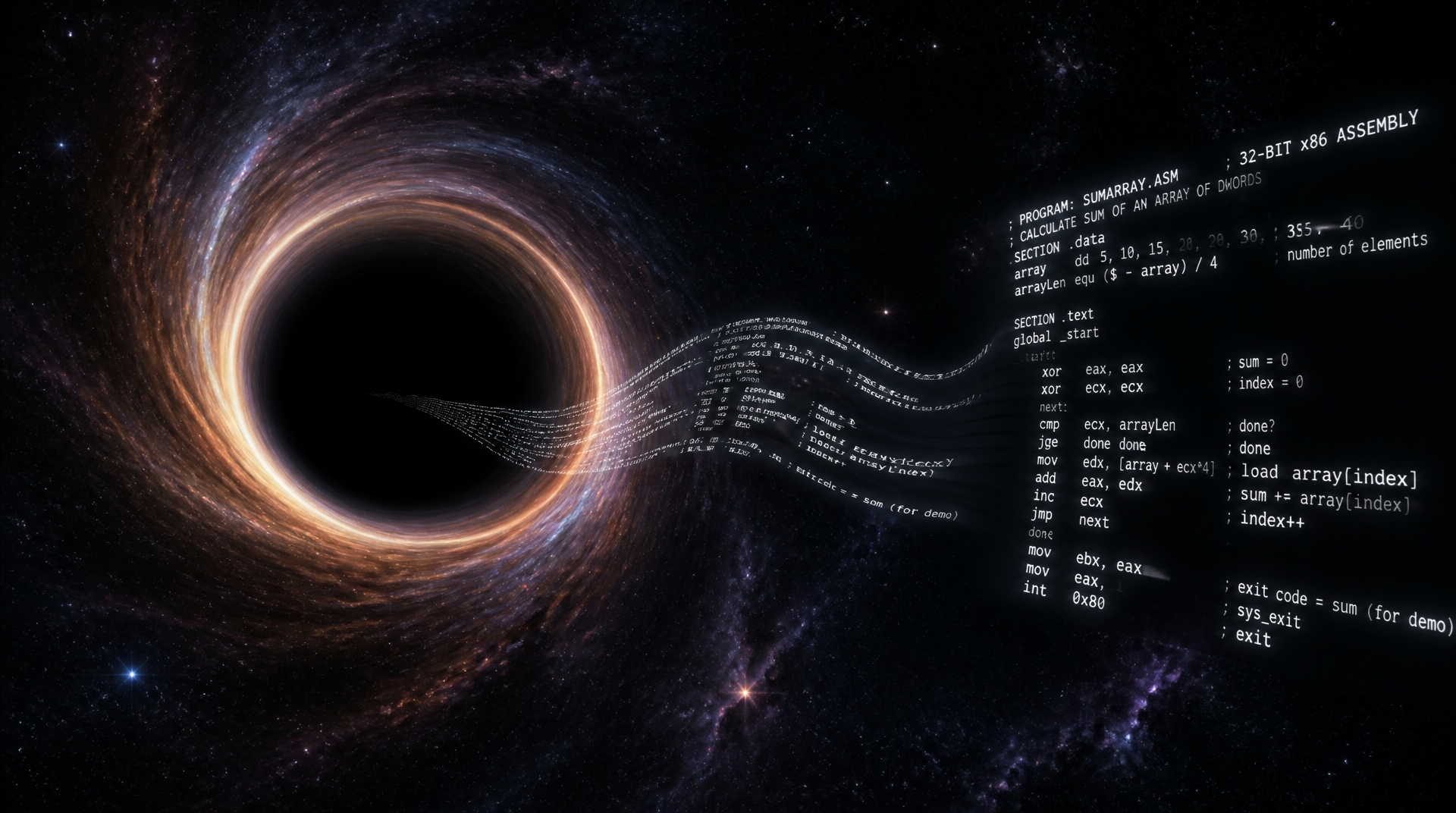
the chapter, in a folder named _BOOT, sits BOOT.BIN:
five hundred and twelve bytes of assembler that boots a PC from a floppy
and puts the words I am loaded! on the screen.
That is as far as Singularity ever got. Not because the idea was wrong,
but because writing an operating system from the boot sector up is not a
project. It is a career, and I already had one of those, plus four
children and a publisher who wanted a different book.
The Part That Was Actually The Idea

Here is what I have understood since, and it took an embarrassing number
of years: the boot sector was never the point. Windows boots fine.
Nobody is waiting for me to solve that.
The point was buried three items down in Chapter One's wish list, in a
sentence about how the system should not have a file system at all, but
should use the disk to store objects. I knew that mattered. I
could not have told you why, and I certainly could not have told you what
it would look like from the outside.
What it looks like from the outside is this. You have a document. The
document knows what it is, and therefore it knows how to do things to
itself. You do not go get a program and point it at the document. You
open the document, and the things that can be done to it are simply
there, because they belong to it.
Open a web page on my desktop and it gives you three tabs: View, Edit,
Source. Not because I wired up a browser, an editor, and a text editor
and made them cooperate, but because "web page" is a kind of thing that
knows it has those three faces. A song has a Play. A photograph has a
View and an Edit. A folder is a document too—it is the kind of
document whose contents are other documents—and it opens the same
way everything else does.
Not The Three Letters After The Dot
The piece I am proudest of is invisible, which is usually how it
goes.
Windows decides what to do with a file by looking at its extension and
consulting a registry of which program claimed that extension last. My
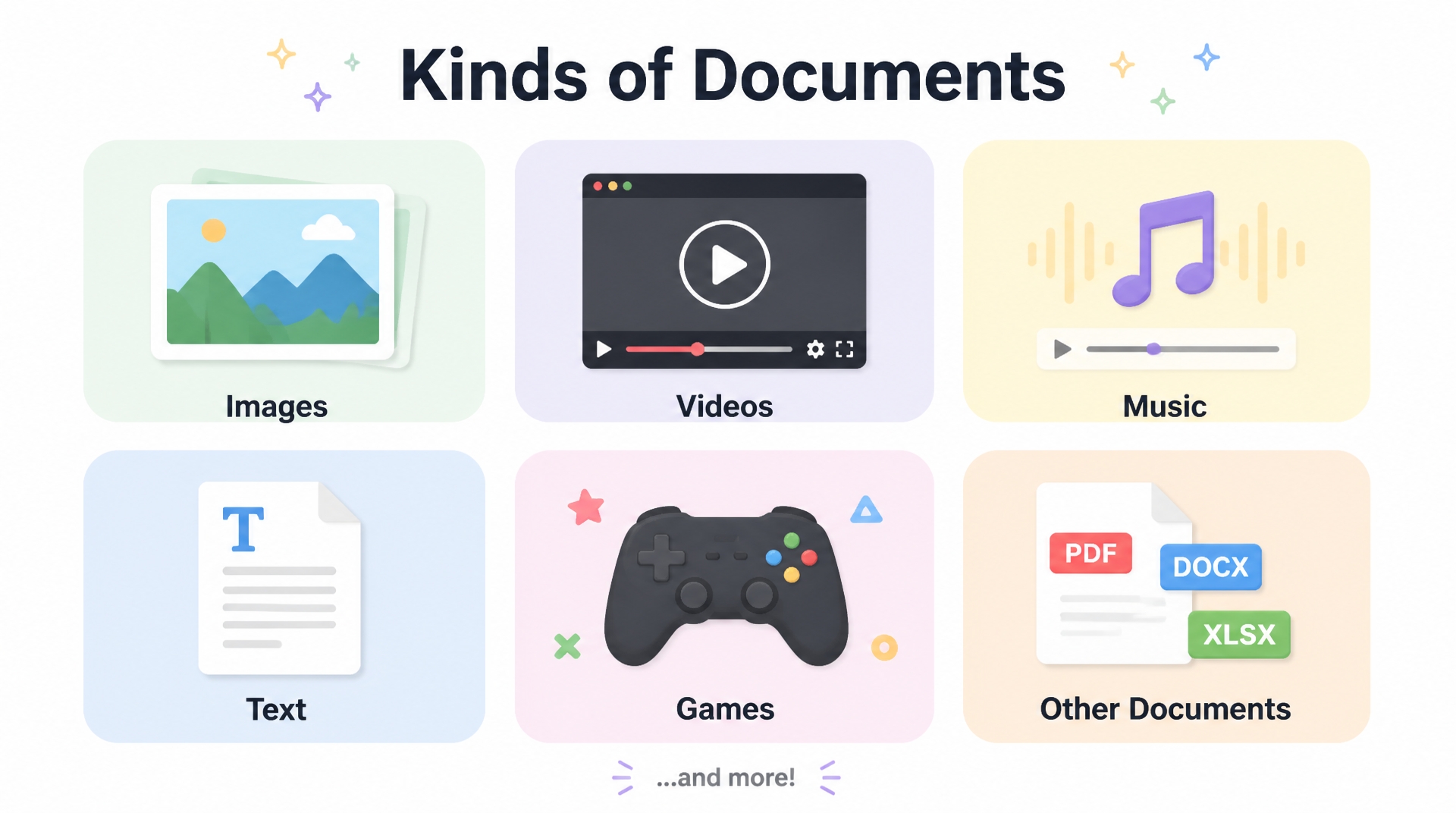
system asks a different question, which is what the thing is.
Music. Pictures. Markup. Plain text. The extension is evidence, not the
verdict, and a shortcut resolves to whatever it points at, so a shortcut
to a folder opens the folder instead of launching something.
That sounds like a distinction without a difference until you notice what
it makes possible. A contact is a kind of thing. So is a mail account.
Neither of them is a file, and neither of them has three letters after a
dot, and both of them can walk into this system later and be treated
exactly like everything else, because the system was never asking about
files in the first place. It was asking about kinds.
And when it meets a kind it does not know, it does not bluff. It hands the
thing to Windows and lets Windows open it however Windows likes. The
unknown case is not a failure; it is a doorway, and leaving it open is
the only reason a system like this can be built by one retired man
instead of a division.
My favorite detail is a file extension. Double-click a .reg
file in Explorer and Windows quietly rewrites your registry, because
somewhere along the line somebody decided that "open" and "execute" were
the same verb. My system shows it to you as text. You asked to look at
it. Merely looking at a thing should never change your machine.
Multiple Desktops
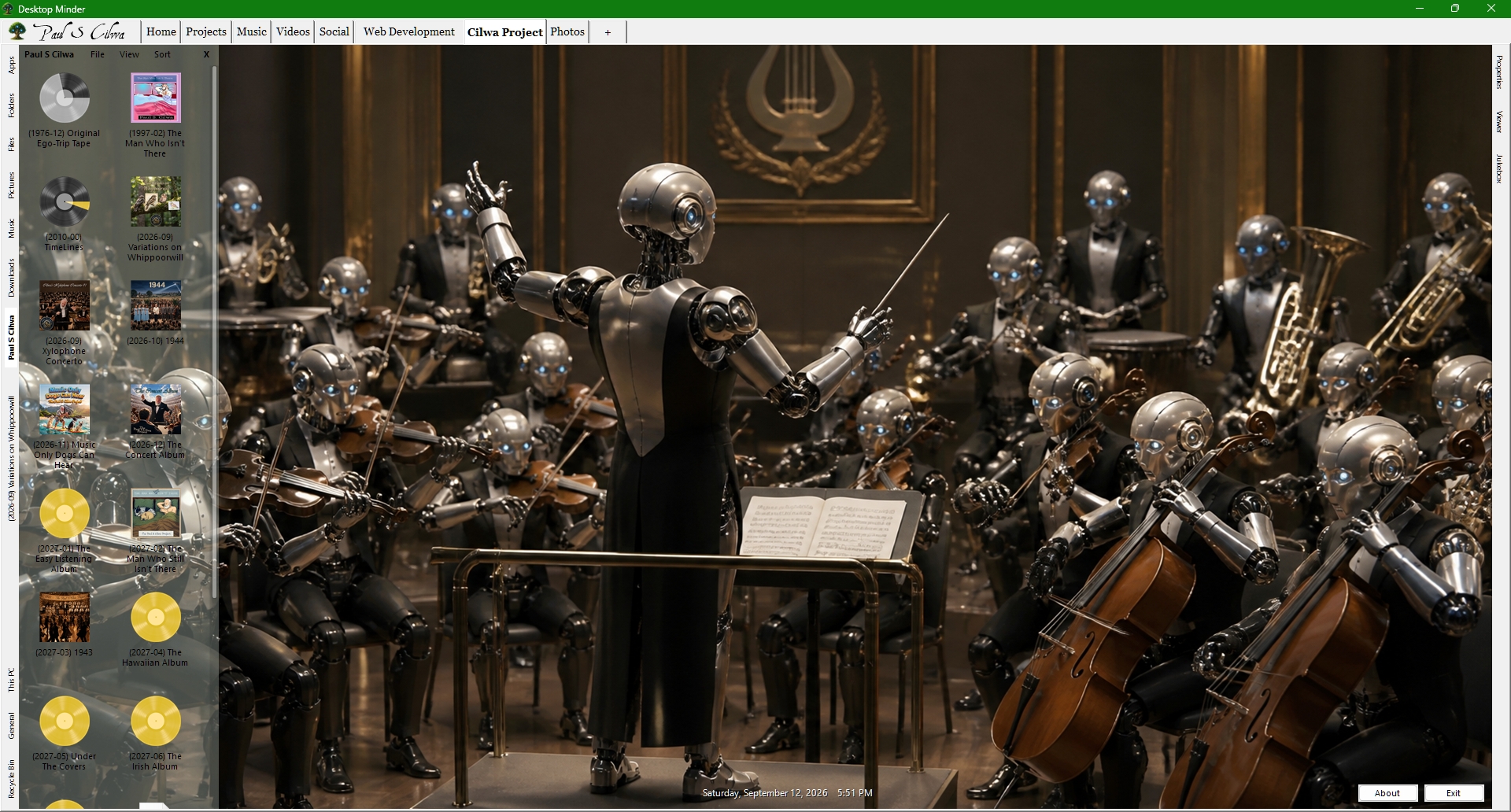
The other half of it is that there is not one desktop. There are as many as you like!
Home, Internet, Social, Music, Places, Photos, Projects, Videos, Betsy's Wedding—you
name it. Each one has its own wallpaper, its own contents, and its
own idea of what you came there to do. It's like having a dozen laptops in front
of you, each one with a different purpose, and you can switch between them
with a single mouse click.
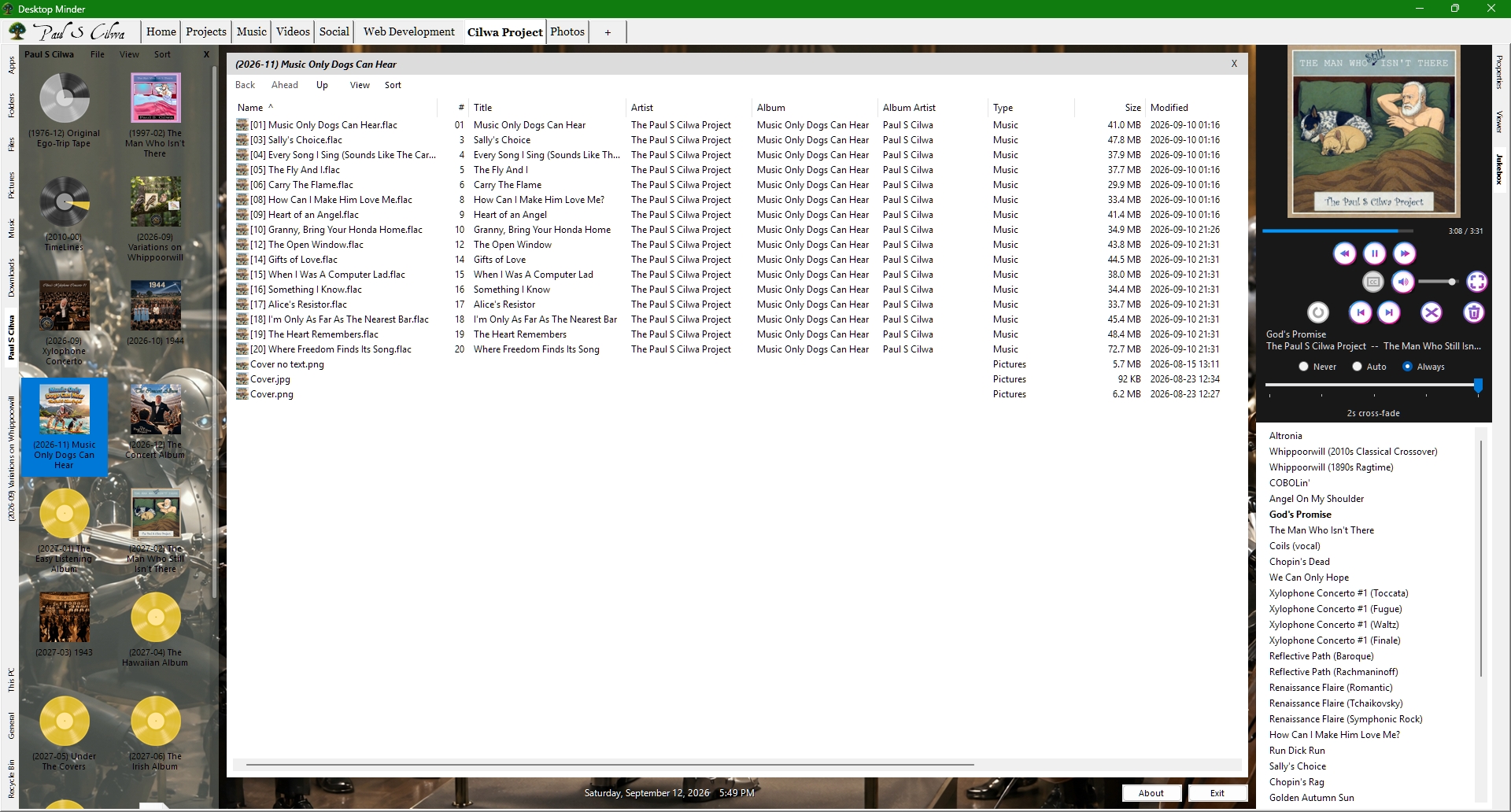
And when you double-click a document, it opens for viewing in the center section.
You can open one document and then another, and move back and forth between them.
And there's also a popout "Jukebox" that you can ask any audio document to play in
(as well as simply dragging the song to the Jukebox).
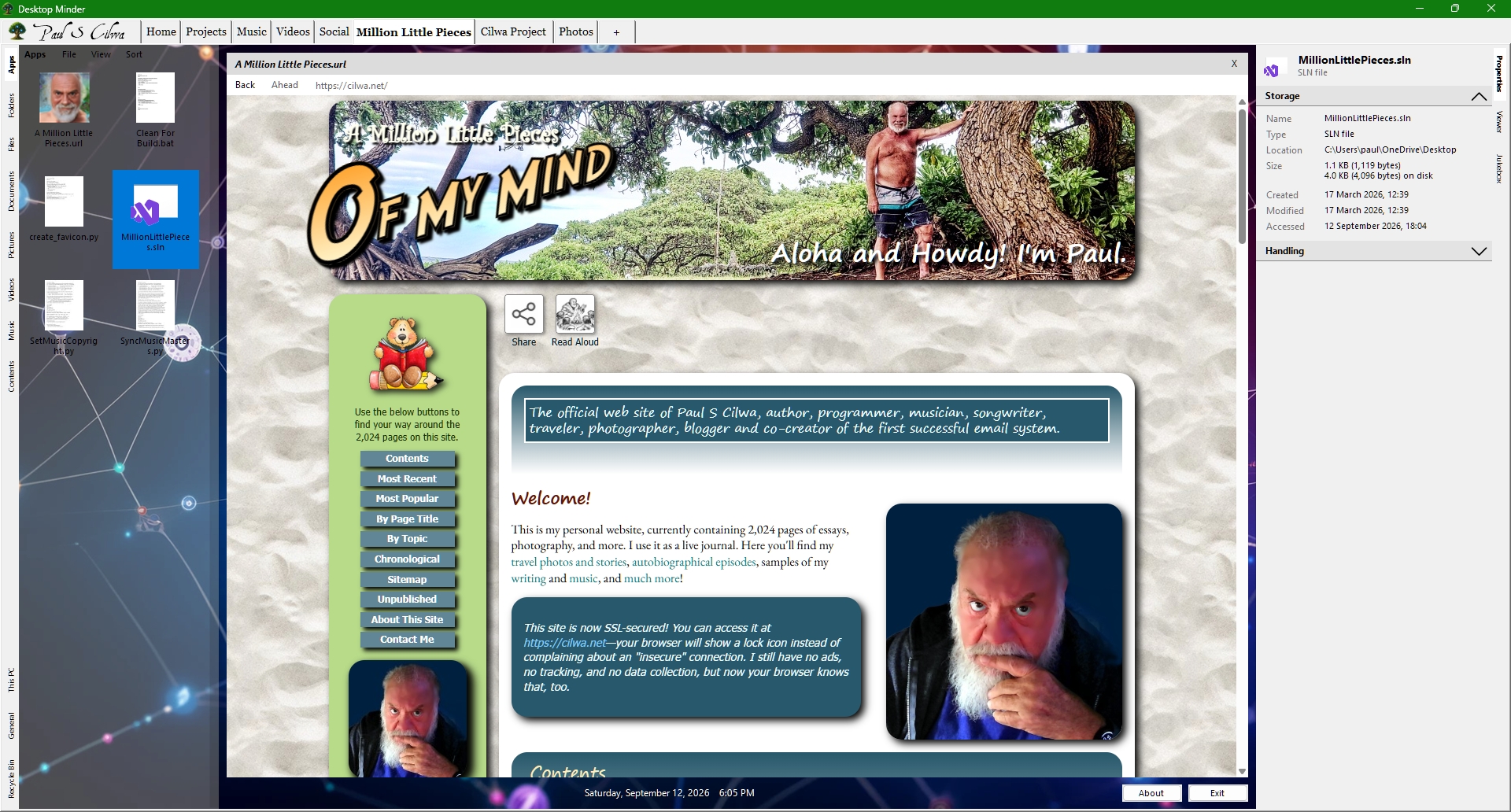
You don't even need a separate Internet browser! A link to a web site is the
website, conceptually; which is also a document!
This is not a feature I invented so much as one I stole from every
kitchen I have ever been in. Nobody keeps the ant poison on the same shelf
as the Skinny'n'Sweet. The single desktop, accumulating everything for
years until it is a wall of two hundred identical icons, is not how
anyone organizes a physical space, and there was never a reason why it had
to be how we organize a digital one.
Why A Man Of Seventy-Five Is Writing An Operating System
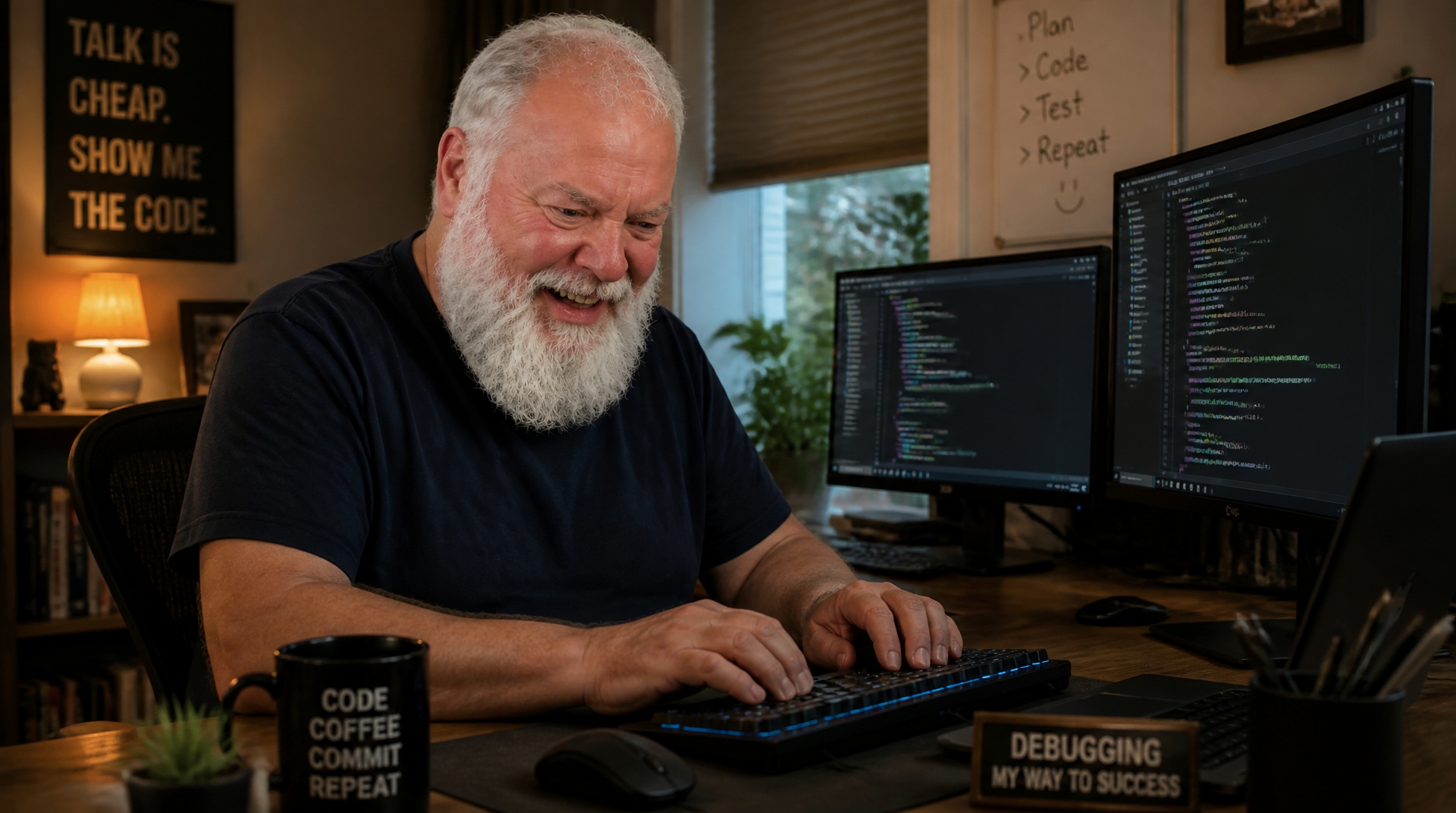
Because walking is getting harder.
I would rather put that plainly than dress it up. The distances shrink a
little each month now. Things I used to do without planning them now require
planning, and some of them have have had to come off the list altogether. I
am not going to pretend that is fine, and I am equally not going to sit
here and be sad about it in public; so what is left is the honest
middle: a fair amount of my life now happens at a desk, and the question
is what is on the desk.
What is on my desk is a problem I have been wanting to solve since 1995,
which turns out to be an extraordinary thing to own. It is deep enough
that I will not exhaust it. It is mine, in the sense that nobody assigned
it and nobody is waiting for it. It requires nothing of my hips. And it
is the same idea I had at forty-four, still good, finally buildable,
because the machine on my desk today would have been a supercomputer then
and because I have thirty-one more years of knowing how to write
software.
Oh, and access to an AI that is able to do all the typing in 1000th of the
time it would take me to do it myself! —Which is exactly what prevented me
from finishing it 44 years ago. It turns out all I needed was an amanuensis
who could type as fast as I can think, and that is exactly what I have
been doing.
People ask retired programmers whether they miss it. I never know what to
say, because I did not stop. The deadlines stopped. The meetings stopped,
and I recommend that part to everyone. The work, though, the work that
I always loved, is right here.
I Am Loaded
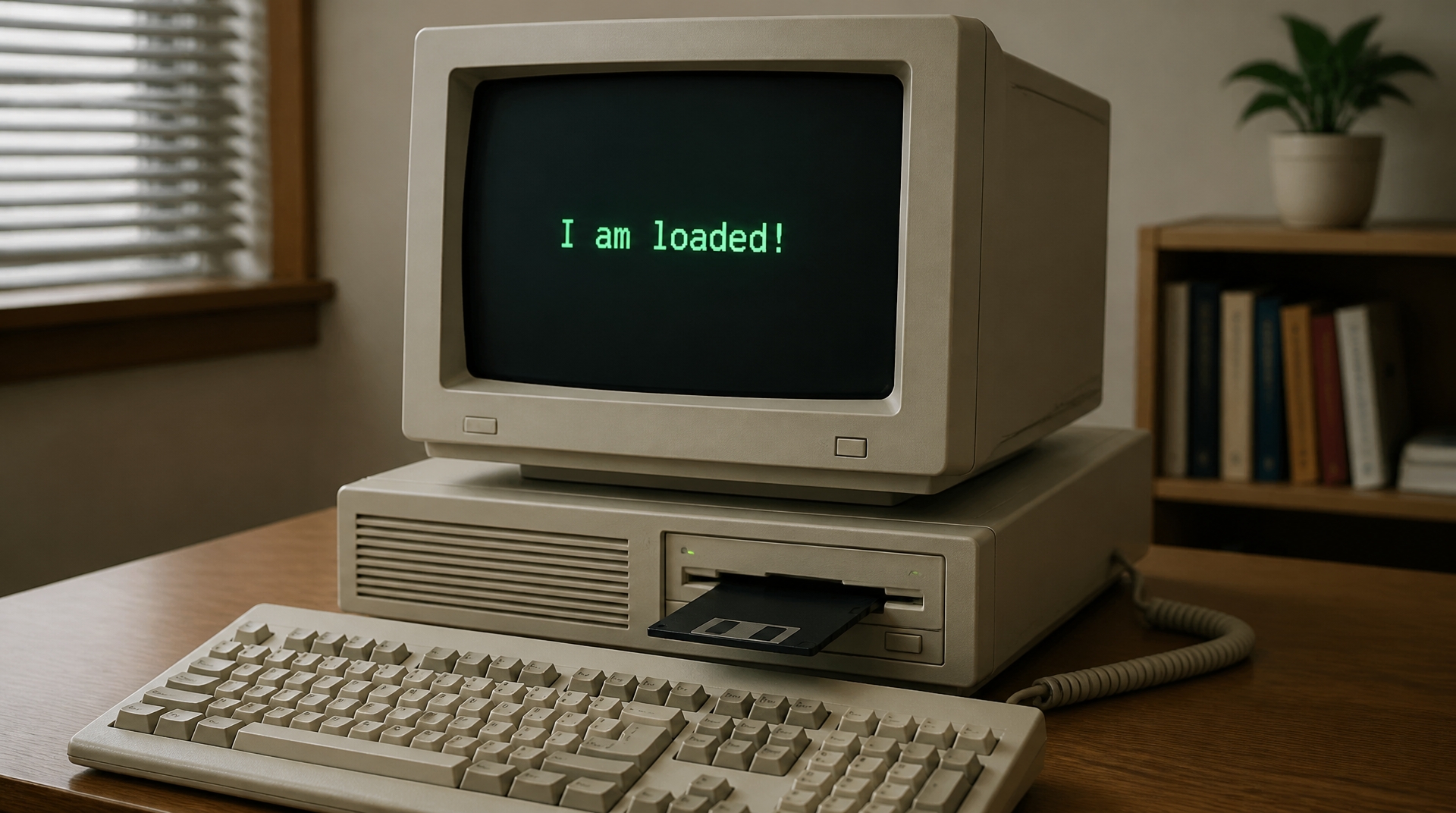
The book was called The Operating System of Your Dreams, and the book was
never the point, just my best path forward at the time.
Somewhere in a folder on this machine there is a floppy disk image that,
if you fed it to a PC of the right vintage, would print I am loaded!
and stop. I wrote it in 1995 and it still works. It does not do anything
useful and it never did. What it does is announce that it got here.
Thirty-one years later, so have I.
The Operating System of Your Dreams
|
By: Paul S Cilwa |
Occurred: 12/9/1995
Posted: 9/12/2026 |
|
Page Views: 86 |
| Hashtags: #OperatingSystems #Programming #Assembler |
| The opening chapters of the book I started in 1995, reproduced as written. Build your own 20th Century operating system! |
| Estimated reading time: 17 minute(s) (3921 words) |
You may wonder, if you've never written an operating system
before, how you could possibly be qualified to write one. Well, as a
computer professional, or even a computer user, you have spent many hours
running one application or another...perhaps, in addition to the
occasional game. When you run these applications, you are subject to the
user interface, file system, and peripheral support for monitors and
printers and perhaps modems, that the operating system provides. So, who
would be more qualified to design an operating system for users, than a
user?