|
|
|
|
Page Views: 109 |
| Hashtags: #History #Humanorigins #ZechariaSitchin |
| Have extraterrestrials ever visited earth, and if they did—did they interact with humans? |
| Estimated reading time: 12 minute(s) (2832 words) |

Back in the '60s, the author Erich von Daniken made headlines with his book,
Chariots of the Gods, and its sequels, in which he presented a huge amount
of evidence that he claimed proved aliens had visited Earth in the past. This
evidence included anachronistic metals, devices, and common myths. Von Daniken's
work was marred by two flaws. First, he had a tendency to make up "facts" when
he couldn't find the ones he wanted. Second, his evidence really only proved
that a superior technology once existed on Earth, not that it was necessarily
alien. Many readers, therefore, were left with the conclusion that von Daniken
had unintentionally proven the existence of Atlantis!
The fact is, however, that aliens have visited Earth…and have left
behind, not a trinket or two, but volumes of written evidence, in the
form of clay tablets left behind in the ruins of Sumer, Earth's first historical
civilization.
The Earth Chronicles
No one suspected the existence of the Sumerian people and language before the
mid-19th century CE. The first major excavations leading to the discovery of
Sumer were conducted between 1842-54 at Assyrian sites such as Nineveh, Dur
Sharrukin, and Calah by the French archaeologists Paul émile Botta and Victor
Place; the British archaeologists Sir Austen Henry Layard and Sir Henry
Creswicke Rawlinson; and the Iraqi archaeologist Hormuzd Rassam. Thousands of
tablets and inscriptions dating from the 1st millennium BCE, the vast majority
written in Akkadian, were uncovered.
If these tablets and illustrated cylinder seals had been first viewed today, we
would immediately recognize in the cuneiform symbols drawings of spacecraft, aircraft, radiation
treatments, and astronomical data. However, the best minds of the 1850s could
not imagine such things, and certainly not in relation to a long-dead
civilization. They did the best they could in translating the ancient texts, but
found many concepts that defied their imaginations. When confronted with a text,
for example, that stated a person was going to make a something that would raise
him or her above everyone and everything else in the world, that something was
translated "name." The original word, shem, actually means
"spacecraft;" but who in the 19th century could have guessed that?
It wasn't until Zecharia Sitchin came along with a fresh eye that the texts
were revealed in their true meaning.
Sitchin's biography, taken from the dust jacket of The Twelfth Planet:
Zecharia Sitchin was raised in Palestine, where he acquired a profound
knowledge of modern and ancient Hebrew, other Semitic and European languages,
the Old Testament, and the history and archaeology of the Near East. He
attended the London School of Economics and Political Science and graduated
from the University of London, majoring in economic history. A leading
journalist and editor in Israel for many years, he now lives and writes in New
York. One of the few scholars able to read and understand Sumerian, Sitchin
has based
The Earth Chronicles,
a series of books dealing with Earth's and
man's histories and prehistories, largely on the Sumerian records as well as
other ancient texts written down on clay tablets by the ancient civilizations
of the Near East. His books have been widely translated, reprinted in
paperback editions, and converted to Braille for the blind.
Sitchin's basic premise is that the Sumerians, who claimed to have been
created by a race of "gods" from another planet in this Solar System, were
correct. This premise is easily tested; if the Sumerians were, indeed, given
knowledge by advanced aliens, that knowledge should be more correct than
otherwise possible…and, sure enough, their astronomical tables include
accurate orbital information for all the planets, including Uranus, Neptune, and
even Pluto—the three planets of our Solar System that are not visible to the
naked eye. (They were not re-discovered until 1781, 1846, and 1930,
respectively.) Even the major moons of Jupiter, re-discovered by Galileo in
1610, were known to the Sumerians!

This proof of their scientific knowledge demands that we take their other
stories, if not at face value, at least with an open mind and willing attitude.
According to the Sumerians, the "gods" were beings who looked much like us
(we were created "in their image") but came from a world far from the Sun, that
they called Nibiru. They made pictures of their gods interacting with humans. The gods
were always shown as being much taller than humans, with disproportionately large eyes.
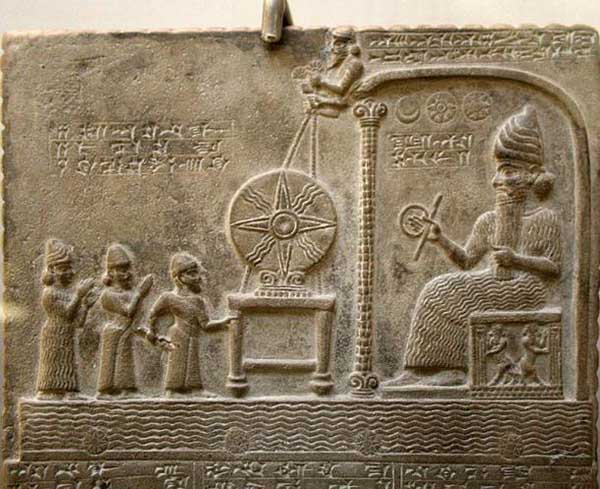
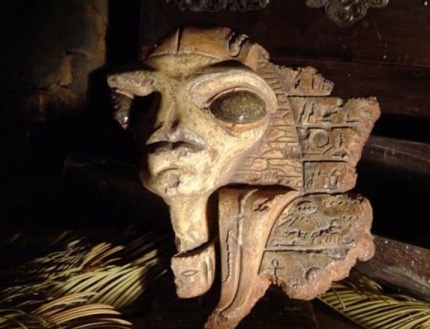
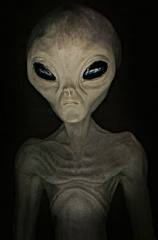
Hmmm…okay, somebody has to say it: The Sumerian image of a Nibiruan isn't all
that dissimilar from the modern image of the aliens called "Greys" who are
infamous for the abduction of humans?
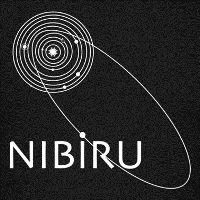
In Sumerian, NI.BI.RU means "planet of the crossing;" they
named their world that because, every 3600 years, it crossed from the outer
depths of the Solar System into its inner reaches—it had, in other words, an
extremely elliptical orbit, like a comet (Something we'd expect from a rogue planet that
had been captured by our solar system).
Some 450,000 years ago, according to the Sumerians' timeline, a Nibiruan fled
from his home world to Earth. Nibiru was having some sort of environmental
crisis at the time, which required gold to rectify. When this Nibiruan, called
Alalu, discovered that Earth was rich in the yellow metal, he put aside past
differences and contacted his home world. (I suspect his name is the origin of our word
"hallelujiah" which came to us from the Hebrew which came from Sumerian.)
Within five thousand years, the Nibiruans (who are extremely long-lived and
move with glacial deliberation) were able to mount a massive space program and
send 500 astronauts to Earth to extract gold from the waters of what is now the
Persian Gulf. These astronauts, the Anunaki (meaning, "Those Who To Earth From
Heaven Fell"), are the "giants" of the Old Testament, the "Sons of God" who
married the "daughters of men." However, that is getting way ahead of the story;
for, according to the Sumerians, mankind had not yet been created.
Anyway, by 416,000 years ago, it became evident to the Nibiruans that extracting gold
from seawater was too inefficient a process to save their home world in time, and the
order came to mine it instead. (There are, in fact, the remains of extremely
ancient gold mines in South Africa, whose age defies analysis. They were clearly artificially dug,
but no organic material has been found within for carbon dating purposes.) The Anunaki,
hired to be spacemen and lab techs, found themselves pressed into service as
miners. The work was hard and intolerable to them; still, in true Nibiruan
fashion, they endured it for well over 100,000 years before mutinying.
In response to the mutiny, a Nibiruan named Ninhursag used genetic
manipulation to combine the genes of "ape-woman" (presumably H. Erectus) and Nibiruans
to produce Man (Cro-Magnon, or anatomically modern, humans). This happened,
according to the Sumerians, about 300,000 years ago somewhere near Africa's
Rift Valley. Until recently, this date would have sounded much too soon for the
appearance of modern humans; but recent finds of extremely old anatomically-modern
human have made it plausible.
At first, the genetically altered humans were sterile and had to be
artificially carried to term by Nibiruan "birth goddesses," chosen from among
the Anunaki, who apparently found that type of labor to be preferable to working
in the mines. Obviously, though, this means of producing workers was inherently
inefficient. Enki, the Nibiruan whose idea all this was, broke ranks and
secretly manipulated the workers additionally, making it possible for them to
procreate.

An amazing aspect of this story is that the first workers were given the task
of tending a garden. Where was it? The Sumerian name was…E.DIN! What's more,
the "Tree of Knowledge" takes on special significance when we remember that
"knowing" is a Biblical euphemism for having sex…and when we find out that
Enki's "trademark" or symbol was…the serpent!
By 100,000 years ago, mankind's place in this colony world of Nibiru seemed
secure. Many of the Anunaki—called nefilim in Hebrew, and translated
"giants" in the King James Version of The Bible—took for themselves wives and
husbands from among the humans; the job of genetic manipulation had been so
thorough that the mixed couples could even bear children. This practice was
looked upon by the Nibiruan leaders with alarm, however. Some also doubted the
use of another species for service was good for the Nibiruans' own welfare. Some
Nibiruans began to wonder if it might ever be possible to close this particular
can of worms.
The Flood

By 75,000 years ago, the most recent ice age gripped Earth. It was fourth in
a series (they started when the continents drifted to near their current
configuration), but the first in the Nibiruans' experience. Sea levels fell; once-lush
areas became deserts; temperatures dropped. The glaciers of the world grew, and
grew, and grew. By about 13,000 years ago, the seas had fallen to 200 feet below
their present level, and the glaciers covering Antarctica had reached critical
mass. Almost any celestial jiggling could send them plunging into the oceans;
and one was on its way. Nibiru, near the far end of its eccentric orbit,
had on a previous pass had shaken loose a comet from the Oort Cloud.
That comet had fallen into the inner Solar System, and was about to
hit Earth on its 3600-year orbit.
It was not hard for Nibiruan scientists to calculate that the collapsing ice
shelves of Antarctica would produce a world-wide tidal wave, or even when; the
Nibiruans were hastily called into orbit, forced to leave their human husbands
and wives, even prevented by oath from warning them of what was about to befall.
One Nibiruan, however—our friend, Enki—told his favorite human anyway. That human,
known as Ziasudra to the Sumerians and Noah to the Hebrews,
was instructed to build a submersible vessel and to wait there with his family and
with the genetic samples of all Earthly animals and pairs of animals of various
genera to serve as surrogate parents so that Earth's fauna could be restored
after the deluge.
The igigi, Nibiruan astronauts who maintained an orbiting space
station, were not prepared to support hundreds of displaced Anunaki; food
supplies ran low and it was a hungry group of Nibiruans who landed on the soggy
Earth after many weeks of flood. They might well have been upset to find
surviving humans…if the humans hadn't had food with them. The Anunaki, even
Enki's (and our) nemesis Enlil, grudgingly decided that the Nibiruan/human
alliance was here to stay.
Nibiruans could only commute to and from their home world when it was near
the Sun—otherwise, it was just too long a journey. That happened every 3600
years. In each of the next few of these Nibiruan years, according to the
Sumerian sources, humans were "given" new technologies: First, agriculture;
then, domesticated animals that provided humans with servants as humans served
the Nibiruans. Finally, cities were introduced as support for armies of
Nibiruans, as individual "gods" fought for control and position.
The Sumerians recorded the loosening of buried gold by the Deluge, so that
placer mining could be conducted in South America (and South American records
bear out the visitation of bearded white men from the East). They recorded the
Pyramid Wars, and even described the granite plug found in the Great Pyramid and
explained why no mummies were ever found in these supposed "tombs." They
described the result of nuclear fallout on the cities of their civilization (and
the remains of cities have been found there that were "chopped off at the
foundation," all walls smashed in the same direction, as would happen in a
nuclear blast).
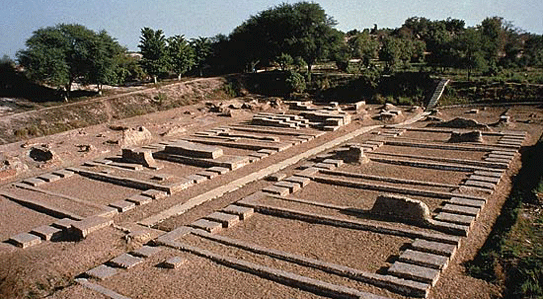
By 2023 BCE, the winds carried the radioactive cloud to Sumer, as described
in the Lamentations dictated by a Nibiruan as people died
of (perfectly described) radiation sickness; animals perished; the water was poisoned;
the soil became barren. Sumer and its great civilization lay prostrate. Its legacy passed to
Abraham's seed as he begot—at age 100—a legitimate heir: Isaac.
The God of Abraham
In many ways, the God of Abraham was different from the "gods" who preceded
him, the Nibiruans who had tinkered so fatefully with humankind. For one thing,
he was invisible: The Nibiruans, at least at first, had worked face-to-face and
side-by-side with their human servants. Yahweh, as he called himself when Moses
asked, was never to be seen (and in fact, Moses was forbidden, on pain of death,
to even sneak a peek). For another thing, the Nibiruans had never been shy
about posing for statues and other illustrations. Yahweh refused to allow any
images of himself. Also, alone among all the gods, Yahweh was not married and
was not even involved in any other the dramatic love affairs that so illustrated
the "morals" (or lack thereof) of the Nibiruans.
For these reasons, Sitchin proposed that Yahweh was not a Nibiruan…that, as
the Nibiruans were "gods" to us, Yahweh was God to the Nibiruans, and he had
gotten tired of the way the Nibiruans were treating us, and had decided to take
over. However, Sitchin was devoutly religious; my personal opinion is that Yahweh was simply another
alien from some totally different planet, here specifically to destroy them, and then leave.
Certainly, the Old Testament tells of Yahweh's people (who were supposed to put
Yahweh ahead of the other gods, an odd thing to demand if there were,
in fact, no other gods) attacking the various
remnants of Nibiruan-centered religion, until at last none remained.
And then, Yahweh seemed to leave us alone, though his followers continued to worship
him and still do. (And some Pacific islanders still
worship the cargo planes
that arrived in the Second World War, praying for their return.)
Where Did They Go?
If the Nibiruans spent so much time manipulating the affairs of humans,
literally half a million years…where did they go? Why haven't we heard from
them since the time Yahweh played an active part in our development?
I see four possibilities.
They destroyed themselves. Certainly they had the power—nuclear bombs and
other weapons of mass destruction—and they had the bad attitudes to use them.
The Nibiruans had science and technology, but little self-restraint, a
combination that our own recent close calls with nuclear weapons suggests
could be deadly, indeed.
Yahweh destroyed them on their home world, as he managed to wipe them out
on ours.
They decided to leave us alone. Perhaps they solved their ecological
crisis and no longer needed Earth's gold. Perhaps Yahweh scared them away.
Perhaps they developed a conscience in spite of themselves.
They are still here. Depending how human they really look, they might be
"immortals" living among us, the "secret government," or even the aliens who
abduct some of us now for—what else?—genetic experimentation.
While the question of where they went is certainly of importance—especially
if they are still here—another urgent issue is: What part of us is Earth, and
what part Nibiruan? What parts were built into us for the Nibiruans' benefit,
and not ours?
These questions will be addressed in the next essay in this series.
Bibliography
Books in the Earth's Chronicles series: (All Avon Books)
The 12th Planet
The Stairway to Heaven
The Wars of Gods and Men
The Lost Realms
When Time Began
Companion Book:
Genesis Revisited
Links