|
By: Paul S Cilwa |
Posted: 8/9/2006 |
|
Page Views: 6,609 |
| Hashtags: #Science #History #Music #SoundRecording |
| We examine the invention of the electric microphone and its effect on sound recording. |
| Estimated reading time: 14 minute(s) (3259 words) |
What was needed, though no one realized it in 1910, was the ability to record
through an electric microphone.
Sound is a mechanical phenomenon. As I described
previously, it is the result of perceiving pressure waves that travel
through the air (or another medium, such as water). An old conundrum goes, "If a
tree falls in the forest and there's no one there, does it make a sound?" By my
definition of sound, the answer would be "No. Sound waves emanate
from the fall, but sound
requires a creature or device to perceive those waves."
As a mechanical phenomenon, sound has certain built-in limitations. It cannot
travel in a vacuum, for instance—in space, as science fiction author Harlan
Ellison pointed out, no one can hear you scream. Sound also cannot be heard over
great distances, and it cannot inherently be heard after the fact—hence the
development of the talking machine, which solved the time problem, as well as
the distance problem, as long as you didn't mind an enforced time delay.
But it did not solve the problem of real-time transmission of sound over
great distances. With home-recorded cylinders, you could send voice mail to a
loved one in another city, but not have a long-distance conversation.
This was not a new problem, of course.
 The
problem of long-distance writing had been solved for millennia, with
complex messages sent by courier, or smoke signals, or semaphore flags (good for
modest distances only) or signal beacons, such as those seen in The Lord of
the Rings. However, because of the complexity of these solutions—and the
fact they all require a third party to monitor and receive and interpret the
messages—an opportunity was left open for anyone clever enough to invent a new
method…perhaps one not based on mechanics.
The
problem of long-distance writing had been solved for millennia, with
complex messages sent by courier, or smoke signals, or semaphore flags (good for
modest distances only) or signal beacons, such as those seen in The Lord of
the Rings. However, because of the complexity of these solutions—and the
fact they all require a third party to monitor and receive and interpret the
messages—an opportunity was left open for anyone clever enough to invent a new
method…perhaps one not based on mechanics.
Electricity is not a mechanical phenomenon. Where mechanics involves
the movement of molecules of matter in large groups, electricity operates within
a much smaller arena, that of the atom. Atoms are composed of a nucleus
surrounded by a cloud of electrons, bits of matter so small and light they can
actually travel at light speed. Normally, they just whiz around their nucleus.
However, when atoms bond to create molecules, they do so by sharing their
electrons. And, in the more metallic molecules such as those that compose gold
or copper or even carbon atoms, the electrons flow so easily that they are
willing to jump from one block of it to another, as long as they are near.
That's how extension cords, and electrical plugs and outlets work.
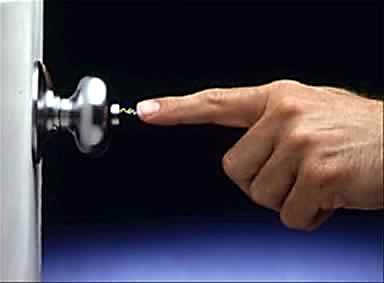
But this was unimaginable as little as 500 years ago. While the golden-age
Greeks knew of static electricity (the thing that gives you a jolt when you
touch metal after shuffling your feet across a carpet), they couldn't think of
any use for it. (The Sumerians built galvanic batteries, possibly for electric
acupuncture or electro-plating, but their use was long forgotten by the time of
the Greeks.) The first battery to produce a large electric current was built by
Alessandro Volta, whose name gave us our term for the "punch" of an electric
current: the volt.
In fact, there are just three terms that, if you know them, make electricity
fairly easy to understand. First is polarity. Polarity is either
positive or negative. Electrons have a negative charge, and (by
comparison) atoms that are short on electrons have a positive charge. A positive
charge attracts electrons, so electrons always flow from where there are a lot
of them (negative) to where there are few of them (positive) if they can.
Next is amperes, named after
André-Marie Amp?re, another scientist who played around a lot with
electricity. Amperes is the measurement of how many electrons happen to
be flowing at the moment. Think of it as analogous to the measurement of how
much water is flowing in a river.
And volts is the last. While this is analogous to the speed of
the water in a river, it really isn't speed because all electrons move at the
speed of light. But you can think of it as the punch of the electrons. If
you allow a lot of amperes of electricity to flow through you (by holding a
negative wire in one hand and a positive wire in the other) at low voltage, you
won't feel a thing. But even a small amount of amperes can give you a nasty or
even fatal jolt if the voltage is high enough. (That's how
Tasers work.)
Like the energy in water dropping over a waterfall, voltage is always a
relative term—usually relative to the ground, the surface of that great battery,
Mother Earth. That's why, when you have two or three wires to connect to a light
switch you are wiring, or to an electrical plug, one is always called "ground."
That wire is connected, somewhere in your house, to the actual earth on which
your house stands. If you, personally, are touching the ground—or a wire
touching the ground—you are said to be "grounded." It's an electrical term.
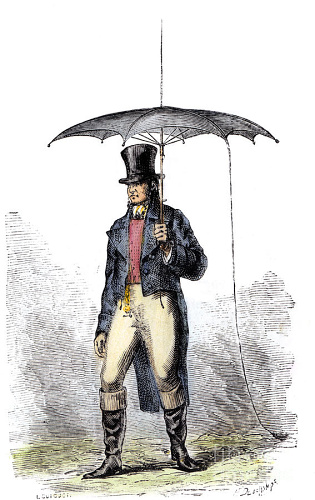
If a spike of metal is placed on your roof, and a wire from it is
attached to ground, that's a lightning rod
(invented by Benjamin Franklin,
by the way). Lightning will be attracted to
the rod instead of your chimney or the peak of your roof; and
because the wire allows the enormous amperage of the lightning bolt
to flow to ground easily, the lightning rod protects your house from
what otherwise would be a dangerous cause of house fires.
The reason that a house may burn if it is hit by lightning (and not
protected by one or more lightning rods) is that, unlike the wire
connecting a lightning rod to the ground, a house is not a good
conductor of electricity. A good conductor is something that
allows electricity to pass through it without reducing the
electricity's voltage in the process. Gold and copper are excellent
conductors, which is why we use them in wires to connect high-end
electronic and electric components. Wood and brick are poor
conductors. And anything that lowers voltage, emits heat in the
process. So if lightning strikes an unprotected house, the wood or
bricks that lie between the strike and the ground will get so hot as
they lower the lightning's very high voltage that they will explode
in a shower of flame and sparks.
With these three concepts, you can understand any of the other words you hear
about electricity. For example, watts—named after
James Watt (the one who contributed to the development of the steam engine,
not Ronald Reagan's Secretary of the Interior)—are simply calculated by
multiplying volts times amperes. And AC—alternating current—is an
electric current whose polarity switches from positive to negative many times
per second. (In the United States, that's usually 60 times per second).
DC, direct current, flows instead at a constant polarity.
There's just one more aspect of electricity you need to know before you
would be ready to live in the nineteenth century and try to invent the
microphone, and that's the fact that electricity and magnetism seem to be
related somehow. (In the 20th century, that relationship was finally understood
so that we now speak of electro-magnetism as a single force of nature.)
If you make a coil of wires—that is, you wind a long wire around and around a
tube, being careful to lay each loop of wire precisely adjacent to the one
before it—and move a magnet back and forth within the tube, you will actually
create an electric current in the wires. (That's the basis of the generator.)
And, if you run a current through the wires and place an iron rod inside the
tube, you will magnetize the rod!
Aware of these facts, the unsung German
scientist Philipp
Reis tried to create a telephone in 1860. Remember, this is long
before the Gramophone but after the phonautograph, a device used to
study the pressure waves of sound. So Reis knew that the basic
components of a telephone would be these:
A microphone, to change the mechanical energy of sound into some kind
of electrical equivalent.
A transport system, to get the electrical energy from the source to
the destination.
A loudspeaker, to change the electrical energy back into the
mechanical energy of sound, so the receiver could hear it.
I am, of course, using the modern terms for these components, since the words
did not yet exist with these meanings.
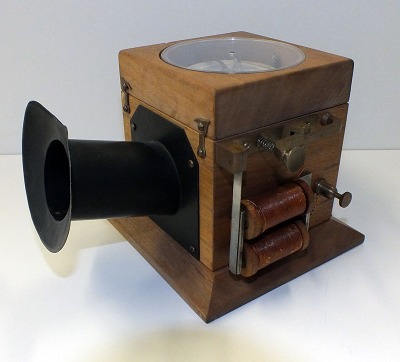
Reis' original idea was to use a rubber diaphragm as a switch for both
microphone and speaker. He thought that if a very sensitive switch were attached
to the diaphragm, so that sound waves would cause the circuit to be broken and
reestablished thousands of times a second, the electricity would spark at the
other end, causing the receiving diaphragm to vibrate and reproduce the incoming
sound. This didn't work, of course; it was impossible (at the time) to create
such a delicately sensitive switch.
But Reis then tried taking advantage of electricity's magnetic properties. He
attached a slim magnetic rod to the diaphragm and allowed it to move freely
within a tube of tightly wound wire. When sound hit the diaphragm, the diaphragm
made the rod vibrate back-and-forth, which set up an alternating current in the
wires. When this current reached the receiver, the alternating magnetic field
caused the rod to vibrate back-and-forth, which forced the diaphragm
up-and-down, which recreated the pressure waves of the original sound! And
it was an elegant invention, too, with its single device that could act as both
microphone and speaker. It was demonstrated all over Europe, including once in
Scotland at the same time that Alexander Graham Bell was there, visiting his
father. The telephone was invented.
Or was it? Reis wasn't much of an entrepreneur, and his explanation of how
his device worked wasn't as clear as mine. He never patented it, so was never
forced to describe precisely how it worked. In fact, when Alexander
Graham Bell tried to build on Reis' invention, he found he couldn't duplicate it
exactly. Bell thought Reis was varying the resistance of an external
electric current, that is, varying its conductivity, as Reis had attempted to do
in his first effort. He didn't realize that Reis' design actually created
an electric current. (And neither do most current historians.)
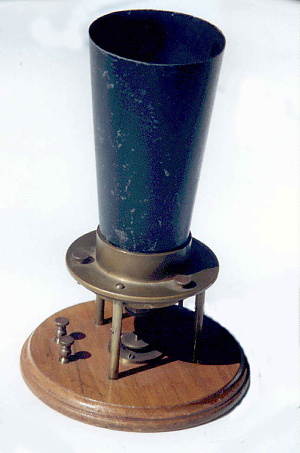
So Bell had to start from scratch, and he decided that the microphone
("mouthpiece") and loudspeaker ("earpiece") should be different devices.
Emile Berliner, the same guy that invented the disc Gramophone, is credited
with having invented the first microphone, since
he patented his invention. However, it wasn't very useful. Working on a
different design, Bell's is considered the first useful microphone
(although it's very similar to one patented by Elisha Gray just two hours
after Bell patented his!—Which, of course, invalidated Gray's patent).
In this version, a constant source of electricity (a battery) provides a
steady current that passes through the coil of wires. The diaphragm makes the
magnetic rod vibrate with the sound. But, this time, the rod is fighting the
magnetic field set up by the steady current running through the coil. This fight
has the effect of modulating the voltage of the current in exact lock-step to
the pressure waves of the sound hitting the diaphragm.
The loudspeaker was made up of a standard megaphone with a rubber diaphragm
at its narrow end, just like the one used in a Gramophone. However, a magnetic
rod was attached to the diaphragm instead of a phonograph needle; and that rod
was inserted into a coil. When the fluctuating current arrives from the
microphone, the rod vibrates, making the diaphragm vibrate, recreating the sound
waves which are then amplified by the megaphone horn.
And that still wouldn't have been a successful telephone if Bell
hadn't been such a terrific entrepreneur. He tried to sell his patents to the
Western Telegraph Company (a "speaking telegraph" seemed a likely improvement
for them) but they referred to it as "a toy" and refused to buy. Still, Bell
never lost faith. And when he demonstrated the telephone at the Philadelphia
World Exhibition in 1876, it proved to be a hit and the investors lined up.
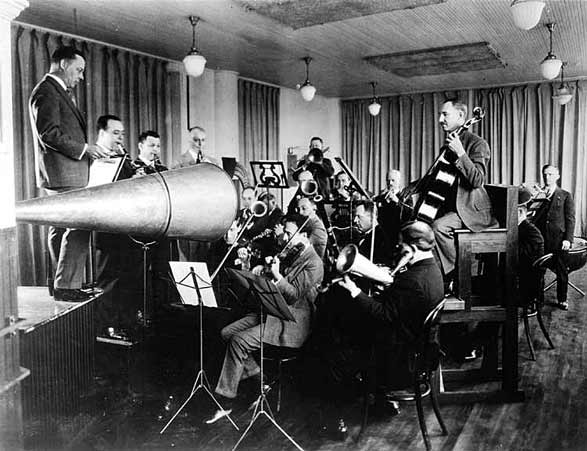
Nevertheless, by 1924, when hundreds of homes had telephones, record players
still relied on mechanical sound reproduction and all music recording was
accomplished similarly, with performers singing and playing as loudly as they
could into a giant megaphone that drove a needle into a master disk.
That changed in 1925, when a device was developed that could convert the
electrical signal from a microphone, not into sound, but into the wobbly lines
inscribed by the needle onto a record master. Its inventors hoped this system
would produce sound as good as that made by a direct transcription from an
acoustic horn. Instead, it turned out to be much better. The patents were
jointly owned by Victor, Columbia and HMV Records, who refused (at first) to
share it, of course.
The era of electric recording had begun.
By 1926, some companies without access to the new microphones, such as Odeon
in Europe,
advertised on their record sleeves and catalogs that their recordings were
electric, even though they were not; record buyers insisted on it. By 1927, the
patent owners capitulated, finally realizing there was more money to be made
selling microphones than by trying to corner the recording market.
The process of making records electrically then remained essentially the same
for the next several decades.
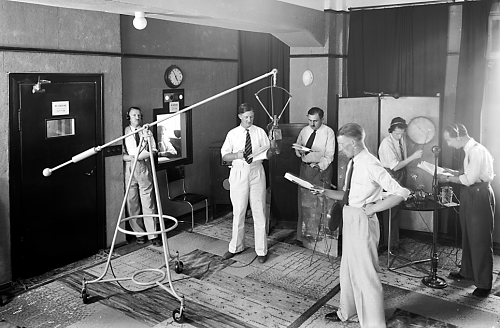
Recording artists would gather in the studio with their instruments and
sheets of music. Because the intensity of sound from the double bass caused the
cutting needle to jump out of the groove, it was replaced by the tuba. Special
violins, called Strohs, with built-in acoustic amplifiers were used in place of
the standard instrument. The orchestra would be seated on bleachers, at first
gathering around the recording horn, then (after 1925) the single microphone.
Although the microphone had a volume control, that was the only control the
recording engineer had. The singer or singers would be placed just in front of
the horn or microphone, learning to "pull back" for particularly lusty passages
so the needle wouldn't jump the groove with excessive volume.
The recording was made directly onto the master, a wax platter. There might
be several "takes" but each one had to run from the beginning to the end of the
piece—there were no "cuts" because such a thing wasn't technically possible. The
performers had to take care to not exceed the four-minute time limit of a
ten-inch disk.
After the recording, the wax master of the selected take would be
electroplated, and an inverted "matrix" pressed from that. This matrix had
squiggly ridges where the grooves of the original wax master were. From the
matrix could be pressed some number of "mothers" (typically ten) made of a much
sturdier material than that of the wax master. The mothers, as negatives of a
negative, had grooves that matched those of the original wax master. And from
the mothers, would be created "stampers," each of which could press grooves into
up to 1,000 shellac records. All these steps were needed because of the
fragility of the original wax master.
Before 1925, records weren't always recorded at 78 rpm (revolutions per
minute). In practice, the speed of each platter differed from others, from
perhaps 64 rpm to a heady 92 rpm or more. The speed was sometimes specified on
the record label, sometimes not—and even when it was, some records labeled 78
rpm may in reality have been recorded as slowly as 72 rpm! The clockwork record
players of the day permitted infinite adjustment of speed but it was anybody's
guess just what speed was "correct." The user had to make adjustments by ear.
By 1925, the speed had standardized on just over 78 rpm, derived from the
gears used and the growing use of electric motors to turn the disks during
recording, even if not in playback. Indeed, the fact that most record players
were wind-up affairs that didn't require electricity may well have contributed
to the survival of the medium.
Because other improvements in electronics in that same year—1925—turned
broadcast radio from a curiosity to a commercial success. And radio, which used
not only electric microphones but also magnetic loudspeakers and played music by
live orchestras, nearly swamped the record business in popularity. I believe it
was the fact that a portable, wind-up phonograph could be brought along to the
beach or on a picnic or to one's remote vacation home was the primary reason
that people continued to buy records, especially after the start of the Great
Depression in 1929, which was the all-time nadir for the record business.

And, unlike the equipment of today, record players were made to last, portables no
less than cabinet units.—So much so, that when I was seven (in 1958) I was
given a cabinet Victrola that played perfectly, and which provided me with
almost constant music for the next three years.

78s were sold singly, packaged in flimsy paper sleeves that provided a
minimum of protection, and in albums composed of five or ten sleeves and
constructed similarly to photo albums of the time; hence the name. (The term
"record album" came to mean a collection of songs, which is why when long
playing records were introduced, people called them "albums" even though they
usually consisted of just one disk.) The very first 78s were recorded on just
one side, but two-sided discs soon overshadowed the one-sided variety in the
marketplace.
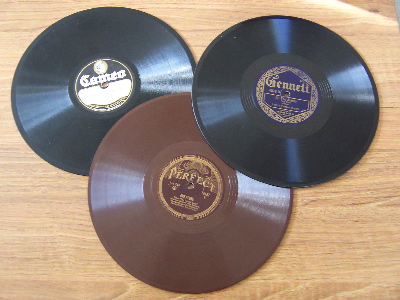
Manufacturers experimented with a
number of different materials for 78s. Edison's disks even included a layer
of crushed stone! But they finally settled on "shellac," a pre-plastics
substance derived from the excretions of a bug from India. The shellac formed
the two surfaces of a disk, pressed against a filler. The shellac itself was
usually mixed with lampblack, which gave it a black color as well as improved
sound quality; but sometimes another dye would be used to create a "colored"
record—red or brown or blue—to catch the consumer's eye.
78s were still being manufactured in the United States when I was a kid. By
then some were made of vinyl or another plastic, which had a quieter surface but
couldn't stand up to the weight of a typical 78 record player tone arm. They
continued to be sold in India into the 1960s, where lack of electricity in rural
areas guaranteed a market of Victrola-owners. 78-rpm Beatles records from India
are among the most sought-after Beatles memorabilia.
But by the 1960s the world had embraced a throw-away approach to technology,
and the 78's days were numbered. In the next segment of this series we'll look
at the 78's replacements: the 45 and the LP.