Listen To The Music
|
By: Paul S Cilwa |
Posted: 9/1/2006 |
|
Page Views: 5,929 |
| Hashtags: #Science #History #Music #SoundRecording |
| We look at the development of record players. |
| Estimated reading time: 11 minute(s) (2436 words) |
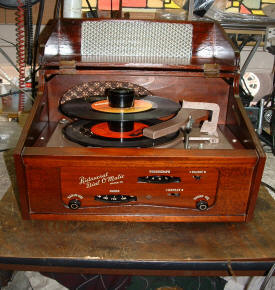
The mid-thirties saw the
introduction of improved record players. Although gramophones and Victrolas,
which had been built to last, remained in use, new players were introduced that
could play several discs sequentially, without user intervention. They were
called "record changers" and suspended a stack of records—typically six or
more—above the turntable on a tall spindle. When the user started playing a
stack, the spindle would allow a single disk to drop to the turntable, where it
would gently fall on a cushion of air created by the falling disk itself. A
mechanism would then place the tone arm at the beginning of the record. When the
record ended, the tone arm was guided by the record's groove into a center area
that signaled the tone arm to rise and return itself to its resting place while
the next disk dropped on its own cushion of air atop the disk below, and the
process was repeated. The spindle was designed to sense when no records
remained, at which point the record changer would turn itself off.